
NAD+ Buffered
900mg per vial
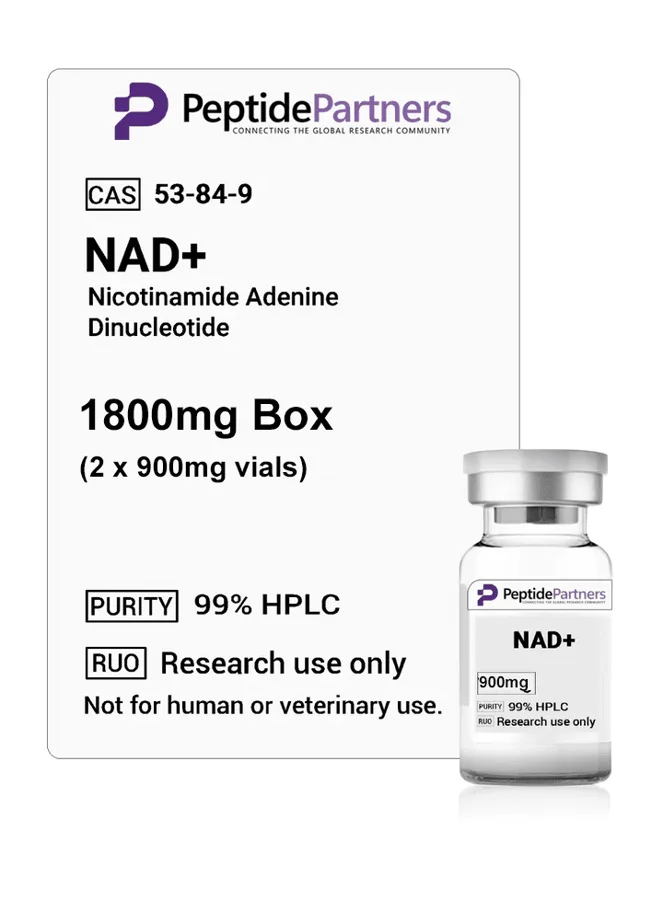
Available packs
NAD+ Buffered
$198 - $738
Buy NAD+ Buffered (900mg vials) from Peptides Partners
Laboratories and institutional investigators seeking high-capacity coenzymes for cellular bioenergetics research can buy NAD+ Buffered in robust 900mg presentations from Peptides Partners. Nicotinamide adenine dinucleotide (NAD+) represents one of the most fundamental metabolic molecules in cellular biology, participating in hundreds of enzymatic oxidation-reduction reactions and serving as an obligatory substrate for signaling enzymes that govern genomic stability and mitochondrial maintenance. When conducting scaled in vitro assays, high-throughput screening, or multi-replicate metabolic investigations, standard low-mass vials can introduce workflow bottlenecks and batch-to-batch dilution variability. The 900mg buffered vial profile from Peptides Partners is engineered to address these operational constraints by providing an expanded mass of pure, stabilized substrate in a single, vacuum-sealed borosilicate container.
Unlike unbuffered beta-NAD+ free acid, which typically creates an intensely acidic microenvironment upon aqueous reconstitution, buffered NAD+ includes a balanced physiological buffering system designed to preserve solution pH within a neutral target range. This structural stabilization minimizes premature spontaneous hydrolysis, optimizes enzymatic compatibility, and protects delicate cell cultures from acidic shock during substrate addition. Peptides Partners supplies pure, analytical-grade research peptides and cellular cofactors synthesized exclusively for in vitro, ex vivo, and non-human animal research settings. By securing your laboratory inventory through Peptides Partners, your research team gains access to reliable chemical stability, comprehensive batch traceability, and bulk packaging options tailored to demanding experimental designs.
What is NAD+ Buffered?
NAD+ Buffered is a specialized laboratory formulation of beta-nicotinamide adenine dinucleotide (CAS Number: 53-84-9) that incorporates an integrated buffering mechanism to stabilize the compound upon liquid reconstitution. Chemically, beta-NAD+ consists of two mononucleotides—nicotinamide mononucleotide (NMN) and adenosine mononucleotide (AMP)—linked by a high-energy pyrophosphate bridge. In its native free-acid form, beta-NAD+ exhibits a chemical formula of C21H27N7O14P2 and a molecular mass of approximately 663.43 g/mol. In aqueous environments, the free acid releases hydronium ions, often lowering the solution pH to between 2.0 and 3.0 depending on the final solute concentration.
This rapid acidification presents notable complications in biochemical and cell biology research. Low pH environments accelerate the hydrolytic cleavage of the beta-N-glycosidic bond linking the nicotinamide ring to its ribose moiety, producing free nicotinamide and ADP-ribose, which eliminates the catalytic utility of the coenzyme. Furthermore, introducing an acidic solution into mammalian or bacterial culture systems disrupts physiological homeostatic buffers, skewing experimental results in viability and enzymatic assays. NAD+ Buffered solves this challenge by blending pure beta-NAD+ with inert, precisely calibrated buffering salts (such as sodium phosphate or sodium bicarbonate buffers). Upon reconstitution with neutral laboratory-grade water or saline, the resulting solution maintains a stable physiological pH (typically between 6.8 and 7.4), eliminating the need for post-reconstitution titration with sodium hydroxide or other adjusting agents that risk osmotic variations or accidental over-alkalization.
Research effects studied
As a master regulator of cellular bioenergetics, NAD+ has been studied extensively in preclinical and clinical research for its pivotal roles in metabolic pathways, genomic maintenance, and signaling cascades. Academic investigations span a diverse range of physiological systems:
- Mitochondrial Respiration and Oxidative Phosphorylation: In mitochondrial research, NAD+ serves as the central electron acceptor in glycolysis and the tricarboxylic acid (TCA) cycle, transforming into its reduced form, NADH. Investigators examine how shifts in the intracellular NAD+/NADH ratio influence the activity of mitochondrial complex I (NADH:ubiquinone oxidoreductase), electron transport chain efficiency, and overall adenosine triphosphate (ATP) synthesis rates under various metabolic challenges.
- Sirtuin Pathway Activation: A substantial volume of peer-reviewed literature explores NAD+ as an indispensable, rate-limiting co-substrate for the class III histone deacetylases known as sirtuins (SIRT1 through SIRT7). Researchers evaluate SIRT1 and SIRT3 activation to study transcriptional networks regulating mitochondrial biogenesis (via PGC-1alpha deacetylation), antioxidant defense mechanisms (via FOXO transcription factor activation), and chromatin remodeling.
- DNA Repair via Poly(ADP-ribose) Polymerases (PARPs): Investigators study the consumption of NAD+ by PARP enzymes, predominantly PARP-1, in response to genotoxic stress and DNA single-strand breaks. In cellular models of genomic instability, research assesses how high levels of PARP activation rapidly deplete the intracellular NAD+ pool, altering cellular survival thresholds and bioenergetic reserves.
- Ectoenzyme and Calcium Signaling Biology: Scientific interest focuses on CD38 and CD157, membrane-bound glycohydrolases and ADP-ribosyl cyclases that consume NAD+ to generate cyclic ADP-ribose (cADPR) and nicotinic acid adenine dinucleotide phosphate (NAADP). These secondary messengers regulate intracellular calcium mobilization from the endoplasmic reticulum, influencing downstream calcium-dependent signaling pathways.
- Cellular Senescence and Aging Models: Preclinical models frequently observe a progressive, tissue-specific decline in NAD+ bioavailability associated with chronic inflammation, sustained CD38 overexpression, and impaired salvage pathway kinetics. Experimental interventions examine whether replenishing extracellular or intracellular NAD+ pools preserves cellular architecture, delays phenotypic markers of senescence, and supports microvascular endothelial function in aged cell lines.
How to use in the laboratory
When working with NAD+ Buffered in a laboratory setting, researchers must apply rigorous handling, reconstitution, and documentation techniques to maintain coenzyme integrity and ensure experimental reproducibility. The compound is non-sterile in its raw state and intended strictly for research purposes.
- Reconstitution Protocol: Calculate the volume of solvent required based on the high 900mg mass per vial. Recommended solvents include sterile bacteriostatic water, sterile deionized water (ddH2O), or sterile 0.9% sodium chloride for injection (saline). Because this formulation is pre-buffered, reconstitution with neutral diluents yields a physiological pH, bypassing secondary titration steps. Gently introduce the solvent along the interior glass wall of the vial using a calibrated micropipette under a laminar flow hood. Swirl the vial gently until the cake is fully dissolved; avoid vigorous vortexing or mechanical shaking, which can introduce shear forces and excessive aeration.
- Stock Concentration Setup: Due to the large mass (900mg), laboratories often prepare high-concentration master stocks (e.g., 50 mM to 100 mM) for subsequent dilution into working concentrations tailored to specific enzyme assays, multi-well cell culture plates, or organ perfusion systems. Always verify complete dissolution before proceeding with serial dilutions.
- Working Aliquots: To prevent continuous degradation caused by multiple temperature shifts, divide the concentrated stock solution into single-use, sterile microcentrifuge tubes immediately after reconstitution. Label each tube with the compound name, concentration, solvent identity, preparation date, and operator initials.
- Laboratory Record-Keeping: Maintain an exhaustive digital or physical laboratory notebook recording the specific lot number, manufacturer (Peptides Partners), mass per vial (900mg), date of initial receipt, reconstitution timeline, and specific assay parameters. Track and log the total number of freeze-thaw cycles for every working aliquot to monitor possible baseline decline in catalytic activity.
Pack sizes and price per mg
Peptides Partners provides scalable procurement options designed to accommodate varying laboratory budgets, project durations, and experimental throughputs. Supplying NAD+ Buffered in high-capacity 900mg vials reduces packaging overhead and delivers exceptional cost efficiency for high-volume research initiatives. Researchers can buy NAD+ Buffered across three tiered bundle configurations:
| Pack Size | Total Active Mass | Total Price (USD) | Price per mg (USD) |
|---|---|---|---|
| 2 vials x 900mg | 1,800 mg | $198 | $0.110 per mg |
| 5 vials x 900mg | 4,500 mg | $427 | $0.095 per mg |
| 10 vials x 900mg | 9,000 mg | $738 | $0.082 per mg |
Procuring research peptides and cellular coenzymes in higher vial counts significantly depresses the unit cost per milligram, enabling laboratories to execute extensive, multi-plate experimental series without compromising budget allocation. The 10-vial tier offers the lowest unit cost at approximately $0.082 per milligram, making it the preferred selection for institutional core facilities and high-throughput research platforms.
Storage and handling
Nicotinamide adenine dinucleotide is a chemically reactive dinucleotide vulnerable to thermal breakdown, photolytic cleavage, and hydrolytic degradation. Adherence to proper physical handling and storage conditions is vital to preserve active titer and experimental consistency:
- Lyophilized Powder Storage: Store unopened vials of lyophilized NAD+ Buffered at -20°C for routine storage periods, or at -80°C for prolonged archival holds exceeding six months. Keep vials stored in a sealed container alongside an active desiccant packet to prevent atmospheric moisture ingress through the elastomer stopper. Protect the material from ambient and direct ultraviolet (UV) light exposure.
- Temperature Equilibration: Before piercing the septa or reconstituting the powder, allow the vial to equilibrate to ambient room temperature (approximately 20°C to 25°C) inside a desiccated chamber for 20 to 30 minutes. Opening cold vials directly in humid laboratory air causes immediate moisture condensation onto the lyophilized cake, which accelerates hygroscopic clumping and hydrolytic cleavage.
- Reconstituted Solution Stability: Once dissolved, aqueous NAD+ solutions are fundamentally less stable than the dry solid. Maintain working liquid stocks on wet ice (0°C to 4°C) during active bench procedures. For medium-term storage, keep aliquoted liquid stocks frozen at -20°C; for extended preservation, store at -80°C. Avoid repeated freeze-thaw cycles; discarding residual solution after two freeze-thaw events is considered standard best practice.
- Personal Protection and Hygiene: Personnel handling NAD+ Buffered must wear standard personal protective equipment (PPE), including nitrile gloves, wrap-around laboratory safety glasses, and a clean laboratory coat. Perform all manipulation of dry powder within an appropriate chemical fume hood or biosafety cabinet to limit inhalation or mucous membrane contact.
Quality and documentation
Peptides Partners enforces strict quality control parameters to verify that every batch of NAD+ Buffered meets analytical standards required for advanced biochemical research. High-resolution High-Performance Liquid Chromatography (HPLC) is employed to confirm chemical purity and assess the absence of major breakdown contaminants such as free nicotinamide, adenosine monophosphate, or ADP-ribose adducts. Mass Spectrometry (MS) verifies the precise molecular identity, fragmentation profile, and structural integrity of the synthesized dinucleotide.
Each production lot is accompanied by a comprehensive Certificate of Analysis (COA) detailing the active compound mass, residual moisture content, counter-ion and buffer composition, chromatographic purity metrics, and verified analytical spectra. Reagents supplied by Peptides Partners are manufactured under rigorous cleanroom conditions to ensure minimal endotoxin contamination, making them well-suited for sensitive mammalian cell lines and enzymatic kinetic assays. All materials sold are classified strictly as research chemicals and are not intended for diagnostic, clinical, therapeutic, veterinary, or human application.
Frequently asked questions
Why is a buffered formulation of NAD+ advantageous over standard beta-NAD+ free acid?
Standard beta-NAD+ in its free-acid state yields an acidic aqueous solution (pH 2.0 to 3.0), which accelerates the hydrolytic cleavage of the dinucleotide’s high-energy glycosidic bonds and risks shocking biological cultures. NAD+ Buffered incorporates pre-calibrated, physiologically compatible buffer salts directly into the lyophilized matrix. Upon reconstitution with neutral laboratory water or saline, the formulation self-equilibrates to a physiological pH range (6.8 to 7.4), eliminating post-reconstitution titration steps and preserving chemical stability in experimental assays.
What is the functional difference between NAD+ and NADH in cellular respiration research?
NAD+ and NADH represent the oxidized and reduced states of the same dinucleotide coenzyme pair. NAD+ acts primarily as an electron acceptor in catabolic pathways such as glycolysis, beta-oxidation, and the citric acid cycle, where it receives hydride ions to form NADH. Conversely, NADH functions as a primary electron donor, transferring electrons to complex I of the mitochondrial electron transport chain to generate the proton gradient that drives ATP synthesis. In addition, only NAD+ serves as a consumable substrate for non-redox signaling enzymes like sirtuins and PARPs.
How does the 900mg vial size benefit institutional and high-throughput research platforms?
Many commercial NAD+ offerings provide modest quantities (e.g., 100mg to 500mg), requiring researchers running large-scale protocols to reconstitute multiple vials across an experimental timeline. This introduces cumulative weighing, pipetting, and concentration variances. The 900mg presentation provides a substantial quantity of stabilized material in a single container, streamlining master-mix preparation, reducing plastic consumables, and lowering the effective price per milligram for laboratories conducting high-volume research.
What solvents are compatible with NAD+ Buffered for in vitro assays?
NAD+ Buffered dissolves readily in sterile deionized water, bacteriostatic water, and sterile 0.9% physiological saline. It is also compatible with standard buffered tissue culture media, such as Dulbecco’s Modified Eagle Medium (DMEM) and RPMI-1640, provided the final concentration does not exceed the osmotic tolerances of the host cell line. Organic solvents such as dimethyl sulfoxide (DMSO) or ethanol are generally not recommended as primary reconstitution vehicles due to potential negative effects on dinucleotide solubility and enzymatic stability.
Related Peptides Partners research peptides
Pinealon (20mg vials); SS-31 (50mg vials); 5-Amino-1MQ (10mg vials).
NAD+ Buffered lot documentation
Certificates of analysis are matched to the actual lot supplied with your order. Email sales@peptidespartners.co with the product name and pack size to request the current lot's purity, identity and screening documents before purchase.
Storage
Research peptides are typically supplied lyophilized (freeze-dried), which keeps them stable for shipping and storage. Store unopened vials cool, dry and away from light; for long-term storage, a freezer is generally recommended.
After reconstitution, keep vials refrigerated and use sterile laboratory technique. Follow the handling guidance supplied with your lot documentation.
- Short name
- NAD+ Buffered (900mg vials)
- Vial strength
- 900mg vials
- Pack sizes
- 1800mg pack, 4500mg pack, 9000mg pack
- Pack count options
- 2, 5, 10 vial packs
- CAS number
- 53-84-9
- Category
- Mitochondrial
- SKU
- PP-31427
- Compliance
- Research Use Only. Not for use in diagnostic tests.