
SS-31
50mg per vial
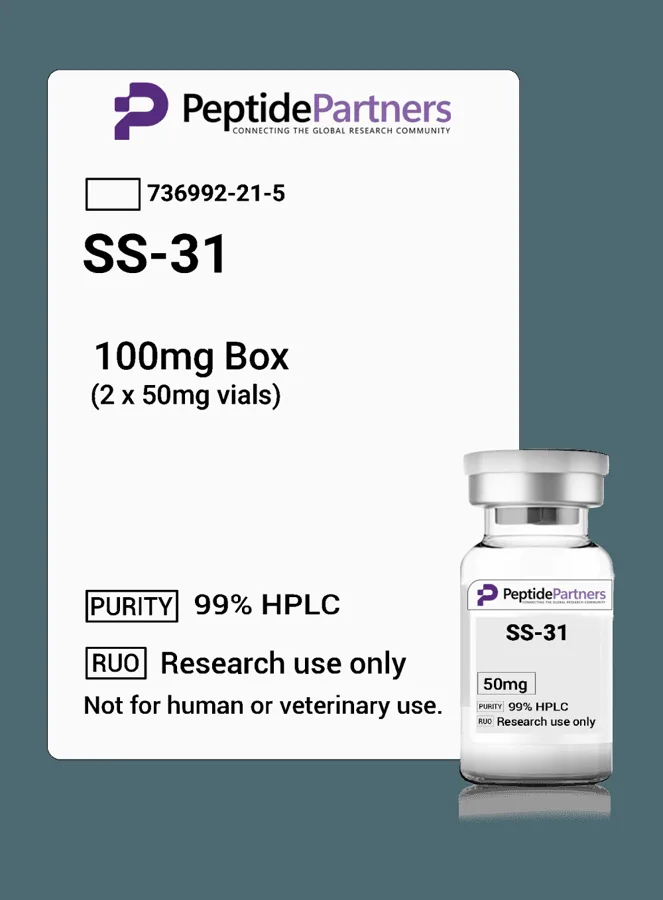
Available packs
SS-31
$280 - $950
Buy SS-31 (50mg vials) from Peptides Partners
Laboratories and academic institutions seeking high-grade mitochondrial research compounds can buy SS-31 in robust 50mg configurations directly through Peptides Partners. Mitochondria-targeted peptides represent one of the most dynamic frontiers in cell biology, biophysics, and metabolic research. SS-31, historically classified under the Szeto-Schiller peptide series and also known in scientific literature as elamipretide or bendavia, has garnered significant attention across international laboratories investigating cellular energetics, organelle integrity, and electron transport chain mechanics.
When investigating complex biochemical pathways, consistent reagent integrity is critical to obtaining reproducible, publication-quality data. Peptides Partners supplies pure, lyophilized SS-31 formulated specifically for in vitro assays, cell culture experimentation, and preclinical model exploration. The 50mg vial format is deliberately designed to provide researchers with substantial experimental volume, reducing inter-assay variation across extended research designs, multi-well titration plates, or longitudinal animal model evaluations. By sourcing research peptides through our specialized catalog, investigators secure access to dependable chemical reagents that meet rigorous physical and analytical benchmarks.
What is SS-31?
SS-31 is a synthetic, cell-permeable tetrapeptide with the chemical sequence D-Arg-Dmt-Lys-Phe-NH2 (where Dmt represents 2′,6′-dimethyltyrosine). It has been assigned the Chemical Abstracts Service registry number CAS 736992-21-5. Developed through pioneering work led by Dr. Hazel Szeto and Dr. Peter Schiller, this compound belongs to an exclusive class of aromatic-cationic peptides engineered to selectively target and concentrate within the inner mitochondrial membrane (IMM).
The architectural uniqueness of SS-31 lies in its structural motif, which features alternating aromatic residues and basic amino acids. Despite possessing a net positive charge of +3 at physiological pH, SS-31 readily crosses cell membranes via passive diffusion rather than active transport mechanisms. More importantly, unlike lipophilic cations (such as triphenylphosphonium compounds), SS-31 concentrates on the matrix face of the inner mitochondrial membrane independently of mitochondrial transmembrane potential (ΔΨm). This independent uptake mechanism ensures that even within experimentally uncoupled, depolarized, or pathologically compromised mitochondria, the peptide consistently localizes to its biological target.
The primary binding partner for SS-31 within the inner mitochondrial membrane is cardiolipin, a unique dimeric phospholipid predominantly confined to the inner mitochondrial membrane where it coordinates the structural organization of cristae and respiratory enzyme supercomplexes. Biochemical mapping has established that the positive charges of arginine and lysine on SS-31 form strong electrostatic associations with the negatively charged phosphate headgroups of cardiolipin, while the aromatic rings (Dmt and phenylalanine) intercalate into the hydrophobic acyl chain region. Through this stereospecific interaction, SS-31 stabilizes cardiolipin-dense microdomains, preventing structural reorganization and bioenergetic decoupling in experimental environments.
Research effects studied
Scientific interest in SS-31 spans hundreds of peer-reviewed preclinical evaluations and specialized clinical trials, examining organelle dysfunction across various cellular models. In published research, SS-31 has been investigated across multiple operational domains:
- Mitochondrial Electron Transport and ATP Kinetics: Numerous in vitro studies have demonstrated that by stabilizing cardiolipin within cristae membranes, SS-31 helps preserve the spatial architecture of respiratory supercomplexes (respirasomes). This preservation has been studied for its role in optimizing electron flux between Complex I, Complex III, and Complex IV, maintaining mitochondrial proton-motive forces, and supporting ATP synthesis rates under conditions of metabolic stress or nutrient deprivation.
- Mitigation of Pathological Reactive Oxygen Species (ROS): Because cardiolipin is particularly rich in polyunsaturated fatty acids, it is exceptionally vulnerable to oxidative degradation. Peroxidized cardiolipin detaches from Cytochrome c, shifting Cytochrome c from an electron carrier into a destructive peroxidase. Research models have evaluated SS-31 for its capacity to prevent cardiolipin peroxidation, optimize electron transport, and attenuate electron leakage at Complexes I and III, thereby reducing pathological ROS production directly at the source without quenching essential cytosolic redox signaling.
- Cardiovascular and Ischemia-Reperfusion Dynamics: Preclinical investigations into myocardial infarction, pressure-overload hypertrophy, and heart failure with preserved ejection fraction (HFpEF) have frequently utilized SS-31. Researchers have assessed its ability to protect endothelial microvasculature, prevent mitochondrial permeability transition pore (mPTP) opening upon tissue reoxygenation, and preserve left ventricular contractile function in ex vivo and in vivo rodent models.
- Renal Microcirculation and Glomerular Integrity: Ischemic, toxic, and diabetic kidney injury models frequently exhibit mitochondrial fragmentation within renal proximal tubular epithelial cells and podocytes. SS-31 has been evaluated extensively for its influence on microvascular rarefaction, mitochondrial cristae restoration, and the mitigation of tubulointerstitial fibrosis in both acute and chronic kidney disease models.
- Skeletal Muscle Function and Sarcopenia: Aging phenotypes and muscular dystrophy models often display marked decrements in muscle endurance and maximal force production related to mitochondrial energetic decay. Literature indicates that experimental administration of SS-31 has been studied for reversing mitochondrial uncoupling, reducing chronic intracellular oxidative stress, and restoring normalized muscle contractility in aged and exercised laboratory cohorts.
- Neurodegenerative and Sensory Models: Preclinical laboratories investigating neurodegenerative phenotypes, including models of Amyotrophic Lateral Sclerosis (ALS), Alzheimer’s, Parkinson’s disease, and sensory neuropathies (such as age-related macular degeneration and ototoxicity), have analyzed SS-31 for its neuroprotective potential, suppression of microglial neuroinflammation, and attenuation of apoptosis induced by mitochondrial failure.
How to use in the laboratory
SS-31 (50mg vials) provided by Peptides Partners is intended strictly for qualified laboratory personnel engaged in scientific research. It is neither intended nor permitted for human consumption, clinical intervention, diagnostic procedures, or veterinary administration. The following guidelines provide standard, general procedures for handling, reconstituting, and maintaining SS-31 within professional experimental environments.
When preparing lyophilized SS-31 for experimental assays, strict adherence to aseptic laboratory procedures is essential to prevent microbial contamination and reagent degradation:
- Solvent Selection: SS-31 is highly hydrophilic due to its polar and charged amino acid constituents. It exhibits rapid and complete dissolution in sterile deionized water, bacteriostatic water, or standard physiological buffers such as sterile Phosphate-Buffered Saline (PBS, pH 7.2–7.4). For sensitive in vitro enzymatic assays or cell culture systems, endotoxin-free, cell-culture-grade water is recommended.
- Reconstitution Protocol: Calculate the volume of solvent required to reach your designated stock concentration. For example, adding 5.0 mL of solvent to a 50mg vial of SS-31 results in a stock concentration of 10 mg/mL (10,000 μg/mL). Using a sterile syringe or precision pipette, introduce the liquid against the inner glass wall of the vial rather than directly onto the lyophilized pellet to minimize mechanical shear.
- Dissolution Technique: Allow the vial to stand undisturbed at ambient room temperature for several minutes while the cake hydrates. Gently roll or invert the vial until the peptide is completely dissolved. Avoid vigorous agitation or high-speed vortexing, which can introduce shear forces that promote peptide foaming or denaturation.
- Filtration Considerations: If the reconstituted solution must be sterilized for long-term cell culture work, pass the liquid through a sterile, 0.22 μm low-protein-binding syringe filter (such as polyvinylidene fluoride [PVDF] or polyethersulfone [PES]) to avoid significant reagent adsorption.
- Laboratory Record-Keeping: Standardized laboratory notebooks should record the date of reconstitution, solvent lot number, precise reconstitution volume, calculated working concentration, vial lot number, and operator initials. Each aliquot must be clearly labeled with appropriate hazard identification, storage requirements, and expiry schedules established by your institutional standard operating procedures (SOPs).
Pack sizes and price per mg
To support scientific investigations of varying scopes—ranging from pilot biochemical assays to high-throughput screening and long-term in vivo projects—Peptides Partners provides SS-31 in several bulk package tiers. Packaging in substantial 50mg vials lowers the overall acquisition cost per milligram, enabling laboratories to maximize their grant allocations and research budgets.
| Pack Size | Total Peptide Content | Total Price (USD) | Effective Price per mg |
|---|---|---|---|
| 2 vials × 50mg | 100mg | $280 | $2.80 / mg |
| 5 vials × 50mg | 250mg | $575 | $2.30 / mg |
| 10 vials × 50mg | 500mg | $950 | $1.90 / mg |
Investigators can select the configuration that matches their laboratory workflow. The multi-vial options ensure that separate projects or lab stations can maintain independent, uncompromised stocks without repeatedly entering and handling a single bulk container.
Storage and handling
Appropriate environmental controls are necessary to maintain the physical stability and chemical purity of SS-31 across its shelf life. Synthetic peptides containing tyrosine derivatives (such as 2′,6′-dimethyltyrosine) and aromatic amino acids are vulnerable to degradation through oxidation, hydrolysis, and repeated temperature fluctuations if not managed correctly.
Lyophilized Product Storage: Vials containing lyophilized SS-31 should be maintained at -20°C for standard laboratory holding, or at -80°C for long-term archival storage exceeding six to twelve months. Store vials in a dark environment protected from direct light, ideally contained within a sealed container alongside active desiccant packs to mitigate atmospheric humidity.
Vial Equilibration: Before unsealing a refrigerated or frozen vial, allow the container to equilibrate naturally to ambient room temperature (approximately 20 to 30 minutes). Opening a cold vial exposes the dry peptide powder to ambient air, causing immediate condensation of atmospheric moisture into the vial, which can initiate hydrolytic degradation and accelerate potency loss.
Storage of Reconstituted Solutions: Once dissolved, aqueous solutions of SS-31 must never be stored long-term at room temperature. Liquid aliquots may be kept at 2°C to 8°C for short-term use (typically not exceeding 24 to 48 hours). For extended storage, divide the reconstituted stock solution into single-use, sterile polypropylene microcentrifuge tubes and freeze them immediately at -20°C or -80°C. Aliquoting prevents the degradation associated with repeated freeze-thaw cycles. Reconstituted solutions should be consumed within institutional quality timelines, generally not exceeding 3 to 6 months at -80°C.
Laboratory Safety and PPE: Standard biosafety practices must be upheld at all times. Personnel handling SS-31 powder or solution should wear appropriate personal protective equipment (PPE), including lab coats, chemical safety glasses, and nitrile gloves. Manipulations should take place within a certified chemical fume hood or biosafety cabinet.
Quality and documentation
At Peptides Partners, every batch of research peptides is manufactured using advanced solid-phase peptide synthesis (SPPS) methodologies to ensure precise sequence fidelity, structural accuracy, and batch-to-batch consistency. Synthetic control over the alternating D- and L-amino acid sequence of SS-31 requires meticulous coupling chemistries, particularly around the modified 2′,6′-dimethyltyrosine (Dmt) residue.
Our catalog items undergo comprehensive analytical verification, utilizing high-performance liquid chromatography (RP-HPLC) to assess chromatographic purity and electrospray ionization mass spectrometry (ESI-MS) or matrix-assisted laser desorption/ionization time-of-flight (MALDI-TOF) mass spectrometry to confirm exact molecular mass (C32H49N9O5, MW: 639.8 g/mol for the free base). Each shipment arrives with extensive, batch-specific documentation, ensuring that your research group maintains full traceability and compliance with institutional auditing requirements.
Frequently asked questions
What structural characteristic allows SS-31 to cross cellular membranes?
Despite carrying a +3 net positive charge at neutral pH, SS-31 crosses lipid bilayers via passive diffusion. This is made possible by its alternating aromatic and basic amino acid sequence (D-Arg-Dmt-Lys-Phe-NH2). The aromatic rings provide sufficient lipophilicity to shield the polar charges, enabling the molecule to penetrate the hydrophobic core of the plasma membrane without requiring specialized carrier-mediated transport or membrane receptor systems.
How does SS-31 distinguish itself mechanistically from general systemic antioxidants?
Traditional non-targeted antioxidants (such as Vitamin E, Vitamin C, or N-acetylcysteine) distribute uniformly throughout the cytosol and extracellular space, often indiscriminately scavenging ROS. This can disrupt physiological redox signaling pathways necessary for cellular adaptation. In contrast, SS-31 selectively localizes to cardiolipin within the inner mitochondrial membrane, stabilizing respiratory complexes and optimizing electron transport. By doing so, it prevents electron leakage and stops excessive superoxide generation directly at the source, rather than functioning merely as an external scavenger.
Can SS-31 be dissolved in organic solvents like DMSO for specific assay configurations?
Yes. While SS-31 exhibits excellent solubility in aqueous solutions (such as sterile water and PBS), it is also soluble in polar organic solvents, including dimethyl sulfoxide (DMSO) and dimethylformamide (DMF), when experimental assays require non-aqueous delivery vehicles. If preparing DMSO stock solutions, ensure that the final concentration of DMSO in down-stream cell culture media remains within acceptable non-toxic parameters (typically ≤0.1% v/v) to avoid vehicle-induced cytotoxicity.
What regulatory status applies to researchers who buy SS-31 from Peptides Partners?
All peptides, including SS-31 (50mg vials), distributed by Peptides Partners are sold exclusively for research use only (RUO). They have not been approved by the U.S. Food and Drug Administration (FDA), the European Medicines Agency (EMA), or any other regulatory authority for diagnostic, clinical, therapeutic, or human use. Purchasing entities must be verified research establishments, academic laboratories, or licensed commercial scientific organizations capable of handling biochemical compounds in accordance with federal, state, and institutional regulations.
Related Peptides Partners research peptides
TB-500 (TB4, 10mg vials); GLP-3 Retatrutide (24mg vials); Combo Vial: BPC-157/TB-500 (20mg vials).
SS-31 lot documentation
Certificates of analysis are matched to the actual lot supplied with your order. Email sales@peptidespartners.co with the product name and pack size to request the current lot's purity, identity and screening documents before purchase.
Storage
Research peptides are typically supplied lyophilized (freeze-dried), which keeps them stable for shipping and storage. Store unopened vials cool, dry and away from light; for long-term storage, a freezer is generally recommended.
After reconstitution, keep vials refrigerated and use sterile laboratory technique. Follow the handling guidance supplied with your lot documentation.
- Short name
- SS-31 (50mg vials)
- Vial strength
- 50mg vials
- Pack sizes
- 100mg pack, 250mg pack, 500mg pack
- Pack count options
- 2, 5, 10 vial packs
- CAS number
- 736992-21-5
- Category
- Mitochondrial
- SKU
- PP-9746
- Compliance
- Research Use Only. Not for use in diagnostic tests.