
GLP-3 Retatrutide
24mg per vial
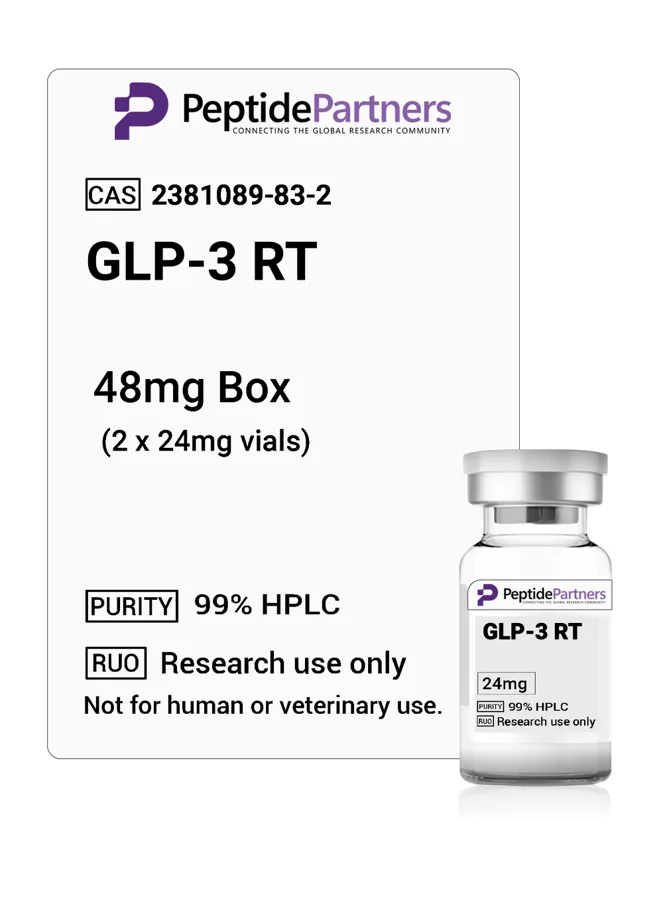
Available packs
GLP-3 Retatrutide
$230 - $1,512
Buy GLP-3 Retatrutide (24mg vials) from Peptides Partners
Investigators and academic institutions seeking advanced metabolic research compounds can buy GLP-3 RT through the dedicated catalog at Peptides Partners. Classified under our metabolics portfolio, Retatrutide (CAS: 2381089-83-2) represents one of the most structurally sophisticated multi-agonist peptides currently synthesized for non-clinical research. Often designated as GLP-3 or a “triple G” agonist in contemporary biochemical literature, this compound engages three distinct metabolic receptor pathways simultaneously: the glucagon-like peptide-1 (GLP-1) receptor, the glucose-dependent insulinotropic polypeptide (GIP) receptor, and the glucagon receptor (GCGR).
Our 24mg vial format is formulated specifically for sustained laboratory projects, high-throughput receptor binding assays, and pharmacokinetic evaluation across multi-week protocols. High-concentration, single-vial packaging reduces vial-to-vial variability across large sample sets and offers significant operational efficiency for laboratories studying metabolic signaling cascades. When sourcing research peptides from Peptides Partners, research teams receive laboratory-grade, lyophilized materials manufactured under rigorous synthetic controls designed to ensure structural fidelity, batch consistency, and reliable assay reproducibility. All items supplied are strictly intended for in vitro, ex vivo, and non-human animal research applications conducted by qualified scientific personnel.
What is GLP-3 Retatrutide?
Retatrutide (chemical designation LY3437943; CAS registry number 2381089-83-2) is a synthetic 39-amino-acid peptide engineered to exhibit agonism across three major peptide hormone receptors responsible for nutrient sensing, energy expenditure, and glycemic regulation. Structurally, the molecule is built upon an engineered peptide backbone derived in part from the native GIP sequence, modified to incorporate specific residues that confer high-affinity binding to both GLP-1 and glucagon receptors.
To overcome the short biological half-life inherent to endogenous peptide hormones, which are typically cleared within minutes by enzymatic cleavage, Retatrutide incorporates two critical structural modifications:
- Alpha-Aminoisobutyric Acid Substitutions: Non-proteinogenic amino acids (such as Aib) are incorporated at defined positions within the amino-terminal region. This modification provides profound steric hindrance against dipeptidyl peptidase-4 (DPP-4) degradation, preventing the rapid cleavage that characterizes native incretins.
- Fatty Diacid Acylation: The peptide backbone is conjugated to a C20 fatty diacid moiety via a hydrophilic linker (typically consisting of gamma-glutamic acid and PEG-based spacers). This lipophilic side chain facilitates reversible, high-affinity non-covalent binding to circulating serum albumin, markedly reducing renal filtration and prolonging the systemic presence of the molecule in pharmacokinetic models.
In biochemical taxonomy, single-target agonists (such as selective GLP-1 mimetics) and dual-target agonists (such as GLP-1/GIP co-agonists) have provided extensive insight into incretin-mediated biological responses. Retatrutide expands upon this paradigm by introducing balanced, potent agonism at the glucagon receptor alongside GLP-1 and GIP activation. In receptor-expressing cell line assays, Retatrutide displays functional potency across all three targets, though with calibrated relative affinities engineered to avoid excessive glycogenolytic stimulation while maintaining beneficial hepatic energy turnover.
Research effects studied
In preclinical and foundational clinical literature, Retatrutide has been studied across diverse metabolic and cellular models to elucidate the physiological interplay of triple receptor co-activation. Key investigative domains include:
Triple Incretin and Glucagon Receptor Engagement
The simultaneous activation of GLP-1, GIP, and glucagon receptors produces distinct molecular signaling events downstream of heterotrimeric G-protein-coupled receptors (GPCRs). Research models demonstrate robust intracellular cyclic adenosine monophosphate (cAMP) accumulation following peptide binding in cells expressing human GLP-1R, GIPR, or GCGR. Scientific inquiry centers on how simultaneous Gs-coupled signaling via three distinct inputs alters downstream gene expression, particularly pathways governing cellular respiration, mitochondrial biogenesis, and lipid clearance.
Hepatic Metabolism and Lipid Handling
A primary focus of Retatrutide investigation is its impact on hepatic lipid composition. Unlike pure incretin mimetics, the inclusion of glucagon receptor agonism selectively engages hepatocytes. In preclinical rodent models of metabolic dysfunction-associated steatohepatitis (MASH) and hepatic steatosis, Retatrutide has been observed to stimulate mitochondrial fatty acid beta-oxidation, downregulate de novo lipogenesis enzymes (such as fatty acid synthase and acetyl-CoA carboxylase), and enhance cellular turnover of stored intrahepatic triglycerides.
Energy Expenditure and Thermogenesis
Glucagon receptor stimulation is historically associated with metabolic rate modulation. In calorimetry chambers, laboratory animal models administered Retatrutide exhibit increased resting energy expenditure independent of locomotor activity. Researchers have examined whether this thermogenic shift arises through brown adipose tissue (BAT) activation, uncoupling protein-1 (UCP-1) upregulation, or augmented futile lipid cycling within subcutaneous and visceral white adipose depots.
Glycemic Control and Beta-Cell Dynamics
Despite the presence of glucagon receptor activity—which typically promotes hepatic glucose output—the balanced co-activation of GLP-1 and GIP receptors provides potent, glucose-dependent stimulation of insulin secretion from pancreatic beta cells. In preclinical glucose tolerance tests, co-agonism prevents sustained hyperglycemia while modulating glucagon counter-regulation, allowing researchers to evaluate complex endocrine feedback loops in models of impaired glucose handling.
Neuroendocrine Satiety Circuits
Central nervous system pathways controlling appetite and nutrient consumption have been studied extensively using Retatrutide. In rodent models, peripheral administration engages receptors within the arcuate nucleus of the hypothalamus and the area postrema of the brainstem. Investigations demonstrate altered expression of pro-opiomelanocortin (POMC) and neuropeptide Y (NPY) transcripts, leading to profound reductions in cumulative food intake and altered macronutrient selection.
How to use in the laboratory
Retatrutide 24mg is supplied as a sterile, lyophilized cake or powder inside sealed glass serum vials. Because of its complex primary structure and lipophilic diacid moiety, precise laboratory handling is required to maintain peptide stability and ensure consistent experimental results.
Reconstitution Procedures
- Solvent Selection: Reconstitution should be performed using sterile bacteriostatic water (0.9% benzyl alcohol) for multi-use analytical workflows, or sterile 0.9% sodium chloride injection / laboratory-grade phosphate-buffered saline (PBS) for immediate use in assay environments sensitive to antimicrobial preservatives.
- Temperature Equilibration: Before introducing any diluent, remove the lyophilized vial from cold storage and allow it to equilibrate to ambient laboratory room temperature (20°C to 25°C) for approximately 30 minutes. Reconstituting cold lyophilized cakes can cause rapid condensation inside the vial, altering volume measurements and introducing moisture-induced aggregation.
- Diluent Addition: Aseptic technique must be maintained under a laminar flow hood. Introduce the reconstitution fluid slowly along the interior glass wall of the vial using an appropriate micropipette or sterile syringe. Avoid direct, high-pressure liquid jetting onto the peptide cake to prevent structural shearing and excessive foaming.
- Dissolution: Gently swirl or invert the vial manually. Never vortex or vigorously agitate Retatrutide solutions; mechanical shear stress can disrupt tertiary peptide interactions and accelerate the formation of sub-visible fibrils or insoluble aggregates. Allow the vial to stand undisturbed for 5 to 10 minutes until the solution is completely clear and particulate-free.
Laboratory Record-Keeping and Handling Controls
To adhere to institutional research compliance standards, laboratories should implement standardized logging protocols for every vial of Retatrutide used:
- Document the date of receipt, lot number, reconstituting diluent, final concentration (e.g., mg/mL), and identity of the handling researcher.
- Calibrate all micropipetting instruments prior to stock dilution preparation to maintain volumetric precision.
- Implement single-use aliquot protocols where feasible. Dividing reconstituted stock solutions into low-protein-binding microcentrifuge tubes immediately after dissolution minimizes the degradation associated with repeated freeze-thaw cycles.
Pack sizes and price per mg
To support academic, industrial, and institutional research projects of varying scale, Peptides Partners offers GLP-3 Retatrutide 24mg vials in four tiered procurement packages. Purchasing multi-vial configurations significantly reduces the effective cost per milligram, enabling high-volume laboratories to optimize grant and departmental budgets.
| Pack Configuration | Total Peptide Content | Total Price (USD) | Price per Milligram |
|---|---|---|---|
| 2 vials x 24mg | 48 mg | $230 | $4.79 / mg |
| 5 vials x 24mg | 120 mg | $480 | $4.00 / mg |
| 10 vials x 24mg | 240 mg | $880 | $3.67 / mg |
| 20 vials x 24mg | 480 mg | $1512 | $3.15 / mg |
The 24mg vial format is particularly suited for high-throughput screening and long-term longitudinal animal protocols where low-mass vials (such as 2mg or 5mg formats) necessitate frequent, error-prone reconstitution steps and introduce inter-batch solvent deviations.
Storage and handling
Maintaining proper physical storage conditions is critical for preserving the integrity of Retatrutide throughout its experimental lifecycle. Synthetic peptides containing hydrophobic modifications and specialized side-chain linkages are susceptible to hydrolytic cleavage, deamidation, and methionine oxidation if exposed to improper storage variables.
Lyophilized Peptide Storage
- Long-Term Archive: Lyophilized vials should be maintained at -20°C to -80°C in an ultra-low temperature laboratory freezer. Under these conditions, protected from moisture and light, the un-reconstituted peptide exhibits excellent stability over extended archival periods.
- Desiccation and Humidity: Store vials inside sealed containers containing anhydrous desiccant packets. Ambient moisture can infiltrate standard vial crimp seals over time, promoting spontaneous hydrolysis of the peptide backbone.
- Photoprotection: Keep vials stored in their original packaging or dark containment boxes to prevent photo-oxidation catalyzed by ultraviolet or intense laboratory fluorescent lighting.
Reconstituted Solution Storage
- Short-Term Handling: Once reconstituted in sterile bacteriostatic solvent, stock solutions may be refrigerated at 2°C to 8°C for short experimental windows, generally recommended not to exceed 14 to 21 days depending on the solvent system and preservative concentration.
- Frozen Aliquots: If reconstituted solutions must be stored for longer periods, prepare discrete, single-assay aliquots and store immediately at -20°C or -80°C. Do not subject reconstituted peptide solutions to repetitive freeze-thaw cycles, as ice crystal formation promotes denaturing, aggregation, and loss of functional receptor binding capacity.
Safety and Disposal
Personnel handling Retatrutide should wear standard laboratory personal protective equipment (PPE), including nitrile gloves, protective eyewear, and a lab coat. Handle lyophilized powders within certified chemical fume hoods or biological safety cabinets to prevent accidental inhalation or mucosal contact. Dispose of any residual peptide, contaminated consumables, or sharps in accordance with institutional biohazardous and chemical waste guidelines.
Quality and documentation
Sourcing research peptides requires rigorous analytical verification to ensure that experimental readouts reflect true biological activity rather than batch-to-batch variations, synthesis truncations, or residual chemical contaminants. Peptides Partners adheres to established biochemical quality control parameters for all analytical compounds:
- Reverse-Phase High-Performance Liquid Chromatography (RP-HPLC): Every production lot undergoes chromatographic separation to ensure precise purity profiling. RP-HPLC confirms the removal of truncated peptide fragments, deletion sequences, and deprotection artifacts generated during solid-phase peptide synthesis (SPPS).
- Electrospray Ionization Mass Spectrometry (ESI-MS) / MALDI-TOF: Molecular identity is confirmed by verifying the precise monoisotopic mass and charge states of the intact conjugate, ensuring that the peptide sequence and the conjugated C20 diacid linker match calculated theoretical values.
- Physical Consistency: Vials are visually inspected for uniform cake formation, moisture-free sealing, and absence of physical particulate matter before packaging under inert gas conditions (such as nitrogen or argon purging).
- Institutional Traceability: Individual lots are tracked through dedicated batch numbering systems, enabling academic and private laboratories to retrieve synthesis verification data and maintain comprehensive audit trails for regulatory compliance.
Frequently asked questions
What distinguishes GLP-3 Retatrutide from dual and single incretin mimetics in research models?
While single agonists target solely the GLP-1 receptor (e.g., semaglutide models) and dual agonists target both GLP-1 and GIP receptors (e.g., tirzepatide models), Retatrutide integrates a third regulatory pathway via deliberate glucagon receptor agonism. In research models, this triple profile permits the simultaneous examination of incretin-mediated glycemic control and insulin secretion alongside glucagon-driven hepatic fatty acid oxidation, energy expenditure, and thermogenic adaptation.
What solvents are recommended for reconstituting lyophilized Retatrutide 24mg?
The standard diluent for general laboratory research is sterile bacteriostatic water (containing 0.9% benzyl alcohol), which preserves solution stability across multiple sampling procedures over several weeks. For in vitro cell-based assays or assays sensitive to alcohol preservatives, sterile physiological saline (0.9% NaCl) or sterile PBS (pH 7.2 to 7.4) should be used. Solvents must be introduced slowly along the vial wall without vigorous agitation.
Why is Retatrutide supplied in a 24mg vial format?
The 24mg mass format is engineered for high-throughput or longitudinal studies that require higher stock concentrations or large sample volumes. Preparing concentrated stock solutions from a single 24mg vial reduces cumulative pipetting variance, limits solvent batch variations, and streamlines protocol workflows compared to managing multiple lower-mass vials.
Is GLP-3 Retatrutide approved for human therapeutic use or clinical treatment?
No. GLP-3 Retatrutide provided by Peptides Partners is strictly an investigational chemical intended exclusively for laboratory research, in vitro studies, and preclinical testing by qualified professionals. It is not an approved medication, diagnostic tool, or dietary product, and it is under no circumstances intended for human consumption, clinical administration, or medical therapy.
Related Peptides Partners research peptides
KBT Blend: BPC-157/TB-500/KPV (60mg vials); BPC-157 (40mg vials); GLP-3 RT (12mg vials).
GLP-3 Retatrutide lot documentation
Certificates of analysis are matched to the actual lot supplied with your order. Email sales@peptidespartners.co with the product name and pack size to request the current lot's purity, identity and screening documents before purchase.
Storage
Research peptides are typically supplied lyophilized (freeze-dried), which keeps them stable for shipping and storage. Store unopened vials cool, dry and away from light; for long-term storage, a freezer is generally recommended.
After reconstitution, keep vials refrigerated and use sterile laboratory technique. Follow the handling guidance supplied with your lot documentation.
- Short name
- GLP-3 Retatrutide (24mg vials)
- Vial strength
- 24mg vials
- Pack sizes
- 48mg pack, 120mg pack, 240mg pack, 480mg pack
- Pack count options
- 2, 5, 10, 20 vial packs
- CAS number
- 2381089-83-2
- Category
- Metabolics
- SKU
- PP-875
- Compliance
- Research Use Only. Not for use in diagnostic tests.