
GLP-3 Retatrutide
12mg per vial
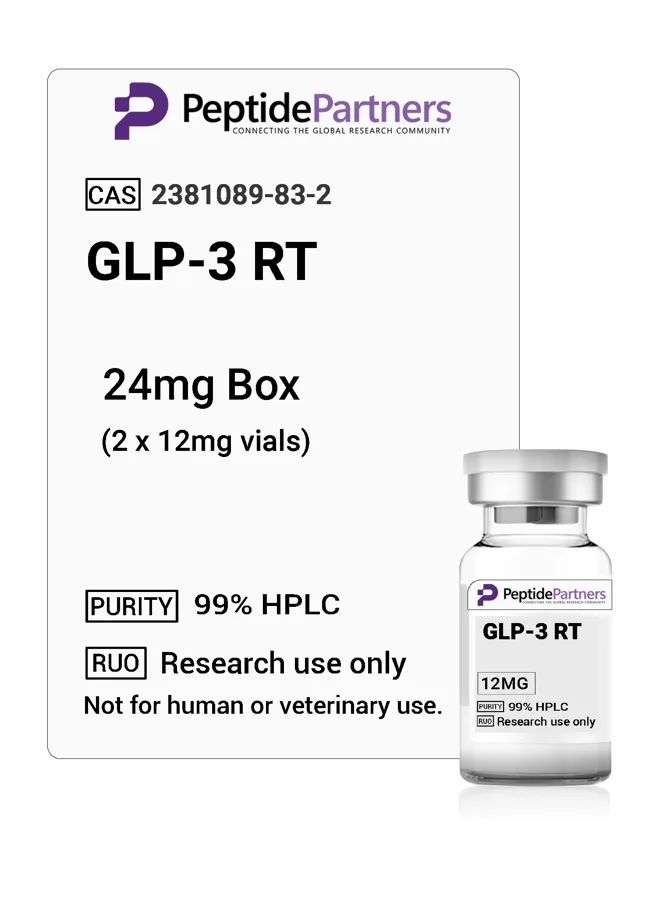
Available packs
GLP-3 Retatrutide
$124 - $1,000
Buy GLP-3 Retatrutide (12mg vials) from Peptides Partners
Peptides Partners provides premium-grade GLP-3 Retatrutide supplied in standardized 12mg glass vials for controlled laboratory environments. As biomedical investigations into complex metabolic pathways expand, investigators require precisely quantified, stable chemical reference materials to ensure reproducibility across experimental assays. When academic laboratories, pharmaceutical research facilities, and independent life science institutions look to buy GLP-3 RT, Peptides Partners delivers high-integrity lyophilized preparations manufactured under rigorous synthetic standards.
Each unit contains 12 milligrams of lyophilized peptide mass, vacuum-sealed under inert atmospheric conditions to protect the structural integrity of the polypeptide chain during storage and transport. Metabolic regulation, energy expenditure mechanics, and receptor co-activation profiles demand reliable reagents that eliminate batch-to-batch variability. Peptides Partners is dedicated to supplying verified research peptides intended strictly for in vitro laboratory evaluation, analytical chemistry validation, and preclinical animal research models. This compound is strictly not for human consumption, therapeutic intervention, or clinical diagnostics.
By securing GLP-3 Retatrutide through our catalog, researchers gain access to stable, solid-phase synthesized peptides formulated specifically to meet the demands of advanced pharmacological screening, receptor-binding kinetics, and molecular signaling explorations.
What is GLP-3 Retatrutide?
GLP-3 Retatrutide (alternatively recognized in preclinical literature as LY3437943) is an engineered, unimolecular triple-hormone receptor agonist. The molecule represents a structural evolution in metabolic endocrinology, transitioning beyond single-target incretin mimetics and dual incretin agonists into multi-receptor functional pharmacology. Retatrutide is designed to simultaneously interact with and activate three distinct G-protein coupled receptors (GPCRs) involved in metabolic regulation:
- The Glucagon-Like Peptide-1 receptor (GLP-1R)
- The Glucose-Dependent Insulinotropic Polypeptide receptor (GIPR)
- The Glucagon receptor (GCGR)
Structurally, Retatrutide is a synthetic single-chain peptide consisting of 39 amino acids. The peptide backbone is derived from a modified GIP sequence, altered strategically with non-coded alpha, alpha-disubstituted amino acid residues to confer resistance against endogenous enzymatic degradation, particularly cleavage mediated by dipeptidyl peptidase-4 (DPP-4). To extend its functional plasma half-life in physiological research models, the sequence incorporates a fatty diacid side-chain conjugated via a specialized linker at a specific lysine residue. This C20 diacid fatty acyl moiety enables high-affinity, reversible binding to serum albumin, shielding the peptide from rapid renal filtration.
Because Retatrutide is a proprietary investigational peptide sequence without an assigned public CAS registry designation (CAS: n/a), chemical verification relies on targeted mass spectrometry and high-resolution chromatography. The compound represents a benchmark tool within metabolic literature for studying the complex bioenergetic interplay governed by triple incretin-glucagon agonism.
Research effects studied
In academic and preclinical literature, multi-agonist peptides have garnered significant interest due to their capacity to modulate divergent downstream intracellular signaling cascades. Retatrutide has been studied in preclinical and translational research settings to elucidate how simultaneous engagement of GLP-1, GIP, and glucagon receptors influences cellular bioenergetics, nutrient partitioning, and endocrine homeostasis.
Published investigations focus heavily on the synergistic mechanisms produced by co-activating these three distinct pathways:
- GLP-1 Receptor Pathways: In isolated pancreatic beta-cell models and rodent bioassays, activation of the GLP-1 receptor by Retatrutide has been observed to stimulate cyclic adenosine monophosphate (cAMP) production, promoting glucose-dependent insulin secretion. In central nervous system models, research has explored its role in modulating hypothalamic appetite-regulating networks, specifically through pro-opiomelanocortin (POMC) and cocaine- and amphetamine-regulated transcript (CART) neuronal pathways.
- GIP Receptor Pathways: Experimental models evaluating the GIP component indicate complementary insulinotropic activity in glycemic control assays. Concurrently, researchers investigate GIP receptor signaling in peripheral adipose tissue to study adipocyte lipid buffering, potential protection against lipotoxicity, and the modulation of glucagon-mediated lipolysis.
- Glucagon Receptor (GCGR) Engagement: The defining functional differentiator of Retatrutide from dual incretin agonists is its balanced recruitment of the glucagon receptor. Preclinical rodent studies demonstrate that hepatic GCGR activation stimulates mitochondrial fatty acid beta-oxidation and downregulates de novo lipogenesis. In energy balance research, glucagon receptor signaling is linked to elevated resting metabolic rate, increased substrate turnover, and non-shivering thermogenesis via brown adipose tissue (BAT) activation.
- Hepatic and Lipid Dynamics: In murine models of diet-induced obesity (DIO) and metabolic dysfunction-associated steatohepatitis (MASH), Retatrutide has been studied for its ability to reduce intrahepatic triglyceride accumulation, lower markers of hepatic inflammation, and preserve lean tissue mass relative to total mass reduction.
These collective observations position Retatrutide as an indispensable tool for exploring receptor crosstalk, allosteric receptor interactions, and the molecular thermodynamics of multi-target metabolic therapies.
How to use in the laboratory
Handling synthetic peptides requires adherence to precise biochemical laboratory practices to prevent contamination, hydrolysis, or loss of peptide yield due to non-specific surface adsorption. When preparing GLP-3 Retatrutide for in vitro assays or preclinical protocols, technical staff must observe standard biosafety procedures within a designated biosafety cabinet or laminar flow workstation.
Reconstitution of the lyophilized powder should be performed with rigorous attention to physicochemical factors:
- Diluent Selection: Depending on the downstream assay specifications, reconstitute using sterile bacteriostatic water (containing 0.9% benzyl alcohol) for multi-use analytical sampling, or sterile normal saline (0.9% sodium chloride injection grade) or sterile water for injection (WFI) for immediate single-assay applications.
- Solvation Procedure: Direct the diluent slowly along the interior glass wall of the vial rather than applying direct pressure to the lyophilized cake. This reduces foaming and mechanical shear stress on the peptide structure.
- Dissolution: Gently swirl the vial in circular motions until the cake is fully dissolved into a clear, particle-free solution. Never vortex or aggressively shake peptide solutions, as high physical agitation can induce peptide aggregation and secondary structural denaturation.
- Concentration Calibration: Calculate final working stock concentrations based on total volume added. For example, introducing 1.2 mL of solvent to a 12mg vial yields a stock concentration of 10 mg/mL, whereas 2.4 mL yields 5 mg/mL, simplifying subsequent micro-pipetting into cell culture media or microplates.
- Laboratory Record-Keeping: Record the date of reconstitution, diluent lot number, calculated concentration, and technician initials directly on the vial label or inventory management system. Maintain accurate documentation logs tracing reconstitution timelines against experimental assay data to ensure experimental reproducibility.
Pack sizes and price per mg
To accommodate diverse project scales—from exploratory cell-culture screens to high-throughput animal model studies—Peptides Partners offers GLP-3 Retatrutide (12mg vials) across multiple tier configurations. Ordering multi-vial quantities lowers the research expenditure per milligram, enabling laboratories to optimize project budgets while securing identical batch lots for experimental control.
| Pack Configuration | Total Peptide Content | Price (USD) | Price per mg |
|---|---|---|---|
| 2 vials x 12mg | 24 mg | $124 | $5.17 / mg |
| 5 vials x 12mg | 60 mg | $290 | $4.83 / mg |
| 10 vials x 12mg | 120 mg | $545 | $4.54 / mg |
| 20 vials x 12mg | 240 mg | $1000 | $4.17 / mg |
Securing larger pack allocations ensures that research groups have sufficient peptide volume from a uniform synthesis lot, minimizing analytical discrepancies across multi-week assay runs.
Storage and handling
Preserving peptide stability depends on appropriate environmental controls. Like most synthetic multi-agonist polypeptides, Retatrutide possesses functional amino acid residues vulnerable to atmospheric moisture, thermal degradation, and light exposure.
Laboratory storage conditions must be monitored systematically:
- Lyophilized Vials: Unopened vials containing lyophilized cake should be stored long-term at -20°C in a manual defrost freezer. For extended archival storage exceeding twelve months, -80°C is recommended. Under these conditions, the dry peptide remains stable and resistant to spontaneous chemical degradation. If storage at low temperatures is temporarily unavailable, sealed vials may be held at 2°C to 8°C for short-term handling periods not exceeding four weeks.
- Desiccation: Prior to opening a frozen vial for reconstitution, allow the container to equilibrate to ambient room temperature inside a desiccator or sealed container. Opening cold vials directly to ambient air causes atmospheric moisture to condense onto the cake, initiating hydrolytic cleavage.
- Reconstituted Solutions: Following reconstitution, liquid working stocks must be maintained at 2°C to 8°C and evaluated within a restricted experimental window (typically within 14 to 28 days depending on the antimicrobial properties of the diluent).
- Aliquot Strategy: If long-term utility of a reconstituted stock is required, immediately partition the liquid into single-use polypropylene microcentrifuge tubes and freeze at -20°C or -80°C. Avoid repeated freeze-thaw cycles, as crystal formation across thermal transitions destabilizes secondary peptide conformations and induces precipitation.
- Light Exposure: Store vials away from direct sunlight, fluorescent lighting, and ultraviolet sources to prevent photochemical oxidation of aromatic residues.
Quality and documentation
Reliable biological research demands analytical certainty. When laboratories buy GLP-3 RT from Peptides Partners, they are sourcing compounds subjected to standardized analytic protocols designed to verify chemical identity, integrity, and net peptide content.
Every synthesis lot is subjected to dual instrumental verification:
- Reverse-Phase High-Performance Liquid Chromatography (RP-HPLC): Used to confirm the analytical profile, baseline resolution, and separation of the target polypeptide from minor truncated or deletion sequences.
- Electrospray Ionization Mass Spectrometry (ESI-MS): Employed to unequivocally verify the molecular weight and monoisotopic mass of the target 39-amino acid conjugated structure against theoretical calculations.
All units are labeled with unique lot numbers allowing direct tracking against internal production batches. Researchers can integrate this documentation directly into regulatory, institutional, or laboratory quality management protocols. Peptides Partners maintains an uncompromising focus on catalog integrity, guaranteeing that our research peptides perform consistently across complex analytical systems.
Frequently asked questions
What distinguishes Retatrutide from dual agonists like Tirzepatide in research?
While dual agonists such as Tirzepatide engage both GLP-1 and GIP receptors, Retatrutide integrates a third pharmacological target: the glucagon receptor (GCGR). This unimolecular triple-agonist profile allows researchers to study the distinct contribution of glucagon signaling—specifically hepatic fatty acid oxidation, glycogenolysis, and brown adipose thermogenesis—alongside standard incretin-mediated glucose regulation and appetite modulation pathways.
What diluents are suitable for reconstituting GLP-3 Retatrutide vials?
Common laboratory solvents include sterile bacteriostatic water (containing 0.9% benzyl alcohol), sterile 0.9% sodium chloride (normal saline), and sterile water for injection (WFI). The choice depends entirely on downstream requirements; bacteriostatic water is preferred for multi-use laboratory testing over several weeks, whereas preservative-free saline or WFI is standard for immediate cell-culture or in vivo animal assays where benzyl alcohol might interfere with cellular viability.
Can reconstituted Retatrutide be subjected to repeated freeze-thaw cycles?
No. Repeated thermal cycling between liquid and solid phases creates mechanical stress that promotes polypeptide aggregation, structural denaturation, and loss of receptor-binding affinity. If the entire 12mg volume cannot be utilized within a single experimental workflow, the reconstituted liquid should be immediately divided into pre-labeled, single-use aliquots and maintained frozen at -20°C or -80°C until use.
Is GLP-3 Retatrutide authorized for human administration or diagnostic use?
No. GLP-3 Retatrutide provided by Peptides Partners is strictly designated as a research-use-only (RUO) biochemical agent. It is synthesized exclusively for in vitro laboratory investigations, chemical analysis, and approved preclinical animal studies. It has not undergone clinical manufacturing controls and must never be administered to humans, compounded into medicinal formulations, or utilized in clinical diagnostics.
Related Peptides Partners research peptides
Glutathione (1500mg vials); MOTS-c (10mg vials); SS-31 (50mg vials).
GLP-3 Retatrutide lot documentation
Certificates of analysis are matched to the actual lot supplied with your order. Email sales@peptidespartners.co with the product name and pack size to request the current lot's purity, identity and screening documents before purchase.
Storage
Research peptides are typically supplied lyophilized (freeze-dried), which keeps them stable for shipping and storage. Store unopened vials cool, dry and away from light; for long-term storage, a freezer is generally recommended.
After reconstitution, keep vials refrigerated and use sterile laboratory technique. Follow the handling guidance supplied with your lot documentation.
- Short name
- GLP-3 Retatrutide (12mg vials)
- Vial strength
- 12mg vials
- Pack sizes
- 24mg pack, 60mg pack, 120mg pack, 240mg pack
- Pack count options
- 2, 5, 10, 20 vial packs
- Category
- Metabolics
- SKU
- PP-27849
- Compliance
- Research Use Only. Not for use in diagnostic tests.