
Glutathione
1500mg per vial
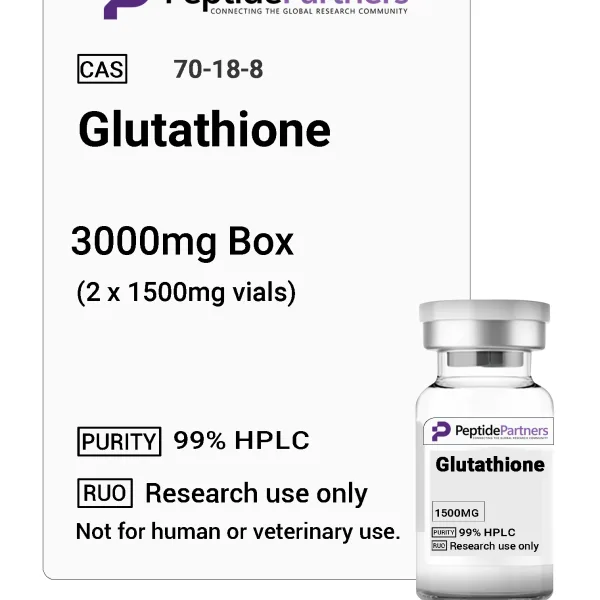
Available packs
Glutathione
$92 - $350
Buy Glutathione (1500mg vials) from Peptides Partners
Laboratories and institutional investigators seeking high-capacity antioxidant reference standards can buy Glutathione in 1500mg lyophilized vials directly from Peptides Partners. Glutathione is among the most extensively investigated endogenous tripeptides in biochemical, toxicological, and cellular physiology research. Formulated specifically to meet the stringent demands of in vitro assays, metabolic tracking, and redox balance modeling, these high-concentration vials provide research facilities with the flexibility required for both micro-scale and high-throughput experimental architectures.
At Peptides Partners, our catalog is structured exclusively for laboratory-based research and scientific inquiry. Every batch of our research peptides and biomolecules is synthesized, packaged, and handled under rigid quality parameters to ensure physical uniformity, high solubility, and dependable reproducibility across experimental series. Our 1500mg presentation provides an exceptional yield per vial, minimizing inter-vial variance and simplifying large-volume reagent preparation for ongoing laboratory protocols. Whether your study investigates free-radical scavenging capacity, cellular apoptosis pathways, or heavy-metal chelation kinetics, sourcing your biochemical reagents through Peptides Partners guarantees access to dependable materials engineered solely for academic, clinical, and industrial research environments.
What is Glutathione?
Glutathione is a low-molecular-weight tripeptide structurally designated as gamma-L-glutamyl-L-cysteinylglycine (C10H17N3O6S). Unlike standard peptides synthesized via ribosomal translation, glutathione is produced intracellularly through a two-step, ATP-dependent enzymatic pathway. The first rate-limiting step involves glutamate-cysteine ligase (GCL), which joins the amino group of cysteine to the gamma-carboxyl group of glutamate rather than the conventional alpha-carboxyl link. This unique gamma-glutamyl linkage confers significant biochemical stability, protecting the molecule from degradation by intracellular aminopeptidases and leaving it susceptible primarily to cleavage by gamma-glutamyl transferase (GGT), an enzyme localized predominantly on external cell membranes. The second step is catalyzed by glutathione synthetase, which appends glycine to the C-terminus of the gamma-glutamylcysteine intermediate.
The operational core of the glutathione molecule resides within the sulfhydryl (-SH) functional group of its central cysteine residue. In biological systems, glutathione exists in two distinct forms: the monomeric, active reduced state (commonly abbreviated as GSH) and the dimeric, oxidized disulfide state (GSSG). In physiological in vitro and in vivo models, the molar ratio of GSH to GSSG serves as an essential metric of cellular redox state and overall mitochondrial integrity. Under quiescent, non-stressed conditions, the intracellular GSH:GSSG ratio typically exceeds 100:1, maintained by the continuous activity of glutathione reductase (GR) in conjunction with reduced nicotinamide adenine dinucleotide phosphate (NADPH). When oxidative challenge occurs, glutathione peroxidase (GPx) utilizes GSH as an electron donor to reduce hydrogen peroxide and lipid hydroperoxides into water and corresponding lipid alcohols, generating GSSG as a byproduct.
Beyond its function as a direct antioxidant, glutathione is a critical nucleophilic cofactor in Phase II cellular detoxification. Enzymes belonging to the Glutathione S-Transferase (GST) superfamily facilitate the conjugation of GSH to electrophilic compounds, xenobiotics, and intermediate drug metabolites, increasing their water solubility for export through ATP-binding cassette (ABC) transporter complexes, including the multidrug resistance-associated proteins (MRPs). Consequently, glutathione remains a fundamental subject of investigation across multiple biomedical disciplines, including toxicology, pharmacology, neurobiology, and metabolic physiology.
Research effects studied
Due to its central position in cellular homeostasis, glutathione has been studied in preclinical and laboratory research across an expansive array of scientific paradigms. Investigators routinely employ exogenous and intracellular glutathione manipulations to observe cellular adaptations under controlled stressors:
- Oxidative Stress and Free Radical Neutralization: In preclinical models of oxidative damage, researchers examine the capacity of GSH to directly quench reactive oxygen species (ROS) and reactive nitrogen species (RNS), including hydroxyl radicals, superoxide anions, and peroxynitrite. Studies utilizing spectrophotometric, fluorometric, and electron paramagnetic resonance (EPR) assays regularly assess the rate at which elevated GSH concentrations mitigate macromolecular damage, such as lipid peroxidation and DNA strand breakage.
- Mitochondrial Redox Signaling and Apoptosis: Research has explored the compartmentalized dynamics of the mitochondrial glutathione pool. Because mitochondria lack the enzymes necessary for de novo glutathione synthesis, they rely on specialized transport mechanisms to recruit cytosolic GSH. Investigations into permeability transition pore (mPTP) opening and cytochrome c release frequently monitor the depletion of mitochondrial GSH as an early triggering event in intrinsic apoptotic signaling.
- Protein S-Glutathionylation: Post-translational modifications are central to signal transduction. Preclinical studies have evaluated the reversible formation of mixed disulfides between glutathione and protein cysteinyl residues (S-glutathionylation). This reversible modification serves a dual role: it shields critical enzymes from irreversible oxidative carbonylation and acts as a dynamic molecular switch modulating the activity of structural proteins, transcription factors (such as NF-kappa-B), and metabolic enzymes.
- Xenobiotic Metabolism and Conjugation: In cellular toxicology models, researchers frequently test the interaction of glutathione with environmental mutagens, chemotherapeutic agents, and heavy metals. Studies demonstrate that glutathione coordinates with metal ions such as cadmium, mercury, and arsenic, neutralizing their electrophilic reactivity and facilitating their transport across cellular membranes via multidrug resistance transport systems.
- Immune Cell Proliferation and Function: In vitro immunological assays have investigated the role of intracellular redox balance in lymphocyte and macrophage activation. Published findings note that lymphocyte activation and clonal expansion depend on optimal intracellular thiol levels, with glutathione availability modulating interleukin synthesis, receptor responsiveness, and macrophage phagocytic activity.
- Neuroprotective Paradigms: Glial-neuronal metabolic cooperation is a prominent focus in neurochemistry research. Scientists examine how astrocytes synthesize and export glutathione or its precursors to support adjacent neurons, which possess lower endogenous antioxidant capacities and heightened vulnerability to excitotoxic glutamate insult.
How to use in the laboratory
Glutathione supplied by Peptides Partners is intended strictly for in vitro and laboratory experimental workflows. It is not formulated, authorized, or suitable for any form of human or veterinary administration. Adherence to sound laboratory techniques, aseptic practices, and meticulous documentation is essential to obtain reliable and reproducible results.
Before initiating any experimental procedure, researchers should review the following standardized handling practices:
- Reconstitution Protocol: Glutathione 1500mg is provided as a sterile, lyophilized cake in a sealed glass vial. Reconstitution should be performed within an ISO-certified laminar flow hood or biological safety cabinet to prevent microbial contamination. Slowly introduce a suitable laboratory solvent—typically sterile deionized water, sterile phosphate-buffered saline (PBS, pH adjusted if necessary), or high-purity laboratory-grade bacteriostatic water—using a sterile syringe and needle. Direct the liquid stream down the interior glass wall rather than directly onto the lyophilized powder to avoid foaming.
- Dissolution and Solubilization: Glutathione exhibits high water solubility. Gently swirl the vial in circular motions until the lyophilized cake is completely dissolved and the solution is clear and colorless. Vigorous shaking or agitation must be avoided, as the mechanical stress and introduction of atmospheric air can accelerate the spontaneous oxidation of reduced sulfhydryl groups into GSSG.
- Working Concentration and pH Monitoring: Unbuffered aqueous solutions of free-acid glutathione can possess an acidic pH. When preparing stock solutions for physiological cell culture media or enzyme kinetic assays, researchers must monitor and adjust the pH to approximately 7.2 to 7.4 using dilute, sterile sodium hydroxide (NaOH) or an appropriate physiological buffer to prevent altering the experimental media conditions.
- Aliquoting Strategy: Due to the high concentration of the 1500mg vial, it is standard practice to partition the freshly reconstituted stock solution into single-use microcentrifuge tubes or cryogenic vials. Aliquoting limits exposure to atmospheric oxygen and completely prevents the degradation associated with repeated freeze-thaw cycles.
- Record-Keeping and Inventory Tracking: Rigorous record-keeping is critical for auditability and experimental integrity. Investigators should log the date of reconstitution, the solvent batch and volume used, the calculated stock concentration (e.g., mg/mL or mM), the nominal pH, and the technician initials. Every aliquot should be clearly labeled with chemical identity, concentration, date, and storage location.
Pack sizes and price per mg
To support academic labs, biotechnology institutions, and analytical testing facilities with varied experimental scopes, Peptides Partners provides Glutathione (1500mg vials) in multiple multi-vial configurations. Purchasing higher-quantity packages significantly decreases the price per milligram, enabling predictable budget management for high-throughput screening and long-term assay runs.
The table below provides a detailed breakdown of available package sizes, total cumulative peptide mass, package cost, and corresponding cost per milligram:
| Package Configuration | Total Compound (mg) | Package Price (USD) | Price per Milligram (USD) |
|---|---|---|---|
| 2 vials x 1500mg | 3,000 mg | $92.00 | ~$0.0307 / mg |
| 5 vials x 1500mg | 7,500 mg | $200.00 | ~$0.0267 / mg |
| 10 vials x 1500mg | 15,000 mg | $350.00 | ~$0.0233 / mg |
When you buy Glutathione in larger quantities from Peptides Partners, your laboratory benefits from a reliable continuity of supply from uniform manufacturing lots, alongside substantial cost efficiencies designed to assist research grant optimization.
Storage and handling
Maintaining the structural stability and preventing premature oxidation of the free sulfhydryl group requires strict adherence to environmental controls during both storage and benchtop handling:
- Lyophilized Powder Storage: Unopened vials containing lyophilized Glutathione should be stored in a dry, dark environment at -20°C for long-term preservation. Storage at 2°C to 8°C is acceptable for short-term periods (up to several weeks), provided the vials remain protected from ambient moisture and light. Lyophilized cakes are hygroscopic; keep vials tightly sealed within their original packaging until reconstitution is actively performed.
- Reconstituted Solution Stability: Once dissolved in aqueous solutions, the thiol group of glutathione is susceptible to oxidation, forming GSSG when exposed to dissolved oxygen, elevated temperatures, or basic pH levels. Reconstituted solutions should ideally be prepared fresh for critical quantitative assays. If intermediate storage is necessary, aliquots should be immediately frozen at -20°C or, ideally, -80°C.
- Avoidance of Freeze-Thaw Cycles: Freezing and thawing stock solutions repeatedly causes thermal and oxidative stress that degrades reduced glutathione, altering experimental concentrations and shifting the baseline GSH:GSSG ratio. Aliquots should be thawed once, utilized within the experimental timeframe, and any unused remainder properly discarded.
- Laboratory Safety and Personal Protection: While glutathione is an endogenous biological molecule, laboratory safety protocols must be followed. Personnel handling research peptides and dry powders should wear standard personal protective equipment (PPE), including nitrile gloves, laboratory coats, and safety goggles. Handle bulk powder or broken glass within a certified fume hood to avoid inhalation of particulates or contact with mucosal surfaces.
Quality and documentation
Scientific rigor requires absolute confidence in the physical and chemical specifications of laboratory reagents. Peptides Partners prioritizes chemical verification, physical uniformity, and traceability across our complete inventory of research peptides and biochemical standards. Glutathione (1500mg vials) is subjected to strict analytical release protocols prior to catalog distribution.
Each batch is analytically profiled using modern separation and identification methodologies, including High-Performance Liquid Chromatography (HPLC) to evaluate chromatographic profile and purity, along with Mass Spectrometry (MS) to confirm molecular weight and empirical structure. Physical parameters—such as cake uniformity, reconstitution clarity, and dissolution rate—are systematically reviewed to eliminate impurities or particulate insolubility that could compromise sensitive cellular or optical detection systems.
To support institutional compliance and experimental reproducibility, lot-specific analytical documentation is maintained for every product run. Research teams can reference lot numbers to trace production timing, handling records, and analytical data. This focus on verifiable standards ensures that when investigators buy Glutathione from Peptides Partners, their experimental observations reflect true biochemical dynamics rather than synthetic variation or material degradation.
Frequently asked questions
What is the primary difference between GSH and GSSG in laboratory assays?
GSH represents the monomeric, reduced form of glutathione containing a single free thiol (-SH) group, which functions as the active electron donor in antioxidant and conjugation assays. GSSG represents the oxidized dimer, formed when two GSH molecules become joined via a covalent disulfide bond (-S-S-). Laboratory assays frequently quantify the ratio between GSH and GSSG to establish whether a given cellular culture or tissue lysate is undergoing oxidative stress, with a high GSH:GSSG ratio signifying a normal reducing environment and a suppressed ratio indicating redox disruption.
Which laboratory solvents are compatible with 1500mg Glutathione vials?
Glutathione is a hydrophilic tripeptide exhibiting high solubility in aqueous media. Commonly utilized laboratory solvents include sterile deionized water, sterile normal saline (0.9% NaCl), and sterile phosphate-buffered saline (PBS). For cell culture applications, stock solutions can be introduced directly into neutral-pH culture media, provided that any pH adjustments needed due to high stock concentrations of glutathione are verified prior to cell exposure. The use of organic solvents, such as ethanol or DMSO, is generally unnecessary and may hinder complete dissolution.
Can this product be utilized for animal or human clinical therapeutics?
No. Glutathione supplied by Peptides Partners is synthesized and sold strictly for laboratory-based research use only (RUO). It is not manufactured under human or veterinary cGMP pharmaceutical guidelines and is not licensed, cleared, or intended for medical treatment, clinical diagnosis, direct animal administration, or human consumption. Any application outside of controlled in vitro or preclinical laboratory research constitutes a violation of intended usage parameters.
Why is Glutathione offered in a high-capacity 1500mg vial size?
Many biochemical applications—such as protein refolding buffers, affinity chromatography elution protocols (e.g., eluting GST-fusion proteins), and high-throughput cellular screening series—require substantial concentrations of reduced glutathione. A 1500mg presentation provides research teams with a sufficient mass of compound in a single container to prepare high-volume or high-molarity working stocks without the need to pool multiple lower-capacity vials, thereby reducing preparation time, technical error, and lot-to-lot baseline variability.
Related Peptides Partners research peptides
Humanin (10mg vials); MOTS-c (40mg vials); TB-500 (TB4, 10mg vials).
Glutathione lot documentation
Certificates of analysis are matched to the actual lot supplied with your order. Email sales@peptidespartners.co with the product name and pack size to request the current lot's purity, identity and screening documents before purchase.
Storage
Research peptides are typically supplied lyophilized (freeze-dried), which keeps them stable for shipping and storage. Store unopened vials cool, dry and away from light; for long-term storage, a freezer is generally recommended.
After reconstitution, keep vials refrigerated and use sterile laboratory technique. Follow the handling guidance supplied with your lot documentation.
- Short name
- Glutathione (1500mg vials)
- Vial strength
- 1500mg vials
- Pack sizes
- 3000mg pack, 7500mg pack, 15000mg pack
- Pack count options
- 2, 5, 10 vial packs
- Category
- Anti-oxidant
- SKU
- PP-37816
- Compliance
- Research Use Only. Not for use in diagnostic tests.