
TB-500
10mg per vial
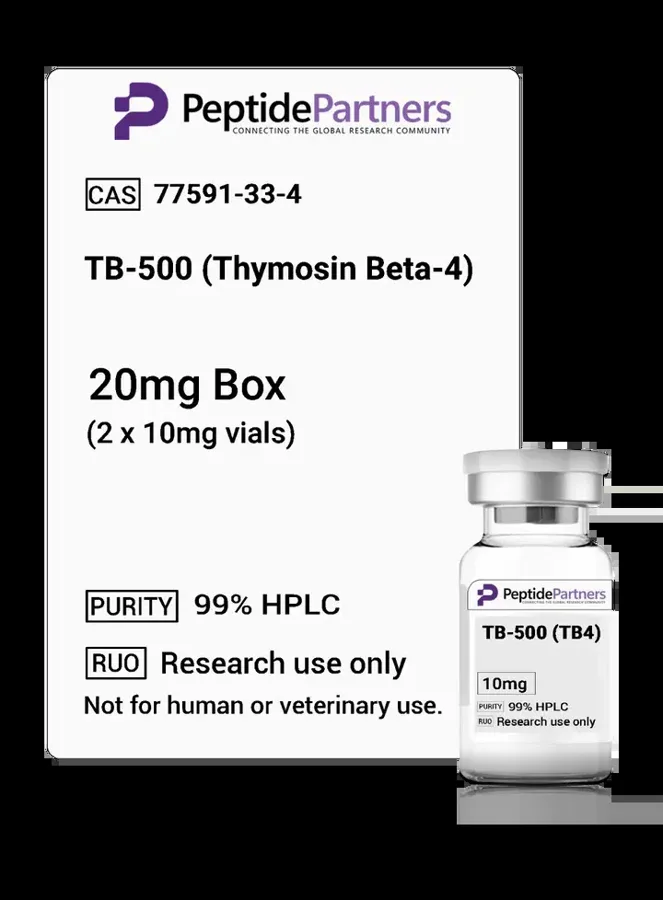
Available packs
TB-500
$130 - $490
Buy TB-500 (Thymosin Beta-4) TB4, 10mg vials from Peptides Partners
Laboratories and institutional investigators seeking high-grade cellular repair reference materials can buy TB-500 directly from Peptides Partners. Supplying dependable, analytical-grade research peptides is the core operational focus of Peptides Partners, ensuring that qualified scientists obtain thoroughly characterized biochemical tools for exploratory assay systems. Thymosin Beta-4 (TB4, frequently designated as TB-500 in synthetic peptide research literature) represents one of the most widely scrutinized naturally occurring actin-sequestering peptides in modern experimental biology.
Each vial provided by Peptides Partners contains 10mg of pure, lyophilized peptide formulated specifically for non-clinical laboratory evaluations. Lyophilization under tightly regulated moisture and temperature parameters ensures the peptide matrix preserves its structural integrity during shipment and long-term storage. When institutions buy TB-500 through our platform, they obtain compounds packaged in heavy-walled borosilicate glass vials, sealed with high-integrity butyl rubber stoppers and flip-off aluminum crimps to prevent atmospheric degradation, contamination, and moisture infiltration.
TB-500 is supplied exclusively for in vitro laboratory studies, biochemical interaction assays, and authorized in vivo animal model research. The product is strictly not intended for diagnostic, human therapeutic, medicinal, or veterinary applications. By maintaining strict quality and analytical handling standards, Peptides Partners supports universities, biotechnology ventures, and independent scientific facilities with reproducible reagents designed to meet demanding investigational protocols.
What is TB-500?
TB-500 is a synthetic peptide structurally corresponding to Thymosin Beta-4 (often abbreviated as Tβ4 or TB4), an endogenous, water-soluble 43-amino-acid peptide originally isolated from thymus gland tissue. Identified biochemically under CAS number 77591-33-4, Thymosin Beta-4 belongs to the beta-thymosin family of highly conserved polar polypeptides. The full chemical structure of native Thymosin Beta-4 comprises an N-terminal acetylated sequence containing 43 residues: Ac-Ser-Asp-Lys-Pro-Asp-Met-Ala-Glu-Ile-Glu-Lys-Phe-Asp-Lys-Ser-Lys-Leu-Lys-Lys-Thr-Glu-Thr-Gln-Glu-Lys-Asn-Pro-Leu-Pro-Ser-Lys-Glu-Thr-Ile-Glu-Gln-Glu-Lys-Gln-Ala-Gly-Glu-Ser. Its calculated molecular weight is approximately 4,963.5 g/mol.
Within native eukaryotic cells, Thymosin Beta-4 is widely distributed in the cytoplasm and acts as the predominant G-actin (monomeric globular actin) sequestering protein. Through this biochemical mechanism, it maintains an unpolymerized pool of actin monomers, releasing them in response to specific cellular signals to facilitate actin polymerization into filamentous F-actin. This continuous regulation of the cytoskeleton is a prerequisite for cell locomotion, structural remodeling, and morphological adaptability.
In biochemical and biomedical literature, the term TB-500 is frequently utilized to denote synthetic analogs or functional formulations embodying the biological sequence of Thymosin Beta-4. Within the 43-amino-acid chain, researchers have mapped the primary actin-binding domain to a localized hexapeptide sequence: Leu-Lys-Lys-Thr-Glu-Thr (LKKTET). Preclinical studies indicate that this functional motif plays an essential role in mediating actin dynamics, endothelial tube formation, and cellular migration. The synthetic preparation offered by Peptides Partners is synthesized via solid-phase peptide synthesis (SPPS), ensuring an accurate sequence configuration free of biological contaminants such as animal-derived pathogens, endotoxins, or unwanted cellular debris.
Research effects studied
Over the past three decades, Thymosin Beta-4 and its synthetic equivalents have been the subject of an extensive array of preclinical and translational studies. Biomedical investigators actively explore the peptide’s capacity to modulate tissue homeostasis, tissue injury response pathways, and cellular defense mechanisms across several physiological systems:
- Actin Dynamics and Cytoskeletal Reorganization: Because of its high-affinity association with monomeric G-actin, TB-500 has been widely examined in cellular biophysics. Studies investigate how the peptide inhibits spontaneous actin polymerization while simultaneously mobilizing actin subunits toward leading edges of migrating cells, thereby directing lamellipodia and filopodia formation.
- Endothelial Cell Migration and Angiogenesis: In vascular biology models, researchers have studied Thymosin Beta-4 for its ability to stimulate the migration of endothelial cells and promote capillary-like tube formation. Preclinical wound-healing assays regularly assess how the compound upregulates vascular endothelial growth factor (VEGF) expression and matrix metalloproteinases (MMPs), facilitating extracellular matrix degradation and new blood vessel formation.
- Dermal and Cutaneous Repair Models: A large body of preclinical research investigates the role of TB-500 in dermal wound closure. Rodent and porcine cutaneous models show that topical or localized application of the peptide correlates with accelerated re-epithelialization, enhanced collagen deposition, and the rapid recruitment of keratinocytes to wounded margins without driving excessive fibrosis or hyperplastic scar tissue.
- Cardiac Tissue Regeneration and Post-Ischemic Remodeling: Cardiothoracic research groups have evaluated Thymosin Beta-4 in myocardial infarction and ischemia-reperfusion models. Investigators have reported that the peptide activates resident epicardial progenitor cells, stimulates cardiac cell survival pathways via Akt phosphorylation, and dampens cardiomyocyte apoptosis following hypoxic insult.
- Anti-Inflammatory and Cytoprotective Pathways: Molecular research suggests that TB-500 exerts an inhibitory effect on specific pro-inflammatory cascades, notably reducing nuclear factor kappa B (NF-κB) activation and decreasing circulating tumor necrosis factor-alpha (TNF-α) and interleukin levels in induced inflammatory models.
- Corneal and Ocular Surface Healing: Experimental ophthalmology assays utilize Thymosin Beta-4 to study corneal epithelial migration following chemical burns or mechanical debridement, highlighting its cytoprotective properties on ocular surface tissues.
- Tendon, Ligament, and Skeletal Muscle Repair: Musculoskeletal researchers assess the peptide’s capability to induce satellite cell activation and muscle fiber regeneration while reducing local oxidative stress in damaged connective tissue fibers.
How to use in the laboratory
To preserve structural fidelity and ensure reliable downstream experimental outcomes, laboratory personnel must handle TB-500 using standardized chemical hygiene and biochemical handling techniques. The compound is intended solely for in vitro assay systems, analytical testing, or controlled preclinical animal models.
- Reconstitution Diluents: The lyophilized cake is highly soluble in sterile aqueous media. Standard laboratory practice involves reconstituting the peptide in sterile bacteriostatic water (containing 0.9% benzyl alcohol) for multi-aliquot preservation, sterile water for injection (USP grade), or sterile phosphate-buffered saline (PBS, pH 7.4) depending on the metabolic requirements of downstream cell culture or spectrophotometric assays.
- Reconstitution Technique: Introduce the diluent against the internal glass wall of the vial rather than forcing the liquid directly onto the lyophilized powder cake. This minimizes physical foaming and hydrodynamic shear forces that can disrupt peptide conformation. Once the solvent is introduced, gently swirl the vial with a slow, circular motion until the solute is completely dissolved. Never shake, vortex, or expose the peptide solution to violent agitation.
- Aseptic Handling: All reconstitution steps should be performed within a laminar flow hood or a certified biosafety cabinet. Laboratory operators should wear clean nitrile gloves, laboratory coats, and eye protection, disinfecting the rubber septa of vials with 70% isopropyl alcohol prior to needle entry.
- Serial Dilutions: For cell-based assays or analytical HPLC/MS calibration runs, perform serial dilutions using compatible assay buffers (such as serum-free media or balanced salt solutions). Avoid introducing chelating agents or extreme pH shifts that could alter peptide solubility or binding affinity.
- Laboratory Record-Keeping: Investigators should log the date of reconstitution, solvent volume added, calculated working concentration, lot number, and operator identity in their laboratory records to ensure traceability across experimental replicates.
Pack sizes and price per mg
Peptides Partners provides TB-500 (Thymosin Beta-4) in 10mg vials across three distinct pack tiers. This structure allows research facilities to optimize procurement costs according to their anticipated assay scale, whether running limited exploratory screenings or broader high-throughput experimental series. By calculating the exact price per milligram, research institutions can budget their material expenditures efficiently while working with high-integrity research peptides.
| Pack Size | Total Milligrams (mg) | Price (USD) | Price per Milligram (USD/mg) |
|---|---|---|---|
| 2 vials x 10mg | 20 mg | $130.00 | $6.50 / mg |
| 5 vials x 10mg | 50 mg | $290.00 | $5.80 / mg |
| 10 vials x 10mg | 100 mg | $490.00 | $4.90 / mg |
Procuring larger multi-vial configurations significantly lowers the cost per active milligram, offering academic institutions and commercial research entities an economical method to maintain consistent batch supply across protracted study timelines.
Storage and handling
Peptide stability depends heavily upon strict adherence to thermal and environmental controls. Peptides Partners recommends the following environmental parameters for handling and storing TB-500:
- Lyophilized Powder Storage: Upon receipt, unopened vials containing the dry lyophilized powder should be stored in a freezer maintained at -20°C for stable storage up to 24 months. For extended archival storage exceeding 24 months, -80°C storage is recommended. The powder can tolerate ambient room temperature during standard transit for brief durations (typically 7 to 14 days) without measurable degradation, provided the seal remains intact.
- Protection from Light and Humidity: Store vials in their original packaging or inside secondary light-impermeable containers to prevent photo-oxidation. Keep vials inside a desiccated enclosure or sealed bag containing silica gel packs to minimize moisture ingress during storage.
- Reconstituted Solution Storage: Once dissolved in bacteriostatic water or sterile buffer, the reconstituted solution should be kept refrigerated at 2°C to 8°C and utilized within 3 to 4 weeks. If the peptide is reconstituted in sterile water without an antimicrobial agent, it should be used immediately or partitioned into sterile single-use aliquots.
- Avoid Freeze-Thaw Cycles: If long-term storage of reconstituted TB-500 is necessary, aliquot the liquid into sterile polypropylene microcentrifuge tubes and store at -20°C or -80°C. Never subject reconstituted peptide solutions to repetitive freeze-thaw cycles, as the ice crystallization process shears peptide bonds, leading to loss of biological activity and peptide fragmentation.
Quality and documentation
Reproducibility is fundamental to scientific discovery. At Peptides Partners, our supply pipeline emphasizes analytical consistency and batch-to-batch homogeneity across our catalog of research peptides. Every production batch of TB-500 (CAS: 77591-33-4) is synthesized using automated solid-phase platforms and refined via preparative reversed-phase high-performance liquid chromatography (RP-HPLC).
Analytical verification procedures include:
- High-Performance Liquid Chromatography (HPLC): Analytical HPLC profiles are generated for every production run to confirm peptide purity and detect potential deletion sequences or synthesis artifacts.
- Mass Spectrometry (MS): Electrospray ionization mass spectrometry (ESI-MS) or matrix-assisted laser desorption/ionization time-of-flight (MALDI-TOF) mass spectrometry is employed to confirm that the observed molecular weight precisely matches the theoretical mass of Thymosin Beta-4 (4,963.5 g/mol).
- Lyophilization Integrity: Continuous monitoring of vacuum cycles, condenser temperatures, and moisture levels guarantees a dry, uniform cake structure that reconstitutes rapidly in aqueous solutions.
All laboratory supplies distributed by Peptides Partners are labeled with traceable batch numbers, allowing research teams to maintain rigorous documentation and validation standards throughout their project lifecycles.
Frequently asked questions
What is the difference between TB-500 and native Thymosin Beta-4 in experimental settings?
In the majority of current biomedical research literature, TB-500 is used interchangeably with synthetic Thymosin Beta-4 (CAS 77591-33-4), encompassing the full 43-amino-acid polypeptide chain. Some early literature identified TB-500 as the localized functional hexapeptide fragment LKKTET (residues 17-22), which represents the primary actin-binding domain. However, commercial research-grade TB-500 provided by Peptides Partners comprises the complete 43-amino-acid synthetic sequence, providing investigators with the identical biochemical profile and physiological binding capacity of endogenous Thymosin Beta-4 without mammalian cell contamination.
Which solvents are compatible for reconstituting TB-500 in laboratory research?
TB-500 exhibits high water solubility across standard physiological pH ranges. For experiments requiring multiple sampling events over several weeks, sterile bacteriostatic water containing 0.9% benzyl alcohol is the standard laboratory solvent. For sensitive cell culture systems or in vitro enzymatic assays where benzyl alcohol might interfere with cellular viability or enzyme kinetics, sterile phosphate-buffered saline (PBS, pH 7.4) or sterile endotoxin-free water should be utilized. Solvents should be selected in direct alignment with experimental protocols and downstream instrument compatibility.
Can reconstituted TB-500 undergo multiple freeze-thaw cycles?
No. Subjecting reconstituted TB-500 to repeated freeze-thaw cycles promotes mechanical degradation through ice crystal formation and can disrupt the tertiary interactions of the peptide chain. If the reconstituted solution will not be completely consumed during a single experimental workflow, it should be divided into single-use, sterile polypropylene aliquots immediately following initial dissolution and stored at -20°C or -80°C. Aliquots should only be thawed once immediately prior to assay introduction.
What analytical techniques are standard for verifying TB-500 batch identity?
The standard analytical suite for confirming the identity and purity of TB-500 includes reversed-phase high-performance liquid chromatography (RP-HPLC) coupled with ultraviolet (UV) detection, alongside mass spectrometry (ESI-MS or MALDI-TOF). RP-HPLC confirms the chromatographic purity by separating the main target compound from any synthesis truncation products, while mass spectrometry confirms that the molecular mass matches the theoretical structure of 4,963.5 g/mol. Nuclear magnetic resonance (NMR) spectroscopy and amino acid analysis (AAA) may also be deployed in formal characterization assays to evaluate sequence fidelity.
Related Peptides Partners research peptides
Tesamorelin (10mg vials); KBT Blend: BPC-157/TB-500/KPV (60mg vials); Combo Vial: CJC-1295 no DAC/Ipamorelin (20mg vials).
TB-500 lot documentation
Certificates of analysis are matched to the actual lot supplied with your order. Email sales@peptidespartners.co with the product name and pack size to request the current lot's purity, identity and screening documents before purchase.
Storage
Research peptides are typically supplied lyophilized (freeze-dried), which keeps them stable for shipping and storage. Store unopened vials cool, dry and away from light; for long-term storage, a freezer is generally recommended.
After reconstitution, keep vials refrigerated and use sterile laboratory technique. Follow the handling guidance supplied with your lot documentation.
- Short name
- TB-500 (Thymosin Beta-4) TB4, 10mg vials
- Vial strength
- 10mg vials
- Pack sizes
- 20mg pack, 50mg pack, 100mg pack
- Pack count options
- 2, 5, 10 vial packs
- CAS number
- 77591-33-4
- Category
- Cellular repair
- SKU
- PP-872
- Compliance
- Research Use Only. Not for use in diagnostic tests.