
Tesamorelin
10mg per vial
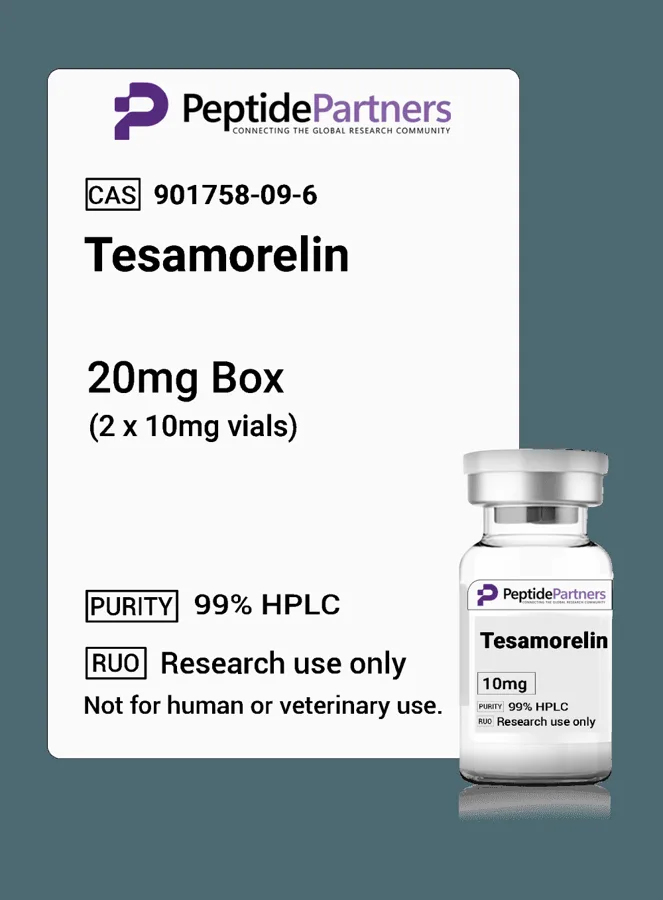
Available packs
Tesamorelin
$122 - $898
Buy Tesamorelin (10mg vials) from Peptides Partners
Investigators and institutional laboratories seeking high-integrity metabolic research peptides can buy Tesamorelin in 10mg vials directly through Peptides Partners. Cataloged under CAS number 901758-09-6, Tesamorelin is a synthetic analogue of growth hormone-releasing factor (GRF) that has become a prominent tool in the study of neuroendocrine regulation, visceral adiposity, lipid signaling, and cellular metabolism. Supplied as a stable, lyophilized white powder in sealed glass vials, this formulation is specifically intended for controlled in vitro assays, cellular culture systems, and preclinical animal research models.
When laboratories acquire research peptides from Peptides Partners, they receive reagents prepared under rigorous manufacturing parameters designed to reduce variability across experimental batches. Each 10mg vial provides an optimal quantity for analytical assay design, high-performance liquid chromatography (HPLC) characterization, ligand-receptor binding evaluations, and longitudinal metabolic investigations. Peptides Partners maintains an uncompromising commitment to supporting the life science community with strictly research-grade compounds, ensuring transparent catalog data, robust packaging standards, and dedicated logistical handling for laboratories worldwide.
What is Tesamorelin?
Tesamorelin is a 44-amino-acid synthetic peptide analogue of endogenous growth hormone-releasing hormone (GHRH). Chemically identified as [trans-3-hexenoyl]-GHRH (1-44) amide, the peptide carries the empirical molecular formula C221H366N72O67S with an approximate molecular mass of 5135.9 g/mol. The primary amino acid sequence corresponds to human GHRH(1-44), but incorporates a structural modification at the N-terminus: the covalent attachment of a trans-3-hexenoyl group.
In biological systems, native human GHRH is rapidly cleaved and deactivated by the ubiquitous brush-border enzyme dipeptidyl peptidase-4 (DPP-4), which targets the initial N-terminal dipeptide sequence (Tyr-Ala). This rapid degradation yields an extremely short half-life in physiological matrices, complicating prolonged in vitro and ex vivo analyses. The synthetic addition of the hydrophobic trans-3-hexenoyl moiety to the N-terminal tyrosine residue of Tesamorelin provides significant steric hindrance against DPP-4 cleavage. Consequently, the peptide demonstrates enhanced enzymatic resistance and prolonged biological stability relative to unmodified GHRH(1-44) while fully preserving functional affinity for the GHRH receptor (GHRH-R).
Upon binding to the GHRH-R—a class B G-protein-coupled receptor located primarily on the surface of pituitary somatotropes—Tesamorelin stimulates intracellular adenylyl cyclase activity. This initiates the generation of cyclic adenosine monophosphate (cAMP) and subsequent protein kinase A (PKA) phosphorylation cascades. In turn, these signaling cascades trigger gene transcription for growth hormone (GH) synthesis and stimulate regulated, pulsatile exocytosis of endogenous GH into extracellular media or circulation. Because Tesamorelin acts at the level of the pituitary axis, it preserves normal endogenous negative feedback mechanisms, including somatostatin-mediated inhibition, distinguishing it mechanistically from direct growth hormone administration or non-selective secretagogues.
Research effects studied
Over the past two decades, Tesamorelin has been studied in preclinical and clinical research across diverse metabolic, endocrine, and neurological models. Published academic literature highlights multiple distinct biological axes where this synthetic GHRH analogue serves as an informative molecular probe:
- Visceral Adipose Tissue (VAT) Metabolism: Investigators have extensively explored Tesamorelin in models characterized by dysregulated fat distribution and ectopic lipid accumulation. Research indicates that GHRH-mediated increases in pulsatile GH activate hormone-sensitive lipase (HSL) and downregulate lipoprotein lipase (LPL) in deep visceral depots, shifting lipid dynamics toward enhanced lipolysis without depleting peripheral subcutaneous adipose reserves.
- Hepatic Steatosis and Lipid Partitioning: Preclinical and clinical investigations have evaluated the peptide’s capacity to alter intrahepatic triglyceride (IHTG) content. By facilitating physiological levels of circulating insulin-like growth factor 1 (IGF-1) and downstream hepatic beta-oxidation, Tesamorelin has been utilized to study pathways that mitigate non-alcoholic fatty liver conditions and suppress fibrogenesis markers.
- Carbohydrate and Insulin Sensitivity Dynamics: Unlike exogenous human growth hormone administration—which frequently induces direct peripheral insulin resistance and glucose intolerance—Tesamorelin has been monitored in metabolic studies to assess how endogenous pulsatile GH release balances IGF-1 production with glucose homeostasis. Research protocols frequently monitor fasting glucose, glycosylated hemoglobin (HbA1c), and homeostatic model assessment (HOMA-IR) parameters under prolonged exposure.
- Cardiovascular and Endothelial Biomarkers: Preclinical models evaluating atherogenesis and vascular tone have assessed the systemic impact of Tesamorelin-driven IGF-1 elevation. Researchers have analyzed its downstream association with circulating inflammatory markers, including high-sensitivity C-reactive protein (hs-CRP), adiponectin, soluble intercellular adhesion molecule-1 (sICAM-1), and lipid subfractions like apolipoprotein B (ApoB).
- Cognitive Function and Neuroprotection: GHRH receptors are expressed beyond the pituitary gland, including throughout hippocampal and prefrontal cortical regions of the brain. Neurobiology researchers have investigated Tesamorelin in animal and human models of age-related cognitive decline, examining its potential to modulate gamma-aminobutyric acid (GABA) levels, reduce brain myo-inositol concentrations, and influence synaptic plasticity linked to executive function.
- Muscle Protein Synthesis and Anabolic Signaling: In wasting and metabolic disease models, Tesamorelin has served as an experimental agent to measure changes in lean soft tissue mass, nitrogen balance, and cellular signaling pathways governed by the Akt/mTOR cascade downstream of IGF-1 receptor activation.
How to use in the laboratory
Working with Tesamorelin requires standard biochemical laboratory practices tailored for sensitive peptide structures. It is supplied strictly as a research-use-only compound; it is not for human or animal application, diagnosis, or therapeutic use. Standard operating procedures (SOPs) should govern reconstitution, handling, and experimental record-keeping.
Reconstitution should always be conducted within an aseptic environment, such as an ISO Class 5 laminar flow cabinet or biosafety enclosure. Lyophilized vials must be allowed to equilibrate to room temperature (typically 20°C to 25°C) for at least 20 minutes prior to reconstitution. This step prevents condensation from forming within the interior of the vial upon unsealing, which can prematurely hydrolyze the peptide cake.
To reconstitute the 10mg vial:
- Swab the elastomeric chlorobutyl rubber stopper with a sterile 70% isopropanol wipe and allow it to air-dry completely.
- Select an appropriate, research-grade diluent based on the specific down-stream assay requirements. Typical laboratory solvents include sterile bacteriostatic water for in vitro stock preservation, sterile 0.9% sodium chloride solution for isotonic experimental conditions, or cell-culture-grade phosphate-buffered saline (PBS, pH 7.2–7.4).
- Using a sterile syringe fitted with a low-gauge needle, draw the calculated volume of diluent (e.g., 2.0 mL of solvent added to 10mg yields a working concentration of 5 mg/mL; 5.0 mL yields 2 mg/mL).
- Direct the needle tip toward the inner glass wall of the vial. Slowly introduce the diluent so that it runs down the glass surfaces, avoiding direct, forceful jetting into the lyophilized matrix.
- Allow the vial to stand undisturbed for several minutes to allow the solvent to fully hydrate the peptide.
- Gently roll or swirl the vial between the palms or on a low-speed orbital plate until completely dissolved. Do not vortex, shake vigorously, or invert aggressively, as mechanical shear stress can disrupt tertiary interactions and promote peptide aggregation or degradation.
Following full dissolution, the resulting solution should be visually inspected. It must be clear, colorless, and free of visible particulates. Researchers should immediately prepare single-use or assay-specific aliquots into sterile, low-binding polypropylene microcentrifuge tubes. This step prevents repeated freeze-thaw cycles, which are detrimental to peptide integrity. Every aliquot must be systematically labeled with the compound identifier (Tesamorelin 10mg), batch or lot number, date of reconstitution, final concentration, and the operator’s initials in accordance with Good Laboratory Practice (GLP) standards.
Pack sizes and price per mg
Peptides Partners provides tiered packaging configurations designed to accommodate both small-scale pilot assays and comprehensive, high-throughput research programs. Laboratories can buy Tesamorelin in volume to optimize their budget, benefiting from lower costs per milligram at larger procurement quantities.
| Pack Size | Total Active Compound | Price (USD) | Price per Milligram |
|---|---|---|---|
| 2 vials x 10mg | 20 mg | $122 | $6.10 / mg |
| 5 vials x 10mg | 50 mg | $287 | $5.74 / mg |
| 10 vials x 10mg | 100 mg | $514 | $5.14 / mg |
| 20 vials x 10mg | 200 mg | $898 | $4.49 / mg |
Bulk acquisition offers research teams significant efficiency gains, reducing the unit cost from $6.10 per milligram in the 2-vial package down to $4.49 per milligram when purchasing the 20-vial tier. This cost-effective structure facilitates prolonged longitudinal studies and multi-arm preclinical assays while ensuring all working vials originate from a uniform production run.
Storage and handling
Maintaining proper thermal and environmental conditions is essential for preserving the stability and biological activity of Tesamorelin throughout its experimental lifespan.
Lyophilized Powder:
- Unopened, lyophilized vials should be maintained at -20°C for short-to-intermediate storage (up to 12 months) or at -80°C for long-term archival purposes (up to 24 months).
- Keep the product shielded from direct light exposure by retaining vials inside their protective boxes or within dedicated opaque secondary storage units.
- Store vials in a moisture-controlled environment or with desiccants to mitigate the risk of hygroscopic water uptake through the vial seal over time.
Reconstituted Solution:
- Once dissolved, liquid Tesamorelin solutions should be stored at 2°C to 8°C (refrigerated) if they are to be consumed within 24 to 48 hours in ongoing protocols.
- For intermediate storage, divide the reconstituted solution into sterile, single-use aliquots and immediately freeze at -20°C or -80°C. Frozen aliquots are typically stable for 1 to 3 months, provided they are not subjected to thermal cycling.
- Avoid frost-free freezers, as their internal temperature fluctuations during automatic defrost cycles lead to micro-thawing and accelerated peptide denaturation.
- Discard any aliquot that has undergone repeated freeze-thaw cycles or shows signs of turbidity, precipitation, or discoloration.
Standard personal protective equipment (PPE)—including nitrile gloves, eye protection, and laboratory coats—must be worn at all times during the manipulation of Tesamorelin to prevent experimental contamination and maintain laboratory safety.
Quality and documentation
Analytical verification is paramount for researchers relying on synthetic peptides for reproducible data. Peptides Partners subjects every production batch of Tesamorelin to stringent quality-control protocols before release into the catalog.
Purity profiles are established via High-Performance Liquid Chromatography (HPLC), which resolves the main target peptide peak from synthesis intermediates, deletion sequences, and deamidation byproducts. Molecular mass and identity are confirmed using electrospray ionization mass spectrometry (ESI-MS) or matrix-assisted laser desorption/ionization time-of-flight (MALDI-TOF) mass spectrometry, ensuring the resulting spectral data match the theoretical molecular weight of 5135.9 g/mol within validated tolerance limits.
Furthermore, analytical screening verifies low residual solvent levels, controlled net peptide content, and batch-to-batch homogeneity. Comprehensive documentation, including lot-specific Certificates of Analysis (COA) and safety data sheets (SDS), is accessible to support institutional audits, methodology reporting, and academic publication standards.
Frequently asked questions
What is the molecular difference between native GHRH and Tesamorelin?
Native human GHRH is an endogenous 44-amino-acid peptide that undergoes rapid enzymatic inactivation by DPP-4 at its N-terminal region. Tesamorelin retains the identical 44-amino-acid chain of human GHRH(1-44) amide but features a synthetic trans-3-hexenoyl group attached to the N-terminal tyrosine. This modification creates steric hindrance that limits DPP-4 cleavage, significantly extending its structural stability in research media while retaining full agonism at the GHRH receptor.
How should reconstituted Tesamorelin be maintained to preserve peptide stability?
Following reconstitution, the peptide solution should be transferred into low-adsorption polypropylene tubes, subdivided into single-use experimental volumes, and frozen at -20°C or -80°C. Storage between 2°C and 8°C is acceptable only for short intervals (up to 48 hours). Repeated freezing and thawing must be strictly avoided, as the formation and melting of ice crystals can cause mechanical shearing and denaturation of the peptide backbone.
Which solvents are compatible for dissolving lyophilized Tesamorelin in research protocols?
Common laboratory solvents include sterile bacteriostatic water, sterile 0.9% sodium chloride (saline), and sterile cell-culture-grade phosphate-buffered saline (PBS, pH 7.2 to 7.4). The choice of diluent depends on the downstream analytical method or biological assay. For long-term aliquot storage, neutral pH buffers or sterile water are generally preferred, avoiding highly acidic or alkaline matrices that could accelerate spontaneous deamidation or oxidation.
What research domains currently focus on Tesamorelin in published scientific literature?
In contemporary academic literature, Tesamorelin is widely investigated within metabolic endocrinology, particularly concerning intrahepatic lipid accumulation, visceral adipose tissue dynamics, and pituitary-somatotrope feedback loops. Additionally, ongoing preclinical studies explore its utility in neurobiology for analyzing GHRH-mediated cognitive processing, executive brain function, and neuromuscular signaling pathways.
Related Peptides Partners research peptides
Thymosin Alpha-1 (TA1, 10mg vials); KLOW Blend: BPC-157/TB-500/GHK-Cu/KPV (80mg vials); DSIP (5mg vials).
Tesamorelin lot documentation
Certificates of analysis are matched to the actual lot supplied with your order. Email sales@peptidespartners.co with the product name and pack size to request the current lot's purity, identity and screening documents before purchase.
Storage
Research peptides are typically supplied lyophilized (freeze-dried), which keeps them stable for shipping and storage. Store unopened vials cool, dry and away from light; for long-term storage, a freezer is generally recommended.
After reconstitution, keep vials refrigerated and use sterile laboratory technique. Follow the handling guidance supplied with your lot documentation.
- Short name
- Tesamorelin (10mg vials)
- Vial strength
- 10mg vials
- Pack sizes
- 20mg pack, 50mg pack, 100mg pack, 200mg pack
- Pack count options
- 2, 5, 10, 20 vial packs
- CAS number
- 901758-09-6
- Category
- Metabolics
- SKU
- PP-2564
- Compliance
- Research Use Only. Not for use in diagnostic tests.