
Combo Vial: CJC-1295 no DAC/Ipamorelin
20mg per vial
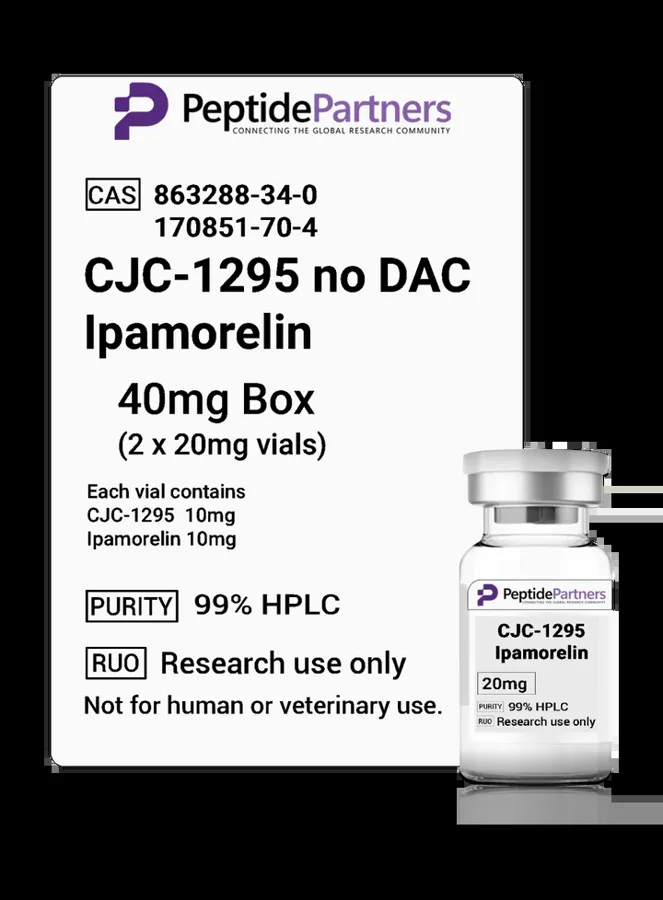
Available packs
Combo Vial: CJC-1295 no DAC/Ipamorelin
$220 - $877
Buy Combo Vial: CJC-1295 no DAC/Ipamorelin (20mg vials) from Peptides Partners
Laboratories and institutional investigators seeking high-integrity peptide preparations can buy Combo Vial: CJC-1295 no DAC/Ipamorelin directly from Peptides Partners. This high-capacity 20mg formulation combines two extensively analyzed peptides into a single lyophilized matrix designed for specialized research into secretagogue synergy, endocrine pathways, and cellular repair models. Peptides Partners serves as a dependable source for pure, analytical-grade research peptides synthesized to rigorous physical and biochemical specifications. When researchers purchase from our comprehensive catalog, they obtain carefully controlled biochemicals designed exclusively for in vitro, ex vivo, and non-clinical preclinical experimentation.
Each 20mg vial contains a co-lyophilized formulation of CJC-1295 without the Drug Affinity Complex (frequently identified in biochemical literature as Modified Growth Hormone Releasing Factor 1-29, or Mod GRF 1-29) alongside the selective growth hormone secretagogue pentapeptide Ipamorelin. Combining these two complementary agents within a standardized 20mg research format enables investigators to study dual-receptor endocrine stimulation pathways without the variability of manual reconstitution mixing. Whether your laboratory is conducting fundamental assays into downstream somatotropic signaling or exploring molecular repair kinetics across various cell lines, Peptides Partners delivers consistent batch quality, precise fill volumes, and reproducible stability across every order.
What is Combo Vial: CJC-1295 no DAC/Ipamorelin?
The Combo Vial: CJC-1295 no DAC/Ipamorelin (20mg) is an advanced research preparation integrating two distinct synthetic peptides that engage separate, complementary signaling cascades within mammalian endocrine and cellular systems. The primary component, CJC-1295 no DAC (CAS: 863288-34-0), is a 29-amino acid synthetic peptide analog of native growth hormone-releasing hormone (GHRH). It features specific amino acid substitutions at positions 2, 8, 15, and 27 relative to the native GHRH(1-29) sequence, specifically incorporating D-alanine, glutamine, alanine, and leucine. These modifications significantly improve resistance to enzymatic cleavage by dipeptidyl peptidase-4 (DPP-4) while preserving complete binding affinity for the pituitary GHRH receptor. Because this variant lacks the Drug Affinity Complex (DAC)—a maleimidopropionic acid bioconjugate that binds serum albumin—it exhibits a physiological, non-continuous clearance profile that mimics endogenous pulsatile release patterns rather than creating an artificial, sustained plateau.
The secondary component of this formulation is Ipamorelin, a synthetic pentapeptide with the sequence Aib-His-D-2-Nal-D-Phe-Lys-NH2. Classified as a growth hormone secretagogue receptor (GHS-R1a) agonist, or ghrelin mimetic, Ipamorelin possesses a unique pharmacological profile relative to earlier generation hexapeptides such as GHRP-6 and GHRP-2. Research has established that Ipamorelin binds with high selectivity to the GHS-R1a receptor, avoiding cross-reactivity with peripheral neuroendocrine receptors that regulate adrenocorticotropic hormone (ACTH), cortisol, and prolactin secretion.
Combining CJC-1295 no DAC with Ipamorelin within a unified 20mg vial provides researchers with a balanced model system to study dual-agonist biological dynamics. The GHRH receptor operates via a G-protein-coupled pathway that stimulates adenylate cyclase, elevating intracellular cyclic adenosine monophosphate (cAMP) and activating protein kinase A (PKA). Concurrently, Ipamorelin stimulates GHS-R1a, triggering the phospholipase C (PLC) cascade to generate inositol trisphosphate (IP3) and diacylglycerol (DAG), which mobilizes intracellular calcium ions (Ca2+). When examined simultaneously in cellular models, these convergent pathways generate an amplified biological response compared to single-agent stimulation, providing a versatile platform for exploring endocrine regulation and regenerative cellular mechanisms.
Research effects studied
In modern preclinical literature, the dual-secretagogue framework represented by this combo vial has been studied across a wide spectrum of physiological, biochemical, and cellular repair environments. Investigators frequently utilize these research peptides to assess how amplified somatotropic signaling impacts target tissues at the molecular level. Below are several prominent domains of ongoing investigation:
- Extracellular Matrix and Fibroblast Proliferation: Research models focusing on cellular repair and tissue restoration regularly explore how pulsatile GHRH and GHS-R1a activation modulates collagen synthesis, fibronectin deposition, and fibroblast migration. In vitro models of wound healing and tissue scaffolding utilize these secretagogues to assess gene expression changes associated with extracellular matrix turnover and tissue integrity.
- Skeletal Muscle Protein Turnover: Preclinical investigations into muscular atrophy, sarcopenia, and catabolic states employ CJC-1295 no DAC and Ipamorelin to measure rates of fractional protein synthesis. By stimulating downstream insulin-like growth factor 1 (IGF-1) cascades and initiating the mechanistic target of rapamycin (mTOR) pathway, this peptide pairing provides a controlled system for monitoring nitrogen retention and myotube hypertrophy in culture.
- Bone Density and Chondrocyte Dynamics: Ipamorelin has been explored extensively in rodent and cell-based models for its osteogenic properties. Researchers investigate osteoblast differentiation, mineralization rates, and chondrocyte metabolic activity when exposed to combined GHS-R1a and GHRH agonist environments, providing foundational data on skeletal maintenance.
- Metabolic Rate and Adipocyte Lipolysis: The somatotropic axis plays a fundamental regulatory role in lipid mobilization. In cellular and animal metabolic studies, dual secretagogue exposure has been examined for its ability to enhance lipolytic enzyme expression, modulate insulin sensitivity markers, and regulate adipokine production without disturbing steady-state glycemic baselines.
- Neuroprotective Signaling: Emerging literature examines the influence of GHS-R1a agonists and GHRH analogs on neuronal viability and neuroinflammation. Laboratory models of oxidative stress assess whether downstream signaling intermediates initiated by these peptides exert protective effects on cellular morphology, mitochondrial respiration, and apoptotic thresholds.
- Receptor Selectivity and Endocrine Specificity: Comparative pharmacology studies analyze Ipamorelin and CJC-1295 no DAC to map receptor desensitization kinetics and off-target hormone expression. Because this combination avoids inducing significant surges in cortisol or prolactin in controlled studies, it serves as an analytical reference standard for clean, selective secretagogue activity.
How to use in the laboratory
To ensure valid and reproducible experimental data, researchers must handle the Combo Vial: CJC-1295 no DAC/Ipamorelin using strict aseptic protocols, standardized analytical techniques, and meticulous record-keeping. The following laboratory procedures provide a framework for preparation, reconstituting, and experimental tracking:
Aseptic Environment and Material Preparation: Reconstitution should take place within an ISO-certified laminar flow cabinet or biosafety cabinet. Before opening materials, clean all exterior surfaces with 70% isopropanol or an equivalent laboratory disinfectant. Ensure that all analytical consumables, pipettes, and diluents are of certified molecular biology grade.
Reconstitution Protocol:
- Select an appropriate, sterile laboratory diluent such as bacteriostatic water containing 0.9% benzyl alcohol or sterile non-pyrogenic sodium chloride solution (0.9%), depending on experimental cell culture compatibility.
- Introduce the diluent slowly along the inner glass wall of the vial using a calibrated micropipette or laboratory syringe to prevent direct hydraulic disruption of the lyophilized cake.
- Allow the solvent to saturate the peptide mass completely. Gently swirl the vial horizontally between your fingers until all material has fully dissolved into a transparent solution. Avoid vigorous shaking, agitating, or vortexing, as excessive mechanical shear forces can cause peptide denaturation or aggregation.
Aliquot Strategy: Once dissolved, divide the master solution into single-use microcentrifuge tubes or cryogenic vials using low-binding polypropylene plasticware. This practice prevents the physical and chemical degradation associated with repeated freeze-thaw cycles. Label each container with the exact compound name, batch number, final concentration, reconstitution date, and handling technician’s initials.
Record-Keeping and Assay Tracking: Institutional protocols require rigorous documentation of all research peptides. Maintain a centralized chemical inventory log tracking the receipt date, storage location, volume added, target stock concentration, and volume consumed per assay. Any residual peptide solutions must be archived or discarded in compliance with local biosafety and environmental health regulations.
Pack sizes and price per mg
To support varying scales of preclinical and in vitro research, Peptides Partners offers the 20mg Combo Vial: CJC-1295 no DAC/Ipamorelin in three distinct packaging tiers. Ordering larger bundle quantities lowers the overall cost per milligram, enabling laboratories to plan extended experimentation while optimizing research budgets.
| Pack Size | Total Milligrams | Total Price (USD) | Price per Milligram |
|---|---|---|---|
| 2 vials x 20mg | 40 mg | $220 | $5.50 / mg |
| 5 vials x 20mg | 100 mg | $484 | $4.84 / mg |
| 10 vials x 20mg | 200 mg | $877 | $4.39 / mg |
Each tier is packaged in robust, sterile glass research vials equipped with hermetic aluminum crimp seals and protective flip-off caps, ensuring physical isolation and long-term chemical integrity throughout international transport and laboratory storage.
Storage and handling
Peptide stability depends heavily on environmental conditions. Both CJC-1295 no DAC and Ipamorelin contain peptide bonds susceptible to hydrolytic cleavage, thermal decomposition, and photo-oxidation if stored improperly. Adhering to the following environmental parameters will preserve the structural fidelity of the compound:
Lyophilized Product Storage: The intact, unopened lyophilized powder should be stored at temperatures of -20°C (-4°F) for standard research intervals, or at -80°C (-112°F) for long-term archiving exceeding twelve months. Store vials in a dark container protected from direct ambient light, UV radiation, and environmental moisture. Desiccant packs inside the primary storage container are recommended to prevent moisture condensation during freezer access.
Pre-Opening Equilibration: When retrieving lyophilized vials from cold storage, allow the sealed vial to reach ambient room temperature (approximately 20°C to 25°C) before puncturing or removing the stopper. Opening cold containers can introduce atmospheric moisture, which causes rapid hygroscopic aggregation of the peptide cake and promotes degradation.
Post-Reconstitution Care: Reconstituted liquid preparations must be stored under continuous refrigeration between 2°C and 8°C (36°F to 46°F) and should typically be utilized within 21 to 28 days if preserved with a bacteriostatic agent. If sterile water was used for cell culture applications, solutions should be used immediately or divided into aliquots and frozen at -20°C or colder. Do not expose liquid peptide stocks to repeated cycles of freezing and thawing, as ice crystal formation disrupts the secondary conformation of delicate peptide sequences.
Personal Safety and Chemical Hygiene: Personnel handling this product must wear standard laboratory personal protective equipment (PPE), including a laboratory coat, nitrile gloves, and safety goggles. Wash hands thoroughly following any procedure, and handle open vessels in a manner that eliminates aerosol generation or accidental inhalation.
Quality and documentation
At Peptides Partners, every catalog compound undergoes systematic analytical scrutiny to verify chemical identity, sequence structure, and batch consistency. Research peptides supplied for laboratory investigation must meet uniform parameters so that experimental observations reflect authentic biological properties rather than contamination or variable reagent concentrations.
Our analytical quality framework includes high-performance liquid chromatography (HPLC) to establish chromatographic profile and purity standards, alongside electrospray ionization mass spectrometry (ESI-MS) to confirm the exact theoretical molecular mass of both CJC-1295 no DAC and Ipamorelin. Lyophilization cycles are managed to control residual moisture content, counterion presence, and peptide solubility. Batch records, safety data sheets (SDS), and analytical certificates are maintained for institutional compliance and laboratory audit readiness, providing researchers with complete transparency over their experimental inputs.
Frequently asked questions
Why are CJC-1295 no DAC and Ipamorelin combined in a single vial for research?
Combining CJC-1295 no DAC and Ipamorelin in a single vial allows investigators to evaluate dual-pathway secretagogue synergy while eliminating manual measurement variations. In neuroendocrine research, GHRH analogs activate the GHRH receptor via cAMP/PKA pathways, while ghrelin mimetics stimulate GHS-R1a via PLC/IP3/calcium cascades. Co-formulation provides an exact, reproducible stoichiometric ratio for experimental consistency across cell culture lines and biological assays.
How does CJC-1295 without DAC differ from CJC-1295 with DAC?
The primary difference lies in the absence of the Drug Affinity Complex (DAC), a maleimide-derived reactive linker that binds covalently to circulating serum albumin to extend plasma half-life. CJC-1295 without DAC (Mod GRF 1-29) does not bind to albumin and retains a significantly shorter, physiological clearance profile. This allows investigators to model pulsatile endocrine stimulation rather than sustained, continuous receptor occupancy.
What reconstitution solvents are typically utilized for this peptide blend?
Laboratories typically reconstitute this co-lyophilized formulation using sterile bacteriostatic water (containing 0.9% benzyl alcohol) for multi-draw laboratory testing, or sterile 0.9% sodium chloride injection solution. For in vitro cell culture systems where benzyl alcohol may induce cytotoxicity, sterile endotoxin-free water for injection or tissue-culture-grade buffered saline is commonly selected.
What analytical techniques confirm the stability and identity of this combo vial?
Analytical verification is achieved through reverse-phase high-performance liquid chromatography (RP-HPLC) coupled with mass spectrometry (MS). RP-HPLC confirms the chromatographic separation, retention times, and relative purity of each component within the dual matrix, while mass spectrometry confirms the distinct molecular weights of CJC-1295 no DAC and Ipamorelin against theoretical models.
Related Peptides Partners research peptides
DSIP (5mg vials); Glutathione (1500mg vials); Pinealon (20mg vials).
Combo Vial: CJC-1295 no DAC/Ipamorelin lot documentation
Certificates of analysis are matched to the actual lot supplied with your order. Email sales@peptidespartners.co with the product name and pack size to request the current lot's purity, identity and screening documents before purchase.
Storage
Research peptides are typically supplied lyophilized (freeze-dried), which keeps them stable for shipping and storage. Store unopened vials cool, dry and away from light; for long-term storage, a freezer is generally recommended.
After reconstitution, keep vials refrigerated and use sterile laboratory technique. Follow the handling guidance supplied with your lot documentation.
- Short name
- Combo Vial: CJC-1295 no DAC/Ipamorelin (20mg vials)
- Vial strength
- 20mg vials
- Pack sizes
- 40mg pack, 100mg pack, 200mg pack
- Pack count options
- 2, 5, 10 vial packs
- CAS number
- 863288-34-0
- Category
- Cellular repair
- SKU
- PP-873
- Compliance
- Research Use Only. Not for use in diagnostic tests.