
Pinealon
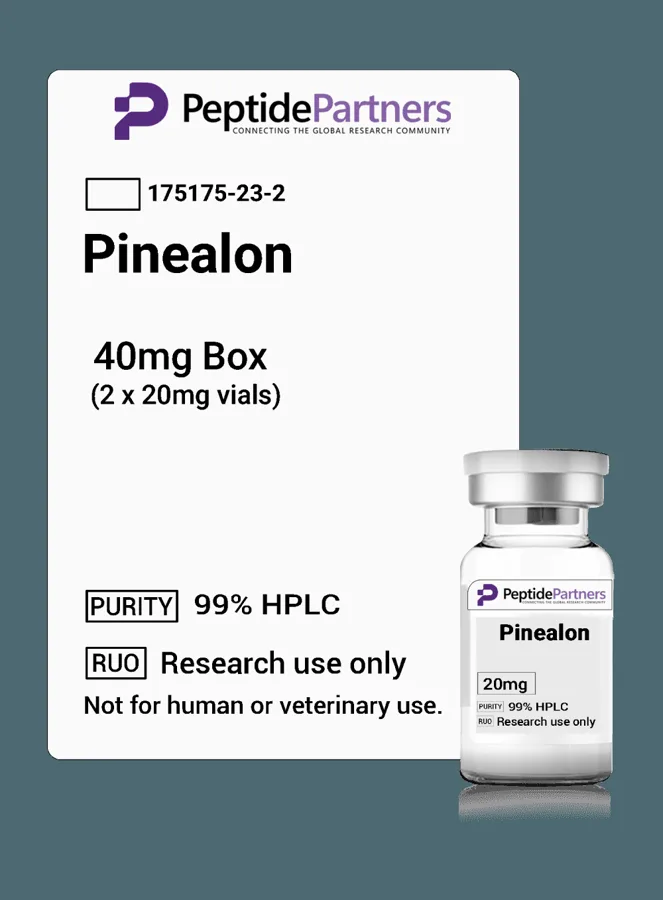
20mg per vial
Available packs
Pinealon
$100 - $340
Buy Pinealon (20mg vials) from Peptides Partners
Peptides Partners provides analytical-grade Pinealon (20mg vials) formulated specifically for qualified scientific laboratories, academic institutions, and corporate research departments. Categorized under our mitochondrial and cellular physiology catalog, Pinealon is a synthetic tripeptide investigated extensively for its regulatory potential in cellular bioenergetics, oxidative balance, and epigenetic transcription. When researchers seek to buy Pinealon for controlled in vitro or preclinical animal investigations, finding consistently characterized, highly stable reagents is fundamental to securing reproducible scientific data. Peptides Partners meets this requirement by supplying research peptides manufactured to strict synthesis specifications, ensuring that academic and biotechnology labs receive compounds with verified chemical identity, accurate molecular weights, and minimal residual impurities.
Every vial of Pinealon distributed by Peptides Partners contains 20mg of lyophilized tripeptide, synthesized using standardized solid-phase peptide synthesis (SPPS) protocols. Our catalog exists solely to support foundational science, ranging from cell culture assays observing mitochondrial respiratory dynamics to molecular biology studies examining transcriptional networks in neural tissue cultures. Research peptides supplied through our platform are explicitly prepared for research use only (RUO) and must never be employed in clinical, diagnostic, veterinary, or human therapeutic contexts. By establishing rigorous batch traceability and transparent technical data, Peptides Partners empowers investigators to conduct critical baseline, comparative, and downstream molecular evaluations with total confidence in their peptide source material.
What is Pinealon?
Pinealon is a synthetic, short-chain peptide bioregulator comprised of three amino acid residues: L-glutamic acid, L-aspartic acid, and L-arginine. It is commonly designated by its standard amino acid sequence Glu-Asp-Arg (EDR) or its single-letter code E-D-R. With the chemical formula C15H26N6O8 and a molecular mass of approximately 418.4 g/mol, Pinealon carries the Chemical Abstracts Service registry number (CAS) 175175-23-2. Structurally, the tripeptide is defined by two acidic amino acid residues (glutamate and aspartate) adjacent to a basic, positively charged guanidino-containing residue (arginine), creating a net charge profile and spatial conformation that facilitates targeted molecular interactions within biological research environments.
Originally derived from the broader framework of peptide bioregulator research pioneered in Eastern European physiological studies, Pinealon was conceptualized through structural analysis of low-molecular-weight peptide extracts obtained from pineal and cerebral cortical tissues. Researchers discovered that ultra-short peptide sequences could traverse cell membranes via endocytic or carrier-mediated pathways and directly enter the cellular nucleus. Once inside, short peptides such as Glu-Asp-Arg have been observed interacting directly with DNA strands and histone architecture, modifying gene expression profiles without altering the underlying genetic sequence. Because of its distinctive biochemical structure and its documented capacity to interact with pathways governing cellular respiration, Pinealon is classified within the mitochondrial category of biochemical reagents, offering an accessible model for investigating organelle-specific protection, metabolic regulation, and cellular longevity.
Research effects studied
In peer-reviewed preclinical literature, Pinealon has been studied across a variety of scientific models focusing on mitochondrial biology, neuroprotection, signal transduction, and cellular stress adaptation. A primary avenue of research involves its influence on mitochondrial respiratory parameters. Experimental investigations utilizing cultured neuronal and endothelial cell lines have reported that exposure to the EDR tripeptide correlates with preserved mitochondrial membrane potential (ΔΨm) during chemically induced oxidative stress or glucose-oxygen deprivation. In vitro assays demonstrate that Pinealon exposure reduces the excessive generation of mitochondrial reactive oxygen species (mROS), thereby limiting downstream oxidative lesions to mitochondrial DNA, lipid membranes, and respiratory chain protein complexes.
Furthermore, published studies have evaluated Pinealon for its role in regulating apoptotic pathways. Cellular models challenged with pro-apoptotic stimuli, such as hydrogen peroxide or excitotoxic concentrations of glutamate, have shown shifts in key apoptotic biomarkers when pretreated with Glu-Asp-Arg. Specifically, researchers have observed a downregulation in cleaved caspase-3 activity and an altered ratio of Bax to Bcl-2 proteins, favoring cellular preservation and structural membrane stabilization. These findings suggest that the tripeptide participates in mitochondrial-mediated survival cascades, making it a valuable target for research into degenerative models where programmed cell death is accelerated by metabolic failure.
Epigenetic and transcriptional modulation represents another significant domain of Pinealon research. Using fluorescence spectroscopy and molecular docking simulations, investigators have explored how EDR binds to the major and minor grooves of double-stranded DNA. Preclinical data indicate that this binding can modulate the expression of genes involved in endogenous antioxidant defense, notably superoxide dismutase (SOD1, SOD2) and catalase. In animal models of accelerated aging and environmental hypoxia, administration of Pinealon in controlled experimental protocols has been associated with improved cognitive task performance, preservation of synaptic density markers, and reduced biomarkers of lipid peroxidation in brain homogenates. In cardiovascular and endothelial cell studies, researchers have additionally observed modulation of endothelial nitric oxide synthase (eNOS) expression, prompting investigations into how the peptide might influence microvascular perfusion and oxygen delivery under ischemic challenge.
How to use in the laboratory
Experimental protocols involving Pinealon require consistent benchtop techniques to ensure structural preservation, concentration accuracy, and experimental reproducibility. Pinealon (20mg vials) is supplied as a lyophilized white to off-white cake. Reconstitution should be planned strictly according to the design of the in vitro or in vivo model and performed within an appropriate biosafety cabinet or laminar flow hood to eliminate the risk of microbial contamination.
- Solvent Selection: Because of its polar and charged amino acid side chains, Pinealon demonstrates high solubility in aqueous solutions. Common research diluents include sterile bacteriostatic water, sterile deionized water, or sterile phosphate-buffered saline (PBS, pH 7.2 to 7.4). For assays requiring defined chemical media, serum-free basal medium may also serve as a direct solvent.
- Reconstitution Mechanics: Allow the sealed vial to equilibrate to ambient room temperature before introducing solvent to minimize condensation. Introduce the chosen diluent down the internal glass wall of the vial using a sterile laboratory pipette or syringe rather than ejecting it directly onto the lyophilized cake. Swirl the vial gently with a slow rotational motion until complete dissolution is attained. Avoid vigorous vortexing or rapid shaking, as mechanical shearing can disrupt peptide bonds or cause excessive foaming.
- Aliquoting: Once the peptide is fully solubilized to the target stock concentration (e.g., 2 mg/mL, 5 mg/mL, or 10 mg/mL), divide the stock solution into single-use, sterile polypropylene microcentrifuge tubes. Aliquoting prevents the degradation associated with repeated freeze-thaw cycles, which can hydrolyze peptide linkages and compromise biological activity.
- Laboratory Record-Keeping: Implement detailed laboratory logs indicating the date of reconstitution, solvent used, final concentration, calculated volume, and unique lot number. Affix clear, solvent-resistant labels to all primary stock and working-solution containers. Researchers must track dilution calculations rigorously to verify that in vitro media concentrations remain within intended micromolar or nanomolar research parameters.
Pack sizes and price per mg
To support scientific projects of varying scope, Peptides Partners provides tiered packaging for Pinealon (20mg vials). Purchasing multi-vial packs offers substantial cost efficiencies, reducing the baseline cost per milligram for laboratories executing high-throughput screening or multi-cohort longitudinal studies. The available configurations and their corresponding pricing metrics are detailed in the table below:
| Pack Configuration | Total Content (mg) | Total Price (USD) | Price per Milligram (USD/mg) |
|---|---|---|---|
| 2 vials x 20mg | 40 mg | $100.00 | $2.50 / mg |
| 5 vials x 20mg | 100 mg | $225.00 | $2.25 / mg |
| 10 vials x 20mg | 200 mg | $340.00 | $1.70 / mg |
Investigators managing extensive research designs can leverage the 10-vial tier to reduce expense down to $1.70 per milligram, facilitating long-term budgetary predictability across experimental replicates and controlled control-group matrices.
Storage and handling
Maintaining the structural stability of synthetic peptides requires strict adherence to temperature and environmental controls throughout their lifecycle in the research facility. Lyophilized Pinealon possesses higher thermal stability than solubilized variants, but environmental stressors such as elevated temperatures, humidity, and direct ultraviolet light will accelerate degradation via deamidation, oxidation, and hydrolysis.
Upon receipt from Peptides Partners, store intact vials in a dedicated laboratory freezer maintained at -20°C for standard short-to-medium-term storage (up to 12 months). For extended multi-year preservation, storage at -80°C is recommended. The lyophilized peptide should remain sealed in its original amber or clear glass vial with an intact rubber stopper and crimp seal, stored alongside a desiccant pack to limit moisture ingress.
Following reconstitution, peptide degradation dynamics increase significantly. Liquid working aliquots should be preserved at -20°C or -80°C and utilized within 30 to 90 days, depending on solvent selection and environmental sterility. If stored short-term at 2°C to 8°C, reconstituted Pinealon should be consumed within 5 to 7 days. Always thaw aliquots on ice immediately prior to experimental application, and discard any residual volume rather than returning it to deep freeze. All laboratory waste, spent vials, and disposable plasticware coming into contact with the reagent must be handled and disposed of in accordance with regional institutional biosafety and chemical hygiene regulations.
Quality and documentation
Integrity in scientific research depends entirely on the analytical reliability of the primary chemical reagents. Peptides Partners subjects every production batch of Pinealon to thorough analytical verification to ensure identity confirmation and quantitative precision. The core chemical parameters assessed include sequence fidelity, molecular weight verification, and residual organic solvent analysis.
Analytical verification is routinely executed utilizing High-Performance Liquid Chromatography (HPLC) to establish chromatographic profile consistency, coupled with Liquid Chromatography-Mass Spectrometry (LC-MS) or Matrix-Assisted Laser Desorption/Ionization Time-of-Flight (MALDI-TOF) mass spectrometry to confirm exact molecular mass corresponding to the theoretical target of 418.4 g/mol for Glu-Asp-Arg. In addition, physical stability inspections confirm uniform lyophilization, ensuring clean dissolution profiles during downstream laboratory reconstitution. Material Safety Data Sheets (MSDS/SDS) and analytical batch records are maintained to assist laboratory compliance managers in updating their internal chemical inventories and satisfying institutional oversight protocols.
Frequently asked questions
What is the molecular composition and sequence of Pinealon?
Pinealon is a synthetic tripeptide comprised of three L-amino acids arranged in the sequence L-glutamic acid, L-aspartic acid, and L-arginine (Glu-Asp-Arg or EDR). It has a calculated molecular formula of C15H26N6O8, a molecular weight of approximately 418.4 g/mol, and is cataloged under CAS number 175175-23-2. The presence of two carboxylic side chains alongside a basic guanidino group gives the molecule distinct electrochemical properties suited for cellular signaling studies.
Why is Pinealon evaluated in mitochondrial research models?
Researchers utilize Pinealon in mitochondrial investigations because published preclinical data suggest the tripeptide participates in the regulation of mitochondrial membrane potential, reduction of reactive oxygen species (ROS) formation, and preservation of respiratory chain activity under hypoxic or oxidative stress conditions. It serves as an experimental model for examining how ultra-short regulatory peptides modulate cellular survival and organelle-specific stress responses.
What solvents are typically used to reconstitute Pinealon in the laboratory?
Due to its hydrophilic amino acid composition, Pinealon dissolves readily in standard laboratory aqueous diluents. Commonly employed solvents include sterile deionized water, bacteriostatic water containing 0.9% benzyl alcohol, and sterile phosphate-buffered saline (PBS, pH 7.2 to 7.4). Solvents should be selected based on the specific compatibility requirements of the planned cellular assays or downstream analytical equipment.
Can Pinealon be used for clinical, therapeutic, or diagnostic purposes?
No. Pinealon supplied by Peptides Partners is strictly designated for laboratory research use only (RUO). It is not licensed, approved, or formulated for human consumption, clinical application, diagnostic procedures, or veterinary administration. All research peptides must be handled exclusively by qualified personnel within controlled laboratory facilities adhering to institutional chemical safety guidelines.
Related Peptides Partners research peptides
PP Water (10mL vials); TB-500 (TB4, 10mg vials); 5-Amino-1MQ (50mg vials).
Pinealon lot documentation
Certificates of analysis are matched to the actual lot supplied with your order. Email sales@peptidespartners.co with the product name and pack size to request the current lot's purity, identity and screening documents before purchase.
Storage
Research peptides are typically supplied lyophilized (freeze-dried), which keeps them stable for shipping and storage. Store unopened vials cool, dry and away from light; for long-term storage, a freezer is generally recommended.
After reconstitution, keep vials refrigerated and use sterile laboratory technique. Follow the handling guidance supplied with your lot documentation.
- Short name
- Pinealon (20mg vials)
- Vial strength
- 20mg vials
- Pack sizes
- 40mg pack, 100mg pack, 200mg pack
- Pack count options
- 2, 5, 10 vial packs
- CAS number
- 175175-23-2
- Category
- Mitochondrial
- SKU
- PP-17546
- Compliance
- Research Use Only. Not for use in diagnostic tests.