
PP Water
10mL per vial
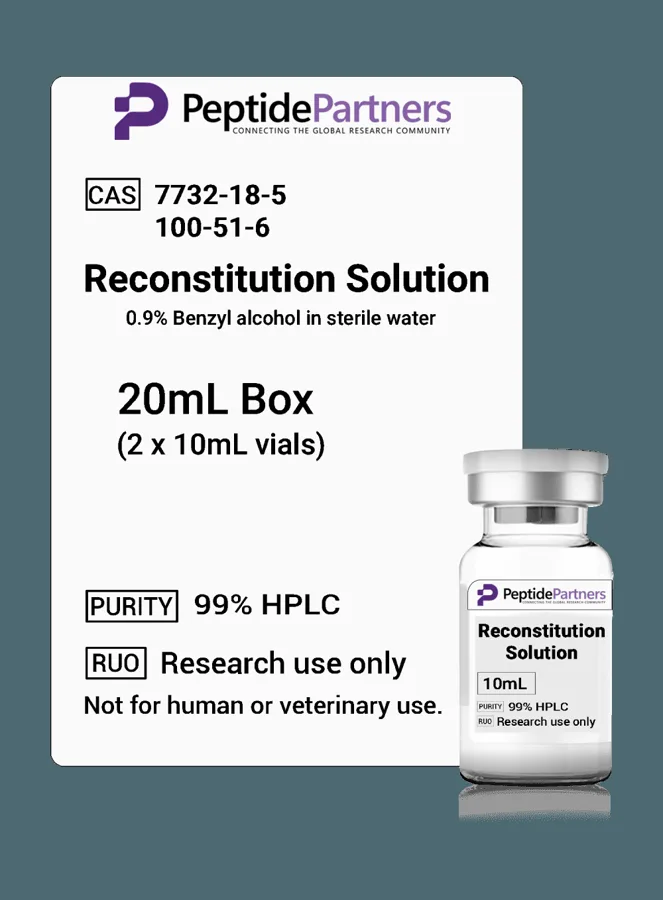
Available packs
PP Water
$29 - $115
Buy PP Water (10mL vials) from Peptides Partners
Peptides Partners provides premium reconstitution solutions engineered specifically to support rigorous in vitro, analytical, and cellular research environments. When working with delicate synthetic compounds, the choice of solvent is just as critical as the quality of the peptide sequence itself. Researchers who buy PP Water secure a dedicated, high-grade reconstitution vehicle designed to minimize baseline experimental variables and protect peptide integrity from the moment of solubilization.
Lyophilized research peptides arrive in an unhydrated, stable solid state that requires precise liquid reconstitution before they can be introduced into assays, cell culture environments, or spectroscopic workflows. Using uncontrolled, non-standardized water sources can introduce heavy metals, organic contaminants, ionic variations, or endotoxins that inadvertently compromise peptide folding, accelerate cleavage, or interfere with quantitative measurements. PP Water (10mL vials) from Peptides Partners provides the scientific community with an ultra-pure, standardized solvent profile that ensures reproducible experimental outcomes across all research disciplines.
Every vial is produced to meet the uncompromising demands of contemporary scientific laboratories. Packaged in inert borosilicate glass with airtight elastomer stoppers, PP Water preserves pure aqueous conditions until the exact moment of experimental deployment. Whether your laboratory investigates receptor-ligand kinetics, mass spectrometry structural elucidation, or proteolytic stability assays, acquiring research-grade diluents from Peptides Partners safeguards your research peptides against solvent-induced anomalies.
What is PP Water?
PP Water is a highly purified, sterile, and pyrogen-controlled aqueous medium identified by CAS number 7732-18-5. Chemically represented as dihydrogen monoxide (H2O), it serves as the foundational universal solvent in biological chemistry. Within specialized biochemical research, however, generic water is inadequate; PP Water undergoes multi-stage deionization, reverse osmosis, ultrafiltration, and thermal sterilization to remove dissolved minerals, particulate matter, volatile organic carbon, and microbial pyrogens.
The molecular configuration of water features a bent geometry with a bond angle of approximately 104.5 degrees, generating a permanent electrical dipole. This distinct dipolar architecture gives PP Water a high dielectric constant, enabling it to break solute-solute electrostatic interactions and form robust hydration shells around polar, hydrophilic, and charged amino acid side chains. For research peptides, which frequently feature diverse arrangements of cationic, anionic, and neutral residues, this solvation capacity is critical for facilitating an orderly transition from a lyophilized solid cake to a homogenous solution.
Unlike standard laboratory distilled water, PP Water is prepared under controlled cleanroom conditions to ensure near-zero electrical conductivity and negligible levels of trace divalent cations such as magnesium and calcium. The absence of these trace ions prevents unintended ion-complexation or premature peptide aggregation, ensuring that the biological characteristics observed during experimentation reflect solely the peptide under investigation.
Research effects studied
Scientific literature consistently highlights that the choice and quality of the aqueous solvent directly impact the chemical and physical stability of synthetic peptides during laboratory analysis. Preclinical investigations into peptide stability, conformational preservation, and analytical accuracy have focused extensively on the physical dynamics of purified water as a primary solvent.
- Secondary Structure Preservation: Far-ultraviolet circular dichroism (far-UV CD) spectroscopy studies demonstrate that ultra-pure aqueous media free of disruptive background ions permit peptides to adopt their native or intended secondary structures, including alpha-helices, beta-sheets, and random coils, without non-specific structural collapse.
- Endotoxin-Sensitive Cellular Assays: In vitro immunological and cell-signaling experiments have shown that diluents harboring minute endotoxin residues can independently trigger Toll-like receptor (TLR) pathways in cell lines. Utilizing pyrogen-depleted water eliminates these false-positive cellular activation cascades, isolating the genuine biological activity of research peptides.
- Prevention of Trace-Metal Catalyzed Cleavage: Preclinical analytical research indicates that trace transitions metals (such as iron or copper) commonly found in sub-standard water can catalyze oxidative cleavage and methionine oxidation in synthetic peptides. Studies confirming the removal of such trace elements show marked reductions in chemical degradation over post-reconstitution monitoring periods.
- Minimization of Chromatographic Ghost Peaks: Analytical chemists frequently observe spurious background signals during high-performance liquid chromatography (HPLC) and liquid chromatography-mass spectrometry (LC-MS) when solvent purity is compromised. Research confirms that purified, low-TOC (Total Organic Carbon) water ensures clean baseline profiles and unambiguous mass identification.
- Hydrodynamic Radius and Aggregation Kinetics: Dynamic light scattering (DLS) studies have evaluated peptide self-assembly kinetics across various media. Purified neutral aqueous diluents provide a baseline reference point to study how peptide concentration, ionic strength adjustments, and temperature influence monomer-to-oligomer transitions.
How to use in the laboratory
Proper reconstitution and handling protocols ensure that the structural integrity of both the diluent and the research peptides is maintained throughout the analytical workflow. Reconstitution should always take place under aseptic conditions within an active laminar flow hood or biosafety cabinet.
- Thermal Equilibration: Before piercing the septum, allow both the vial of PP Water and the vial containing the lyophilized peptide to equilibrate to room temperature (typically 20°C to 25°C). Introducing cold diluent to a warm lyophilized cake can induce rapid precipitation or alter thermodynamic dissolution behavior.
- Septum Decontamination: Disinfect the rubber stoppers of both vials using a sterile 70% isopropanol wipe. Allow the alcohol to air-dry completely to prevent solvent contamination by trace isopropanol.
- Aspiration: Using a calibrated laboratory syringe equipped with a sterile, fine-gauge needle, draw the exact pre-calculated volume of PP Water necessary to achieve your target stock concentration (e.g., 1.0 mg/mL, 2.0 mg/mL).
- Controlled Dispensation: Insert the needle into the peptide vial at an angle, directing the tip toward the inside glass wall rather than directly onto the lyophilized powder. Depress the plunger slowly, allowing the water to cascade down the glass. This minimizes turbulence and prevents foaming, which can denature sensitive tertiary peptide assemblies.
- Dissolution Technique: Once the water has been fully transferred, gently swirl the vial using slow, circular motions. Do not shake vigorously or vortex the mixture, as shear forces can disrupt fragile secondary structures and introduce air bubbles that interfere with volume measurements.
- Record-Keeping: Immediately document the procedure in the laboratory information management system (LIMS) or research notebook. Log the date of reconstitution, solvent lot number, target concentration, reconstituted volume, technician identifiers, and assigned storage conditions.
Pack sizes and price per mg
To accommodate varied research schedules, throughput requirements, and budget constraints, Peptides Partners supplies PP Water (10mL vials) in multiple pack tiers. Because PP Water is a high-volume liquid reagent (10mL per vial, corresponding to approximately 10,000 mg of purified H2O per vial at standard laboratory conditions), purchasing in multi-vial configurations significantly lowers the unit expenditure for long-term experimental programs.
| Pack Configuration | Total Reagent Volume | Nominal Mass Equivalent (H2O) | Total Price (USD) | Effective Price per mL | Effective Price per mg Equivalent |
|---|---|---|---|---|---|
| 2 vials x 10mL | 20 mL | 20,000 mg | $29.00 | $1.45 / mL | $0.00145 / mg |
| 5 vials x 10mL | 50 mL | 50,000 mg | $65.00 | $1.30 / mL | $0.00130 / mg |
| 10 vials x 10mL | 100 mL | 100,000 mg | $115.00 | $1.15 / mL | $0.00115 / mg |
When you buy PP Water in larger pack formats, your facility gains the advantage of batch-consistent reconstitution medium across extensive multi-plate assays, longitudinal stability evaluations, and parallel in vitro screening runs while maximizing departmental budgetary allocations.
Storage and handling
To preserve chemical purity and prevent environmental contamination, PP Water must be stored according to rigorous laboratory standards. Unopened vials should be maintained in a clean, dry, climate-controlled environment at temperatures between 15°C and 25°C (room temperature) or refrigerated between 2°C and 8°C. Protect the vials from prolonged exposure to direct sunlight, ultraviolet (UV) radiation sources, and high-intensity artificial light, which can promote photochemical degradation or microscopic leaching from glass surfaces over extended timeframes.
Vials feature a secure, tamper-evident crimp seal with an elastomer septum designed for clean needle penetration. Each vial should be visually inspected prior to use; the liquid must be entirely clear, colorless, and free of visible particulates or phase separation. Do not use vials if the seal has been compromised or if internal haziness is observed.
Because PP Water contains no antimicrobial preservatives, bacteriostatic agents, or additives, it is strongly recommended that any single vial be utilized immediately upon opening for single-session reconstitutions or aliquoted into sterile single-use microcentrifuge tubes under aseptic conditions. Once the septum is pierced repeatedly without a sterile laminar environment, the risk of ambient bioburden introduction increases significantly. Dispose of any residual, unsealed water in accordance with standard institutional hazardous waste and biosafety protocols.
Quality and documentation
Peptides Partners is committed to upholding rigorous analytical standards for all research peptides, diluents, and laboratory supplies. PP Water is manufactured under strict quality-control protocols to guarantee batch-to-batch homogeneity, low conductivity, and negligible endotoxin levels.
Each production lot undergoes thorough verification testing, including:
- Conductivity Analysis: Validated via precision inline conductivity sensors to confirm total ionic depletion in accordance with high-purity laboratory water benchmarks.
- Total Organic Carbon (TOC) Monitoring: Ensures minimal volatile and non-volatile organic content, preventing baseline interference in spectroscopic and chromatographic detection systems.
- Endotoxin Screening: Evaluated using the Limulus Amebocyte Lysate (LAL) assay to confirm that pyrogen levels remain well below background thresholds for cellular and receptor-binding research.
- Sterility Verification: Confirmed via rigorous incubation protocols to ensure the absolute absence of viable bacterial, fungal, or spore-forming contaminants.
Comprehensive lot-specific documentation is retained for complete traceability. Investigators relying on PP Water can easily trace manufacturing metadata, sterilization cycles, and physical quality releases, ensuring full compliance with institutional audit criteria and experimental peer-review standards.
Frequently asked questions
Why is specialized water necessary for reconstituting research peptides instead of standard sterile saline?
Standard sterile saline contains 0.9% sodium chloride, which introduces high concentrations of sodium and chloride ions into the peptide microenvironment. For many synthetic research peptides, high ionic strength can trigger immediate salting-out effects, alter net charge distributions, induce unintended precipitation, or interfere with downstream analytical procedures such as mass spectrometry and circular dichroism. PP Water provides a neutral, ion-free aqueous baseline that dissolves the peptide purely through dipole interactions, allowing the researcher complete control over subsequent buffer conditions, pH adjustments, and ionic strength additions tailored to the specific experimental protocol.
What is the chemical profile and CAS designation of PP Water?
PP Water is chemically pure dihydrogen monoxide, cataloged under CAS number 7732-18-5. It is manufactured without preservatives, antimicrobial additives, buffers, or stabilizing agents. Its physical profile features neutral pH characteristics (subject to atmospheric CO2 equilibration upon exposure), near-zero electrical conductivity, low total organic carbon (TOC), and negligible pyrogen content, making it an unadulterated baseline diluent designed exclusively for laboratory research applications.
How should reconstituted research peptides be stored once PP Water has been introduced?
Once a peptide has been reconstituted with PP Water, its shelf-life profile shifts from the highly stable solid state to a dynamic liquid state that is more susceptible to peptide bond hydrolysis, aggregation, and oxidation. Reconstituted peptide stock solutions should typically be aliquoted into sterile, low-binding microcentrifuge tubes to prevent adsorption to container surfaces. These aliquots should be immediately stored at -20°C or -80°C to minimize degradation pathways. Freeze-thaw cycles must be strictly avoided, as the formation and melting of ice crystals can subject peptide secondary and tertiary structures to mechanical shear stress.
Can PP Water be frozen and thawed repeatedly prior to opening?
Unopened vials of PP Water should not be subjected to repeated freeze-thaw cycles. Freezing aqueous solutions in glass vials causes volumetric expansion, which can compromise the integrity of the elastomer septum, induce microscopic hairline fractures in the borosilicate glass, or create pressure imbalances that compromise sterility. Unopened vials are best stored at controlled room temperature (15°C to 25°C) or under standard refrigeration (2°C to 8°C). If aliquots of pure PP Water are frozen independently in rated polymer cryo-vials, they can remain stable, but maintaining the factory glass vial in its liquid state preserves seal integrity and physical reliability.
Related Peptides Partners research peptides
PT-141 (10mg vials); Tesamorelin (10mg vials); AOD-9604 (10mg vials).
PP Water lot documentation
Certificates of analysis are matched to the actual lot supplied with your order. Email sales@peptidespartners.co with the product name and pack size to request the current lot's purity, identity and screening documents before purchase.
Storage
Research peptides are typically supplied lyophilized (freeze-dried), which keeps them stable for shipping and storage. Store unopened vials cool, dry and away from light; for long-term storage, a freezer is generally recommended.
After reconstitution, keep vials refrigerated and use sterile laboratory technique. Follow the handling guidance supplied with your lot documentation.
- Short name
- PP Water (10mL vials)
- Vial strength
- 10mL vials
- Pack sizes
- 20mL pack, 50mL pack, 100mL pack
- Pack count options
- 2, 5, 10 vial packs
- CAS number
- 7732-18-5
- Category
- Reconstitution
- SKU
- PP-2388
- Compliance
- Research Use Only. Not for use in diagnostic tests.