
AOD-9604
10mg per vial
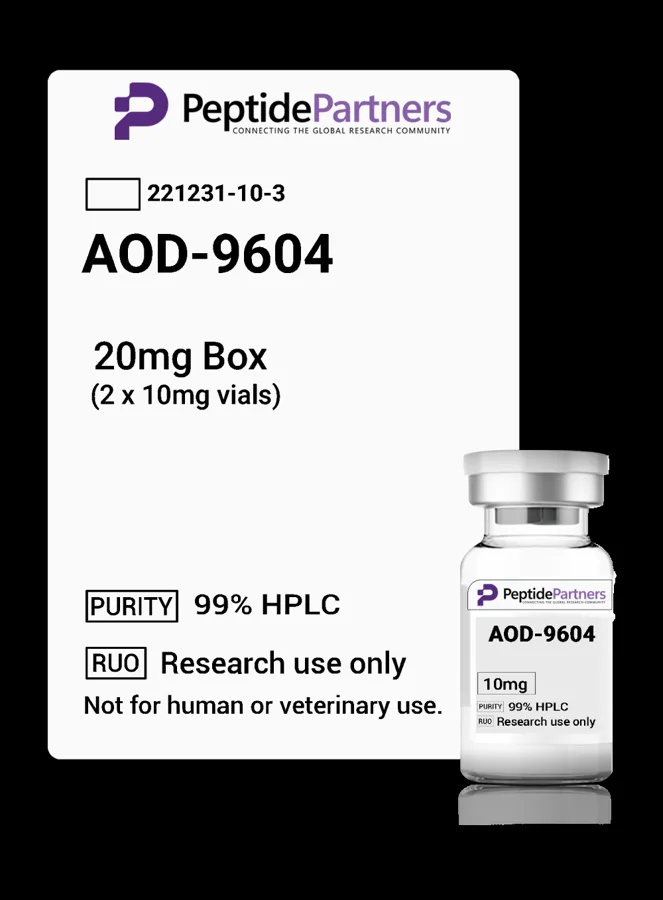
Available packs
AOD-9604
$134 - $520
Buy AOD-9604 (10mg vials) from Peptides Partners
When biomedical researchers and academic institutions prepare to investigate lipid metabolism, cellular bioenergetics, or connective tissue regeneration, sourcing high-integrity reagents is fundamental to securing reproducible results. At Peptides Partners, we provide synthesized AOD-9604 in robust, lyophilized 10mg vials designed specifically for controlled in vitro, ex vivo, and non-clinical in vivo laboratory experimentation. Every batch of our research peptides undergoes stringent synthesis protocols and thorough analytical evaluation to ensure consistent physicochemical performance across experimental runs.
Laboratories seeking to buy AOD-9604 can access multiple volume tiers tailored to the scale of their studies, ranging from initial exploratory assays to high-throughput screening projects. Each sterile glass vial contains a solid, vacuum-sealed lyophilized cake of AOD-9604 (10mg), free of uncharacterized fillers or microbial contaminants. By procuring these reagents from Peptides Partners, investigative teams ensure that experimental parameters remain unclouded by synthesis-related variances, secondary peptide truncations, or unstable counterions.
All compounds provided by Peptides Partners are restricted strictly to laboratory research and scientific evaluation. They are not intended for human consumption, clinical application, veterinary therapy, agricultural use, or any form of domestic administration. Maintaining an uncompromising laboratory-only standard allows researchers to conduct foundational biochemical inquiries with full regulatory and procedural confidence.
What is AOD-9604?
AOD-9604 (CAS Number: 221231-10-3) is a synthetic, hexadecapeptide analog derived from the C-terminal domain of human growth hormone (hGH). Specifically, it encompasses residues 177 through 191 of the native 191-amino-acid somatotropin sequence, modified via the addition of a tyrosine residue at the amino-terminus. Its sequence is typically represented as Tyr-Leu-Arg-Ile-Val-Gln-Cys-Arg-Ser-Val-Glu-Gly-Ser-Cys-Gly-Phe. The structure features an intramolecular disulfide bridge formed between the cysteine residues at positions 7 and 14 (corresponding to Cys182 and Cys189 of the full-length human somatotropin molecule). This internal cyclic bond is critical for stabilizing the tertiary conformation of the peptide fragment, enhancing its resistance to proteolytic degradation relative to linear derivatives.
With an approximate molecular formula of C78H123N23O23S2 and an average molecular weight of approximately 1815.1 g/mol, AOD-9604 was initially designed to isolate the lipolytic domain of somatotropin from its mitogenic and growth-stimulating domains. Intact growth hormone interacts simultaneously with growth hormone receptors across multiple organ systems, triggering downstream cascades including the systemic elevation of insulin-like growth factor 1 (IGF-1) via the hepatic JAK2/STAT5 pathway, as well as inducing profound alterations in glucose handling. Early molecular dissection studies established that the biological actions of somatotropin could be functionally partitioned: while the amino-terminal and core segments participate primarily in somatotropic, chondrocytic, and proliferative pathways, the carboxyl-terminal extremity appears to modulate adipocyte lipid turnover.
Within laboratory catalogs and biological databases, AOD-9604 is often indexed alongside compounds influencing cellular bioenergetics and metabolic pathways, including mitochondrial function. Its classification within metabolic and mitochondrial research contexts stems from its capacity to influence intracellular lipid oxidation pathways and substrate availability within metabolically active tissue cultures, without stimulating the systemic endocrine cascades linked to intact hGH.
Research effects studied
Over several decades of preclinical investigation, AOD-9604 has served as a primary molecular tool for interrogating lipid processing, adipocyte signaling, and cartilage extracellular matrix dynamics. The primary avenues of inquiry documented in scientific literature include:
- Lipolysis Induction and Lipogenesis Inhibition: In rodent and cell-line models, AOD-9604 has been studied extensively for its ability to stimulate the breakdown of stored triacylglycerols within mature adipocytes (lipolysis) while simultaneously suppressing the de novo incorporation of free fatty acids into intracellular lipid droplets (lipogenesis). Unlike non-selective receptor modulators, this fragment appears to operate without downregulating or competitively desensitizing insulin receptors.
- Beta-3 Adrenergic Receptor Cross-Talk and Pathway Modulation: Research groups have examined whether AOD-9604 influences the transcription or cell-surface expression of beta-3 adrenergic receptors (Beta-3 AR) in brown and white adipose tissue cultures. Investigators have evaluated changes in intracellular cyclic adenosine monophosphate (cAMP) accumulation and downstream hormone-sensitive lipase (HSL) phosphorylation following exposure to the peptide.
- Mitochondrial Respiration and Energy Substrate Shift: Because beta-oxidation of fatty acids transpires primarily within the mitochondrial matrix, researchers frequently employ AOD-9604 to study substrate-driven mitochondrial oxygen consumption rates (OCR). Preclinical studies assess whether the liberation of non-esterified fatty acids via AOD-9604 triggers transcriptional upregulation of uncoupling proteins (such as UCP-1 in thermogenic adipose models), altering proton leak and respiratory chain kinetics.
- Absence of Somatogenic and Diabetogenic Pathways: A significant body of academic inquiry has verified that AOD-9604 does not bind with high affinity to the primary cytokine-homology region of the growth hormone receptor required for IGF-1 gene transcription. Studies assessing glycemic parameters in animal models have monitored fasting blood glucose, hepatic gluconeogenesis, and peripheral insulin tolerance to confirm that the compound does not induce the transient hyperglycemic states characteristic of full-length somatotropin.
- Chondrogenesis and Cartilage Repair Models: Beyond metabolic inquiries, recent bioengineering and orthobiologic research has investigated AOD-9604 in models of joint degradation and osteoarthritis. Experimental assays examine collagen type II production, proteoglycan matrix accumulation, and matrix metalloproteinase (MMP) regulation within isolated articular chondrocytes and mesenchymal stem cell differentiation assays, often in combination with biopolymer scaffolds or hyaluronic acid matrices.
How to use in the laboratory
To preserve the structural fidelity and functional efficacy of AOD-9604, laboratory personnel must follow established biochemical practices for reconstitution, dilution, and experimental logging. Because AOD-9604 contains a delicate intramolecular disulfide bridge, handling procedures must avoid excessive mechanical or chemical stress.
Prior to reconstituting the lyophilized peptide, the vial should be allowed to equilibrate to ambient room temperature (approximately 20°C to 25°C) inside a desiccated enclosure or laminar flow hood. Opening a cold vial can cause atmospheric moisture to condense rapidly onto the powder, accelerating hydrolytic degradation. Once equilibrated, the rubber septum should be sanitized using a sterile 70% isopropanol wipe and allowed to air-dry completely.
Reconstitution is typically carried out using standard laboratory-grade solvents such as sterile bacteriostatic water (containing 0.9% benzyl alcohol) for multi-use analytical workflows, or sterile phosphate-buffered saline (PBS, pH 7.4) or sterile deionized water for immediate in vitro cell culture application. A sterile syringe and low-gauge needle should be used to introduce the diluent slowly along the interior glass wall of the vial. Introducing solvent directly onto the lyophilized cake under high pressure must be avoided, as localized shearing forces can induce mechanical denaturation of peptide secondary structures.
Once the solvent has entered the vial, the solution should be mixed by gently swirling or inverting the vial in a continuous, smooth motion. Laboratory staff should never vortex AOD-9604, because vigorous agitation introduces air bubbles, promotes interfacial surface denaturation, and risks cleaving the internal Cys-Cys disulfide crosslink. If optical inspection reveals slight particulate resistance, the vial should be left standing upright at 4°C for 10 to 15 minutes to allow passive solubilization to complete.
Comprehensive record-keeping is critical for experimental reproducibility. Researchers should record the exact reconstitution date, solvent type, batch or lot number, calculated stock concentration (e.g., 2.0 mg/mL or 5.0 mg/mL), and the initials of the preparing technician directly on the vial label and within the laboratory information management system (LIMS).
Pack sizes and price per mg
Peptides Partners provides AOD-9604 in standardized 10mg lyophilized vials, available in tiered pack configurations. Scaled volume purchasing enables academic and industrial laboratories to maintain consistency across prolonged experimental timelines while optimizing cost allocations per milligram of active reagent.
| Pack Size | Total Peptide Content (mg) | Total Price (USD) | Price per mg (USD) |
|---|---|---|---|
| 2 vials x 10mg | 20 mg | $134 | $6.70 / mg |
| 5 vials x 10mg | 50 mg | $300 | $6.00 / mg |
| 10 vials x 10mg | 100 mg | $520 | $5.20 / mg |
Opting for multi-vial configurations ensures that researchers can keep spare vials in long-term lyophilized storage at sub-zero temperatures, reconstituting individual units only as experimental phases demand. This modular usage prevents the repeated thermal cycling of bulk solutions.
Storage and handling
Proper environmental containment and temperature control govern the shelf life and structural integrity of AOD-9604. In its original, unopened lyophilized form, AOD-9604 remains stable when stored in a dedicated laboratory freezer at -20°C. For prolonged preservation exceeding six months, storage at -80°C in an environment protected from humidity and ultraviolet radiation is recommended. When maintained consistently under these conditions, the peptide cake shows minimal degradation or spontaneous oxidation.
Following reconstitution, the peptide is susceptible to hydrolytic cleavage, deamidation of glutamine residues, and oxidation of the methionine-adjacent or disulfide domains over time. Reconstituted stock solutions should be maintained at 2°C to 8°C and evaluated within short experimental windows. If prolonged utilization of a single reconstituted batch is required, the solution must be partitioned into single-use, low-binding microcentrifuge tubes (polypropylene or siliconized plastic) and stored at -20°C or -80°C.
Repeated freeze-thaw cycles must be rigorously avoided. Freezing and thawing creates localized cryoconcentration and ice crystal interfaces that physically disrupt the peptide’s tertiary conformation and accelerate aggregation. Any thawed aliquot should be consumed entirely within that working day or appropriately discarded in compliance with institutional laboratory hazardous waste protocols. All handling must take place within an aseptic biosafety cabinet or clean bench to prevent bacterial contamination.
Quality and documentation
Reliable biological and analytical research requires chemical reagents of verified identity and high purity. Every batch of AOD-9604 supplied by Peptides Partners is synthesized via solid-phase peptide synthesis (SPPS), followed by preparative reverse-phase high-performance liquid chromatography (RP-HPLC) purification to systematically isolate full-length target molecules from truncated or deletion sequences.
To substantiate physical identity and composition, finished lots are evaluated through analytical High-Performance Liquid Chromatography (HPLC) to verify chromatographic purity, and High-Resolution Electrospray Ionization Mass Spectrometry (ESI-MS) or Matrix-Assisted Laser Desorption/Ionization Time-of-Flight Mass Spectrometry (MALDI-TOF MS) to confirm the observed molecular weight against theoretical values (1815.1 Da). Batch-specific Certificates of Analysis (COA) document analytical purity percentages, exact molecular weight validation, counterion profiles, and net peptide content.
Our commitment to transparent documentation ensures that principal investigators and laboratory managers can integrate our research peptides into stringent institutional compliance frameworks, grant-funded investigations, and formal experimental audits without concerns regarding batch traceability or chemical uniformity.
Frequently asked questions
What is the structural difference between AOD-9604 and standard hGH fragment 177-191?
Standard hGH fragment 177-191 consists of the native 15-amino-acid C-terminal segment of human growth hormone. AOD-9604 incorporates an additional tyrosine residue at the amino-terminus, making it a 16-amino-acid peptide (Tyr-hGH177-191). This N-terminal tyrosine modification was engineered to increase the biochemical stability of the peptide against endogenous exopeptidases, facilitate iodination or structural tracing in laboratory assays, and support consistent conformational folding around the internal Cys182-Cys189 disulfide ring.
Why is AOD-9604 classified under metabolic and mitochondrial research peptides?
AOD-9604 is grouped within metabolic and mitochondrial research categories because its observed cellular actions primarily alter energy substrate utilization within cell cultures and animal models. By upregulating lipolytic pathways and mobilizing free fatty acids, the compound alters cellular nutrient dynamics, frequently shifting the cell’s energetic dependence toward mitochondrial fatty acid oxidation and prompting downstream alterations in respiratory chain activity and mitochondrial enzyme expression.
What reconstituting solvents are appropriate for AOD-9604 in in vitro investigations?
For standard in vitro assays, sterile bacteriostatic-free solvents such as sterile cell-culture grade water, sterile phosphate-buffered saline (PBS, pH 7.2–7.4), or physiological saline (0.9% NaCl) are typically utilized to prevent solvent-induced cytotoxicity in cell models. When solutions are formulated for extended analytical storage across multiple days without immediate biological application, sterile bacteriostatic water containing 0.9% benzyl alcohol may be utilized to inhibit opportunistic microbial proliferation.
Can AOD-9604 solutions undergo repeated freeze-thaw cycles?
No. Reconstituted AOD-9604 solutions are susceptible to aggregation, structural precipitation, and peptide chain cleavage if subjected to alternating thermal cycles. When liquid water transitions into ice crystals, local concentrations of solutes and peptides increase dramatically, which destabilizes weak molecular interactions and stresses the cyclic disulfide bond. Laboratory personnel should immediately divide newly reconstituted stock solutions into small, single-use aliquots before freezing.
Related Peptides Partners research peptides
AOD-9604 lot documentation
Certificates of analysis are matched to the actual lot supplied with your order. Email sales@peptidespartners.co with the product name and pack size to request the current lot's purity, identity and screening documents before purchase.
Storage
Research peptides are typically supplied lyophilized (freeze-dried), which keeps them stable for shipping and storage. Store unopened vials cool, dry and away from light; for long-term storage, a freezer is generally recommended.
After reconstitution, keep vials refrigerated and use sterile laboratory technique. Follow the handling guidance supplied with your lot documentation.
- Short name
- AOD-9604 (10mg vials)
- Vial strength
- 10mg vials
- Pack sizes
- 20mg pack, 50mg pack, 100mg pack
- Pack count options
- 2, 5, 10 vial packs
- CAS number
- 221231-10-3
- Category
- Mitochondrial
- SKU
- PP-17897
- Compliance
- Research Use Only. Not for use in diagnostic tests.