
BPC-157
10mg per vial
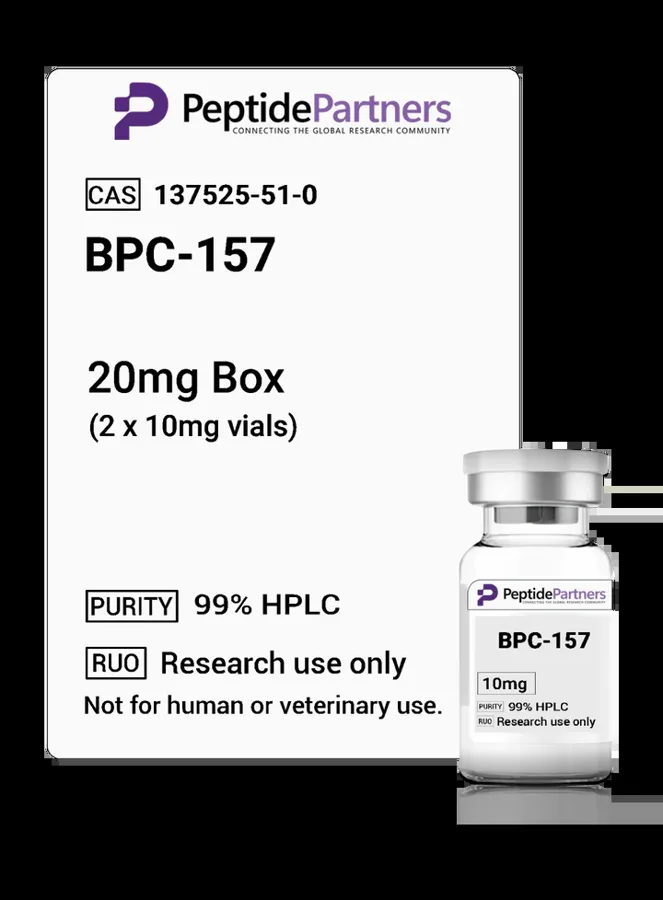
Available packs
BPC-157
$106 - $780
Buy BPC-157 (10mg vials) from Peptides Partners
Investigators seeking high-purity, laboratory-grade compounds for experimental models of cellular repair and tissue regeneration can buy BPC-157 directly from Peptides Partners. BPC-157 (CAS: 137525-51-0) is offered here in individual 10mg glass vials, sealed under inert atmospheric conditions to maintain structural integrity and prevent atmospheric degradation during transport and storage. As a leading supplier of verified research peptides, Peptides Partners caters exclusively to academic institutions, biotechnology organizations, and independent scientific laboratories requiring dependable, batch-tested reagents for in vitro and non-human in vivo study designs.
Each 10mg vial is supplied as a sterile, lyophilized (freeze-dried) powder containing no excipients, binders, or preservative agents that might compromise experimental readouts. Whether your laboratory investigates angiogenic signaling cascades, focal adhesion kinase activation, mucosal surface integrity, or extracellular matrix synthesis, consistent starting material is vital for generating reproducible data. When you buy BPC-157 from Peptides Partners, your procurement aligns with rigorous industry standards for analytical traceability, identity verification, and structural validation.
All items distributed by Peptides Partners, including our cellular repair catalog, are formulated strictly for laboratory research use only (RUO). This compound is not intended for human or veterinary administration, diagnostic screening, therapeutic use, or incorporation into consumer goods. Our focus remains on supporting foundational bioscience through the reliable provision of pristine research peptides.
What is BPC-157?
BPC-157, designated scientifically as Body Protection Compound 157, is a synthetic pentadecapeptide composed of fifteen amino acids. Its specific primary amino acid sequence is Gly-Glu-Pro-Pro-Pro-Gly-Lys-Pro-Ala-Asp-Asp-Ala-Gly-Leu-Val. Biochemically, it represents a partial sequence derived from a naturally occurring peptide found within endogenous mammalian gastric juice. Identified under Chemical Abstracts Service registry number CAS 137525-51-0, the molecule possesses an empirical formula of C62H98N16O22 and a calculated molecular weight of approximately 1419.535 g/mol.
Unlike many endogenous regulatory peptides that demonstrate extreme fragility in hostile chemical environments, BPC-157 exhibits notable conformational stability. In biochemical characterizations, researchers have documented that the peptide lacks intrinsic disulfide bridges, yet maintains conformational resilience across a broad pH spectrum, ranging from highly acidic gastric-simulated environments to neutral and mildly basic physiological buffers. This structural stability has positioned BPC-157 as an attractive target for investigations evaluating peptide degradation mechanics, enzymatic resistance against native proteinases, and stability kinetics in various biological matrices.
Synthesized typically via standardized solid-phase peptide synthesis (SPPS) protocols, the resulting peptide cake is lyophilized to eliminate residual moisture, yielding a white to off-white cake or crystalline powder. In aqueous environments, the free carboxylic acid and basic amino functionalities afford high aqueous solubility, making it an adaptable ligand for a broad range of biological assays, cell culture mediums, and histochemical preparations.
Research effects studied
Across more than two decades of preclinical investigation, BPC-157 has garnered significant interest within the scientific domain of cellular repair, tissue adaptation, and cytoprotective mechanisms. Published literature encompasses an array of in vitro cellular systems, organ bath models, and non-human animal assays exploring how this pentadecapeptide interacts with regulatory molecular networks.
Preclinical studies have explored BPC-157 in the context of:
- Angiogenesis and Vascular Dynamics: Research has studied the compound’s influence on vascular endothelial growth factor (VEGF) signaling, VEGFR2 receptor internalization, and endothelial cell migration assays. Preclinical vascular injury models suggest that the peptide may participate in collateral vessel formation and the activation of the VEGFR2-Akt-eNOS signaling cascade, which modulates regional blood flow and endothelial permeability during cellular response to trauma.
- Fibroblast Activation and Tenocyte Migration: In vitro studies evaluating tendon-derived fibroblasts and tenocytes have documented alterations in the expression of focal adhesion kinase (FAK) and paxillin phosphorylation upon exposure to BPC-157. These biochemical downstream mediators play central roles in cell spreading, cytoskeletal reorganization, and directional motility required for extracellular matrix reorganization during connective tissue repair.
- Gastrointestinal Mucosal Integrity: Because its parent structure was isolated from human gastric secretions, early and ongoing research heavily evaluates BPC-157’s cytoprotective properties across gastrointestinal models. Preclinical assays examining induced gastric ulcers, colonic anastomoses, and chemically mediated enteropathies observe that the peptide influences early growth response gene-1 (Egr-1) expression, mucosal blood flow regulation, and the preservation of epithelial tight junctions.
- Modulation of Nitric Oxide (NO) Pathways: Preclinical investigations into vascular tone have observed interactions between BPC-157 and both endothelial nitric oxide synthase (eNOS) and inducible nitric oxide synthase (iNOS). Investigators have noted that the peptide appears to stabilize vasomotor tone in both hypertensive and hypotensive experimental states, suggesting a homeostatic modulatory effect rather than a unidirectional pharmacological activation.
- Skeletal and Smooth Muscle Regeneration: In animal crush and transection models, laboratory evaluations have examined the recovery of functional contractile properties, satellite cell proliferation markers, and the expression of myogenic regulatory factors such as MyoD and myogenin following exposure to the peptide.
- Central Nervous System Interactions: Preliminary animal models have evaluated potential neuroprotective phenotypes following mechanical spinal trauma or chemical toxicant exposure, noting potential downstream modulations of the serotonergic, dopaminergic, and GABAergic systems, as well as attenuation of oxidative stress markers like malondialdehyde (MDA).
How to use in the laboratory
To ensure valid, reproducible experimental outcomes, laboratory personnel must adhere to standardized handling and reconstitution protocols when working with lyophilized research peptides. The instructions below outline general laboratory processing procedures; they do not constitute instructions for biological administration.
1. Laboratory Environment and Aseptic Technique
Reconstitution should be conducted inside a certified Class II Biosafety Cabinet or laminar flow clean bench. All contact surfaces, vial stoppers, and laboratory instruments must be sanitized using 70% isopropanol or ethanol. Standard personal protective equipment (PPE)—including nitrile gloves, eye protection, and laboratory coats—must be worn at all times to avoid cross-contamination of the peptide material and prevent inadvertent laboratory exposure.
2. Reconstitution Protocols
Prior to reconstitution, allow the sealed vial to equilibrate to room temperature (approximately 20°C to 25°C) inside a desiccator. Opening a chilled vial prematurely introduces ambient humidity, leading to condensation and rapid hydrolytic degradation of the lyophilized peptide cake.
- Select an appropriate solvent based on experimental parameters, such as sterile Bacteriostatic Water (0.9% benzyl alcohol preserved) for extended multi-sampling protocols, or sterile deionized water (USP grade) / sterile phosphate-buffered saline (PBS, pH 7.4) for immediate cell culture experiments sensitive to bacteriostatic preservatives.
- Carefully draw the desired volume of diluent into a sterile laboratory syringe fitted with an appropriate gauge needle (e.g., 22G to 27G).
- Puncture the center of the rubber septum and direct the needle tip toward the inner glass wall of the vial. Dispense the solvent slowly down the wall to avoid mechanical impact onto the cake.
- Do not shake, invert vigorously, or vortex the vial. Peptides are sensitive to mechanical shear stress, which can precipitate denaturation or aggregation. Gently roll the vial between the palms or swirl horizontally on the laboratory bench until the cake is fully dissolved into a clear, colorless solution.
3. Record-Keeping and Aliquoting
Following dissolution, document the exact reconstitution date, batch number, diluent used, and final concentration (mg/mL) directly in laboratory notebooks and on secondary container labels. To minimize stability losses from repeated temperature fluctuations, immediately divide the reconstituted solution into single-use, sterile polypropylene microcentrifuge tubes (low-binding preferred) before freezing.
Pack sizes and price per mg
Peptides Partners provides structured tiered pricing for research facilities managing diverse project scopes. Purchasing larger volume packages substantially reduces the unit cost per milligram, enabling optimized resource allocation for prolonged preclinical trials and high-throughput cellular repair screens.
| Pack Configuration | Total Peptide Content | Package Price (USD) | Effective Price per mg |
|---|---|---|---|
| 2 vials x 10mg | 20 mg | $106.00 | $5.30 / mg |
| 5 vials x 10mg | 50 mg | $244.00 | $4.88 / mg |
| 10 vials x 10mg | 100 mg | $450.00 | $4.50 / mg |
| 20 vials x 10mg | 200 mg | $780.00 | $3.90 / mg |
Storage and handling
Maintaining proper thermal and physical conditions is essential to protect BPC-157 from chemical degradation pathways such as oxidation, deamidation, and peptide chain cleavage.
Lyophilized Peptide (Unopened Vials):
Lyophilized vials received from Peptides Partners are stable at ambient laboratory temperatures during transient shipping periods. However, upon arrival, vials should be cataloged and transferred immediately to cold storage. For short-term preservation (up to 3 months), store unopened vials in a standard laboratory refrigerator at 2°C to 8°C. For long-term preservation (up to 24 months), store unopened vials in a laboratory freezer maintained at -20°C or -80°C. Vials should be stored in desiccated containers protected from light exposure to prevent photo-oxidation.
Reconstituted Peptide (Liquid State):
Once dissolved in an aqueous solvent, the peptide becomes significantly more susceptible to temperature and enzymatic decay. Reconstituted solutions in bacteriostatic water can generally be maintained at 2°C to 8°C for up to 21 to 28 days. Reconstituted solutions prepared in non-preserved diluents (e.g., standard sterile water or PBS) should be used within 24 to 48 hours if held at 2°C to 8°C. For longer storage of reconstituted material, aliquots should be frozen at -20°C or -80°C for up to 3 to 6 months. Avoid repeated freeze-thaw cycles, as each phase transition introduces physical stress that can disrupt peptide conformation and promote precipitation.
Disposal Protocols:
All experimental residues, depleted vials, and contaminated consumables must be discarded in accordance with regional institutional environmental safety protocols for non-hazardous chemical and biological research waste.
Quality and documentation
Precision and repeatability form the bedrock of scientific discovery. Peptides Partners subjects each production batch of research peptides to comprehensive analytical verification protocols before catalog release. We employ rigorous quality control methodologies to confirm identity, determine chemical purity, and identify potential synthetic impurities.
Each batch undergoes High-Performance Liquid Chromatography (HPLC) to verify chromatographic purity and identify any truncated or deletion peptide sequences formed during solid-phase synthesis. Furthermore, electrospray ionization or matrix-assisted laser desorption/ionization mass spectrometry (MS) is utilized to confirm that the observed molecular mass conforms strictly to the theoretical molecular weight of BPC-157 (1419.535 g/mol).
When institutions buy BPC-157 through our catalog, dedicated batch documentation and Safety Data Sheets (SDS) are accessible to ensure your laboratory remains fully compliant with internal environmental health and safety (EHS) requirements and institutional regulatory audits.
Frequently asked questions
What is the CAS number and molecular weight of BPC-157?
BPC-157 is registered under CAS number 137525-51-0. Its empirical chemical formula is C62H98N16O22, yielding an average molecular weight of 1419.535 g/mol. Mass spectrometry data verified by Peptides Partners aligns precisely with these analytical specifications.
What solvent is recommended for reconstituting BPC-157 in a laboratory setting?
The choice of solvent depends on the laboratory assay’s design. For multi-use sampling protocols spanning several days or weeks, sterile Bacteriostatic Water containing 0.9% benzyl alcohol is commonly utilized to inhibit microbial growth. For direct application to cell culture systems, primary tissue explants, or assays sensitive to alcohol toxicity, sterile 0.9% sodium chloride injection or sterile phosphate-buffered saline (PBS, pH 7.4) is generally preferred.
Is BPC-157 intended for human or veterinary medical use?
No. BPC-157 supplied by Peptides Partners is strictly labeled and distributed for in vitro scientific research, biochemical analysis, and preclinical laboratory studies. It is not licensed, approved, or formulated for human consumption, clinical application, veterinary therapy, medical treatment, or inclusion in dietary supplements.
How should research peptides like BPC-157 be inventoried and tracked?
Upon receipt, laboratory personnel should inspect the vials for seal integrity, log the product name, lot number, quantity, date of arrival, and expiry into their chemical inventory management system. Vials should be assigned dedicated cryo-storage space and cross-referenced with the corresponding SDS and analytical documentation maintained on file.
Related Peptides Partners research peptides
BPC-157 (40mg vials); Epithalon (40mg vials); Meta-Z Kit (10mL vials).
BPC-157 lot documentation
Certificates of analysis are matched to the actual lot supplied with your order. Email sales@peptidespartners.co with the product name and pack size to request the current lot's purity, identity and screening documents before purchase.
Storage
Research peptides are typically supplied lyophilized (freeze-dried), which keeps them stable for shipping and storage. Store unopened vials cool, dry and away from light; for long-term storage, a freezer is generally recommended.
After reconstitution, keep vials refrigerated and use sterile laboratory technique. Follow the handling guidance supplied with your lot documentation.
- Short name
- BPC-157 (10mg vials)
- Vial strength
- 10mg vials
- Pack sizes
- 20mg pack, 50mg pack, 100mg pack, 200mg pack
- Pack count options
- 2, 5, 10, 20 vial packs
- CAS number
- 137525-51-0
- Category
- Cellular repair
- SKU
- PP-704
- Compliance
- Research Use Only. Not for use in diagnostic tests.