
Epithalon
40mg per vial
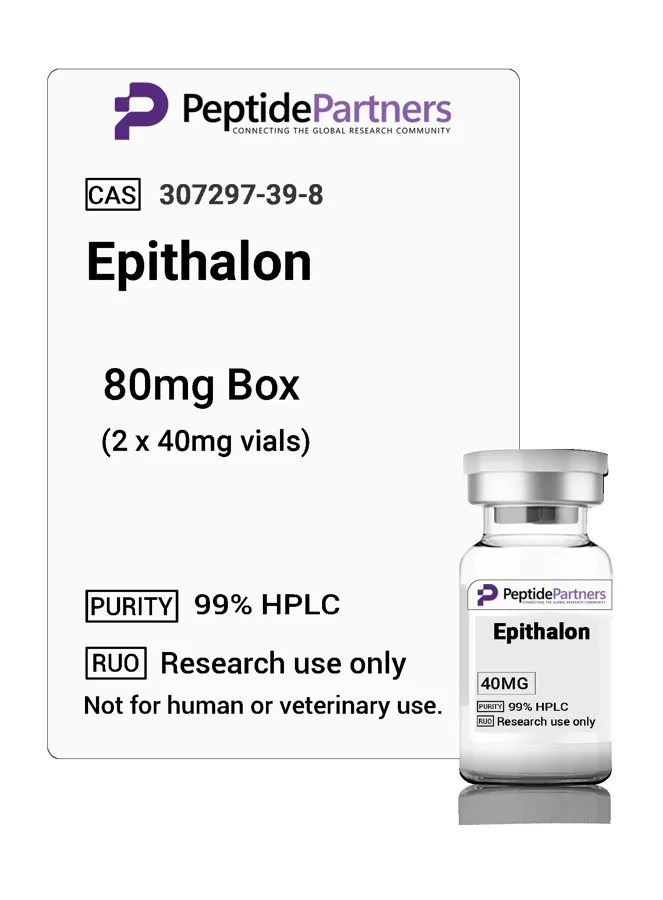
Available packs
Epithalon
$216 - $792
Buy Epithalon (40mg vials) from Peptides Partners
Laboratories and academic institutions seeking consistent, high-purity biomolecules for cellular aging, pineal regulation, and mitochondrial research can buy Epithalon in high-volume 40mg vials from Peptides Partners. Epithalon, also known in scientific literature as Epitalon or AEDG peptide, represents one of the most comprehensively investigated synthetic short peptides within the field of peptide-mediated gerontology. Packaged specifically for rigorous analytical and in vitro workflows, our 40mg vial configurations deliver the mass required for sustained, multi-arm experiments, eliminating the inter-vial reconstitution variability that often complicates longitudinal tissue culture studies.
When researchers choose to buy Epithalon through Peptides Partners, they receive authentic research peptides manufactured under stringent quality controls. Our catalog supports investigators examining cellular signaling cascades, telomeric length maintenance mechanisms, and organelle bioenergetics. Each batch is formulated as a lyophilized white powder designed to ensure physical and chemical stability throughout global transport. As a dedicated provider of research peptides, Peptides Partners ensures that your laboratory has continuous access to the tools necessary to generate reproducible, publication-grade data across all ongoing assays.
What is Epithalon?
Epithalon is an ultra-short synthetic tetrapeptide defined by the amino acid sequence L-alanyl-L-alpha-glutamyl-L-alpha-aspartylglycine (Ala-Glu-Asp-Gly, or AEDG). Registered under the Chemical Abstracts Service registry as CAS 307297-39-8, Epithalon possesses a molecular formula of C14H22N4O9 and a calculated molecular mass of approximately 390.35 g/mol. Categorized broadly within mitochondrial and cellular senescence research, Epithalon was originally developed as a synthetic analogue and structural biomimetic of epithalamin, a natural peptide extract isolated from the bovine pineal gland by researchers at the St. Petersburg Institute of Bioregulation and Gerontology.
The peptide is characterized by its hydrophilic profile and low molecular weight, allowing it to interact with specific molecular targets without the tertiary structural liabilities common to larger polypeptides. The terminal alanine and glycine residues, flanking central acidic amino acids (glutamic acid and aspartic acid), form a stable, linear backbone. In physiological and cellular assays, this precise sequence has demonstrated unique regulatory interactions with nuclear and mitochondrial targets. Research over the past several decades has positioned CAS 307297-39-8 as a pivotal model molecule for probing how low-molecular-weight peptide bioregulators modulate chromatin access, enzyme kinetics, and organelle function in aging cellular populations.
Research effects studied
Epithalon has been evaluated across a broad spectrum of in vitro assays, cellular culture systems, and preclinical animal models to map its biological interactions. A significant focus of modern investigative work centers on mitochondrial integrity, enzyme modulation, and cellular lifespan markers.
Telomerase Activation and Chromatin Remodeling
One of the earliest and most extensively published avenues of inquiry involves the influence of Epithalon on telomere biology. In cultured human somatic cells, including senescent fetal fibroblasts and retinal pigment epithelial cells, Epithalon has been studied in preclinical research for its ability to induce telomerase activity. Specifically, investigative teams have observed upregulation of the human telomerase reverse transcriptase (hTERT) gene following peptide exposure. Researchers hypothesize that this activation occurs via epigenetic interactions, wherein the short AEDG sequence binds directly to specific promoter regions or core histones, altering chromatin conformation from heterochromatin to euchromatin and facilitating access for transcriptional machinery.
Mitochondrial Dynamics and Reactive Oxygen Species (ROS)
Beyond nuclear interactions, Epithalon is categorized within mitochondrial peptide research due to its documented effects on organellar bioenergetics and oxidative equilibrium. Mitochondria are both the primary source of cellular ATP and the main producers of endogenous reactive oxygen species. In preclinical models examining tissue aging, Epithalon administration has been correlated with reduced markers of lipid peroxidation and lower accumulation of intracellular malondialdehyde. Concurrently, investigators have documented enhancements in endogenous antioxidant enzyme pathways, specifically increases in superoxide dismutase (SOD) and glutathione peroxidase (GPx) expression. Through these mechanisms, researchers explore how the peptide influences the mitochondrial inner membrane potential and downregulates apoptotic cascades triggered by oxidative stress.
Pineal Gland Function and Circadian Regulation
Given its origins as an epithalamic biomimetic, Epithalon has been studied extensively for its role in neuroendocrine regulation, specifically within the pineal-hypothalamic axis. Preclinical trials utilizing rodent and non-human primate models have evaluated the peptide’s ability to modulate melatonin synthesis and pineal morphology during chronological senescence. Observations indicate that the peptide can alter nocturnal melatonin peaks, leading researchers to examine its prospective utility in restoring phase-shifted circadian gene networks, such as CLOCK and BMAL1, in cultured pinealocytes.
Preclinical Longevity and Tumorigenesis Studies
Longitudinal assays across rodent cohorts have evaluated the systemic effects of Epithalon on mean and maximum lifespan, as well as the spontaneous incidence of age-associated pathological events. In these protocols, research teams noted alterations in T-cell differentiation markers, cellular immune responses, and the rate of spontaneous tumor development in historical control strains. These systemic findings continue to generate academic interest regarding the compound’s fundamental impact on cellular repair mechanisms and replicative arrest.
How to use in the laboratory
Working with Epithalon (40mg vials) requires adherence to standard laboratory protocols designed for synthetic, lyophilized peptides. The 40mg format offers high chemical concentration, making it critical to establish rigorous volumetric and analytical workflows prior to unsealing the vial.
- Environmental Preparation: Reconstitution should be executed inside a certified Class II biosafety cabinet or laminar flow hood to preserve chemical integrity and prevent airborne bacterial or fungal contamination.
- Solvent Selection: Epithalon demonstrates favorable solubility in polar aqueous solutions. Typical laboratory vehicles include sterile bacteriostatic water (containing 0.9% benzyl alcohol) for multi-use analytical workflows, sterile water for injection (WFI), or sterile phosphate-buffered saline (PBS, pH 7.4) for direct physiological cell culture applications.
- Reconstitution Protocol: Introduce the chosen solvent slowly along the internal glass wall of the vial using a low-dead-volume laboratory syringe. Avoid direct, pressurized expulsion onto the lyophilized cake. Allow the solvent to naturally saturate the powder, followed by gentle, manual rotation of the vial. Do not agitate aggressively or subject the solution to mechanical vortexing, as shear forces can disrupt peptide integrity.
- Calculations and Stock Concentrations: Because the vial contains 40mg of active substance, adding 4.0 mL of diluent yields a stock concentration of 10 mg/mL, while 8.0 mL yields 5 mg/mL. Precision pipettes should be utilized to distribute the parent solution into smaller single-use microcentrifuge tubes to prevent subsequent contamination.
- Documentation and Record-Keeping: The working aliquot must be labeled with the compound name, CAS registry number (307297-39-8), batch number, exact stock concentration, solvent used, date of reconstitution, and the researcher’s initials. Laboratory logs should catalog the solvent volume, calculated molecular purity, and intended experimental timeline.
Pack sizes and price per mg
To accommodate diverse laboratory scale requirements—ranging from pilot cell culture evaluations to extensive, multi-vial comparative assays—Peptides Partners provides Epithalon in three bulk packaging options. Purchasing higher aggregate quantities decreases the marginal cost per milligram, providing significant budgetary advantages for funded academic laboratories and commercial research operations.
| Pack Option | Total Quantity (mg) | Total Price (USD) | Price Per mg (USD) |
|---|---|---|---|
| 2 vials x 40mg | 80 mg | $216 | $2.70 |
| 5 vials x 40mg | 200 mg | $480 | $2.40 |
| 10 vials x 40mg | 400 mg | $792 | $1.98 |
The 2-vial package serves investigators conducting focused baseline validations or short-term in vitro exposure models. For multi-replicate assays or extended longitudinal studies across multiple cell lines, the 5-vial and 10-vial tiers lower the experimental expenditure to as low as $1.98 per milligram, maximizing the utilization of grant allocations and operational budgets.
Storage and handling
Appropriate physical storage is critical for maintaining the chemical structural fidelity of Epithalon and preventing peptide degradation pathways such as hydrolysis, deamidation, or oxidation.
Lyophilized vials received from Peptides Partners should be transferred immediately to a cold-storage facility. For short-term experimental periods (under 30 days), the dry powder may be held at 2°C to 8°C. For prolonged storage (ranging from several months up to two years), vials must be kept at -20°C or -80°C in a manual-defrost freezer. Avoid auto-defrost freezers, as their internal thermal cycles cause localized temperature swings that can accelerate physical breakdown of the cake. Vials must be protected from ultraviolet radiation, ambient fluorescent light, and environmental moisture; storing vials within sealed, secondary containment containing a desiccant pack is strongly recommended.
Once reconstituted, the liquid solution should be maintained at 2°C to 8°C and utilized within two to three weeks if prepared with bacteriostatic water. For longer-term aqueous storage, stock solutions must be aliquoted into sterile, polypropylene cryovials and frozen at -20°C or below. Reconstituted peptides must never be subjected to repeated freeze-thaw cycles; once an aliquot is thawed for experimental use, any remaining liquid should be retained at refrigerated temperatures for immediate short-term use or disposed of according to institutional protocols.
Quality and documentation
Analytical integrity is essential for experimental reproducibility. Peptides Partners subjects every manufactured batch of research peptides to exhaustive structural and physical characterization before release into our catalog. Quality assurance protocols encompass high-performance liquid chromatography (HPLC) to verify chromatographic purity and identify any potential peptide fragments or counter-ion variations, alongside electrospray ionization mass spectrometry (ESI-MS) to ensure absolute confirmation of the target molecular weight (390.35 g/mol).
Every shipment of Epithalon is linked to a batch-specific Certificate of Analysis detailing these analytical metrics, net peptide content, residual moisture parameters, and physical solubility profiles. Our commitment to transparent documentation ensures that principal investigators and research technicians can integrate our synthetic biomolecules into their analytical workflows with full scientific confidence.
Frequently asked questions
What is the precise chemical structure and sequence of Epithalon?
Epithalon is an ultra-short peptide bioregulator consisting of four amino acids in the sequence L-alanyl-L-alpha-glutamyl-L-alpha-aspartylglycine (Ala-Glu-Asp-Gly, or AEDG). Its chemical identification corresponds to CAS 307297-39-8, with a molecular formula of C14H22N4O9 and a molecular weight of 390.35 g/mol.
What experimental systems are typically utilized in Epithalon research?
Epithalon is primarily deployed in cellular and molecular research environments. Typical models include human diploid fibroblast cultures used to evaluate cellular senescence and telomerase reverse transcriptase (hTERT) activity, isolated rodent pineal tissue for circadian output studies, and primary neural or myocardial cell lines exposed to oxidative stress to quantify reactive oxygen species and mitochondrial enzyme kinetics.
Which laboratory solvent is recommended to dissolve 40mg of Epithalon?
Due to the hydrophilic nature of the AEDG sequence, Epithalon dissolves rapidly in sterile laboratory solvents. Researchers commonly employ sterile water for injection (WFI), bacteriostatic water for multi-use analytical storage, or sterile phosphate-buffered saline (PBS, pH 7.4). Solvents containing high organic fractions (such as pure DMSO or ethanol) are generally unnecessary for this peptide sequence and may introduce unwanted variables in cell culture assays.
Can Epithalon supplied by Peptides Partners be used in clinical or therapeutic applications?
No. Epithalon (40mg vials) supplied by Peptides Partners is intended strictly for in vitro and laboratory research applications. It is not licensed, approved, or formulated for human consumption, clinical diagnosis, veterinary administration, or therapeutic treatment. All materials are restricted to qualified academic, clinical, and corporate research personnel operating within appropriate laboratory environments.
Related Peptides Partners research peptides
GHK-Cu (100mg vials); Ipamorelin (10mg vials); PT-141 (10mg vials).
Epithalon lot documentation
Certificates of analysis are matched to the actual lot supplied with your order. Email sales@peptidespartners.co with the product name and pack size to request the current lot's purity, identity and screening documents before purchase.
Storage
Research peptides are typically supplied lyophilized (freeze-dried), which keeps them stable for shipping and storage. Store unopened vials cool, dry and away from light; for long-term storage, a freezer is generally recommended.
After reconstitution, keep vials refrigerated and use sterile laboratory technique. Follow the handling guidance supplied with your lot documentation.
- Short name
- Epithalon (40mg vials)
- Vial strength
- 40mg vials
- Pack sizes
- 80mg pack, 200mg pack, 400mg pack
- Pack count options
- 2, 5, 10 vial packs
- CAS number
- 307297-39-8
- Category
- Mitochondrial
- SKU
- PP-27050
- Compliance
- Research Use Only. Not for use in diagnostic tests.