
GHK-Cu
100mg per vial
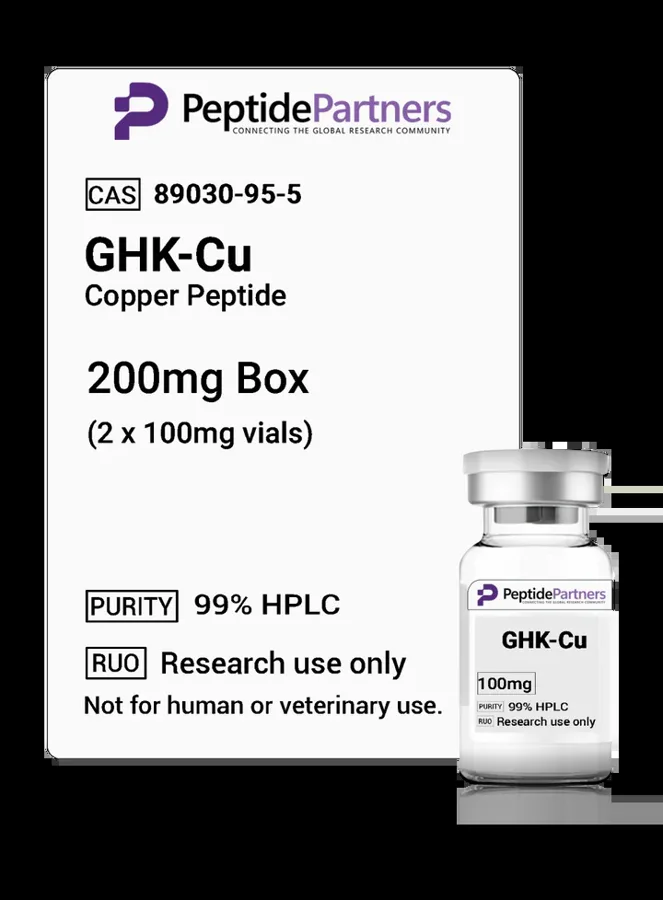
Available packs
GHK-Cu
$76 - $480
Buy GHK-Cu (100mg vials) from Peptides Partners
Investigators seeking high-capacity formats for cellular, biochemical, and molecular research can buy GHK-Cu in 100mg vials directly from Peptides Partners. GHK-Cu (glycyl-L-histidyl-L-lysine copper complex, CAS: 89030-95-5) is one of the most widely referenced metallopeptides in scientific literature, cataloged under the anti-oxidant class for its demonstrated ability to modulate oxidative cascades and quench reactive oxygen species in experimental models. While standard research configurations often provide smaller aliquots, the 100mg vial format is engineered specifically for laboratories executing high-throughput screening, multi-well cell culture assays, longitudinal gene expression panels, or extensive comparative biochemical investigations requiring uniform lot integrity.
When laboratories acquire research peptides through Peptides Partners, they receive synthetically produced, lyophilized compounds formulated to meet rigorous scientific criteria. Each 100mg glass vial provides a generous yield of active peptide-metal complex, reducing inter-assay variability by allowing multiple experimental phases to draw from the identical production run. Whether exploring radical-scavenging dynamics, extracellular matrix biology, or chromatin remodeling pathways, our supply infrastructure ensures consistent availability, transparent pricing tiers, and verifiable physicochemical integrity for the worldwide scientific community.
What is GHK-Cu?
GHK-Cu is a naturally occurring tripeptide-copper conjugate formed by the spontaneous, high-affinity chelation of copper(II) ions (Cu2+) by the tripeptide glycyl-L-histidyl-L-lysine. The sequence was originally isolated from human plasma fractions in 1973 by Dr. Loren Pickart during investigations into age-dependent biological factors regulating liver cell survival in vitro. In native biological systems, GHK exists as an extracellular matrix-derived signal that forms a high-affinity square-planar coordination complex with Cu2+, an essential transition metal cofactor for numerous cellular enzymes.
Identified by CAS registry number 89030-95-5, the chemical structure of the GHK-Cu complex consists of the amino acid sequence Gly-His-Lys coordinated to a divalent copper ion through the alpha-amino nitrogen of the glycine residue, the deprotonated amide nitrogens of the peptide backbone, and the imidazole nitrogen of the histidine residue. The lysine side chain remains accessible, providing a positively charged, hydrophilic tail that influences its aqueous solubility, ionic interactions, and cellular transport mechanisms. The resulting chemical formula is typically described as C14H22CuN6O4 (or associated salt forms, such as the acetate or chloride conjugate), possessing a distinctive deep blue coloration in aqueous solution that serves as an optical confirmation of successful copper coordination.
Within biochemistry and cell biology, GHK-Cu functions as a copper chaperone and biological signaling mediator. Copper is an essential microelement required for the active sites of enzymes such as superoxide dismutase (SOD1), cytochrome c oxidase, lysyl oxidase, and tyrosinase. However, unchelated or “free” copper ions can catalyze deleterious Fenton-type reactions, generating destructive hydroxyl radicals. The physiological significance of the GHK carrier molecule lies in its ability to safely transport, exchange, and donate Cu2+ to specific enzymatic acceptors while simultaneously dampening oxidative stress, rendering it a foundational subject of study in anti-oxidant research.
Research effects studied
Over five decades of preclinical investigation have positioned GHK-Cu at the intersection of cellular defense, anti-oxidant biology, wound kinetics, and epigenetic regulation. Academic literature documents diverse mechanisms through which this copper complex influences cellular behavior:
- Anti-Oxidant Mechanisms and Free Radical Scavenging: Preclinical models classify GHK-Cu as a potent indirect and direct anti-oxidant. Research has revealed that GHK-Cu suppresses iron-dependent lipid peroxidation by binding non-transferrin-bound iron ions and inhibiting hydroxyl radical formation. Furthermore, exposure to the complex has been shown to upregulate cellular expression of anti-oxidant defense enzymes, notably copper-zinc superoxide dismutase (Cu/Zn-SOD) and glutathione peroxidase, thereby decreasing intracellular accumulation of reactive oxygen species (ROS) in cell cultures subjected to acute oxidative stressors.
- Extracellular Matrix (ECM) Remodeling and Fibroblast Activation: Extensive in vitro assays demonstrate that GHK-Cu stimulates the transcription and synthesis of primary structural proteins within dermal and connective tissues. Fibroblast cultures treated with GHK-Cu exhibit concentration-dependent increases in type I and type III collagen synthesis, elastin production, and the secretion of essential glycosaminoglycans, such as hyaluronic acid and chondroitin sulfate. In addition, the peptide regulates matrix metalloproteinases (MMPs) and their tissue inhibitors (TIMPs), favoring balanced remodeling rather than aberrant fibrotic accumulation.
- Anti-Inflammatory Modulation: Studies examining inflammatory cascades indicate that GHK-Cu modulates the production of several classical pro-inflammatory cytokines. In cultured macrophages and epithelial models, researchers have observed significant reductions in tumor necrosis factor-alpha (TNF-α), interleukin-6 (IL-6), and transforming growth factor-beta-1 (TGF-β1). The peptide appears to exert this dampening effect, in part, by suppressing the activation of nuclear factor kappa B (NF-κB) pathways.
- Angiogenesis and Tissue Repair Kinetics: Preclinical wound healing paradigms document that GHK-Cu accelerates tissue repair through stimulated angiogenesis. Investigations report elevated expression of basic fibroblast growth factor (bFGF) and vascular endothelial growth factor (VEGF) following exposure to the peptide, resulting in enhanced endothelial cell migration, capillary tube formation, and cellular proliferation across damaged monolayers.
- Broad-Spectrum Genomic and Epigenetic Modulation: Recent computational and transcriptomic studies utilizing the Broad Institute’s Connectivity Map have revealed that GHK-Cu can modulate the expression of an estimated 4,000 human genes. Research suggests it shifts overall gene expression profiles toward states associated with cellular defense, DNA repair pathways, and proteasomal degradation of damaged proteins, while simultaneously downregulating genes associated with pro-inflammatory and degenerative cascades.
How to use in the laboratory
The handling and reconstitution of GHK-Cu 100mg vials must follow standardized laboratory protocols to preserve structural integrity, maintain stoichiometric copper coordination, and ensure reproducibility across in vitro or ex vivo research workflows.
Prior to reconstitution, the lyophilized vial should be allowed to equilibrate to room temperature (18°C to 22°C) for approximately 30 minutes. This prevents atmospheric moisture from condensing inside the vial when the vacuum seal is broken, which could destabilize the peptide cake. Preparation of the working or stock solution must be performed inside a certified laminar flow hood or biological safety cabinet using strict aseptic technique.
Appropriate laboratory diluents include sterile bacteriostatic water, sterile water for injection, or physiological buffers such as phosphate-buffered saline (PBS, pH 7.2 to 7.4). When reconstituting the large 100mg format, standard laboratory practice often involves preparing a high-concentration stock solution (for example, 10 mg/mL, achieved by introducing 10 mL of diluent into the vial, or 20 mg/mL using 5 mL). The solvent should be introduced smoothly against the inner glass wall rather than dropped directly onto the lyophilized cake. Allow the vial to rest undisturbed for several minutes as the material wets, followed by gentle swirling or rocking. Do not vortex vigorously, as mechanical shear stress and excessive foaming can degrade the peptide or disrupt coordinate copper bonding.
Upon full dissolution, the resulting liquid will exhibit a clear, uniform, characteristic light-to-deep blue tint, reflecting the Cu2+ coordination complex. Laboratory records should rigorously capture the reconstitution date, precise concentration, diluent lot number, technician initials, and calculated expiration dates for both parent stock and subsequent serial working dilutions. The concentrated stock should be promptly divided into sterile, single-use microcentrifuge tubes or cryogenic vials to mitigate repeated atmospheric exposure.
Pack sizes and price per mg
To support sustained scientific protocols, Peptides Partners supplies GHK-Cu in multiple packaging volumes. Procuring research peptides in multi-vial configurations offers distinct cost-per-milligram advantages, enabling laboratories to optimize their operational consumables budget.
| Pack Configuration | Total Quantity (mg) | Total Price (USD) | Price per Milligram |
|---|---|---|---|
| 2 vials x 100mg | 200 mg | $76.00 | $0.380 / mg |
| 5 vials x 100mg | 500 mg | $165.00 | $0.330 / mg |
| 10 vials x 100mg | 1,000 mg | $285.00 | $0.285 / mg |
| 20 vials x 100mg | 2,000 mg | $480.00 | $0.240 / mg |
As outlined above, purchasing larger pack sizes yields substantial economy-of-scale savings, reducing the unit cost from $0.380 per milligram in the introductory 2-vial package down to $0.240 per milligram in the 20-vial tier. This makes the 100mg presentation exceptionally practical for continuous, high-volume laboratory applications.
Storage and handling
Proper environmental control is vital for maintaining the molecular stability of GHK-Cu. The compound is sensitive to excessive heat, moisture, and prolonged exposure to direct ultraviolet radiation, which can promote oxidation or dissociation of the chelated copper ion.
- Lyophilized Storage: In its unconstituted, lyophilized powder state, GHK-Cu vials should be stored at -20°C for routine medium-term laboratory use. For long-term archival storage extending beyond 12 months, -80°C is strongly recommended. Desiccated containers protect the rubber stopper seals from ambient humidity. Under proper sub-zero conditions, lyophilized GHK-Cu maintains its chemical stability for up to 24 to 36 months.
- Reconstituted Solution Storage: Once dissolved, the aqueous peptide solution should never be kept at ambient laboratory temperatures for prolonged periods. Aliquots destined for use within 7 to 14 days may be held at 2°C to 8°C. For long-term assay timelines, aliquoted working solutions should be stored at -20°C or -80°C.
- Freeze-Thaw Considerations: Multiple freeze-thaw cycles must be strictly avoided. Repeated ice crystal formation and thawing cause progressive degradation of the peptide chain and destabilization of the copper chelate. Aliquoting into dedicated single-use volumes immediately after reconstitution eliminates this risk.
- Light Protection: Due to the potential for photochemical reduction of Cu2+ under continuous high-intensity light, store vials in light-resistant secondary packaging or amber storage boxes.
- Personal Protection: Standard laboratory safety guidelines apply. Personnel should wear nitrile gloves, laboratory coats, and eye protection when handling the dry cake or liquid stock to prevent accidental inhalation or dermal contact.
Quality and documentation
At Peptides Partners, every batch of GHK-Cu is subject to standardized analytical characterization to verify structural authenticity, chemical purity, and stoichiometry. Synthetic peptide integrity is confirmed through analytical High-Performance Liquid Chromatography (HPLC), which verifies chromatographic purity, and Mass Spectrometry (such as MALDI-TOF or ESI-MS), which corroborates the expected molecular weight and confirms stoichiometric coordination of the copper ion.
Each shipment is linked directly to a traceable batch number, corresponding to comprehensive Certificate of Analysis (CoA) documentation detailing net peptide content, residual moisture, and appearance criteria. All 100mg vials are packaged under sterile, sealed, nitrogen-purged conditions using USP Type I borosilicate glass and pharmaceutical-grade butyl stoppers with aluminum crimp seals. This ensures maximum protection against moisture ingress and atmospheric oxidation during transit and storage. GHK-Cu is distributed strictly for in vitro laboratory research and educational experimentation; it is not for human or animal consumption, veterinary use, or therapeutic utility.
Frequently asked questions
Why does GHK-Cu display a distinct blue color when reconstituted?
The distinctive blue color is an intrinsic physicochemical property of the complex, arising from the coordination chemistry between the divalent copper ion (Cu2+) and the nitrogen atoms of the glycyl-L-histidyl-L-lysine tripeptide backbone. The ligand field around the central Cu2+ ion causes d-orbital splitting, which absorbs light within the red spectrum and transmits blue wavelengths. The presence of this clear blue hue serves as a rapid visual confirmation of successful copper chelation.
What is the most stable buffer for reconstituting GHK-Cu in cell culture assays?
For most biological and cell culture investigations, sterile phosphate-buffered saline (PBS) adjusted to a physiological pH range between 7.2 and 7.4 or sterile pure water is ideal. Buffers that contain strong metal chelators—such as EDTA, EGTA, or high concentrations of competing divalent cations—must be avoided, as they can sequester the copper ion away from the tripeptide backbone, converting the compound into unchelated GHK and fundamentally altering experimental outcomes.
How does the 100mg vial format benefit high-throughput research compared to smaller sizes?
The 100mg vial provides a substantial mass of peptide within a single, homogeneous production lot. When running automated liquid handlers, multi-plate ELISA assays, or extended cell culture passages, using a single 100mg vial avoids the inter-vial reconstitution discrepancies and lot-to-lot baseline variations that often occur when combining numerous smaller 5mg or 10mg vials across an ongoing study.
Is GHK-Cu identical in experimental behavior to unchelated GHK peptide?
No. While the tripeptide sequence (Gly-His-Lys) is identical, the presence of the chelated copper atom substantially alters the molecule’s chemical reactivity, spatial geometry, and biological targets. Unchelated GHK lacks the specific optical properties, copper-transport capabilities, and distinct anti-oxidant profile of GHK-Cu. Furthermore, gene expression comparative studies demonstrate that the copper-coordinated complex modulates a distinct subset of cellular pathways that unchelated GHK cannot replicate without ambient transition metals.
Related Peptides Partners research peptides
GLOW Blend: BPC-157/TB-500/GHK-Cu (70mg vials); Kisspeptin (10mg vials); Semax (30mg vials).
GHK-Cu lot documentation
Certificates of analysis are matched to the actual lot supplied with your order. Email sales@peptidespartners.co with the product name and pack size to request the current lot's purity, identity and screening documents before purchase.
Storage
Research peptides are typically supplied lyophilized (freeze-dried), which keeps them stable for shipping and storage. Store unopened vials cool, dry and away from light; for long-term storage, a freezer is generally recommended.
After reconstitution, keep vials refrigerated and use sterile laboratory technique. Follow the handling guidance supplied with your lot documentation.
- Short name
- GHK-Cu (100mg vials)
- Vial strength
- 100mg vials
- Pack sizes
- 200mg pack, 500mg pack, 1000mg pack, 2000mg pack
- Pack count options
- 2, 5, 10, 20 vial packs
- CAS number
- 89030-95-5
- Category
- Anti-oxidant
- SKU
- PP-941
- Compliance
- Research Use Only. Not for use in diagnostic tests.