
Semax
30mg per vial
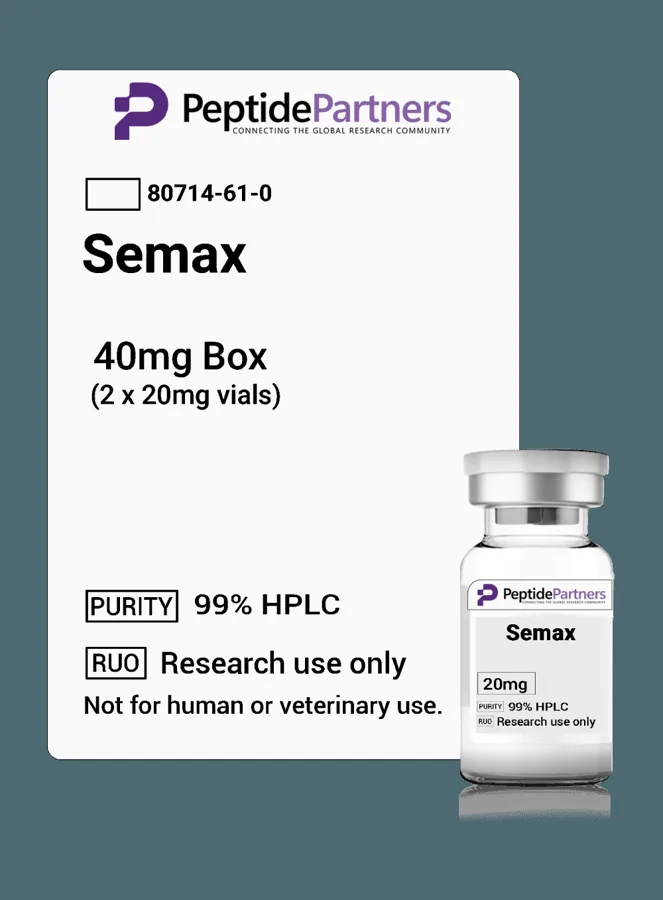
Available packs
Semax
$81 - $311
Buy Semax (30mg vials) from Peptides Partners
Laboratories and scientific institutions seeking verified regulatory compounds can buy Semax in 30mg lyophilized vials directly from Peptides Partners. As an established distributor of high-grade research peptides, Peptides Partners supplies biochemical reagents designed exclusively for in vitro, ex vivo, and non-human in vivo experimental applications. Each production lot is synthesized through advanced automated protocols to ensure sequence fidelity, structural reproducibility, and minimal counter-ion variation across experimental batches.
The 30mg presentation provides an optimal concentration format for high-throughput screening, multi-arm behavioral assays, and cellular signaling investigations. Standardized vial sizing simplifies molar calculations and inventory management in academic, clinical, and industrial laboratories. When investigators order research peptides from Peptides Partners, materials are shipped in secure, temperature-resilient packaging engineered to protect molecular stability during transit. Semax supplied by Peptides Partners is strictly reserved for qualified scientific investigation and laboratory research; it is not for human or veterinary use, medical therapy, clinical diagnostics, or consumer administration.
What is Semax?
Semax is a synthetic regulatory heptapeptide characterized by the primary amino acid sequence Met-Glu-His-Phe-Pro-Gly-Pro (often abbreviated as MEHFPGP). Structurally, Semax was developed through rational drug design based on the N-terminal core of adrenocorticotropic hormone, specifically the ACTH(4-10) sequence (Met-Glu-His-Phe), which had historically been implicated in neurotropic and behavioral processes without activating peripheral steroidogenesis.
Native ACTH(4-10) exhibits a very short biological half-life due to rapid cleavage by endogenous proteolytic enzymes, including aminopeptidases and neutral endopeptidases. To enhance structural stability and prolong biological activity, researchers conjugated the C-terminal tripeptide Pro-Gly-Pro (PGP) to the ACTH(4-10) core. The resulting heptapeptide demonstrates significantly enhanced resistance to enzymatic degradation while retaining the functional characteristics of the initial sequence. Crucially, Semax lacks the steroidogenic sequence elements present in intact ACTH, meaning it does not stimulate the adrenal cortex to produce glucocorticoids or mineralocorticoids in experimental animal models.
Within laboratory nomenclature, Semax is categorized among nootropic and neuroregulatory peptides. Its molecular formula is C37H51N9O10S, with a molecular mass of approximately 813.92 g/mol. Research surrounding this molecule centers primarily on its neuromodulatory, neurotrophic, and transcriptomic properties within central nervous system tissues.
Research effects studied
Semax has been the subject of extensive preclinical research and limited clinical research, particularly concerning its interactions with cellular signaling pathways in neural and vascular tissues. Published investigations have explored several key mechanisms of action:
- Modulation of Neurotrophic Factors: Multiple preclinical studies have evaluated the capacity of Semax to regulate neurotrophin expression. In rodent models and cultured neural cell lines, Semax administration has been associated with rapid and sustained increases in the transcription and protein expression of Brain-Derived Neurotrophic Factor (BDNF) and its primary high-affinity receptor, Tropomyosin receptor kinase B (TrkB). Parallel studies have reported increases in Nerve Growth Factor (NGF) levels, primarily within the hippocampus and frontoparietal cortex.
- Transcriptomic and Gene Expression Changes: Genome-wide microarray profiling in animal models of focal cerebral ischemia has demonstrated that Semax influences the expression of hundreds of genes involved in immune response, vascularization, and cellular integrity. Research indicates that the peptide downregulates inflammatory markers—such as interleukin-6 (IL-6) and tumor necrosis factor-alpha (TNF-alpha)—while upregulating genes associated with cell survival, extracellular matrix remodeling, and neuroprotection.
- Neurotransmitter Turnover and Release: Neurochemical investigations have observed shifts in monoamine metabolism following Semax exposure. Microdialysis studies in laboratory rodents demonstrate alterations in striatal dopamine and serotonin turnover rates. These effects appear to be indirect, potentially mediated by modulatory actions on presynaptic uptake mechanisms or vesicular dynamics rather than direct receptor agonism.
- Cerebrovascular and Microcirculatory Dynamics: In experimental models of vascular occlusion and transient hypoxia, Semax has been studied for its effects on local cerebral blood flow and hemostatic parameters. Researchers have noted preserved microvascular perfusion, attenuated platelet aggregation, and stabilization of vascular endothelial barriers during ischemic challenge.
- Cognitive and Synaptic Plasticity Models: In behavioral neuroscience paradigms—such as the Morris water maze, passive avoidance, and novel object recognition tests—Semax has been investigated for its influence on learning efficiency, reference memory retention, and reversal learning. Electrophysiological research suggests that Semax promotes long-term potentiation (LTP) at CA1-CA3 hippocampal synapses, providing a neurophysiological correlation to observed behavioral outcomes.
How to use in the laboratory
To preserve peptide stability and ensure experimental consistency, laboratory personnel must follow rigorous handling and reconstitution methodologies. Semax is delivered as a sterile, lyophilized cake within sealed glass serum vials. The following guidelines pertain strictly to bench-level scientific preparation:
- Laboratory Environment: All reconstitution and dilution steps should be executed within a certified laminar flow hood or biosafety cabinet using aseptic technique to prevent bacterial or fungal contamination.
- Diluent Selection: Depending on the experimental endpoint, acceptable diluents include sterile bacteriostatic water (containing 0.9% benzyl alcohol), sterile normal saline (0.9% NaCl), or physiological laboratory buffers such as sterile phosphate-buffered saline (PBS, pH 7.4). For assays sensitive to preservatives, non-preserved sterile water for injection or sterile buffer is recommended.
- Reconstitution Protocol: Equalize the vial to room temperature (18°C–25°C) for 15–30 minutes prior to reconstituting to prevent condensation within the lyophilized cake. Introduce the diluent slowly along the inner glass wall using a sterile syringe and narrow-gauge needle. Avoid discharging fluid directly onto the lyophilized powder.
- Solubilization Technique: Gently swirl the vial in a smooth circular motion until the lyophilized cake is fully dissolved. Do not shake vigorously, vortex, or sonicate, as mechanical shear stress can denature peptide chains and induce aggregation. Semax typically reconstitutes rapidly into a clear, colorless liquid.
- Aliquot Strategy: To avoid deleterious freeze-thaw cycles, divide the reconstituted solution into single-use microcentrifuge tubes (preferably low-binding polypropylene) according to working assay volumes before freezing.
- Documentation and Traceability: Maintain precise laboratory logs documenting the date of reconstitution, solvent type, batch number, final concentration, operator identity, and storage conditions. Vials should be labeled with unambiguous hazardous material and research-use-only identifiers.
Pack sizes and price per mg
Peptides Partners provides Semax in multi-vial configurations to accommodate both pilot studies and longitudinal research protocols. Purchasing multi-vial packages significantly lowers the cost per milligram, enabling laboratories to maximize their grant and institutional funding.
| Package Configuration | Total Content (mg) | Total Price (USD) | Price per mg (USD) |
|---|---|---|---|
| 2 vials x 30mg | 60 mg | $81.00 | $1.35 per mg |
| 5 vials x 30mg | 150 mg | $182.25 | $1.215 per mg |
| 10 vials x 30mg | 300 mg | $310.50 | $1.035 per mg |
Each vial contains 30mg of purified Semax in a stable, lyophilized matrix. Investigators running extended dose-response curves or large animal cohorts can realize up to a 23.3% cost reduction when transitioning from the 2-vial package to the 10-vial bulk tier.
Storage and handling
Proper environmental control is essential to prevent chemical degradation—such as deamidation, methionine oxidation, or peptide cleavage—over extended storage intervals.
- Lyophilized Powder: Store unopened vials at -20°C for routine medium-term preservation (up to 24 months) or at -80°C for prolonged archival storage. If refrigeration at 2°C to 8°C is necessary upon immediate receipt, the powder remains stable for up to 90 days, provided it is kept dry and shielded from light.
- Light and Moisture Protection: Keep vials stored in their original secondary packaging or an opaque storage box. Avoid moisture ingress by ensuring rubber septa and crimp seals remain intact; use desiccated storage cabinets where available.
- Reconstituted Solutions: Aqueous Semax solutions stored at 2°C to 8°C should be consumed in experimental workflows within 14 to 21 days (when using bacteriostatic vehicle) or within 3 to 5 days (when using unpreserved sterile water or saline). For longer durations, aliquot and freeze working solutions at -20°C or -80°C for up to 3 to 6 months.
- Freeze-Thaw Prevention: Repeated cycles of freezing and thawing compromise the structural integrity of the peptide. Once an aliquot is thawed, it should be utilized immediately and the remainder discarded.
- Safety Equipment: Personnel handling raw materials or concentrated solutions must wear standard laboratory personal protective equipment (PPE), including nitrile gloves, eye protection, and clean laboratory coats.
Quality and documentation
Peptides Partners maintains high operational standards in the synthesis, purification, and verification of analytical-grade research peptides. Our manufacturing workflow employs automated solid-phase peptide synthesis (SPPS) using pure Fmoc-protected amino acids to ensure target sequence precision.
Following synthesis, intermediate fractions undergo purification via reverse-phase high-performance liquid chromatography (RP-HPLC) to remove incomplete synthesis chains and organic residual solvents. Molecular weight verification and sequence confirmation are conducted via electrospray ionization mass spectrometry (ESI-MS) or matrix-assisted laser desorption/ionization time-of-flight (MALDI-TOF) analysis. Analytical documentation—including analytical profiles and lot-specific Certificates of Analysis (CoA)—is cataloged for each production cycle, ensuring complete transparency and batch-to-batch consistency for the academic and scientific communities.
Frequently asked questions
What is the primary amino acid sequence of Semax?
Semax has the amino acid sequence Met-Glu-His-Phe-Pro-Gly-Pro. It consists of the ACTH(4-10) core sequence coupled to a C-terminal Pro-Gly-Pro tripeptide. This specific heptapeptide structure was synthesized to stabilize the biologically active core against rapid enzymatic degradation by carboxypeptidases without exhibiting intrinsic corticotropic activity.
How does Semax differ from native adrenocorticotropic hormone (ACTH)?
Native ACTH is a 39-amino-acid peptide produced by the anterior pituitary gland that primarily stimulates cortisol and glucocorticoid synthesis via the melanocortin 2 receptor (MC2R). Semax incorporates only residues 4 through 10 of ACTH, modified with a stabilizing PGP terminal fragment. Because it lacks the residues required for MC2R activation, Semax does not stimulate adrenal hormone release, functioning instead as a neuroregulatory compound in experimental literature.
Which diluents are recommended for reconstituting Semax 30mg?
For standard in vitro or animal models where microbial growth over multiple days is a concern, sterile bacteriostatic water containing 0.9% benzyl alcohol is commonly utilized. If the experimental protocol involves cell culture lines or assays sensitive to benzyl alcohol toxicity, sterile 0.9% sodium chloride (normal saline) or sterile phosphate-buffered saline (PBS) should be employed, with reconstituted aliquots stored frozen until immediate use.
Can reconstituted Semax be repeatedly frozen and thawed?
No. Repeated freeze-thaw cycles induce thermal stress and ice crystal formation, which can shear peptide bonds, accelerate peptide aggregation, and reduce biological activity. Laboratories should divide the reconstituted Semax solution into single-use aliquots in polypropylene microcentrifuge tubes immediately following initial dissolution and thaw individual aliquots only once before running assays.
Related Peptides Partners research peptides
Sermorelin (10mg vials); VIP (10mg vials); BPC-157 (40mg vials).
Semax lot documentation
Certificates of analysis are matched to the actual lot supplied with your order. Email sales@peptidespartners.co with the product name and pack size to request the current lot's purity, identity and screening documents before purchase.
Storage
Research peptides are typically supplied lyophilized (freeze-dried), which keeps them stable for shipping and storage. Store unopened vials cool, dry and away from light; for long-term storage, a freezer is generally recommended.
After reconstitution, keep vials refrigerated and use sterile laboratory technique. Follow the handling guidance supplied with your lot documentation.
- Short name
- Semax (30mg vials)
- Vial strength
- 30mg vials
- Pack sizes
- 60mg pack, 150mg pack, 300mg pack
- Pack count options
- 2, 5, 10 vial packs
- Category
- Nootropics
- SKU
- PP-48198
- Compliance
- Research Use Only. Not for use in diagnostic tests.