
GLOW Blend: BPC-157/TB-500/GHK-Cu
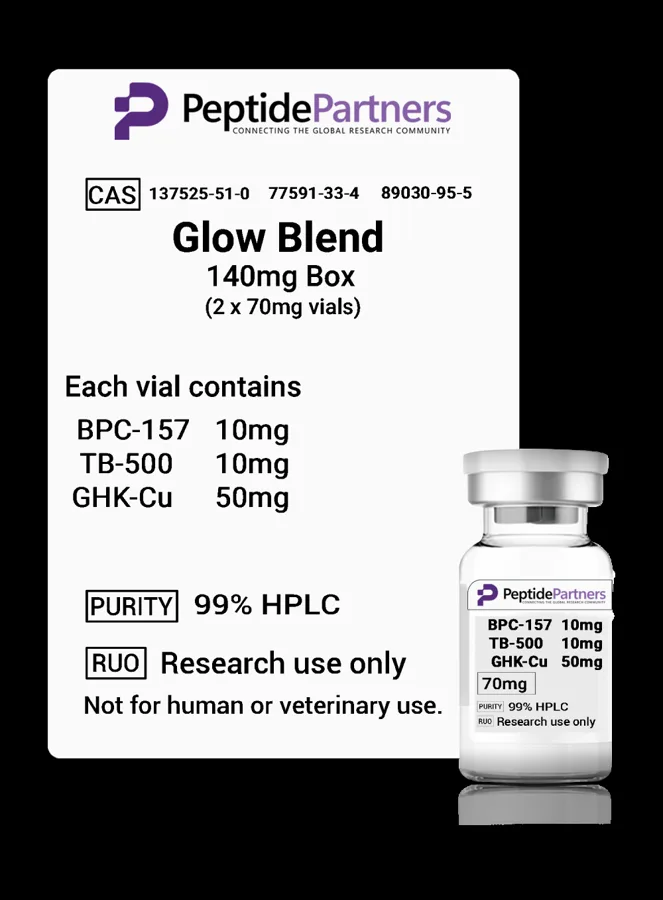
70mg per vial
Available packs
GLOW Blend: BPC-157/TB-500/GHK-Cu
$146 - $616
Buy GLOW Blend: BPC-157/TB-500/GHK-Cu (70mg vials) from Peptides Partners
Investigators and analytical laboratories seeking high-grade multi-peptide formulations can buy GLOW Blend: BPC-157/TB-500/GHK-Cu through Peptides Partners. Formulated specifically to facilitate complex cellular, extracellular matrix, and antioxidant assays, this 70mg composite vial merges three of the most widely scrutinized biomolecules in modern peptide science: Body Protection Compound-157 (BPC-157), Thymosin Beta-4 fragment (TB-500), and Copper Tripeptide-1 (GHK-Cu). Designed exclusively for in vitro experimentation and animal model research, each vial provides qualified scientists with an integrated platform to evaluate biological pathways simultaneously without the compounding variables introduced by manually blending disparate single-peptide solutions.
At Peptides Partners, our objective is to supply research institutions with dependable, chemically stable, and analytically characterized research peptides. Multi-peptide blends like the GLOW formulation demand strict control over lyophilization parameters to prevent uneven moisture distribution, unwanted complexation, or conformational degradation of individual chains. When you buy GLOW Blend: BPC-157/TB-500/GHK-Cu from our catalog, you secure laboratory-grade material prepared in compliance with rigorous quality-assurance protocols. Every unit is strictly designated for laboratory research use only and must never be utilized for human or veterinary diagnostic, therapeutic, or clinical applications.
What is GLOW Blend: BPC-157/TB-500/GHK-Cu?
The GLOW Blend is a specialized composite matrix containing three distinct synthetic peptides in an optimized ratio, standardized within a single 70mg lyophilized cake. Each individual component brings a documented structural and biochemical profile to experimental models, particularly in the fields of cellular cytoprotection, cytoskeletal organization, and free radical neutralization:
- BPC-157 (CAS: 137525-51-0): A 15-amino acid sequence derived from human gastric juice protein (Gly-Glu-Pro-Pro-Pro-Gly-Lys-Pro-Ala-Asp-Asp-Ala-Gly-Leu-Val). Preclinical studies indicate that BPC-157 exhibits high stability in acidic and enzymatically hostile environments, serving as a primary target for research involving nitric oxide (NO) synthase modulation, growth factor signaling, and microvascular maintenance.
- TB-500 (Thymosin Beta-4 Fragment): An active synthetic peptide fragment corresponding to the actin-binding domain (amino acids 17–23: Lys-Leu-Lys-Lys-Thr-Glu-Thr) of naturally occurring Thymosin Beta-4. In cellular biology, TB-500 is recognized for its capacity to sequester monomeric G-actin, regulating cytoskeletal reorganization, lamellipodia formation, and directed cell migration in damaged or stressed cell lines.
- GHK-Cu (Copper Tripeptide-1): A naturally occurring tripeptide (Glycyl-L-Histidyl-L-Lysine) that forms a coordination complex with bivalent copper ions [Cu(II)]. Categorized within the antioxidant research sector, GHK-Cu acts as a physiological modulator of extracellular matrix remodeling, modulating gene expression related to collagen synthesis, decorin expression, anti-inflammatory cascades, and the neutralization of reactive oxygen species (ROS).
By lyophilizing these three molecules together, the GLOW Blend provides a cohesive matrix allowing researchers to analyze the synergistic intersections of tissue architecture preservation, cytoskeletal cell mobility, and oxidative stress modulation within a single, highly repeatable laboratory framework.
Research effects studied
Preclinical studies have consistently explored the cellular and molecular effects of BPC-157, TB-500, and GHK-Cu across multiple experimental domains. While each peptide operates via distinct receptor interactions or enzymatic pathways, their convergence in laboratory models has generated substantial interest in tissue repair models, oxidative stress mitigation, and genetic signaling modulation.
Antioxidant and Radical Scavenging Mechanisms
The antioxidant classification of the GLOW Blend is primarily anchored in the biological properties of GHK-Cu alongside the cytoprotective profile of BPC-157. In biochemical assays, GHK-Cu has been studied for its ability to suppress the production of free radicals, including hydroxyl radicals, by chelating unbound toxic copper ions that otherwise drive Fenton-type reactions. Research indicates that GHK-Cu upregulates cellular antioxidant enzymes, notably superoxide dismutase (SOD) and glutathione peroxidase (GSH-Px), while downregulating pro-inflammatory markers such as tumor necrosis factor-alpha (TNF-α) and interleukin-6 (IL-6). In parallel, BPC-157 has been observed in animal models to normalize lipid peroxidation (measured via malondialdehyde levels) and modulate systemic nitric oxide pathways, shielding vascular and parenchymal tissue from ischemic and oxidative damage.
Cytoskeletal Mobilization and Actin Sequestration
Cellular mobility is an essential phase in tissue remodeling assays. TB-500 functions fundamentally through its actin-sequestering mechanisms. By maintaining a cellular reservoir of unpolymerized G-actin, TB-500 facilitates rapid actin filament rearrangement when mobile cells, such as dermal fibroblasts or endothelial cells, are stimulated. Preclinical scratch assays and chemotaxis models have demonstrated that the presence of TB-500 enhances cellular migration into denuded areas without artificially inducing abnormal proliferation rates, allowing researchers to study physiological wound-closure dynamics under controlled laboratory conditions.
Extracellular Matrix (ECM) Synthesis and Remodeling
GHK-Cu and BPC-157 have been evaluated for their independent and collective influences on extracellular matrix homeostasis. In fibroblast cell cultures, GHK-Cu has been shown to modulate the synthesis of both collagen type I and type III, as well as elastin, proteoglycans, and glycosaminoglycans. Simultaneously, it modulates matrix metalloproteinases (MMPs) and their tissue inhibitors (TIMPs), creating an equilibrium that prevents excessive fibrotic accumulation while encouraging structured structural regeneration. BPC-157 complements this pathway by stimulating early growth response 1 (Egr-1) gene expression and activating vascular endothelial growth factor (VEGF) receptors, establishing downstream angiogenic signaling pathways necessary for supporting matrix deposition in ischemic experimental environments.
How to use in the laboratory
Proper experimental design requires careful handling and reconstitution of multi-peptide compounds to preserve the tertiary structures, chelation bonds, and peptide integrity. When working with GLOW Blend vials, laboratory technicians should adhere strictly to the following reconstitutive and record-keeping standards:
- Aseptic Preparation: Perform all handling within a certified Class II Biosafety Cabinet or laminar flow hood. Wipe the rubber septum of the vial with a sterile 70% isopropyl alcohol swab and allow it to air-dry completely prior to needle penetration.
- Reconstitution Solvents: The GLOW Blend is typically reconstituted using sterile bacteriostatic water (0.9% benzyl alcohol preserved) for multi-draw in vitro research, or sterile 0.9% sodium chloride (saline) or analytical-grade phosphate-buffered saline (PBS) depending on the sensitivity of the downstream cell culture or assay to bacteriostatic agents.
- Solvent Introduction: Slowly introduce the diluent against the internal glass wall of the vial rather than directing the liquid stream directly onto the lyophilized cake. Maintain a gentle, slow fluid transfer to prevent localized mechanical shearing of the peptide chains.
- Dissolution Technique: Allow the diluent to permeate the powder for several minutes. Gently swirl or invert the vial manually until the lyophilized cake is fully dissolved. Do not vigorously shake or vortex the vial, as rapid agitation can induce cavitation, foaming, and conformational denaturation of the peptides, particularly the copper-bound GHK complex.
- Laboratory Record-Keeping: Record the exact volume of diluent added, the calculated final concentration (mg/mL), the date and time of reconstitution, the batch/lot number, and the technician initials on the primary container label and in the laboratory notebook.
Pack sizes and price per mg
Peptides Partners provides tiered purchasing options for research groups requiring scalable quantities of this formulation. Larger pack configurations reduce per-milligram costs, allowing institutions to efficiently plan extensive or long-term multi-sample studies.
| Pack Size | Total Content | Total Price (USD) | Effective Price per mg |
|---|---|---|---|
| 2 vials x 70mg | 140 mg | $146.00 | ~$1.04 / mg |
| 5 vials x 70mg | 350 mg | $312.00 | ~$0.89 / mg |
| 10 vials x 70mg | 700 mg | $616.00 | ~$0.88 / mg |
All packaging tiers feature sealed, vacuum-packed 70mg vials engineered to withstand thermal fluctuations during transit and preserve peptide integrity prior to laboratory arrival.
Storage and handling
Maintaining the structural stability of the GLOW Blend requires adherence to proper environmental controls before and after reconstitution.
- Lyophilized Product Storage: Store unopened vials in a dry, dark environment at -20°C for long-term storage (up to 24 months). For short-term experimental scheduling (under 4 to 8 weeks), unopened vials may be kept refrigerated at 2°C to 8°C. Keep vials protected from direct exposure to natural or ultraviolet light sources to prevent photolytic oxidation of the GHK-Cu chelation bonds.
- Reconstituted Solution Storage: Once dissolved, store the liquid solution at 2°C to 8°C and utilize within 21 to 28 days if reconstituted with bacteriostatic water. If non-preserved diluents (such as sterile PBS or saline) are used, the solution should be utilized immediately or aliquoted into sterile microcentrifuge tubes and stored at -20°C to -80°C to avoid microbial proliferation.
- Freeze-Thaw Cycles: Avoid repeated freeze-thaw cycles. Multiple phase transitions degrade the peptide chains and disrupt copper coordination, leading to precipitation or altered analytical results. Aliquoting upon reconstitution is highly recommended for protocols extending over weeks or months.
- Laboratory Safety and Disposal: Personnel should wear appropriate personal protective equipment (PPE), including nitrile gloves, lab coats, and safety goggles. Dispose of unused peptide solutions, empty vials, and reconstitution needles in accordance with standard institutional hazardous chemical and bio-waste disposal guidelines.
Quality and documentation
To ensure reproducible and uncompromised experimental outcomes, Peptides Partners sources research peptides that undergo strict analytical verification. Multi-component products like the GLOW Blend present unique analytical challenges due to the co-presence of distinct molecular weights and chemical structures.
Quality confirmation is conducted through high-performance liquid chromatography (HPLC) to confirm individual component purity and evaluate against reference baselines. In addition, liquid chromatography-mass spectrometry (LC-MS) is utilized to confirm the exact molecular masses of BPC-157, TB-500, and the GHK-Cu coordination complex, verifying that no degradation or unwanted covalent interactions have occurred during synthesis or lyophilization. Batch-specific analytical documentation is maintained to provide researchers with complete transparency regarding peptide authenticity, counter-ion presence, and physical stability.
Frequently asked questions
What is the rationale behind combining BPC-157, TB-500, and GHK-Cu in research?
The combination allows researchers to simultaneously target distinct yet complementary molecular pathways involved in tissue biology. Preclinical studies suggest that while BPC-157 influences microvascular tone and early gene expression, TB-500 regulates cellular motility via actin dynamics, and GHK-Cu modulates oxidative stress and extracellular matrix remodeling. Studying them concurrently enables the observation of collective cross-talk between cellular migration, antioxidant defense, and matrix restructuring.
How should the 70mg GLOW Blend be reconstituted in an experimental setting?
Reconstitution should occur using an appropriate sterile diluent, such as bacteriostatic water, sterile saline, or buffered laboratory saline. The solvent should be introduced slowly down the interior wall of the vial under aseptic conditions. The vial should be gently swirled rather than shaken or vortexed to ensure complete dissolution without shearing the peptide molecules or disrupting the copper complex.
What is the significance of the copper ion in the GHK-Cu component?
The bivalent copper ion [Cu(II)] in GHK-Cu is coordinated within the tripeptide backbone, converting GHK into an active biochemical delivery system. In research models, this coordination allows GHK to deliver or sequester trace copper ions required for cellular enzyme function (such as lysyl oxidase and superoxide dismutase) while preventing free copper from fueling oxidative, free-radical-generating reactions within cellular environments.
Can GLOW Blend be utilized for in vivo or human administration?
No. GLOW Blend: BPC-157/TB-500/GHK-Cu is supplied strictly for in vitro laboratory experimentation, chemical characterization, and approved preclinical animal models. It is not licensed, approved, or formulated for human or veterinary use, medical therapy, clinical administration, or diagnostic procedures.
Related Peptides Partners research peptides
GLP-1 SM (10mg vials); KPV (10mg vials); Sermorelin (10mg vials).
GLOW Blend: BPC-157/TB-500/GHK-Cu lot documentation
Certificates of analysis are matched to the actual lot supplied with your order. Email sales@peptidespartners.co with the product name and pack size to request the current lot's purity, identity and screening documents before purchase.
Storage
Research peptides are typically supplied lyophilized (freeze-dried), which keeps them stable for shipping and storage. Store unopened vials cool, dry and away from light; for long-term storage, a freezer is generally recommended.
After reconstitution, keep vials refrigerated and use sterile laboratory technique. Follow the handling guidance supplied with your lot documentation.
- Short name
- GLOW Blend: BPC-157/TB-500/GHK-Cu (70mg vials)
- Vial strength
- 70mg vials
- Pack sizes
- 140mg pack, 350mg pack, 700mg pack
- Pack count options
- 2, 5, 10 vial packs
- CAS number
- 137525-51-0
- Category
- Anti-oxidant
- SKU
- PP-2160
- Compliance
- Research Use Only. Not for use in diagnostic tests.