
Humanin
10mg per vial
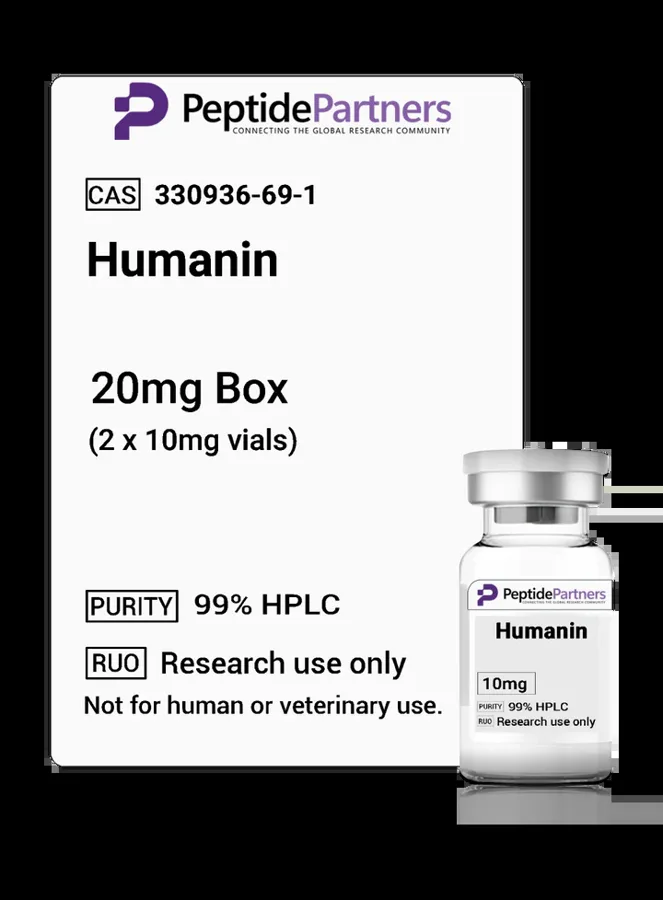
Available packs
Humanin
$165 - $720
Buy Humanin (10mg vials) from Peptides Partners
Qualified scientific researchers and research institutions looking to buy Humanin for controlled laboratory experiments can source verified, high-grade reference material directly through Peptides Partners. Each unit is supplied as a lyophilized powder contained within a sealed 10mg laboratory vial, designed specifically to maintain molecular integrity during international transit and extended storage. Humanin (CAS: 330936-69-1) is one of the most prominent mitochondrial-derived peptides under active investigation across molecular biology, metabolic disease models, gerontology, and neurodegenerative pathways.
When you acquire research peptides from Peptides Partners, you receive analytical consistency crucial for replicable experimental designs. Our catalog serves university departments, contract research organizations, and biotechnology laboratories requiring strict adherence to compositional accuracy and dependable synthesis. Humanin 10mg vials are packaged under sterile, inert gas conditions to prevent premature oxidation and degradation of the sequence before your team is ready to begin reconstitution and assay deployment.
All compounds provided by Peptides Partners are formulated exclusively for in vitro, ex vivo, and non-human in vivo preclinical research. They are not intended, licensed, or packaged for direct human application, clinical diagnostic use, therapeutic administration, or integration into pharmaceutical formulations. By standardizing our supply chain around precision peptide synthesis, we support investigators who require reliable access to foundational signaling molecules like Humanin for cell culture and preclinical inquiry.
What is Humanin?
Humanin is a 24-amino acid bioactive polypeptide that holds a unique place in mammalian biology as a mitochondrial-derived peptide (MDP). First identified in 2001 by researchers screening a functional cDNA library derived from the surviving brain tissue of deceased Alzheimer’s disease patients, Humanin was observed to confer resistance against various insults associated with cellular stress and programmed cell death. Rather than being transcribed directly from the traditional nuclear genome, Humanin is encoded within an open reading frame of the 16S ribosomal RNA (MT-RNR2) gene localized inside the mitochondrial DNA (mtDNA).
The canonical human sequence of Humanin consists of the primary primary structure: Met-Ala-Pro-Arg-Gly-Phe-Ser-Cys-Leu-Leu-Leu-Leu-Thr-Ser-Glu-Ile-Asp-Leu-Pro-Val-Lys-Arg-Arg-Ala (H-MAPRGFSCLLLLTSEIDLPVKRRA-OH). It has a calculated molecular formula of C119H204N34O32S and a nominal molecular mass of approximately 2687.2 g/mol. The peptide sequence features a distinct central hydrophobic domain (Leu9 through Leu12) that plays a critical role in its conformational structure and membrane interactions, while the cysteine residue at position 8 can be involved in dimerization states depending on the cellular redox environment.
Mechanistically, Humanin functions both intracellularly and as a secreted autocrine and paracrine signaling factor. When secreted into the extracellular environment, it interacts with at least two known cell-surface receptor complexes: a heterotrimeric receptor composed of glycoprotein 130 (gp130), the WSX-1 subunit (IL-27Rα), and the ciliary neurotrophic factor receptor alpha (CNTFRα); and the formyl peptide receptor-like 1 (FPRL1, also known as FPR2). Intracellularly, Humanin directly complexes with key regulatory proteins, notably the pro-apoptotic factor Bax and insulin-like growth factor-binding protein-3 (IGFBP-3), altering their downstream biochemical cascades.
Research effects studied
Over the past two decades, academic interest in Humanin has grown substantially, resulting in a large body of literature spanning multiple physiological systems and disease paradigms. As a regulatory factor positioned at the intersection of mitochondrial signaling and cellular defense, researchers frequently utilize Humanin to probe the following pathways in preclinical models:
- Cytoprotection and Anti-Apoptotic Pathways: The core mechanistic study of Humanin centers on its ability to inhibit programmed cell death. In vitro investigations demonstrate that Humanin directly interacts with Bax in the cytoplasm, preventing Bax translocation from the cytosol to the outer mitochondrial membrane. By suppressing Bax oligomerization, Humanin prevents the formation of mitochondrial pores that normally lead to the release of cytochrome c and subsequent caspase-3 activation. Researchers routinely study this interaction in the context of toxic insults, radiation exposure, and oxidative stress models.
- Neurodegenerative Disease Models: Because Humanin was initially discovered in neuronal survival screens, significant research has focused on its behavior in models of Alzheimer’s disease, Parkinson’s disease, and stroke. In preclinical assays, Humanin has been evaluated for its capacity to rescue primary cortical and hippocampal neurons from apoptosis induced by various amyloid-beta (Aβ) fragments, prion peptide fragments, and familial Alzheimer’s disease-linked mutant genes (such as Presenilin-1 and Presenilin-2). These studies often evaluate whether Humanin can preserve synaptic plasticity, maintain long-term potentiation, and reduce hyperphosphorylation of tau.
- Cardiovascular and Endothelial Function: Preclinical investigations have analyzed the vascular role of Humanin, specifically examining endothelial cell survival and nitric oxide (NO) dynamics. In cellular models subjected to oxidized low-density lipoprotein (oxLDL) or hypoxia-reoxygenation injury, Humanin has been observed to preserve endothelial cell viability, upregulate endothelial nitric oxide synthase (eNOS) phosphorylation, and reduce inflammatory cytokine release. Animal models of myocardial ischemia-reperfusion have similarly investigated whether systemic or localized exposure to Humanin can reduce myocardial infarct size and attenuate structural remodeling of cardiac tissue.
- Metabolic Homeostasis and Insulin Sensitivity: Humanin levels naturally decline with age in several species, leading investigators to examine its role in age-related metabolic dysregulation. In rodent models of diet-induced obesity and type 2 diabetes, central and peripheral administration of Humanin has been studied for its effects on hepatic glucose production, whole-body insulin sensitivity, and peripheral glucose disposal. Additionally, Humanin interacts with IGFBP-3 to modulate circulating levels of free IGF-1, presenting an important target for studying the regulation of somatic growth and cellular metabolism.
- Inflammatory and Mitochondrial Quality Control Signaling: By binding to FPRL1/FPR2, Humanin modulates chemotaxis and inflammatory signaling in microglial cells and circulating leukocytes. Furthermore, recent cellular studies explore whether Humanin stimulates mitochondrial biogenesis, maintains basal mitochondrial membrane potential, and limits excessive reactive oxygen species (ROS) production under chemical or metabolic strain.
How to use in the laboratory
Working with synthetic Humanin in an experimental setting requires standard peptide handling practices to preserve molecular stability, prevent enzymatic cleavage, and ensure reproducible dosing concentrations across culture wells or animal cohorts. The following guidelines provide standard preparation and handling methods for research staff:
- Preparation Environment: All reconstitution, diluting, and pipetting steps must be conducted under aseptic conditions within a calibrated laminar flow hood or biosafety cabinet using sterile, pyrogen-free pipette tips and microcentrifuge tubes. Personal protective equipment, including nitrile gloves and a clean laboratory coat, should be worn to avoid introduce external keratin, nucleases, or proteases.
- Reconstitution Solvents: Humanin contains both hydrophobic residues and positively charged arginines. For most cell culture applications, sterile bacteriostatic water, sterile deionized water, or a dilute sterile buffer such as phosphate-buffered saline (PBS, pH 7.2–7.4) can be used. When preparing concentrated working stocks, dissolving the lyophilized powder initially in a small volume of sterile sterile water or dilute acetic acid (if insolubility arises) before adding isotonic buffered saline can facilitate complete dissolution.
- Reconstitution Technique: Introduce the solvent slowly down the internal wall of the glass vial rather than jetting it directly onto the lyophilized cake. Allow the vial to stand undisturbed at ambient temperature for 5 to 10 minutes to permit passive hydration. Gently roll or invert the vial until all lyophilized particles are fully dissolved into a clear, colorless liquid. Do not vortex vigorously, as aggressive mechanical agitation creates shear stresses that can cause peptide aggregation or denaturation.
- Working Aliquots: To prevent the degradation that inevitably occurs with repeated freeze-thaw cycles, reconstitute the 10mg vial to a known primary stock concentration (e.g., 1 mg/mL or 2 mg/mL). Immediately partition the reconstituted solution into single-use, low-binding polypropylene aliquots sized specifically for daily experimental requirements.
- Laboratory Record-Keeping: Maintain detailed documentation in the laboratory notebook or laboratory information management system (LIMS). Record the product catalog number, manufacturer lot number, solvent batch number, date and time of reconstitution, final calculated concentration, calculated volume, and the identity of the technician performing the procedure. Aliquot containers must be clearly labeled with the compound identifier, date of hydration, and expiration threshold according to your institution’s quality standards.
Pack sizes and price per mg
To accommodate both pilot discovery studies and high-throughput preclinical investigations, Peptides Partners supplies Humanin 10mg vials in multiple tiered pack options. Purchasing larger volume packages substantially reduces the unit cost per milligram, providing significant cost efficiency for extended research timelines and parallel group assays.
| Pack Size | Total Quantity (mg) | Total Price (USD) | Effective Price per mg (USD) |
|---|---|---|---|
| 2 vials (10mg each) | 20 mg | $165 | $8.25 / mg |
| 5 vials (10mg each) | 50 mg | $395 | $7.90 / mg |
| 10 vials (10mg each) | 100 mg | $720 | $7.20 / mg |
Investigators who plan to buy Humanin in bulk quantities can leverage our 10-vial tier to secure an effective rate of $7.20 per milligram, ensuring that research budgets are optimized without compromising product availability or lot uniformity. When procuring research peptides for long-range multi-phase studies, acquiring unified manufacturing batches helps researchers maintain consistent baseline metrics across historical control groups.
Storage and handling
Synthetic peptides like Humanin are susceptible to degradation through oxidation, hydrolysis, and peptide bond cleavage if subjected to elevated temperatures, excessive moisture, or direct light. Adhering to validated storage parameters ensures that the material maintains its intended biological activity across its intended shelf life:
- Lyophilized Peptide Storage: Lyophilized Humanin vials must be stored in a dedicated laboratory freezer maintained at -20°C for standard short- to medium-term storage, or at -80°C for long-term archival purposes (up to 24 months). Store vials inside their original light-protective containers or surrounded by an opaque barrier, sealed within a moisture-resistant pouch containing active desiccant packets.
- Equilibration Before Opening: Prior to unsealing a refrigerated or frozen vial, remove it from the cold storage environment and allow it to reach ambient room temperature (approximately 20°C to 25°C) for at least 30 to 45 minutes on the benchtop. Opening a frozen vial prematurely allows warm, ambient atmospheric moisture to condense instantly onto the dry powder, resulting in rapid hydrolytic breakdown and inaccurate dry-weight measurements.
- Reconstituted Solution Stability: Once dissolved, aqueous Humanin solutions are significantly less stable than their solid counterparts. Reconstituted aliquots stored at 2°C to 8°C should generally be utilized within 24 to 48 hours. For storage up to 30 to 90 days, aliquots must be frozen immediately at -20°C or -80°C. Avoid repeated freeze-thaw cycles under all circumstances; discard any aliquot that has undergone more than one thaw cycle to ensure experimental reliability.
- Physical Handling and Waste Management: Handle vials with clean gloves inside a protective enclosure to eliminate contact with skin oils and ambient air currents. Collect all disposable consumables, including pipette tips and empty reconstitution vials, in designated laboratory solid waste receptacles following your organization’s environmental health and safety (EHS) biohazard and chemical disposal guidelines.
Quality and documentation
At Peptides Partners, our supply chain is anchored by analytical transparency and rigorous quality verification protocols. Every batch of Humanin distributed through our catalog is synthesized using solid-phase peptide synthesis (SPPS) methodologies, followed by multi-stage preparative purification to remove truncated sequences, residual reagents, and synthesis side-products.
Each production lot undergoes thorough physicochemical characterization before release:
- High-Performance Liquid Chromatography (HPLC): Analytical reverse-phase HPLC is executed to resolve the primary target peptide from synthesis-related impurities, providing an objective profile of chromatographic purity and retention time consistency.
- Mass Spectrometry (MS): Electrospray ionization mass spectrometry (ESI-MS) or matrix-assisted laser desorption/ionization time-of-flight (MALDI-TOF) is conducted to verify the precise molecular mass of the peptide (calculated [M+H]+ = 2688.2 Da), confirming sequence assembly and absence of major deletion variants.
- Certificate of Analysis (CoA): Batch-specific documentation detailing the physical appearance, molecular weight verification, and chromatographic data is logged for quality governance and made available to laboratory researchers upon request to accompany experimental documentation.
Our commitment to rigorous analytical verification ensures that academic, clinical, and industrial scientists who source research peptides from our platform obtain reliable, documented materials capable of meeting strict publication and grant standards.
Frequently asked questions
What is the molecular weight and sequence of Humanin?
Humanin is a 24-amino acid peptide with the sequence Met-Ala-Pro-Arg-Gly-Phe-Ser-Cys-Leu-Leu-Leu-Leu-Thr-Ser-Glu-Ile-Asp-Leu-Pro-Val-Lys-Arg-Arg-Ala. It has a calculated average molecular weight of approximately 2687.2 g/mol and a monoisotopic mass of 2685.5 g/mol, characterized by a central leucine-rich hydrophobic segment and a positively charged C-terminal domain.
Why is Humanin classified as a mitochondrial-derived peptide (MDP)?
Humanin is termed a mitochondrial-derived peptide because its genetic code is located within an open reading frame of the mitochondrial 16S ribosomal RNA gene (MT-RNR2), rather than on one of the 23 pairs of nuclear chromosomes. It was the first discovered member of this growing class of retrograde mitochondrial signaling molecules, which also includes MOTS-c and the SHLP family.
What solvent is recommended for reconstituting Humanin in experimental assays?
For most biological and cell-based protocols, sterile bacteriostatic water, sterile endotoxin-free water, or sterile phosphate-buffered saline (PBS, pH 7.2–7.4) is recommended. If solubility challenges occur at higher concentrations due to its hydrophobic core, dissolving the peptide in a minimal volume of sterile water or very dilute sterile acetic acid prior to diluting to final working concentrations with buffered media is standard practice.
Is Humanin approved for clinical use or human consumption?
No. Humanin supplied by Peptides Partners is strictly intended for scientific research and development purposes in authorized laboratory environments. It is not approved by the U.S. Food and Drug Administration (FDA) or any international regulatory body for diagnostic, therapeutic, cosmetic, or clinical administration in humans or animals.
Related Peptides Partners research peptides
Ipamorelin (10mg vials); NA Selank Amidate (30mg vials); Tesamorelin (10mg vials).
Humanin lot documentation
Certificates of analysis are matched to the actual lot supplied with your order. Email sales@peptidespartners.co with the product name and pack size to request the current lot's purity, identity and screening documents before purchase.
Storage
Research peptides are typically supplied lyophilized (freeze-dried), which keeps them stable for shipping and storage. Store unopened vials cool, dry and away from light; for long-term storage, a freezer is generally recommended.
After reconstitution, keep vials refrigerated and use sterile laboratory technique. Follow the handling guidance supplied with your lot documentation.
- Short name
- Humanin (10mg vials)
- Vial strength
- 10mg vials
- Pack sizes
- 20mg pack, 50mg pack, 100mg pack
- Pack count options
- 2, 5, 10 vial packs
- CAS number
- 330936-69-1
- Category
- All Products
- SKU
- PP-969
- Compliance
- Research Use Only. Not for use in diagnostic tests.