
MOTS-c
40mg per vial
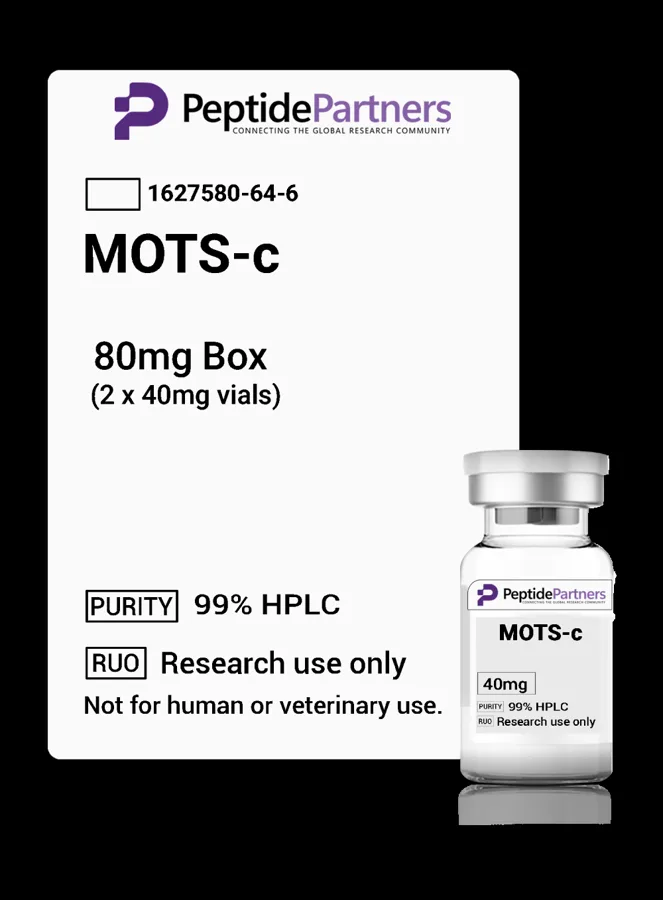
Available packs
MOTS-c
$252 - $800
Buy MOTS-c (40mg vials) from Peptides Partners
Investigators seeking high-purity mitochondrial-derived peptides can buy MOTS-c in high-capacity 40mg vials directly from Peptides Partners. As an established distributor of analytical and research peptides, Peptides Partners supplies verified biochemicals designed exclusively for in vitro experimentation, cellular assays, and preclinical animal research models. Each 40mg format offers an expanded mass quantity suitable for longitudinal experimental designs, automated liquid handling platforms, and continuous assay workflows requiring consistent batch chemistry.
Mitochondrial biology has emerged as a focal point of modern metabolic, genetic, and cellular aging research. Within this scientific framework, MOTS-c (Mitochondrial Open Reading Frame of the 12S rRNA Type-c) represents an intriguing class of regulatory molecules: peptides encoded directly within the mitochondrial genome rather than the nuclear DNA. When laboratories source research peptides through Peptides Partners, they receive lyophilized, synthesized peptides engineered to exact stoichiometric specifications, accompanied by complete batch documentation and rigorous structural validation.
The 40mg vial size is specifically calibrated for laboratories conducting high-throughput screening, multi-plate metabolic profiling, or extensive animal cohort studies where smaller microgram or single-milligram aliquots prove logistically inefficient. By choosing to buy MOTS-c through our catalog, academic institutions, biotechnology enterprises, and independent research laboratories secure dependable access to stable, pure, and meticulously documented compounds designed to advance understanding of cellular bioenergetics.
What is MOTS-c?
MOTS-c is a 16-amino acid peptide originating from a short open reading frame (sORF) situated within the mitochondrial 12S ribosomal RNA (rRNA) gene. Identified under Chemical Abstracts Service registry number CAS 1627580-64-6, this molecule altered long-held genetic paradigms stating that human mitochondrial DNA (mtDNA) exclusively encoded 13 respiratory chain subunits, 22 transfer RNAs (tRNAs), and 2 ribosomal RNAs. The discovery of MOTS-c confirmed that the circular mitochondrial genome also acts as an endocrine-like, non-canonical signaling organelle capable of producing bioactive peptides that communicate directly with the cellular nucleus and peripheral tissues.
The primary linear amino acid sequence of MOTS-c is defined as follows:
Met-Arg-Trp-Gln-Glu-Met-Gly-Tyr-Ile-Phe-Tyr-Pro-Arg-Lys-Leu-Arg
In standard single-letter notation, this sequence is documented as MRWQEMGYIFYPRKLR. The molecular formula of the unmodified peptide is C101H152N28O22S2, yielding a calculated monoisotopic molecular weight of approximately 2,174.6 g/mol. Structural examination reveals a distinctly amphipathic profile characterized by hydrophobic aromatic residues (tryptophan, phenylalanine, tyrosine) balanced by strongly basic, positively charged residues (arginine and lysine) toward the C-terminal and N-terminal segments, along with a central proline-induced conformational turn.
Biochemically, MOTS-c is categorized as a “mitochondrial-derived peptide” (MDP). Unlike classical nuclear-encoded hormonal peptides that transit through the standard endoplasmic reticulum-Golgi secretory pathway via dedicated signal peptides, MOTS-c functions via retrograde mitochondrial-to-nuclear signaling networks. In baseline biological environments, the peptide resides within the mitochondrial matrix and cytosolic compartments. Under conditions of metabolic strain, nutrient deprivation, or oxidative stress, experimental models indicate that MOTS-c translocates across the nuclear membrane to modulate transcriptional expression programs, serving as an adaptive stress-response coordinator.
Research effects studied
The discovery of MOTS-c has initiated a broad spectrum of preclinical investigations spanning biochemistry, cellular physiology, and molecular pharmacology. Below are key areas of investigation documented in peer-reviewed scientific literature:
- AMP-Activated Protein Kinase (AMPK) Signaling: A foundational mechanism described in preclinical research is the capacity of MOTS-c to stimulate the phosphorylation of AMPK at Thr172. Rather than acting as a direct kinase ligand, studies indicate that MOTS-c influences the folate-methionine biochemical pathway. By suppressing folate cycle turnover, the peptide induces an accumulation of 5-aminoimidazole-4-carboxamide ribonucleotide (AICAR), an endogenous intermediate that directly binds to and activates the regulatory gamma-subunit of AMPK. This signaling cascade has made the peptide a focal compound for studying cellular energy sensing and metabolic adaptation.
- Glucose Uptake and Insulin Sensitivity Models: In murine and skeletal muscle cell culture models, MOTS-c exposure has been investigated for its capacity to stimulate cellular glucose transport independent of canonical insulin receptor engagement. Preclinical models of diet-induced obesity demonstrate that exogenous application of the peptide correlates with elevated GLUT4 expression and membrane translocation, enhanced glucose clearance curves, and attenuated hepatic gluconeogenesis. Researchers frequently evaluate MOTS-c to model metabolic flexibility in contexts characterized by systemic insulin desensitization.
- Cellular Stress and Retrograde Nuclear Translocation: Research confirms that metabolic stressors, such as glucose deprivation or heat shock, trigger the active translocation of MOTS-c from the cytoplasm to the nuclear compartment. Once localized to the nucleus, chromatin immunoprecipitation assays reveal that MOTS-c binds directly to DNA response elements in coordination with key transcription factors, including Nuclear Factor Erythroid 2-Related Factor 2 (NRF2). This interaction modulates antioxidant response element (ARE) pathways, downregulating reactive oxygen species (ROS) and coordinating cytoprotective gene expression.
- Physical Performance and Exercise Mimetic Investigations: Preclinical rodent protocols have scrutinized MOTS-c as a potential exercise mimetic. Researchers observe that systematic administration in aging or metabolically challenged mice correlates with increased treadmill exhaustion times, preserved skeletal muscle fiber diameter, and stimulated mitochondrial biogenesis (evidenced by upregulation of PGC-1α and TFAM markers). These studies aim to clarify how cellular organisms adapt to metabolic turnover at the tissue level.
- Lipid Catabolism and Adipose Tissue Dynamics: In vitro experiments utilizing brown, white, and beige adipocyte cultures demonstrate that MOTS-c incubation corresponds with increased expression of uncoupling protein 1 (UCP1) and associated thermogenic markers. Investigations into non-alcoholic fatty liver disease (NAFLD) models report reduced intrahepatic lipid droplet accumulation, suppression of de novo lipogenesis enzymes (such as fatty acid synthase, FAS), and enhanced mitochondrial beta-oxidation rates.
- Cellular Senescence and Longevity Biomarkers: Due to its association with mitochondrial decline, researchers investigate MOTS-c concentrations in biological aging models. Comparative analyses suggest circulating endogenous concentrations of the peptide decrease with advancing chronological age in animal subjects. Studies using senescent cell lines evaluate whether peptide introduction modifies the senescence-associated secretory phenotype (SASP), telomere stability, or systemic inflammatory cytokines.
How to use in the laboratory
Laboratory handling of MOTS-c requires rigorous adherence to synthetic peptide preparation methodologies. The 40mg format provides a substantial stock quantity that should be systematically processed to safeguard chemical integrity across multiple experimental cycles. This material is designed solely for in vitro and laboratory-based preclinical protocols; it is never intended for human administration or clinical use.
Reconstitution protocols must account for the physicochemical attributes of the 16-amino acid sequence. Because the peptide contains both hydrophobic aromatic residues and multiple basic residues, proper solvent selection ensures complete solubility without aggregation:
- Solvent Selection: Primary reconstitution is typically executed using sterile bacteriostatic water (containing 0.9% benzyl alcohol) for research requiring preservation against microbial contamination over multi-week storage, or sterile deionized research-grade water (e.g., Milli-Q) for immediate experimental utilization. If solubility challenges occur at elevated target concentrations, a brief adjustment using dilute acetic acid (0.1% to 1.0%) or sterile phosphate-buffered saline (PBS, pH 7.2–7.4) may be utilized depending on down-stream cellular tolerance parameters.
- Aseptic Reconstitution Technique: Introduce the chosen solvent down the internal glass wall of the vial using a calibrated micropipette or sterile syringe to prevent direct hydraulic impact on the lyophilized cake. Avoid vigorous shaking, mechanical agitation, or high-speed vortexing, which can introduce shear forces capable of denaturing peptide secondary structures or promoting peptide aggregation. Gently roll or invert the vial manually until the optical clarity confirms complete dissolution of the solid material.
- Concentration and Aliquot Management: To maximize stability, researchers routinely prepare a concentrated primary stock (e.g., 10 mg/mL to 20 mg/mL). Immediately following full dissolution, divide the stock solution into single-use, sterile polypropylene or low-protein-binding microcentrifuge tubes. Aliquoting limits ambient thermal degradation and eliminates repeated freeze-thaw cycles, which structurally degrade peptide backbones over time.
- Record-Keeping and Protocol Logging: Document the reconstitution volume, batch identification code, exact concentration calculations, date of preparation, and initial solvent on both the external container labeling and the laboratory information management system (LIMS) or research notebook. Maintain full traceability linking experimental assay results back to the original vial lot documentation.
Pack sizes and price per mg
To support scalable project design, Peptides Partners offers MOTS-c 40mg vials across three tiered packaging options. Purchasing in volume reduces the effective cost per milligram, enabling laboratories to secure substantial reserves for longitudinal studies, dose-response matrix modeling, and multi-investigator projects.
The table below provides a detailed structural breakdown of available pack sizes, total peptide content, overall package price, and calculated cost per milligram:
| Pack Option | Total Active Content | Total Price (USD) | Price per Milligram (USD/mg) |
|---|---|---|---|
| 2 vials x 40mg | 80 mg | $252.00 | $3.15 |
| 5 vials x 40mg | 200 mg | $525.00 | $2.625 |
| 10 vials x 40mg | 400 mg | $800.00 | $2.00 |
Laboratories scaling their research can optimize research budgets by shifting from entry-level experimental validation packs (2 vials) to extensive screening or multi-cohort packaging (10 vials), achieving an expenditure reduction down to $2.00 per milligram.
Storage and handling
Synthetic peptides are susceptible to thermal degradation, oxidation, deamidation, and photochemical decomposition if held in sub-optimal environments. MOTS-c contains methionine residues at positions 1 and 6, which represent potential oxidation sites; consequently, environmental exposure must be methodically regulated.
- Lyophilized Form: In its unopened, freeze-dried state, MOTS-c remains stable when maintained at -20°C for standard laboratory intervals. For extended multi-year preservation, storage at -80°C in a non-frost-free scientific freezer is recommended. Vials should be stored in secondary sealed containment containing active desiccant packs to prevent atmospheric moisture ingress. Prior to opening any vial, allow the container to equilibrate fully to ambient room temperature (approximately 30 to 45 minutes) to avoid vacuum-induced condensation onto the lyophilized powder.
- Reconstituted Solutions: Liquid working solutions should be stored at 2°C to 8°C if scheduled for assay use within 24 to 72 hours. For extended storage, aliquoted solutions must be held at -20°C or -80°C. Avoid domestic or auto-defrost laboratory freezers, as cycling internal temperatures promote ice crystal formation and structural degradation. Reconstituted aliquots must never be subjected to more than a single freeze-thaw sequence.
- Photochemical Protection: Because the peptide contains the light-sensitive aromatic residues tyrosine, phenylalanine, and tryptophan, store both solid vials and liquid stocks in light-resistant conditions, such as amber storage boxes or wrapped in protective laboratory foil.
- Chemical Compatibility: Keep reconstituted peptide stocks away from strong oxidizing agents, strong bases, and trace transition metal solutions, which can accelerate methionine sulfoxide formation or peptide chain cleavage.
Quality and documentation
Peptides Partners enforces stringent analytical standards across our entire portfolio of research peptides. Synthesized utilizing solid-phase peptide synthesis (SPPS) chemistries, every batch of MOTS-c is subjected to rigorous quality-control analysis to ensure reproducibility across experimental repetitions.
Primary analytical methodologies include:
- High-Performance Liquid Chromatography (HPLC): Analytical reverse-phase HPLC is performed to assess chromatographic purity, confirming the elimination of truncated sequences, deletion peptides, and synthesis side-products. The resulting chromatogram provides quantifiable peak-area distribution under validated gradient conditions.
- Mass Spectrometry (MS): Electrospray Ionization Mass Spectrometry (ESI-MS) or Matrix-Assisted Laser Desorption/Ionization Time-of-Flight (MALDI-TOF) confirms exact molecular mass. Spectral data verify that the observed monoisotopic [M+H]+ and multi-charged species correspond directly with the theoretical mass of MOTS-c (2,174.6 g/mol).
- Lot-Specific Certificates of Analysis (CoA): Every product distributed by Peptides Partners is linked to a verified, lot-specific CoA detailing analytical results, peptide content percentages, chemical identity metrics, and physical appearance criteria.
These quality control procedures ensure that investigators sourcing reagents for cell culture, biochemical assays, or animal models receive dependable chemical standards that eliminate synthetic artifacts or variable impurities as confounding experimental variables.
Frequently asked questions
What is the molecular weight and sequence of MOTS-c?
MOTS-c possesses a defined molecular weight of approximately 2,174.6 g/mol with the chemical formula C101H152N28O22S2. Its sequence consists of 16 amino acids organized linearly as Met-Arg-Trp-Gln-Glu-Met-Gly-Tyr-Ile-Phe-Tyr-Pro-Arg-Lys-Leu-Arg (MRWQEMGYIFYPRKLR). This composition features an amphipathic structure characterized by distinct aromatic centers and positively charged terminal regions.
How should reconstituted MOTS-c be prepared for in vitro assays?
For in vitro investigations, researchers reconstitute the lyophilized peptide using sterile, endotoxin-free water or an assay-compatible aqueous buffer under aseptic laminar flow conditions. Once dissolved, the concentrated stock is diluted into cell culture media or balanced salt solutions immediately prior to experiment execution. Working dilutions should be evaluated for osmotic and pH compatibility with the target cellular model, and any unused working media containing the peptide should not be stored long-term due to variable degradation rates in multi-component liquid media.
Why is MOTS-c classified as a mitochondrial-derived peptide rather than a nuclear-encoded peptide?
MOTS-c is designated as a mitochondrial-derived peptide (MDP) because its open reading frame resides entirely within the 12S ribosomal RNA sequence of the mitochondrial genome, rather than within the linear chromosomes of the cell nucleus. It is translated on mitochondrial or localized cytosolic ribosomes and operates in a retrograde fashion, translocating from the cytoplasm or mitochondrial domain into the nucleus to coordinate adaptive transcriptional responses during metabolic stress.
What research solvents are standard for reconstituting 40mg MOTS-c vials?
Standard laboratory reconstitution solvents include sterile research-grade deionized water, bacteriostatic water containing 0.9% benzyl alcohol, or sterile phosphate-buffered saline (PBS). Because 40mg represents a substantial mass quantity, researchers must ensure sufficient solvent volume (e.g., 2mL to 4mL) to achieve manageable working concentrations (such as 10 mg/mL to 20 mg/mL) without exceeding solubility thresholds or introducing high viscosity into pipetting systems.
Related Peptides Partners research peptides
NA Selank Amidate (30mg vials); Sermorelin (10mg vials); KBT Blend: BPC-157/TB-500/KPV (60mg vials).
MOTS-c lot documentation
Certificates of analysis are matched to the actual lot supplied with your order. Email sales@peptidespartners.co with the product name and pack size to request the current lot's purity, identity and screening documents before purchase.
Storage
Research peptides are typically supplied lyophilized (freeze-dried), which keeps them stable for shipping and storage. Store unopened vials cool, dry and away from light; for long-term storage, a freezer is generally recommended.
After reconstitution, keep vials refrigerated and use sterile laboratory technique. Follow the handling guidance supplied with your lot documentation.
- Short name
- MOTS-c (40mg vials)
- Vial strength
- 40mg vials
- Pack sizes
- 80mg pack, 200mg pack, 400mg pack
- Pack count options
- 2, 5, 10 vial packs
- CAS number
- 1627580-64-6
- Category
- Mitochondrial
- SKU
- PP-9668
- Compliance
- Research Use Only. Not for use in diagnostic tests.