
MOTS-c
10mg per vial
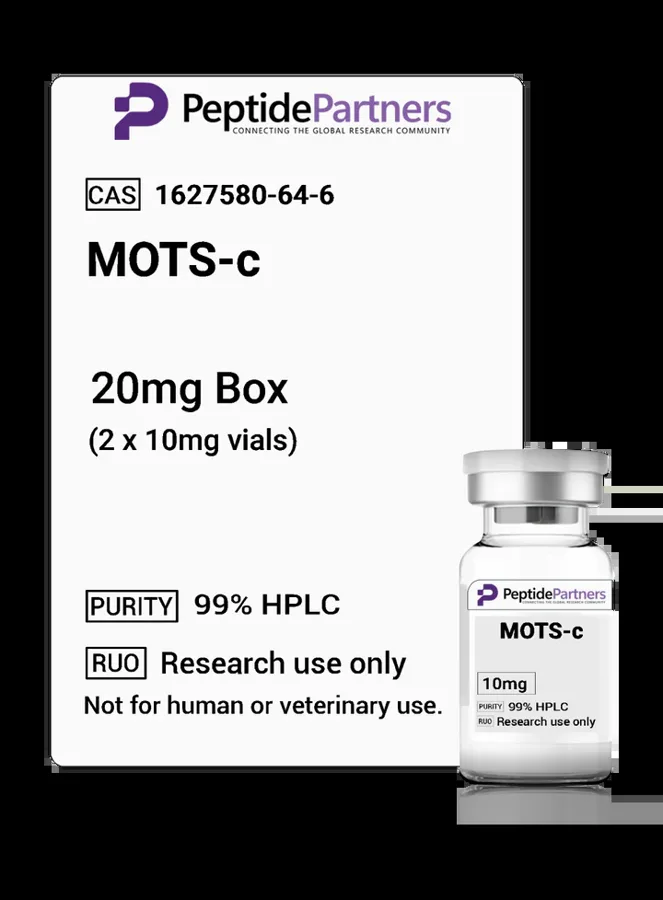
Available packs
MOTS-c
$79 - $338
Buy MOTS-c (10mg vials) from Peptides Partners
Qualified scientific researchers, analytical laboratories, and academic institutions seeking high-purity mitochondrial-derived peptides can reliably buy MOTS-c through Peptides Partners. Each sterile vial contains 10mg of lyophilized MOTS-c (Mitochondrial Open Reading Frame of the 12S rRNA Type-c), synthesized under strict chemical standards to ensure accurate molecular weight, defined sequence integrity, and high lot-to-lot consistency. As a major supplier of research peptides, Peptides Partners distributes reference materials exclusively designed for in vitro assays, cellular cultures, and controlled in vivo animal research. Products provided by Peptides Partners are explicitly not intended for human or veterinary administration, diagnostic procedures, therapeutic treatments, or clinical interventions of any kind.
When laboratories decide to buy MOTS-c for experimental setups, batch consistency and peptide stability are paramount. Our distribution protocols preserve the cold-chain integrity of the lyophilized powder, reducing the potential for early chemical degradation such as deamidation, oxidation, or beta-elimination. Whether your research group is running high-throughput metabolic screens, examining mitochondrial retrograde signaling pathways, or studying cellular energetics in tissue models, Peptides Partners supplies the structural reagents required to yield reproducible experimental endpoints across diverse scientific workflows.
What is MOTS-c?
MOTS-c (Mitochondrial Open Reading Frame of the 12S rRNA Type-c) is a 16-amino acid peptide encoded by a short open reading frame (sORF) within the 12S ribosomal RNA locus of the mitochondrial genome (mtDNA). Identified under the Chemical Abstracts Service registry as CAS: 1627580-64-6, MOTS-c represents an evolutionary shift in classical genetic understanding. Historically, the mammalian mitochondrial genome was thought to encode only thirteen protein subunits involved in the oxidative phosphorylation (OXPHOS) machinery, alongside twenty-two transfer RNAs (tRNAs) and two ribosomal RNAs (12S and 16S). The discovery of functional sORFs demonstrated that mitochondria also encode bioactive signaling peptides, classified broadly as mitochondrial-derived peptides (MDPs).
The primary linear amino acid sequence of MOTS-c is Met-Arg-Trp-Gln-Glu-Met-Gly-Tyr-Ile-Phe-Tyr-Pro-Arg-Lys-Leu-Arg (MRWQEMGYIFYPRKLR). It features a calculated molecular weight of approximately 2174.6 g/mol and exhibits amphipathic chemical properties due to the juxtaposition of charged, basic residues (arginine and lysine) alongside hydrophobic aromatic residues (tryptophan, tyrosine, and phenylalanine). Structurally, this unique distribution of residues influences how the peptide folds, interacts with cell surface components, and associates with intracellular chaperones during cellular stress responses.
Biochemically, MOTS-c functions within what researchers refer to as mitochondrial retrograde signaling—a bidirectional communication axis in which signals originate within the organelle and migrate to the nucleus to modify nuclear gene expression. Under basal cellular conditions, MOTS-c is maintained predominantly within the cytoplasm. However, in response to cellular metabolic perturbations, such as nutrient deprivation or energetic challenge, published models demonstrate that MOTS-c translocates to the cell nucleus. Once inside the nuclear compartment, it physically binds to specific transcription factors, including nuclear factor erythroid 2-related factor 2 (NRF2), altering the downstream transcriptional output governing antioxidant response elements and cellular homeostasis.
Research effects studied
Over the past decade, MOTS-c has emerged as a major focus within cellular metabolism, gerontology, and endocrinology literature. Experimental investigations have surveyed its biochemical pathways across a wide array of cell lines and preclinical animal models:
- AMPK Pathway Activation and Metabolic Regulation: Preclinical investigations have repeatedly observed that MOTS-c treatment stimulates the phosphorylation of 5′ AMP-activated protein kinase (AMPK). In mechanistic assays, this signaling cascade appears to be mediated through MOTS-c’s interference with the folate-methionine cycle. By directly targeting the de novo purine biosynthesis pathway—specifically inhibiting the bifunctional enzyme 5-aminoimidazole-4-carboxamide ribonucleotide formyltransferase/IMP cyclohydrolase (ATIC)—MOTS-c leads to the intracellular accumulation of 5-aminoimidazole-4-carboxamide ribonucleotide (AICAR). As an endogenous structural analog of AMP, AICAR promotes the allosteric activation and subsequent phosphorylation of AMPK at the Thr172 residue. This activation switch directs cellular metabolism away from energy-consuming biosynthetic pathways and toward catabolic energy generation.
- Insulin Sensitivity and Glucose Disposal Models: In murine models of high-fat diet-induced metabolic dysfunction, published literature has examined the ability of MOTS-c to modulate peripheral insulin sensitivity. Researchers have documented an enhanced clearance of glucose from systemic circulation into skeletal muscle beds without an obligate increase in pancreatic beta-cell insulin secretion. Laboratory measurements report an upregulation of glucose transporter type 4 (GLUT4) translocation to the plasma membrane, accompanied by altered rates of glycolysis and fatty acid beta-oxidation.
- Skeletal Muscle Plasticity and Physical Performance: Preclinical research in young and aged rodents has investigated the effects of exogenous MOTS-c administration on physical capacity and muscle architecture. Findings describe adaptations such as improved running capacity, elevated exercise endurance, and altered expression of genes responsible for mitochondrial biogenesis, such as peroxisome proliferator-activated receptor gamma coactivator 1-alpha (PGC-1alpha). Researchers have noted that these muscle adaptations occur alongside reductions in intramuscular lipid accumulation.
- Cellular Senescence and Longevity Pathways: In gerontological research, MOTS-c has been studied for its potential role in modulating molecular hallmarks of aging. Studies utilizing senescent human fibroblasts demonstrate that MOTS-c treatment can suppress the secretion of several senescence-associated secretory phenotype (SASP) factors, including interleukin-6 (IL-6) and tumor necrosis factor-alpha (TNF-alpha). Furthermore, research into mitochondrial retrograde regulation has explored how circulating levels of MOTS-c correlate with biological age across diverse mammalian cohorts.
- Bone Density and Osteogenesis Assays: In vitro experiments utilizing bone marrow-derived mesenchymal stem cells (BMSCs) have explored the influence of MOTS-c on osteogenic differentiation. Preclinical models of osteoporosis describe enhanced mineralization, alkaline phosphatase activity, and the expression of osteogenic marker genes such as Runx2, while concurrently downregulating pathways associated with osteoclastogenesis and bone resorption.
How to use in the laboratory
To preserve structural fidelity and obtain reproducible data, researchers working with MOTS-c in an analytical or cell-culture setting must adhere to standard chemical laboratory practices. Because MOTS-c is supplied as a lyophilized powder, reconstitution represents a critical step where experimental error can easily be introduced.
When handling the product in the laboratory, adhere strictly to the following parameters:
- Equilibration: Before opening the vial, allow the sealed container to equilibrate to ambient room temperature (typically 20°C to 25°C) for at least 30 minutes inside a desiccator or biological safety cabinet. Opening cold vials exposes the dry lyophilized cake to atmospheric moisture, which can cause rapid condensation, partial hydrolysis, and clumping of the peptide powder.
- Aseptic Reconstitution: Reconstitution should be performed within a laminar flow hood using sterile laboratory equipment. Suitable diluents include sterile bacteriostatic water for in vitro stock preservation, sterile water for injection (SWFI), or sterile phosphate-buffered saline (PBS, pH 7.4). Due to the presence of both hydrophobic residues and positively charged basic residues in MOTS-c, dissolving the peptide in pure, neutral water or slightly acidic physiological buffers ensures rapid solubilization without salt precipitation.
- Dissolution Technique: Introduce the chosen solvent slowly along the internal glass wall of the vial using a calibrated pipette. Do not direct the fluid stream straight onto the lyophilized pellet. Allow the liquid to wet the cake, then gently swirl or rotate the vial by hand. Never vortex, sonicate excessively, or vigorously shake peptide solutions, as mechanical shear stress can disrupt secondary conformations or induce covalent aggregation.
- Concentration and Aliquoting: Determine the target working concentration appropriate for your specific cell culture assays or spectrophotometric evaluations (e.g., preparing a stock solution of 1.0 mg/mL or 2.0 mg/mL). Immediately after full dissolution, divide the stock into single-use, sterile polypropylene microcentrifuge tubes. Aliquoting prevents the necessity of multiple freeze-thaw cycles, which are known to degrade peptide bonds and diminish biological activity over time.
- Record-Keeping and Documentation: Standard operating procedures should require researchers to record the date of reconstitution, solvent lot number, final calculated molarity or mass concentration, and the exact initial weight of the reconstituted vial. Maintain a clear laboratory inventory log that tracks each aliquot’s passage through storage to ensure complete experimental traceability.
Pack sizes and price per mg
Peptides Partners provides flexible ordering configurations tailored to laboratory requirements ranging from pilot feasibility testing to extensive, high-sample in vitro protocols. When researchers buy MOTS-c from our catalog, volume scaling offers progressively lower unit costs per milligram, facilitating budget optimization for funded research projects.
The table below summarizes the available pack options, overall quantity, total price, and calculated cost per milligram for MOTS-c (10mg vials):
| Pack Configuration | Total Peptide Content | Total Price (USD) | Price per Milligram (USD) |
|---|---|---|---|
| 2 vials x 10mg | 20 mg | $79.00 | $3.95 / mg |
| 5 vials x 10mg | 50 mg | $188.00 | $3.76 / mg |
| 10 vials x 10mg | 100 mg | $338.00 | $3.38 / mg |
Storage and handling
The chemical stability of research peptides is profoundly affected by temperature, exposure to ultraviolet (UV) radiation, and environmental humidity. To guarantee maximum preservation of MOTS-c in the laboratory, protocols should adhere to validated physical storage standards:
- Lyophilized Peptide Storage: In its intact, dry form, MOTS-c should be stored at -20°C for routine medium-term preservation. For long-term archiving exceeding twelve months, storing the vials at -80°C is strongly recommended. The lyophilized matrix remains stable under these cryogenic conditions, resisting peptide degradation and background oxidation.
- Reconstituted Stock Storage: Once placed into aqueous solution, the susceptibility of the peptide to cleavage and microbial contamination rises significantly. Aliquoted aqueous solutions must be stored at -20°C or -80°C. Aliquots stored at -20°C are generally stable for short-term testing windows (typically up to 4 to 8 weeks), whereas storage at -80°C prolongs solution stability. Working aliquots held temporarily at refrigerated conditions (2°C to 8°C) should be utilized promptly, preferably within 24 to 72 hours.
- Freeze-Thaw Prevention: Repeated cycles of freezing and thawing cause localized solute concentration changes and mechanical stress that destabilize the peptide backbone. Discard any aliquot that has undergone more than one freeze-thaw sequence, or validate the specific stability of re-frozen samples through liquid chromatography prior to testing.
- Light Protection: MOTS-c contains aromatic residues, notably tryptophan and tyrosine, which are inherently photolabile and susceptible to photo-oxidation when exposed to direct light. Vials and aliquots should be preserved inside light-shielding secondary containers, such as amber storage boxes or light-impermeable laboratory storage sleeves.
Quality and documentation
Scientific rigor requires absolute confidence in the structural identity and mass accuracy of all biochemical inputs. At Peptides Partners, every synthesized batch of MOTS-c is subjected to analytical characterization via modern analytical chemistry platforms. We utilize High-Performance Liquid Chromatography (HPLC) to verify peak retention profile and relative purity, ensuring the synthetic sample is free from non-target peptide truncations or incomplete sequences.
In parallel, Electrospray Ionization Mass Spectrometry (ESI-MS) or Matrix-Assisted Laser Desorption/Ionization Time-of-Flight (MALDI-TOF) mass spectrometry is executed to confirm that the observed molecular weight corresponds exactly to the theoretical mass of MOTS-c (2174.6 g/mol). A comprehensive Certificate of Analysis (CoA) containing analytical chromatograms and mass spectra is made available for every lot, allowing research personnel to fulfill laboratory documentation, regulatory compliance, and institutional auditing mandates prior to running assays.
Frequently asked questions
What is the molecular classification and primary sequence of MOTS-c?
MOTS-c is classified as a mitochondrial-derived peptide (MDP). It is encoded by a short open reading frame located within the 12S rRNA region of mitochondrial DNA (CAS: 1627580-64-6). It is composed of 16 amino acids arranged in the sequence Met-Arg-Trp-Gln-Glu-Met-Gly-Tyr-Ile-Phe-Tyr-Pro-Arg-Lys-Leu-Arg, with a calculated molecular weight of approximately 2174.6 g/mol.
How should MOTS-c be reconstituted for in vitro assays?
MOTS-c should be reconstituted under a sterile laminar flow cabinet using an appropriate physiological diluent, such as sterile bacteriostatic water, sterile water for injection, or sterile PBS (pH 7.4). The solvent should be introduced along the glass wall without creating bubbles or mechanical shear. The solution should be gently swirled until completely clear, then immediately portioned into sterile single-use polypropylene aliquots to eliminate the need for freeze-thaw cycles.
Is MOTS-c approved for human therapeutic or clinical application?
No. MOTS-c provided by Peptides Partners is an analytical-grade reagent synthesized exclusively for laboratory research use only (RUO). It is not approved by regulatory bodies, including the U.S. Food and Drug Administration (FDA) or European Medicines Agency (EMA), for human or animal application. It must never be injected, ingested, or applied as a drug, food additive, cosmetic, or therapeutic substance.
What is the recommended storage protocol to prevent peptide degradation?
Lyophilized vials should be maintained frozen at -20°C for routine storage or at -80°C for prolonged holding, kept inside a desiccator or sealed container shielded from light. Following reconstitution, liquid aliquots must be frozen at -20°C or -80°C. Laboratories should avoid exposing the peptide to repeated freeze-thaw events and excessive light to prevent chemical decomposition of photo-sensitive residues such as tryptophan and tyrosine.
Related Peptides Partners research peptides
MOTS-c (40mg vials); Semax (30mg vials); GLP-3 Retatrutide (24mg vials).
MOTS-c lot documentation
Certificates of analysis are matched to the actual lot supplied with your order. Email sales@peptidespartners.co with the product name and pack size to request the current lot's purity, identity and screening documents before purchase.
Storage
Research peptides are typically supplied lyophilized (freeze-dried), which keeps them stable for shipping and storage. Store unopened vials cool, dry and away from light; for long-term storage, a freezer is generally recommended.
After reconstitution, keep vials refrigerated and use sterile laboratory technique. Follow the handling guidance supplied with your lot documentation.
- Short name
- MOTS-c (10mg vials)
- Vial strength
- 10mg vials
- Pack sizes
- 20mg pack, 50mg pack, 100mg pack
- Pack count options
- 2, 5, 10 vial packs
- CAS number
- 1627580-64-6
- Category
- Mitochondrial
- SKU
- PP-988
- Compliance
- Research Use Only. Not for use in diagnostic tests.