
5-Amino-1MQ
10mg per vial
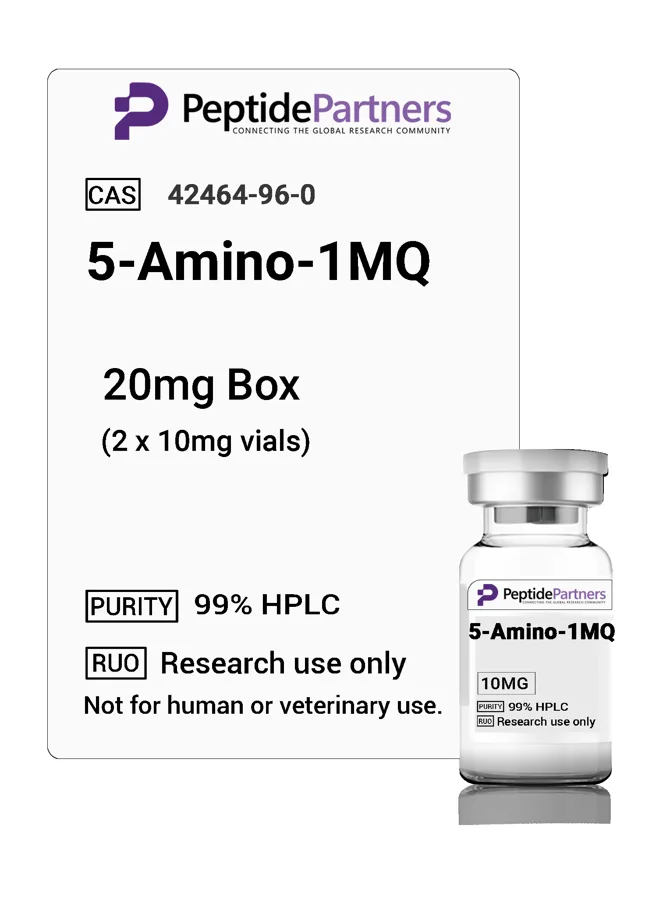
Available packs
5-Amino-1MQ
$56 - $195
Buy 5-Amino-1MQ (10mg vials) from Peptides Partners
Investigators seeking high-integrity metabolic modulators can buy 5-Amino-1MQ directly from Peptides Partners to support controlled laboratory experimentation. Supplied as a stable, lyophilized solid in individual 10mg vials, this reagent is synthesized specifically for preclinical exploration into cellular bioenergetics, enzyme kinetics, and metabolic signaling networks. Peptides Partners provides qualified institutions and independent researchers with rigorously characterized biochemicals, bridging the gap between theoretical molecular biology and replicable benchtop investigation.
5-Amino-1MQ has generated considerable interest across academic and biotechnology laboratories focused on metabolic regulation. As an inhibitor of nicotinamide N-methyltransferase, the compound provides a targeted pharmacological tool to interrogate energy expenditure pathways without disrupting upstream hormonal cascades. When you buy 5-Amino-1MQ from Peptides Partners, you receive a chemical reference standard prepared under exacting synthesis parameters, ensuring that experimental variables remain tightly controlled across consecutive assays.
Within our catalog of research peptides and small molecule biochemicals, 5-Amino-1MQ stands out for its structural precision and specific enzyme-binding profile. Each 10mg vial offers the experimental flexibility required for in vitro cellular cultures, enzymatic inhibition curves, and animal model baseline studies. Peptides Partners maintains strict supply chain oversight to ensure that investigators receive dependable research tools delivered in intact, contamination-free packaging designed for maximum bench stability.
What is 5-Amino-1MQ?
5-Amino-1MQ, chemically recognized as 5-amino-1-methylquinolinium (CAS Registry Number: 42464-96-0), is a small molecule quinoline derivative designed as a targeted, membrane-permeable inhibitor of the intracellular enzyme nicotinamide N-methyltransferase (NNMT). Although frequently categorized alongside research peptides in metabolic study catalogs due to its shared role in peptide-related hormonal and enzymatic pathways, 5-Amino-1MQ is structurally a low-molecular-weight quaternary quinolinium salt. Its primary biochemical utility lies in its capacity to bind the catalytic pocket of NNMT, altering the downstream processing of cellular methyl groups and nicotinamide metabolites.
Nicotinamide N-methyltransferase is a cytosolic enzyme responsible for catalyzing the transfer of a methyl group from S-adenosylmethionine (SAM) to nicotinamide (vitamin B3), yielding 1-methylnicotinamide (1-MNA) and S-adenosylhomocysteine (SAH). In baseline physiological states, NNMT serves as a critical regulator of cellular methylation capacity and NAD+ pool availability. However, overactivation or elevated expression of NNMT has been demonstrated to deplete cellular reserves of nicotinamide, directly attenuating the NAD+ salvage pathway and sequestering active methyl groups away from epigenetic histones and DNA methyltransferases.
By selectively occupying the substrate-binding site of NNMT, 5-Amino-1MQ suppresses the generation of 1-MNA, effectively preserving intracellular levels of unmethylated nicotinamide and SAM. This preservation allows cellular machinery to divert nicotinamide toward nicotinamide phosphoribosyltransferase (NAMPT) and the enzymatic synthesis of nicotinamide mononucleotide (NMN), ultimately sustaining intracellular NAD+ concentrations. Because of its lipophilic character and stable charge distribution, 5-Amino-1MQ crosses mammalian cell membranes readily without requiring complex delivery vectors, making it an invaluable tool for direct in vitro cellular administration.
Research effects studied
Preclinical investigations into 5-Amino-1MQ span a wide array of physiological and biochemical domains. Over the last decade, published research has characterized the compound across various experimental platforms, highlighting its distinct mechanisms of action within metabolic, structural, and cellular longevity frameworks:
- Adipocyte Metabolism and Lipid Dynamics: In animal models of diet-induced obesity, NNMT expression is significantly upregulated in white adipose tissue. Preclinical studies have evaluated how NNMT inhibition via 5-Amino-1MQ alters adipocyte size and basal energy expenditure. Research data indicate that blocking NNMT activity in cultured adipocytes leads to enhanced cellular respiration, increased oxygen consumption rate (OCR), and reduced intracellular triglyceride accumulation without decreasing caloric intake in animal test subjects.
- NAD+ Salvage Pathway Flux and Mitochondrial Biogenesis: By curbing the conversion of nicotinamide to 1-MNA, 5-Amino-1MQ has been studied for its ability to rescue intracellular NAD+ levels. Elevated NAD+ functions as an essential cofactor for sirtuin enzymes (notably SIRT1 and SIRT3) and poly(ADP-ribose) polymerases (PARPs). In vitro research demonstrates that application of 5-Amino-1MQ stimulates downstream transcription factors associated with mitochondrial biogenesis, such as peroxisome proliferator-activated receptor gamma coactivator 1-alpha (PGC-1alpha), driving increased mitochondrial density and oxidative phosphorylation efficiency.
- Epigenetic Methylation Equilibrium: The enzymatic conversion of SAM to SAH by NNMT impacts the cellular methylation potential, commonly quantified by the SAM/SAH ratio. Research models exploring cellular epigenetics have utilized 5-Amino-1MQ to observe alterations in histone methylation patterns. By preventing the systemic consumption of methyl donors by NNMT, researchers have recorded modulations in histone H3 lysine 4 (H3K4) and lysine 27 (H3K27) trimethylation, offering insight into transcriptional silencing and activation mechanisms across metabolic tissues.
- Myogenic Regeneration and Neuromuscular Physiology: Preclinical research exploring skeletal muscle senescence has identified NNMT overactivity in aged muscle stem cells (satellite cells). Studies administering 5-Amino-1MQ to murine models of muscle injury or age-related sarcopenia have documented enhanced satellite cell proliferation, accelerated myofiber fusion, and increased cross-sectional area of regenerating muscle fibers. These findings suggest that the compound facilitates an environment favorable for cellular repair by reversing metabolic exhaustion in progenitor pools.
How to use in the laboratory
5-Amino-1MQ is provided in a lyophilized state and requires careful reconstitution prior to use in laboratory protocols. The compound is strictly intended for scientific research, analytical procedures, and in vitro or animal-based experimental designs. It must not be used for clinical, diagnostic, therapeutic, or direct human application under any circumstances.
To reconstitute 5-Amino-1MQ for laboratory workflows, follow standard chemical handling procedures:
- Solvent Selection: 5-Amino-1MQ typically exhibits high solubility in sterile laboratory-grade water, bacteriostatic water, phosphate-buffered saline (PBS, pH 7.4), or dimethyl sulfoxide (DMSO), depending on the target assay requirements. For cell culture experiments requiring aqueous formulations, sterile saline or sterile PBS is standard. When stock solutions of higher concentration are required for subsequent dilution, pure research-grade DMSO may be utilized.
- Reconstitution Protocol: Ensure all work is conducted under a certified laminar flow hood to maintain sterility. Allow the 10mg vial to reach room temperature (approximately 20°C to 25°C) before introducing the diluent; this prevents moisture condensation on the lyophilized cake. Using a sterile syringe and needle, introduce the measured solvent volume slowly along the inner glass wall of the vial to minimize aggressive turbulence.
- Dissolution: Gently swirl the vial in circular motions until the solid cake is completely dissolved. Avoid vigorous mechanical vortexing or shaking, which can cause excessive foaming or shear stress to sensitive small-molecule complexes. The resulting solution should be clear, transparent, and devoid of particulate matter upon visual inspection under direct light.
- Aliquot Preparation and Record-Keeping: Once dissolved, calculate the precise working concentration (e.g., 10mg/mL or 5mg/mL). To preserve chemical stability, immediately divide the solution into single-use, sterile microcentrifuge tubes. Clearly label each aliquot with the compound identifier, batch number, concentration, solvent type, and reconstitution date. Maintain an accurate laboratory logbook documenting each vial’s usage, freeze-thaw cycles, and downstream application parameters.
Pack sizes and price per mg
Peptides Partners provides flexible ordering configurations to accommodate varying experimental designs, from small-scale exploratory assays to extensive multi-cohort laboratory studies. Ordering in multi-vial configurations significantly reduces the cost per milligram, maximizing the reach of research budgets.
Each vial contains precisely 10mg of pure lyophilized 5-Amino-1MQ. The pricing tiers and corresponding costs per milligram are detailed below:
| Pack Size | Total Content (mg) | Price (USD) | Price per mg (USD) |
|---|---|---|---|
| 2 vials (10mg each) | 20 mg | $56 | $2.80 |
| 5 vials (10mg each) | 50 mg | $120 | $2.40 |
| 10 vials (10mg each) | 100 mg | $195 | $1.95 |
Investigators managing larger screening programs or repeated preclinical protocols benefit substantially from our 10-vial volume, which lowers the baseline reagent cost to $1.95 per milligram. This economy of scale ensures that laboratories can maintain uniform batch consistency across extended analytical timelines.
Storage and handling
Maintaining the structural stability of 5-Amino-1MQ requires adherence to strict laboratory storage protocols. The lyophilized powder and reconstituted solutions have distinct environmental requirements to prevent chemical degradation, hydrolysis, or thermal breakdown.
For long-term storage of intact, unopened vials, keep the product at -20°C in a manual-defrost freezer. Avoid auto-defrost freezers, as their internal temperature cycles can compromise the physical integrity of the lyophilized matrix. When stored at -20°C protected from light, unopened vials typically retain chemical integrity for up to 24 months. For shorter intervals (less than 30 days), unopened vials may be kept in a laboratory refrigerator at 2°C to 8°C.
Once reconstituted into liquid solution, 5-Amino-1MQ must be treated with increased caution. Aqueous solutions stored at 2°C to 8°C should be utilized within 7 to 14 days to prevent progressive hydrolytic degradation. If long-term storage of reconstituted material is necessary, freeze the prepared single-use aliquots at -20°C or -80°C. Aliquots stored at -80°C are generally stable for up to 3 to 6 months. Crucially, avoid repeated freeze-thaw cycles; once an aliquot is thawed, it should be consumed in the ongoing assay or discarded in accordance with institutional chemical safety protocols.
Laboratory personnel should utilize standard personal protective equipment (PPE), including nitrile gloves, protective eyewear, and a lab coat, when handling both the solid cake and reconstituted media. Work should be conducted in an adequately ventilated space, and any spills should be cleaned immediately with appropriate absorbent materials and neutralized using institutional chemical disposal procedures.
Quality and documentation
Peptides Partners is dedicated to supplying the scientific community with reliable research peptides, enzyme inhibitors, and small molecules that adhere to rigorous quality verification standards. Reproducibility is the cornerstone of scientific progress; therefore, every production lot of 5-Amino-1MQ undergoes strict analytical validation before release.
Our quality verification processes include:
- High-Performance Liquid Chromatography (HPLC): Used to confirm the purity profile of the compound, ensuring that related substances, synthetic intermediates, and residual solvents remain well below acceptable analytical thresholds.
- Mass Spectrometry (MS): Electrospray ionization mass spectrometry (ESI-MS) confirms the exact molecular weight and chemical structure corresponding to 5-amino-1-methylquinolinium, verifying batch identity against theoretical molecular values.
- Moisture and Lyophilization Uniformity: Vials undergo stringent environmental controls during the freeze-drying process to ensure consistent cake appearance, minimal residual moisture, and rapid dissolution upon reconstitution.
Institutions purchasing from Peptides Partners can request detailed batch documentation and Certificates of Analysis (COA) corresponding to their order. These records provide transparency regarding synthesis dates, analytical test results, and compound specifications, allowing principal investigators to document standard operating conditions with complete confidence.
Frequently asked questions
What is the primary biological target of 5-Amino-1MQ in research models?
5-Amino-1MQ functions primarily as a selective, competitive inhibitor of nicotinamide N-methyltransferase (NNMT). By binding within the NNMT active site, it prevents the transfer of methyl groups from SAM to nicotinamide, thereby altering cellular NAD+ salvage dynamics, sirtuin activation, and downstream metabolic gene expression in experimental models.
How should reconstituted 5-Amino-1MQ be aliquoted for repeated assays?
Following dissolution with sterile water, PBS, or DMSO, the working liquid should be divided immediately into sterile, low-binding microcentrifuge tubes in volumes tailored to single experimental runs (e.g., 100 to 500 microliters). These aliquots should be frozen at -20°C or -80°C. This technique prevents the chemical degradation associated with repeated freeze-thaw cycles.
Why is 5-Amino-1MQ grouped alongside research peptides?
Although 5-Amino-1MQ is chemically a small-molecule quinoline derivative rather than an amino acid polymer, it is widely utilized alongside metabolic research peptides in studies addressing obesity, cellular aging, and muscle physiology. Because it influences pathways frequently studied in conjunction with growth hormone secretagogues, mitochondrial peptides, and GLP-1 analogs, it is maintained in the Peptides Partners metabolic research catalog.
Is 5-Amino-1MQ approved for human consumption or therapeutic use?
No. 5-Amino-1MQ is strictly a research chemical sold exclusively for laboratory experimentation, in vitro analysis, and preclinical animal investigation. It is not approved by regulatory agencies for human or veterinary use, consumption, injection, or medical therapy. All handling must be conducted by qualified laboratory professionals in compliant research settings.
Related Peptides Partners research peptides
5-Amino-1MQ (50mg vials); Combo Vial: BPC-157/TB-500 (20mg vials); Ipamorelin (10mg vials).
5-Amino-1MQ lot documentation
Certificates of analysis are matched to the actual lot supplied with your order. Email sales@peptidespartners.co with the product name and pack size to request the current lot's purity, identity and screening documents before purchase.
Storage
Research peptides are typically supplied lyophilized (freeze-dried), which keeps them stable for shipping and storage. Store unopened vials cool, dry and away from light; for long-term storage, a freezer is generally recommended.
After reconstitution, keep vials refrigerated and use sterile laboratory technique. Follow the handling guidance supplied with your lot documentation.
- Short name
- 5-Amino-1MQ (10mg vials)
- Vial strength
- 10mg vials
- Pack sizes
- 20mg pack, 50mg pack, 100mg pack
- Pack count options
- 2, 5, 10 vial packs
- CAS number
- 42464-96-0
- Category
- Metabolics
- SKU
- PP-27148
- Compliance
- Research Use Only. Not for use in diagnostic tests.