
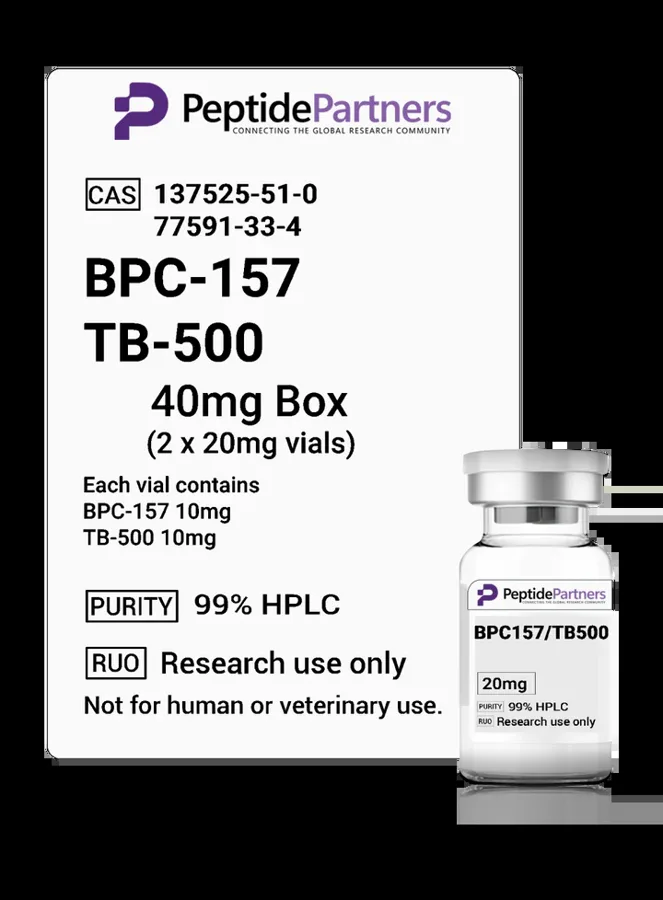
Combo Vial: BPC-157/TB-500
20mg per vial
Available packs
Combo Vial: BPC-157/TB-500
$224 - $880
Buy Combo Vial: BPC-157/TB-500 (20mg vials) from Peptides Partners
Investigators and laboratory professionals looking to evaluate the synergistic actions of cellular repair compounds can buy Combo Vial: BPC-157/TB-500 directly from Peptides Partners. This formulation pairs two of the most extensively examined synthetic peptides in regenerative biology into a single, precisely measured 20mg lyophilized unit. Formulated strictly for in vitro evaluation and animal model research, this dual-peptide preparation streamlines experimental workflows by eliminating the requirement to source, measure, and reconstitute separate single-agent vials for combination protocols.
At Peptides Partners, our catalog is curated to support reliable, reproducible bench science. Each 20mg combo vial combines pentadecapeptide BPC-157 (CAS 137525-51-0) and the synthetic Thymosin Beta-4 derivative TB-500 in a stabilized matrix that preserves molecular integrity during transport and long-term laboratory cold storage. Designed exclusively for non-human research and development, these research peptides provide qualified investigators with a potent tool for probing extracellular matrix dynamics, cell migration, angiogenesis, and tissue integrity pathways.
Ordering research peptides from Peptides Partners ensures batch-to-batch consistency, verified structural identity, and reliable fulfillment. Whether your laboratory is executing preliminary screening assays or long-term multi-cohort experiments, our bulk tier structures and secure distribution networks ensure your research program maintains uninterrupted access to high-purity chemical reagents.
What is Combo Vial: BPC-157/TB-500?
The Combo Vial: BPC-157/TB-500 is a co-lyophilized formulation featuring two distinct molecular entities categorized under cellular repair and tissue recovery research: Body Protection Compound 157 (BPC-157) and synthetic Thymosin Beta-4 (commonly designated TB-500 in research environments). Both peptides have attracted substantial scientific interest due to their complementary biochemical mechanisms in modulating wound microenvironments and structural remodeling.
BPC-157 is a 15-amino acid synthetic peptide with the primary sequence Gly-Glu-Pro-Pro-Pro-Gly-Lys-Pro-Ala-Asp-Asp-Ala-Gly-Leu-Val, cataloged under CAS number 137525-51-0. It is derived from a naturally occurring peptide found in human gastric juice, known as the “body protection compound.” In academic literature, BPC-157 is classified as a stable cytoprotective peptide characterized by its unique resistance to enzymatic degradation, gastric enzymes, and temperature fluctuations relative to other small linear peptides. Mechanistically, research demonstrates that BPC-157 interacts with nitric oxide (NO) synthesis pathways, vascular endothelial growth factor (VEGF) signaling, and the early growth response 1 (Egr-1) gene, which plays a pivotal role in cell differentiation and extracellular matrix generation.
TB-500 is an engineered peptide that mirrors the active region of Thymosin Beta-4 (Tβ4), a ubiquitous 43-amino acid intracellular protein. TB-500 primarily embodies the actin-sequestering domain (often centered around the LKKTETQ motif), which regulates actin polymerization within eukaryotic cells. Actin dynamics dictate how structural cells change shape, adhere, and migrate toward sites of tissue disruption. By maintaining a cellular pool of free monomeric actin (G-actin) and preventing premature polymerization into filamentous actin (F-actin), the active sequences of TB-500 facilitate rapid cell motility and tissue reorganization.
Combining these two agents into a single 20mg vial presents researchers with an integrated model to investigate multi-target cellular repair. While BPC-157 has been observed to modulate local vascular development and local growth factor receptor expression, TB-500 acts directly on cell structural mobility and systemic migration mechanisms. When researchers buy Combo Vial: BPC-157/TB-500, they receive an optimized mixture designed to evaluate whether concurrent receptor-mediated and cytoskeletal pathways produce additive or synergistic outcomes in vitro.
Research effects studied
The individual and combined constituents of the BPC-157/TB-500 combo vial have been the subject of extensive peer-reviewed literature across several primary domains of experimental physiology and cellular biology:
- Angiogenesis and Neovascularization: Preclinical investigations have analyzed how BPC-157 facilitates the formation of new capillary networks from pre-existing blood vessels. Studies indicate that BPC-157 upregulates mRNA expression of VEGF, VEGFR2, and flt-1, accelerating the activation of endothelial cell lines. Concurrently, Thymosin Beta-4 fragments have been documented in laboratory models to stimulate endothelial cell migration and tube formation in Matrigel assays, suggesting a coordinated response that supports nutrient delivery in damaged microenvironments.
- Cytoskeletal Dynamics and Cell Motility: TB-500 is fundamentally researched for its role as a principal G-actin-sequestering peptide. By inhibiting actin polymerization until specific signaling events occur, it allows fibroblasts, keratinocytes, and endothelial cells to rapidly alter morphology and migrate across wounded monolayers in scratch assays. Preclinical models explore how this accelerated cell migration aids in faster closure of experimental cellular lesions.
- Fibroblast Activation and Extracellular Matrix (ECM) Synthesis: In vitro experiments on tendon, ligament, and dermal fibroblasts indicate that BPC-157 exposure enhances cellular survival and stimulates collagen synthesis (specifically Type I and Type III collagen). Studies measure increased expression of focal adhesion kinase (FAK) and paxillin phosphorylation, signaling enhanced mechanical anchoring and tensile matrix formation.
- Modulation of Inflammatory Cytokine Cascades: Preclinical rodent models examining soft-tissue, intestinal, and musculoskeletal disruption have tracked significant reductions in pro-inflammatory markers following exposure to BPC-157 and TB-500. Investigators frequently monitor decreases in tumor necrosis factor-alpha (TNF-α), interleukin-6 (IL-6), and myeloperoxidase (MPO) activity, alongside increases in anti-inflammatory mediators such as interleukin-10 (IL-10).
- Tendon, Ligament, and Myofiber Remodeling: Animal studies investigating transected Achilles tendons, medial collateral ligaments, and crush-injured skeletal muscle tissue frequently utilize combinations of these peptides. Researchers assess functional recovery markers, histological organization of muscle fibers, organized parallel collagen fiber alignment, and reduction of fibrotic scar formation compared to control groups.
- Gastrointestinal and Organ Cytoprotection: Independent evaluations of BPC-157 highlight its protective influence across diverse tissue surfaces, including gastric mucosa, hepatic tissue, and neural cells in culture. Research links these effects to the modulation of both constitutive and inducible nitric oxide synthase (cNOS/iNOS) expression, mitigating oxidative stress and stabilizing cell membrane permeability.
How to use in the laboratory
The Combo Vial: BPC-157/TB-500 (20mg vials) is supplied as a sterile, vacuum-sealed lyophilized cake intended solely for laboratory experimentation. It must not be administered to humans or animals outside approved scientific models. Proper handling, reconstitution, and documentation protocols are essential to ensure the physical stability of both peptide components and to maintain data reproducibility.
Before initiating any laboratory manipulation, review the following standard operating procedures:
- Reconstitution Solution: Peptides of this class are typically reconstituted using Bacteriostatic Water (0.9% benzyl alcohol preserved) or sterile 0.9% Sodium Chloride (saline) for injection, depending on the requirements of downstream assay media. If long-term bacterial preservation is necessary during multi-week bench use, bacteriostatic water is preferred. For sensitive cell culture systems where benzyl alcohol may induce cytotoxicity, sterile normal saline or buffered biological salt solutions (e.g., PBS at pH 7.4) should be employed.
- Reconstitution Protocol:
- Equilibrate the sealed vial to room temperature (20°C to 25°C) for approximately 15 to 30 minutes before reconstitution to prevent internal condensation upon opening the vacuum.
- Sanitize the rubber septum with a sterile 70% isopropyl alcohol swab and allow it to dry completely.
- Using an appropriate laboratory syringe (e.g., equipped with a 21-gauge to 25-gauge needle), slowly aspirate the calculated volume of diluent. A typical reconstitution volume for a 20mg vial ranges between 2.0 mL and 5.0 mL, yielding working concentrations between 10.0 mg/mL and 4.0 mg/mL of total peptide content.
- Insert the needle into the vial at an angle. Direct the stream of diluent down the inner glass wall rather than forcing it directly onto the lyophilized cake. This technique prevents turbulent foaming and shear-stress denaturation of the peptide chains.
- Gently roll or swirl the vial between your palms until the powder is fully dissolved into a clear, colorless liquid. Do not agitate or vortex the vial violently, as peptide bonds can undergo mechanical shearing.
- Aliquotting and Handling: If the reconstituted peptide solution will not be fully utilized within 48 to 72 hours, prepare single-use aliquots using sterile, low-protein-binding microcentrifuge tubes. Aliquotting prevents repeated freeze-thaw cycles, which degrade the tertiary structures of synthetic peptide fragments.
- Experimental Record-Keeping: Maintain meticulous documentation for every vial processed. Laboratory notebooks or digital management software should log the batch/lot number, date of reconstitution, diluent type and volume, resulting concentration (mg/mL), initial physical appearance, and the initials of the handling technician. Keep a dedicated log of freeze-thaw events and remaining aliquot volumes.
Pack sizes and price per mg
To support academic laboratories, institutional research facilities, and independent analytical programs, Peptides Partners offers the 20mg BPC-157/TB-500 combo vial across flexible tier packages. Higher-volume options provide significant reductions in price per milligram, maximizing the reach of your laboratory’s operating budget.
| Pack Configuration | Total Peptide Content | Package Price (USD) | Calculated Price per mg |
|---|---|---|---|
| 2 vials x 20mg | 40 mg | $224.00 | $5.60 per mg |
| 5 vials x 20mg | 100 mg | $500.00 | $5.00 per mg |
| 10 vials x 20mg | 200 mg | $880.00 | $4.40 per mg |
By selecting larger multi-vial packages, research teams can reduce unit costs down to $4.40 per milligram, ensuring that parallel control groups, longitudinal dosing models, and replicate in vitro cultures can be sustained with uniform batch characteristics.
Storage and handling
Maintaining the structural stability of lyophilized and liquid peptides requires rigorous adherence to temperature, light, and humidity parameters:
- Lyophilized (Dry) Storage: Unopened vials containing lyophilized powder should be stored in a freezer maintained at -20°C (-4°F) for standard research timelines of up to 24 months. For ultra-long-term archiving, storage at -80°C is acceptable. The sealed glass container should be stored in a dry, dark environment protected from ambient light and ultraviolet exposure. Desiccated storage containers or sealed zip-closure bags containing silica gel packets are strongly recommended to limit moisture absorption through the rubber stopper.
- Reconstituted (Liquid) Storage: Once dissolved, peptides are significantly more susceptible to hydrolytic cleavage, oxidation, and microbial degradation. Reconstituted solutions should be stored in a laboratory refrigerator at 2°C to 8°C (36°F to 46°F) and utilized within 2 to 4 weeks when prepared with bacteriostatic water. If sterile saline or unpreserved buffers are utilized, the solution should be processed within 24 to 48 hours unless immediately divided and transferred to -20°C storage.
- Freezing Parameters: If aliquots are stored at -20°C, ensure the freezer is a manual defrost unit. Frost-free laboratory freezers utilize thermal cycling to prevent frost buildup, exposing fragile peptide solutions to repeated micro-thawing events that accelerate peptide chain fragmentation. Avoid more than one freeze-thaw cycle per aliquot.
- Laboratory Safety and Personal Protection: Handle this compound exclusively within an appropriate biosafety cabinet, laminar flow hood, or chemical fume hood. Laboratory personnel should wear standard personal protective equipment (PPE), including nitrile gloves, protective laboratory coats, and eye protection. Wipe all outer surfaces with ethanol before and after processing to maintain aseptic experimental conditions.
Quality and documentation
Precision and reproducibility form the bedrock of scientific discovery. When you source research peptides from Peptides Partners, every batch is manufactured under strict quality-assurance guidelines to satisfy the analytical standards of academic, biotechnology, and preclinical laboratories.
Each production run undergoes comprehensive analytical verification, including High-Performance Liquid Chromatography (HPLC) to establish chromatographic purity and single-peak resolution, as well as Liquid Chromatography-Mass Spectrometry (LC-MS) to confirm the exact molecular weight and amino acid sequence configuration of both BPC-157 and the TB-500 sequence. Our lyophilization process is tightly calibrated to ensure residual moisture levels remain minimal, preventing non-enzymatic hydrolysis during transit and storage.
All vials feature secure aluminum crimp seals, pharmaceutical-grade butyl rubber stoppers, and distinct lot identifiers printed directly on the label. This provides research groups with total traceability from our synthesis laboratory through to your facility’s chemical inventory registry, ensuring that all published findings and bench measurements stem from authenticated, unadulterated chemical standards.
Frequently asked questions
What is the proportion of BPC-157 to TB-500 in this 20mg combo vial?
The Combo Vial: BPC-157/TB-500 contains a combined total of 20mg of active lyophilized peptide. Standard catalog formulations typically feature a balanced 1:1 ratio (10mg of BPC-157 and 10mg of TB-500) within the single cake, providing researchers with an equivalent molar-range basis to evaluate concurrent mechanisms in cellular repair pathways. Specific batch composition details are confirmed on the corresponding lot analysis sheet.
Can the reconstituted combo peptide solution be repeatedly frozen and thawed?
No. Repeated freeze-thaw cycles cause mechanical stress and ice-crystal formation that break covalent peptide bonds and destabilize secondary structures, significantly reducing biological activity in assays. To maintain experimental validity, reconstitute the vial once, divide the required volume into single-use microcentrifuge aliquots, and freeze each aliquot once at -20°C until needed for experimentation.
What diluent is best for cell culture and in vitro assays?
While Bacteriostatic Water containing 0.9% benzyl alcohol is ideal for multi-use analytical work, benzyl alcohol is toxic to live cell cultures. For in vitro protocols, scratch assays, or live-cell imaging, reconstitution should be performed using sterile, preservative-free physiological saline (0.9% NaCl) or sterile Phosphate-Buffered Saline (PBS). Reconstitutions prepared with unpreserved diluents must be handled under strict sterile conditions and used promptly.
Is this combo vial approved for human or veterinary therapeutic use?
No. The Combo Vial: BPC-157/TB-500 (20mg vials) offered by Peptides Partners is synthesized and sold strictly for laboratory research, in vitro studies, and preclinical scientific exploration. It is not approved by the U.S. Food and Drug Administration (FDA) or any international regulatory body for human consumption, clinical treatment, medical diagnosis, cosmetic application, or direct veterinary therapeutic administration.
Related Peptides Partners research peptides
Combo Vial: CJC-1295 no DAC/Ipamorelin (20mg vials); GLP-3 RT (12mg vials); NAD+ Buffered (900mg vials).
Combo Vial: BPC-157/TB-500 lot documentation
Certificates of analysis are matched to the actual lot supplied with your order. Email sales@peptidespartners.co with the product name and pack size to request the current lot's purity, identity and screening documents before purchase.
Storage
Research peptides are typically supplied lyophilized (freeze-dried), which keeps them stable for shipping and storage. Store unopened vials cool, dry and away from light; for long-term storage, a freezer is generally recommended.
After reconstitution, keep vials refrigerated and use sterile laboratory technique. Follow the handling guidance supplied with your lot documentation.
- Short name
- Combo Vial: BPC-157/TB-500 (20mg vials)
- Vial strength
- 20mg vials
- Pack sizes
- 40mg pack, 100mg pack, 200mg pack
- Pack count options
- 2, 5, 10 vial packs
- CAS number
- 137525-51-0
- Category
- Cellular repair
- SKU
- PP-863
- Compliance
- Research Use Only. Not for use in diagnostic tests.