
Cagrilintide
10mg per vial
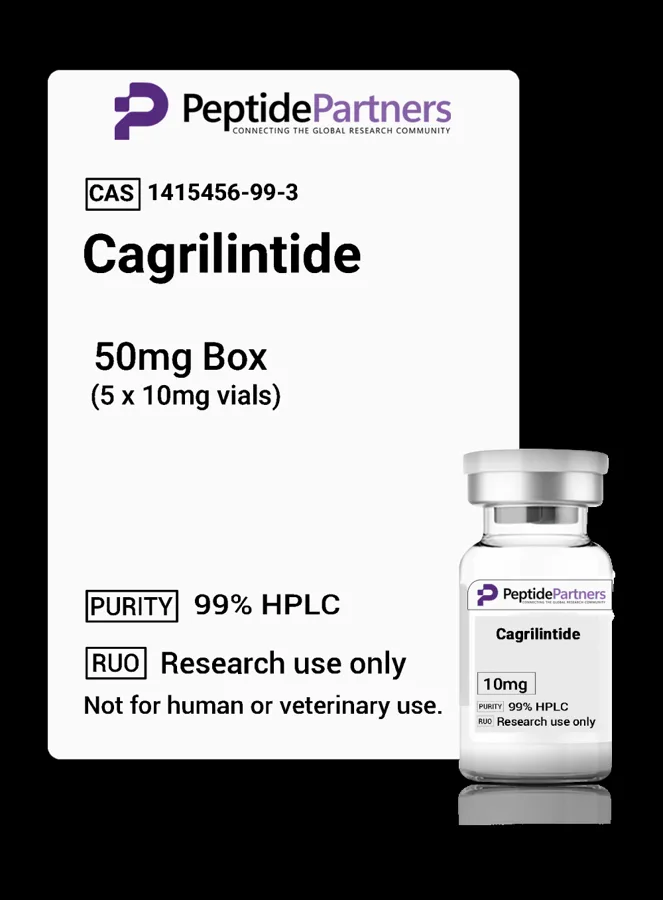
Available packs
Cagrilintide
$335 - $1,050
Buy Cagrilintide (10mg vials) from Peptides Partners
Peptides Partners provides analytical-grade Cagrilintide (10mg vials) formulated specifically for qualified scientific laboratories, university departments, and biotechnology researchers investigating novel metabolic signaling pathways. As interest in long-acting neuroendocrine regulators continues to expand across academic and preclinical disciplines, acquiring chemically stable, precisely quantified peptides is essential to obtaining reproducible experimental data. When institutions buy Cagrilintide through our specialized platform, they gain access to high-purity compounds manufactured under rigorous quality-control protocols that adhere strictly to contemporary analytical research benchmarks.
Cagrilintide has emerged as a cornerstone peptide in contemporary metabolic research, bridging critical investigations into endocrine feedback loops, central appetite signaling, and multi-receptor agonist interactions. Each vial supplied by Peptides Partners contains 10 milligrams of lyophilized Cagrilintide, sealed under an inert nitrogen environment to safeguard molecular integrity during transport and long-term storage. Our catalog of research peptides is exclusively prepared to facilitate advanced biochemical assays, receptor-binding characterization, and in vitro or in vivo animal-model profiling. All materials distributed are intended strictly for laboratory experimentation and are not intended for diagnostic, human, therapeutic, or veterinary applications.
By streamlining procurement for high-demand peptides, Peptides Partners supports institutional investigators with transparent compound documentation, verified molecular specifications, and volume-tiered packaging. Whether your project focuses on cellular signaling cascades in cell culture or comparative pharmacokinetic dynamics in metabolic disease models, our 10mg Cagrilintide vials offer the structural consistency and quantitative precision necessary to advance sophisticated experimental hypotheses.
What is Cagrilintide?
Cagrilintide, registered under CAS number 1415456-99-3, is a synthetic, long-acting acylated analogue of the human neuroendocrine hormone amylin. Endogenous amylin is a 37-amino-acid peptide co-secreted with insulin by pancreatic beta cells in response to nutrient ingestion. While native amylin plays a well-established physiological role in regulating postprandial glucagon secretion, slowing gastric emptying, and signaling satiety to the hindbrain, its translational utility in laboratory research has historically been restricted by significant biophysical liabilities, primarily its extreme propensity to aggregate rapidly into insoluble, cytotoxic amyloid fibrils.
To overcome these physical and chemical limitations, Cagrilintide was engineered with targeted amino acid modifications and lipid conjugation. Structurally, the molecule acts as a non-selective dual amylin and calcitonin receptor agonist (DACRA). It incorporates strategic sequence substitutions that suppress the self-assembly fibrillization cascade observed in native human amylin, yielding an analogue that remains soluble and stable across diverse experimental conditions. Crucially, the peptide backbone is modified with a fatty acid side chain via a specialized hydrophilic linker. This acylation facilitates reversible, high-affinity binding to serum albumin, substantially reducing renal clearance and extending the compound’s biological half-life compared to both unmodified amylin and earlier synthetic analogues like pramlintide.
Within metabolic research models, Cagrilintide serves as a potent investigative tool for evaluating continuous, sustained amylin receptor activation. Because it simultaneously engages calcitonin receptor isoforms (CTR) complexed with receptor activity-modifying proteins (RAMP1, RAMP2, and RAMP3), it provides a unique mechanistic profile for probing how distinct neuroendocrine receptor subtypes coordinate metabolic rate, energetic homeostasis, and downstream intracellular signaling cascades.
Research effects studied
Cagrilintide has been extensively studied in preclinical and clinical research across a broad spectrum of metabolic, neuroendocrine, and biochemical domains. Scientific interest in this peptide focuses largely on its ability to sustainedly engage central nervous system targets and its synergistic interactions when evaluated alongside other metabolic regulators. Below are key research areas documented in published scientific literature:
- Central Appetite Regulation and Satiety Signaling: Preclinical investigations show that Cagrilintide crosses the semi-permeable blood-brain barrier to target amylin receptors located in the area postrema (AP) and the nucleus of the solitary tract (NTS) within the caudal hindbrain. Researchers evaluate how continuous DACRA exposure modulates pro-opiomelanocortin (POMC) and neuropeptide Y/agouti-related peptide (NPY/AgRP) neurocircuits, observing pronounced decreases in voluntary nutrient intake and shifts in macronutrient preference in rodent paradigms.
- Dual Amylin and GLP-1 Receptor Agonist Synergy: A major focus of ongoing investigation involves co-administering Cagrilintide with glucagon-like peptide-1 receptor (GLP-1R) agonists, such as semaglutide. Published studies examine how targeting two distinct physiological pathways—calcitonin/amylin receptor complexes in the hindbrain alongside GLP-1 receptors in the hypothalamus and mesolimbic system—produces non-overlapping, additive reductions in food intake, body weight, and adipose tissue volume in diet-induced obesity (DIO) animal models.
- Gastrointestinal Motility and Nutrient Transit: Experimental studies measure the inhibitory effects of Cagrilintide on gastric emptying rates. By delaying the transit of nutrients from the stomach into the small intestine, researchers analyze downstream impacts on postprandial glucose excursions, enterocyte incretin secretion, and systemic hormonal balances in diabetic and insulin-resistant animal models.
- Insulin Sensitivity and Glycemic Homeostasis: Academic models have studied Cagrilintide for its capacity to suppress inappropriate postprandial glucagon secretion without precipitating hypoglycemia. Research explores how long-term administration alters homeostatic model assessment of insulin resistance (HOMA-IR), lipid clearance profiles, and hepatic steatosis markers in metabolic syndrome cohorts.
- Lipid Metabolism and Energy Expenditure: Beyond appetite suppression, laboratory investigations examine whether prolonged DACRA receptor signaling stimulates brown adipose tissue (BAT) thermogenesis or increases resting energy expenditure via sympathetic nervous system activation, distinguishing primary hypophagic effects from active energetic modulation.
How to use in the laboratory
Cagrilintide is supplied in lyophilized form to maintain structural stability during transit and storage. Achieving reliable, reproducible results in downstream assays requires meticulous attention to laboratory handling, solvent selection, reconstitution protocols, and documentation. The following guidance is designed strictly for in vitro assays, ligand-binding analyses, and authorized animal research procedures.
Reconstitution Protocols: Prior to reconstitution, vials should be allowed to equilibrate to ambient room temperature (typically 20°C to 25°C) for at least 20 to 30 minutes inside a desiccator. This prevents atmospheric moisture from condensing inside the cold vial, which can compromise peptide integrity. For standard laboratory applications, reconstitution is typically performed using sterile, non-pyrogenic bacteriostatic water (containing 0.9% benzyl alcohol) for multi-use analytical workflows, or sterile cell-culture grade water (or buffered saline at a neutral to slightly acidic pH) for single-day experiments or sensitive cell culture assays.
When introducing the diluent, direct the stream down the inner glass wall of the vial using a sterile laboratory pipette or syringe rather than spraying the solvent directly onto the lyophilized cake. Once the solvent is introduced, gently swirl the vial with a slow, circular motion until the cake is fully dissolved. Do not shake, vortex, or expose the solution to high-shear mechanical agitation, as shear forces can disrupt the tertiary structure, precipitate the peptide, or accelerate denaturing of the acylated side chain.
Handling and Aliquoting: To preserve the chemical fidelity of the peptide and prevent degradation caused by repeated freeze-thaw cycles, working solutions should be aliquoted immediately after complete dissolution. Dispense the reconstituted peptide into sterile, low-binding polypropylene microcentrifuge tubes (such as siliconized or protein low-bind tubes) to minimize peptide loss via non-specific adsorption to plastic surfaces. Each aliquot should be sized appropriately for a single experimental run or day of testing.
Laboratory Record-Keeping: Rigorous record-keeping is vital for scientific replication. Researchers must log the following information upon receiving and reconstituting Cagrilintide:
- Assigned internal compound ID and manufacturer lot number.
- Date and time of initial vial reconstitution.
- Type and exact volume of diluent used, along with the calculated final stock concentration (e.g., 2 mg/mL or 5 mg/mL).
- Total number of working aliquots generated and their specific storage location within low-temperature freezers.
- Documented freeze-thaw occurrences per aliquot (which should not exceed one cycle).
Pack sizes and price per mg
To accommodate diverse project scales—from preliminary cell-based binding assays to extended preclinical animal studies—Peptides Partners offers bulk tiering for 10mg Cagrilintide vials. Purchasing multi-vial configurations lowers the research cost per milligram, enabling laboratories to maintain uniform lot consistency across long-term experimental series without exceeding project budgets.
| Configuration | Total Content | Total Price | Effective Price per mg | Research Application Scope |
|---|---|---|---|---|
| 5 vials x 10mg | 50 mg | $335 | $6.70 / mg | Pilot studies, in vitro receptor binding, method validation assays |
| 10 vials x 10mg | 100 mg | $610 | $6.10 / mg | Intermediate cohort studies, cell-line profiling, dose-ranging models |
| 15 vials x 10mg | 150 mg | $835 | $5.57 / mg | Multi-arm comparative trials, chronic metabolic syndrome cohorts |
| 20 vials x 10mg | 200 mg | $1050 | $5.25 / mg | High-throughput screening, multi-investigator institutional projects |
Researchers who buy Cagrilintide in higher unit volumes benefit from significant unit cost reductions, with the 20-vial tier lowering the research expense to $5.25 per milligram. Securing an entire experimental series from a unified batch helps eliminate inter-lot variance, ensuring standardized baseline data across all testing intervals.
Storage and handling
Lyophilized Cagrilintide exhibits high stability when maintained under appropriate environmental parameters. Upon receipt from Peptides Partners, unopened vials should be transferred directly to a dedicated laboratory freezer maintained at -20°C for routine storage (stable for up to 24 months), or -80°C for multi-year archival storage. Storage areas should be dark, dry, and protected from continuous exposure to direct ambient light or ultraviolet radiation.
Once reconstituted, the peptide becomes susceptible to hydrolytic cleavage, deamidation, and microbial proliferation if handled improperly. Liquid aliquots stored at standard refrigeration temperatures (2°C to 8°C) should be utilized within 14 to 21 days when preserved with bacteriostatic water, or within 24 to 48 hours if dissolved in unpreserved sterile water or neutral physiological buffers. For longer storage intervals, reconstituted aliquots must be frozen at -20°C or -80°C. Under no circumstances should an aliquot be subjected to repeated freeze-thaw events; once thawed for an assay, any residual volume should be discarded according to institutional biosafety procedures.
Personnel handling Cagrilintide must utilize standard personal protective equipment (PPE), including a laboratory coat, nitrile gloves, and chemical splash goggles. All manipulation of dry powders or concentrated solutions should occur within a certified biosafety cabinet or chemical fume hood to minimize inhalation risks and prevent inadvertent environmental contamination.
Quality and documentation
The integrity of research peptides directly dictates the validity of scientific conclusions. Peptides Partners enforces strict analytical verification on every synthesized batch of Cagrilintide (CAS 1415456-99-3) to ensure complete chemical fidelity and absence of significant peptide impurities or synthesis truncations.
Each batch undergoes dual-stage analytical testing before release:
- High-Performance Liquid Chromatography (HPLC): Reversed-phase HPLC is executed to establish compound purity and verify the retention profile against reference chromatograms, ensuring that baseline synthesis artifacts, deletion sequences, and residual protecting groups are thoroughly identified and quantified.
- Mass Spectrometry (MS): Electrospray Ionization Mass Spectrometry (ESI-MS) or Matrix-Assisted Laser Desorption/Ionization (MALDI-TOF) is employed to accurately confirm the exact monoisotopic and molecular weight of Cagrilintide, validating that the amino acid chain and acylated lipid anchor are properly assembled.
Comprehensive lot-specific documentation, including analytical Certificates of Analysis (COA) containing purity traces and spectral verification, is available for all catalog items. This documentation ensures that your laboratory remains fully compliant with internal audit standards and external peer-review requirements. All compounds distributed are classified solely for research, laboratory, and in vitro experimentation, and may not be introduced to food, drugs, biological delivery devices, or medical products under any circumstances.
Frequently asked questions
What is the primary pharmacological classification of Cagrilintide?
Cagrilintide is classified as a synthetic, acylated dual amylin and calcitonin receptor agonist (DACRA). In academic and preclinical models, it binds to and activates calcitonin core receptors complexed with receptor activity-modifying proteins 1, 2, and 3 (RAMP1, RAMP2, and RAMP3), as well as independent calcitonin receptors. This dual-action mechanism mimics and extends the actions of native human amylin, allowing researchers to study central homeostatic and hedonic appetite signaling, delayed gastric transit, and integrated energy expenditure.
How does the chemical structure of Cagrilintide differ from pramlintide?
While pramlintide is an earlier synthetic amylin analogue containing three proline substitutions at positions 25, 26, and 28 to prevent amyloid fibril aggregation, it possesses a short biological half-life (approximately 30 to 50 minutes) requiring frequent administration. In contrast, Cagrilintide incorporates distinct sequence modifications along with a conjugated C20 diacid fatty acid side chain via a hydrophilic spacer. This lipid moiety enables reversible non-covalent binding to endogenous albumin, significantly prolonging its pharmacokinetic profile in animal models and dramatically reducing clearance rates.
Is Cagrilintide approved for human clinical use or personal administration?
No. Cagrilintide supplied by Peptides Partners is strictly intended for laboratory research and developmental experimentation. It is not approved by the U.S. Food and Drug Administration (FDA), the European Medicines Agency (EMA), or any other regulatory body for human consumption, clinical treatment, medical diagnosis, or veterinary application. Laboratory personnel must not introduce this material into humans or companion animals under any circumstances. Purchases are restricted to qualified institutional and academic researchers.
What is the optimal solvent for dissolving Cagrilintide in cellular assays?
For cellular assays where bacteriostatic preservatives (such as benzyl alcohol) could induce cytotoxicity or alter cell membrane integrity, sterile cell-culture grade water or sterile phosphate-buffered saline (PBS) adjusted to a physiological pH (around 7.2 to 7.4) is generally recommended for immediate use. If solubility limits are encountered at high stock concentrations, a slightly acidic vehicle (such as dilute sterile acetic acid or sodium acetate buffer, pH 4.0–4.5) can be utilized to aid initial solubilization before bringing the final mixture to assay concentration in culture media. Vehicle controls must always be included in parallel to verify that the solvent does not confound assay results.
Related Peptides Partners research peptides
CJC-1295 no DAC (10mg vials); GLOW Blend: BPC-157/TB-500/GHK-Cu (70mg vials); MOTS-c (40mg vials).
Cagrilintide lot documentation
Certificates of analysis are matched to the actual lot supplied with your order. Email sales@peptidespartners.co with the product name and pack size to request the current lot's purity, identity and screening documents before purchase.
Storage
Research peptides are typically supplied lyophilized (freeze-dried), which keeps them stable for shipping and storage. Store unopened vials cool, dry and away from light; for long-term storage, a freezer is generally recommended.
After reconstitution, keep vials refrigerated and use sterile laboratory technique. Follow the handling guidance supplied with your lot documentation.
- Short name
- Cagrilintide (10mg vials)
- Vial strength
- 10mg vials
- Pack sizes
- 50mg pack, 100mg pack, 150mg pack, 200mg pack
- Pack count options
- 5, 10, 15, 20 vial packs
- CAS number
- 1415456-99-3
- Category
- Metabolics
- SKU
- PP-6347
- Compliance
- Research Use Only. Not for use in diagnostic tests.