
CJC-1295 no DAC
10mg per vial
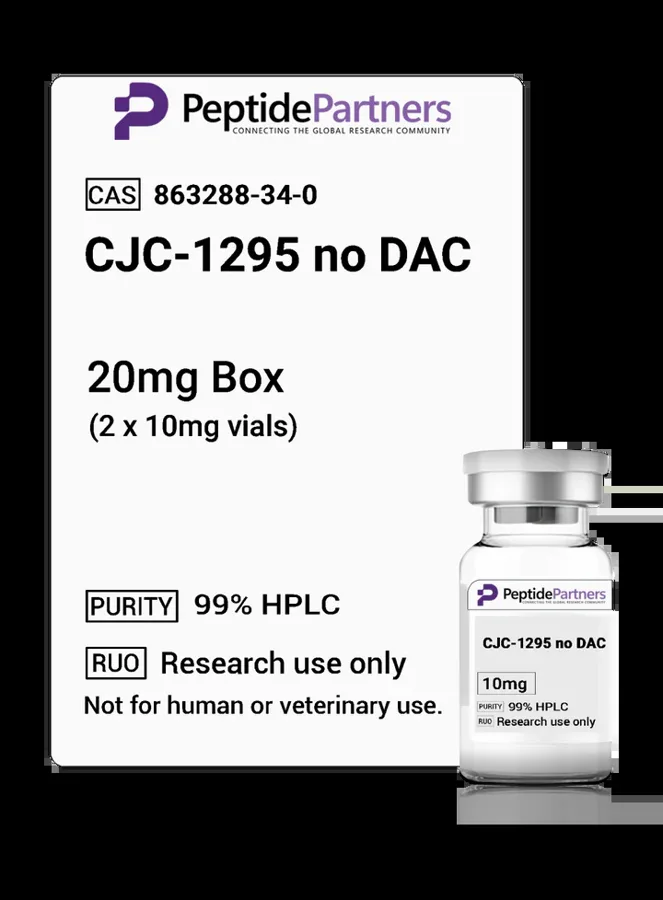
Available packs
CJC-1295 no DAC
$117 - $888
Buy CJC-1295 no DAC (10mg vials) from Peptides Partners
Qualified research institutions and scientific professionals seeking high-integrity compounds can buy CJC-1295 no DAC through Peptides Partners. Our catalog is dedicated exclusively to providing laboratory-grade research peptides that adhere to rigorous quality benchmarks, ensuring consistency, chemical stability, and analytical precision across every batch. Each vial of CJC-1295 no DAC contains 10 milligrams of lyophilized peptide cake manufactured for in vitro, ex vivo, and non-human in vivo experimental platforms. When you buy CJC-1295 no DAC from Peptides Partners, your laboratory receives compounds designed specifically to meet the demanding requirements of academic, clinical, and independent research assays.
Modern biomedical investigations demand exact chemical synthesis and reliable supplier transparency. At Peptides Partners, we recognize that experimental reproducibility depends directly on the purity and uniform molecular architecture of your starting materials. Our 10mg vials provide a flexible volume ideal for a broad spectrum of experimental designs, ranging from cell culture receptor-binding assays to longitudinal metabolic modeling in test subjects. Each container is sealed under sterile, inert atmospheric conditions to protect the underlying peptide sequence from oxidative degradation during transit and storage, giving researchers complete confidence in their experimental baselines.
What is CJC-1295 no DAC?
CJC-1295 no DAC, chemically cataloged under CAS number 863288-34-0, is a synthetic peptide analogue of endogenous Growth Hormone-Releasing Hormone (GHRH). It is frequently referred to in scientific literature as Modified GRF (1-29), or Mod GRF 1-29. Endogenous GHRH is a 44-amino-acid hypothalamic peptide, though pioneering structural biology research determined that the initial 29 amino acids represent the biologically functional core required to bind and activate pituitary GHRH receptors. However, native GRF (1-29) is rapidly cleaved and deactivated in biological fluids by the ubiquitous circulating enzyme dipeptidyl peptidase-4 (DPP-4), leading to an in vivo half-life of only a few minutes.
To overcome this rapid enzymatic deactivation in investigative settings, researchers developed CJC-1295 no DAC by substituting four specific amino acids within the 29-amino-acid chain:
- Position 2: Alanine is substituted with D-Alanine, substantially reducing cleavage vulnerability to DPP-4.
- Position 8: Asparagine is replaced with Glutamine, minimizing spontaneous chemical rearrangement and deamidation.
- Position 15: Glycine is replaced with Alanine, increasing alpha-helical structural stability.
- Position 27: Methionine is replaced with Leucine, eliminating susceptibility to oxidative degradation at the sulfur center.
The “no DAC” designation is critical for experimental clarity. CJC-1295 with DAC (Drug Affinity Complex) incorporates a reactive maleimidopropionic acid bioconjugation linker that covalently binds to circulating serum albumin, prolonging its half-life to multiple days and creating a continuous, non-pulsatile elevation of target hormones. Conversely, CJC-1295 no DAC lacks this albumin-binding moiety. Consequently, CJC-1295 no DAC possesses an operational half-life of approximately 30 minutes in biological systems, which preserves the natural, episodic, and pulsatile secretory dynamics characteristic of physiological growth hormone signaling. With a chemical formula of C152H252N44O42 and a molecular weight of approximately 3367.9 g/mol, CJC-1295 no DAC remains one of the most thoroughly evaluated GHRH analogues in modern biochemical research.
Research effects studied
CJC-1295 no DAC has been studied in preclinical and academic research across various biological models, primarily focused on neuroendocrine signaling cascades, protein synthesis dynamics, cellular regeneration, and somatotrophic axis regulation. By selectively targeting and binding to the G-protein coupled GHRH receptors located on anterior pituitary somatotrophs, CJC-1295 no DAC initiates an intracellular cascade mediated by adenylate cyclase activation, an increase in cyclic adenosine monophosphate (cAMP), and the downstream stimulation of protein kinase A (PKA). This signaling path encourages both the transcription of growth hormone (GH) mRNA and the targeted exocytosis of pre-formed hormone granules.
Key areas of active scientific investigation involving CJC-1295 no DAC include:
- Pulsatile Somatotroph Dynamics: Because CJC-1295 no DAC does not permanently bind to plasma proteins, preclinical studies have evaluated its ability to induce physiological, episodic spikes in growth hormone release rather than tonic, continuous secretion, thereby avoiding down-regulation or desensitization of target receptors over repeated exposures.
- Downstream IGF-1 Axis Modulation: Investigations measuring secondary endocrine responses have repeatedly examined how pulsatile elevations of GH driven by CJC-1295 no DAC correlate with systemic and localized hepatic production of Insulin-like Growth Factor 1 (IGF-1), which coordinates cellular growth, proliferation, and metabolic pathways in target tissues.
- Metabolic Rate and Lipid Utilization: In rodent and cellular models, research peptides within the GHRH secretagogue family have been observed for their role in shifting metabolic substrates, particularly regarding lipolysis stimulation, adipocyte signaling, and the preservation of non-adipose lean tissue in metabolic challenge paradigms.
- Synergistic Co-Administration with GHRPs: A substantial volume of peer-reviewed literature explores the biochemical synergy observed when pairing GHRH analogues like Mod GRF (1-29) with Growth Hormone Secretagogue Receptor (GHSR) agonists, such as Ipamorelin or GHRP-2. These dual-action assays demonstrate enhanced pituitary hormone release by simultaneously driving GHRH receptor pathway activation while attenuating endogenous somatostatin inhibitory feedback.
- Tissue Repair and Cytoprotection: Experimental platforms examining wound recovery, musculoskeletal integrity, and microvascular endothelial response have utilized CJC-1295 no DAC to clarify whether somatotrophic pathway stimulation can enhance localized tissue repair and fibroblast migration in damaged tissue matrices.
- Age-Related Neuroendocrine Plasticity: Preclinical aging models have incorporated Mod GRF (1-29) to determine if counteracting the natural, age-associated decline in hypothalamic GHRH output can restore downstream metabolic markers, cellular autophagy, and cognitive parameters in test subjects.
How to use in the laboratory
Scientific protocols involving CJC-1295 no DAC require meticulous laboratory practices to ensure structural stability and accurate data generation. The peptide arrives as a stable, lyophilized powder requiring careful reconstitution prior to application in experimental systems. The following operational procedures should be integrated into standardized laboratory workflows:
- Temperature Equilibration: Before opening the vial, allow the sealed container to equilibrate to ambient room temperature (typically 20°C to 25°C) inside a laminar flow cabinet for 15 to 30 minutes. This critical step prevents condensation from forming on the cold interior glass, which can lead to premature hydrolysis and localized aggregation of the peptide chain.
- Diluent Selection: Depending on the experimental endpoint, reconstitution is most frequently performed using bacteriostatic water (containing 0.9% benzyl alcohol) for multi-use analytical workflows, or sterile 0.9% sodium chloride or sterile water for injection when single-use or in vitro cell culture viability demands solvent systems free of preservatives.
- Aseptic Reconstitution Technique: Clean the rubber septa with a sterile 70% isopropyl alcohol wipe and allow it to dry completely. Using a sterile laboratory syringe, introduce the selected diluent slowly against the inner glass wall of the vial. Never eject liquid directly onto the lyophilized cake. Maintain the needle tip along the container wall to minimize foaming, shear stress, and cavitation.
- Dissolution Mechanics: Allow the solvent to naturally absorb into the cake. Gently rotate and roll the vial between the palms or gently tilt it in a horizontal plane until the compound is completely dissolved. Never agitate, shake vigorously, or vortex CJC-1295 no DAC, as physical shear forces can denature the tertiary structural integrity of peptide hormones.
- Laboratory Record-Keeping: Implement a strict documentation procedure. Clearly log the vial batch identifier, date of reconstitution, total diluent volume added, derived final concentration (e.g., mg/mL), and the initials of the handling technician directly on both the physical container and the laboratory information management system (LIMS).
Pack sizes and price per mg
To support scientific initiatives of varying scales—from exploratory preliminary assays to high-throughput longitudinal study designs—Peptides Partners supplies CJC-1295 no DAC (10mg vials) in multiple quantity tiers. Tiered pricing structures allow institutional laboratories and research departments to optimize procurement budgets while securing an uninterrupted supply of uniform test material.
| Pack Configuration | Total Peptide Content | Package Price (USD) | Effective Price per mg |
|---|---|---|---|
| 2 vials x 10mg | 20 mg | $117 | $5.85 / mg |
| 5 vials x 10mg | 50 mg | $268 | $5.36 / mg |
| 10 vials x 10mg | 100 mg | $498 | $4.98 / mg |
| 20 vials x 10mg | 200 mg | $888 | $4.44 / mg |
All orders are packaged in protective secondary casing to ensure that temperature changes and physical impacts during transit do not compromise the physical integrity of the lyophilized cakes. Researchers ordering higher volume packages benefit from immediate economies of scale, driving analytical costs down to $4.44 per milligram.
Storage and handling
Proper environmental control is paramount for maintaining the biochemical fidelity of synthetic peptides. CJC-1295 no DAC is sensitive to moisture, thermal fluctuations, and direct ultraviolet (UV) radiation. Investigators must follow strict containment and storage protocols:
Lyophilized Powder: In its unopened, freeze-dried state, CJC-1295 no DAC should be kept in a laboratory freezer maintained at -20°C for standard multi-month storage, or at -80°C for multi-year preservation. Under these sub-zero conditions, protected from atmospheric air and moisture by its vacuum-sealed stopper, degradation is minimized. For short-term experimental staging (under 30 days), sealed vials can be maintained in a standard laboratory refrigerator at 2°C to 8°C away from light sources.
Reconstituted Solution: Once brought into liquid solution, peptides are substantially more vulnerable to bacterial contamination and chemical cleavage (via peptide bond hydrolysis). Liquid solutions must be stored at 2°C to 8°C and evaluated within experimental models within a defined time frame, usually not exceeding 21 to 28 days when bacteriostatic diluents are employed. If liquid stock solutions must be stored for longer periods, prepare single-use aliquots using sterile, low-protein-binding microcentrifuge tubes and freeze them once at -20°C or -80°C. Repeated freeze-thaw cycles must be rigorously avoided, as ice crystal formation disrupts the peptide’s structural conformation.
Laboratory Safety and Handling: Personnel working with CJC-1295 no DAC must wear standard personal protective equipment (PPE), including disposable nitrile gloves, safety goggles, and a clean laboratory coat. All reconstitution, handling, and transferring of reconstituted solutions should take place within a certified biosafety cabinet or laminar airflow clean bench to prevent microbial introduction and ensure worker safety.
Quality and documentation
Peptides Partners is committed to upholding transparency and scientific validity across all research peptides featured in our catalog. Every batch of CJC-1295 no DAC undergoes rigorous analytical verification before release to ensure precise chemical composition, absence of residual synthesis impurities, and accurate peptide content per vial.
Our analytical quality framework includes:
- High-Performance Liquid Chromatography (HPLC): Used to evaluate overall chemical purity and resolve any related synthesis intermediates or truncated fragments, ensuring that the primary active fraction matches expected analytical chromatograms.
- Mass Spectrometry (MS): Confirms the exact theoretical molecular weight and elemental mass fingerprint (approx. 3367.9 Da) of the synthetic peptide sequence, validating that the four designated amino acid substitutions of Modified GRF (1-29) are fully realized.
- Batch Traceability: Every package provided by Peptides Partners corresponds to distinct lot numbers, providing full visibility throughout the production, lyophilization, testing, and distribution cycles for institutional compliance and internal audit controls.
Frequently asked questions
What distinguishes CJC-1295 no DAC from standard CJC-1295 with DAC in research models?
The primary scientific distinction lies in the molecular presence of the Drug Affinity Complex (DAC). CJC-1295 with DAC incorporates a maleimide-based bioconjugation group that forms a stable covalent bond with free cysteine-34 residues on circulating serum albumin, generating an extended half-life measured in days and causing continuous baseline growth hormone elevation. In contrast, CJC-1295 no DAC (Mod GRF 1-29) lacks this complex, yielding an active circulating half-life of roughly 30 minutes. This shorter operational window allows researchers to study physiological, episodic, and pulsatile pituitary hormone release profiles without causing persistent receptor occupancy or receptor down-regulation.
What is the recommended reconstitution solvent for laboratory research with CJC-1295 no DAC?
The appropriate solvent depends directly on the parameters of the research protocol. For multi-week assays involving repeated sampling from the same vial, bacteriostatic water (sterile water containing 0.9% benzyl alcohol) is preferred because it suppresses microbial growth over extended storage at 2°C to 8°C. For acute in vitro assays, cellular microplates, or live tissue culture experiments where benzyl alcohol could introduce cytotoxic artifacts, sterile 0.9% sodium chloride or sterile endotoxin-free water for injection should be utilized instead, with the reconstituted solution used promptly to prevent contamination.
Can CJC-1295 no DAC be combined with other secretagogues in research assays?
Yes, widespread biochemical and preclinical literature frequently documents the co-administration of CJC-1295 no DAC with Growth Hormone Releasing Peptides (GHRPs) or selective ghrelin receptor agonists, such as Ipamorelin, GHRP-6, or Hexarelin. In experimental models, these combinations demonstrate a complementary, non-competitive mechanism of action: CJC-1295 no DAC binds the pituitary GHRH receptor to initiate cAMP-dependent synthesis and release, while ghrelin mimetics act on the GHSR-1a pathway to mobilize intracellular calcium and suppress somatostatin activity, resulting in an amplified, synergistic neuroendocrine response.
What safety guidelines should be observed when handling this peptide in a laboratory environment?
CJC-1295 no DAC is an active biochemical agent restricted exclusively to laboratory research and development applications. It is not intended for human or animal consumption, diagnostic application, clinical therapy, or agricultural integration. Handling personnel should be fully trained in aseptic laboratory procedures, wear proper PPE (gloves, eye protection, lab attire), and work inside designated containment enclosures such as biosafety hoods. In the event of skin or eye contact, the affected area should be flushed immediately with copious amounts of water, and handling waste should be discarded according to institutional biomedical waste management protocols.
Related Peptides Partners research peptides
Combo Vial: BPC-157/TB-500 (20mg vials); GLP-1 SM (10mg vials); NA Selank Amidate (30mg vials).
CJC-1295 no DAC lot documentation
Certificates of analysis are matched to the actual lot supplied with your order. Email sales@peptidespartners.co with the product name and pack size to request the current lot's purity, identity and screening documents before purchase.
Storage
Research peptides are typically supplied lyophilized (freeze-dried), which keeps them stable for shipping and storage. Store unopened vials cool, dry and away from light; for long-term storage, a freezer is generally recommended.
After reconstitution, keep vials refrigerated and use sterile laboratory technique. Follow the handling guidance supplied with your lot documentation.
- Short name
- CJC-1295 no DAC (10mg vials)
- Vial strength
- 10mg vials
- Pack sizes
- 20mg pack, 50mg pack, 100mg pack, 200mg pack
- Pack count options
- 2, 5, 10, 20 vial packs
- CAS number
- 863288-34-0
- Category
- All Products
- SKU
- PP-959
- Compliance
- Research Use Only. Not for use in diagnostic tests.