
KLOW Blend: BPC-157/TB-500/GHK-Cu/KPV
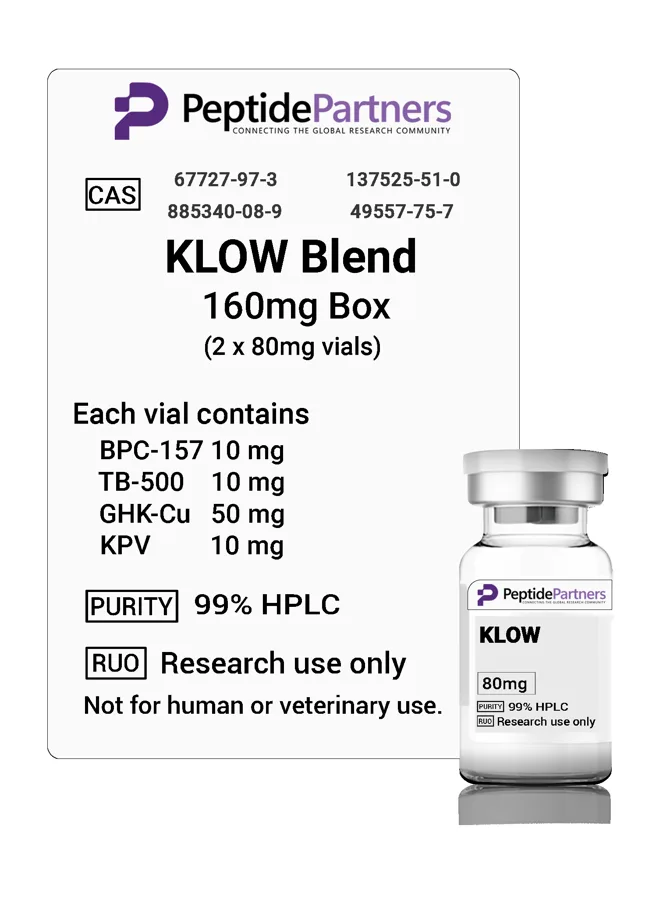
80mg per vial
Available packs
KLOW Blend: BPC-157/TB-500/GHK-Cu/KPV
$192 - $780
Buy KLOW Blend: BPC-157/TB-500/GHK-Cu/KPV (80mg vials) from Peptides Partners
Laboratories and institutional investigators seeking high-integrity peptide sequences can buy KLOW Blend: BPC-157/TB-500/GHK-Cu/KPV through Peptides Partners. Formulated specifically to facilitate complex in vitro and ex vivo comparative analyses, this specialized combination unites four highly investigated peptide entities within a single, precision-filled 80mg lyophilized unit. Peptides Partners delivers laboratory-grade research peptides that adhere strictly to analytical quality standards, providing documented chemical integrity to investigators exploring cellular defense pathways, extracellular matrix synthesis, and macromolecular antioxidant dynamics.
Each vial of the KLOW Blend is prepared using advanced lyophilization techniques designed to preserve the structural stability of diverse peptide chains ranging from short tripeptides to extended oligopeptide structures. When institutions buy KLOW Blend: BPC-157/TB-500/GHK-Cu/KPV from our catalog, they receive materials intended strictly for research, biochemical assaying, and cell-culture modeling. Our distribution workflows emphasize chemical traceability, stable cold-chain compliance, and reliable packaging configurations to safeguard molecular integrity from synthesis through benchtop reconstitution.
What is KLOW Blend: BPC-157/TB-500/GHK-Cu/KPV?
The KLOW Blend is an advanced multi-peptide formulation engineered for sophisticated experimental environments. Rather than evaluating isolated biochemical pathways sequentially, researchers frequently utilize blended synthetic peptides to study overlapping signaling cascades. This composite formulation incorporates four distinct research compounds: Body Protection Compound-157 (BPC-157), Thymosin Beta-4 synthetic fragment (TB-500), Glycyl-L-Histidyl-L-Lysine Copper (GHK-Cu), and the alpha-Melanocyte-Stimulating Hormone tripeptide fragment (KPV). Within research catalogs, this formulation is often categorized under CAS 137525-51-0 (associated historically with primary cytoprotective research standards) and cataloged among high-interest anti-oxidant and cellular remodeling vectors.
To fully grasp the biochemical scope of the KLOW Blend, it is essential to delineate each individual peptide constituent present within the 80mg total solid matrix:
- BPC-157 (Pentadecapeptide): Derived synthetically from a naturally occurring gastric mucosal defense protein, BPC-157 consists of 15 amino acids (Gly-Glu-Pro-Pro-Pro-Gly-Lys-Pro-Ala-Asp-Asp-Ala-Gly-Leu-Val). Preclinical literature identifies its robust stability in various pH environments and its active role in modulating vascular endothelial growth factor (VEGF) transcription, nitric oxide synthase (NOS) pathways, and early growth response protein-1 (Egr-1) expression during tissue regeneration assays.
- TB-500 (Synthetic Fragment of Thymosin Beta-4): TB-500 represents the bioactive, actin-sequestering domain of endogenous Thymosin Beta-4, characterized specifically by the sequence Ac-Ser-Asp-Lys-Pro-Asp-Met-Ala-Glu-Ile-Glu-Lys-Phe-Asp-Lys-Ser-Lys-Leu-Lys-Lys-Thr-Glu-Thr-Gln-Glu-Lys-Asn-Pro-Leu-Pro-Ser-Lys-Glu-Thr-Ile-Glu-Gln-Glu-Lys-Gln-Ala-Gly-Glu-Ser, or often synthesized focusing on the central G-actin-binding hexapeptide LKKTET motif. In cell motility and wound-migration platforms, TB-500 regulates globular-to-filamentous actin polymerization, influencing cytoskeletal remodeling and structural reorganization.
- GHK-Cu (Tripeptide-Copper Chelate): Consisting of glycyl-L-histidyl-L-lysine coordinated with a divalent copper ion (Cu2+), GHK-Cu is an endogenous plasma tripeptide widely researched for its role in the anti-oxidant response and extracellular matrix (ECM) balance. GHK-Cu modulates the transcription of various collagen genes, proteoglycans, and matrix metalloproteinases (MMPs), while concurrently upregulating endogenous antioxidant enzymes such as superoxide dismutase (SOD).
- KPV (Alpha-MSH C-Terminal Tripeptide): Composed of the sequence Lys-Pro-Val, KPV is the non-pigmenting, biologically active C-terminal tripeptide of alpha-melanocyte-stimulating hormone. Preclinical investigations isolate KPV to investigate downstream inhibition of nuclear factor kappa B (NF-κB) translocation, down-regulation of pro-inflammatory cytokines, and stabilization of cell membranes challenged by environmental or oxidative stressors.
By integrating these four peptides into a single 80mg matrix, the KLOW Blend provides researchers with an integrated model to measure simultaneous cytoprotective, structural, and antioxidant signaling in cellular cultures.
Research effects studied
The individual and collaborative profiles of BPC-157, TB-500, GHK-Cu, and KPV have generated extensive attention across cellular biology, molecular biochemistry, and translational research. Investigations cataloged in peer-reviewed scientific literature reveal multiple overlapping domains where these compounds modulate cellular homeostasis.
Modulation of Oxidative Stress and Reactive Oxygen Species (ROS)
The antioxidant profile of this blend is primarily anchored by GHK-Cu and supported by the downstream cytoprotective properties of BPC-157. In vitro assays demonstrate that copper-peptide chelates facilitate the neutralization of free radical intermediates and suppress iron-mediated lipid peroxidation. GHK-Cu has been studied in preclinical models for its ability to rescue damaged dermal fibroblasts exposed to oxidative bursts by upregulating superoxide dismutase (SOD) and catalase transcription. Simultaneously, studies on BPC-157 suggest an ability to maintain organelle integrity under chemically induced oxidative challenges, preserving mitochondrial membrane potential and stabilizing baseline nitric oxide synthesis.
Extracellular Matrix Dynamic Regulation and Fibrogenesis
A major focus of experimental research involving the components of KLOW Blend centers on connective tissue dynamics. Preclinical studies indicate that GHK-Cu and TB-500 work on complementary axes within the extracellular matrix:
- Collagen Synthesis and Remodeling: GHK-Cu demonstrates direct stimulation of both Type I and Type III collagen mRNA synthesis, along with basic fibroblast growth factor (bFGF) production. It concurrently regulates tissue inhibitors of metalloproteinases (TIMPs), which prevents excessive aberrant fibrosis while supporting organized scaffolding.
- Actin Polymerization and Cell Migration: Research peptides like TB-500 act primarily through actin sequestration. By binding free G-actin, TB-500 permits directed migration of endothelial cells and dermal keratinocytes toward areas of micro-disruption in monolayer scratch assays, facilitating accelerated re-epithelialization studies.
Cytokine Regulation and Anti-Inflammatory Signaling
The inclusion of KPV in this research blend introduces a potent vector for studying transcriptional modulation of immune responses. Preclinical cell-culture experiments targeting intestinal epithelial barriers, chondrocytes, and macrophages reveal that KPV traverses cell membranes to directly hinder the nuclear translocation of the p65 subunit of NF-κB. Consequently, baseline and stimulated production of inflammatory cytokines—such as tumor necrosis factor-alpha (TNF-α), interleukin-1 beta (IL-1β), and interleukin-6 (IL-6)—are significantly attenuated in treated cellular lines. Parallel studies on BPC-157 note similar suppression of persistent inflammatory cascades, suggesting potential additive utility when analyzing complex inflammatory conditions in tissue explants.
Angiogenic and Microvascular Research
Microvascular integrity is a prerequisite for tissue viability in experimental biology. BPC-157 has been widely studied for its interaction with the VEGFR-2 signaling cascade, inducing collateral vascular development and endothelial sprout growth in ischemic animal tissue models without inducing systemic dysregulation. TB-500 complements this pathway by stimulating vascular tube formation in Matrigel assays, providing a baseline model for studying combined capillary sprouting and structural repair in vitro.
How to use in the laboratory
The KLOW Blend is intended strictly for in vitro laboratory experimentation, chemical characterization, and analytical assays. Under no circumstances is this material to be introduced into human or animal clinical protocols. Proper handling protocols must be maintained by qualified laboratory personnel.
Reconstitution Methodology
Reconstitution of multi-peptide compounds requires meticulous technique to maintain molecular configuration and prevent denaturation:
- Reagent Selection: Utilize standard laboratory-grade reconstitution solvents, such as sterile Bacteriostatic Water (0.9% benzyl alcohol) for multi-use analytical aliquots, or Sterile Water for Injection / Phosphate-Buffered Saline (PBS, pH 7.4) when conducting immediate, sensitive cell-culture assays where preservative agents could disrupt cell viability.
- Solvent Introduction: Slowly inject the chosen diluent down the inside glass wall of the vial using a low-gauge needle. Direct, high-pressure liquid streams onto the lyophilized cake must be avoided to prevent shear stress on delicate peptide chains.
- Dissolution: Allow the solvent to permeate the solid mass passively. Gently roll or invert the vial between the palms. Do not vortex or violently agitate the solution, as mechanical shear can cause aggregation and structural degradation, particularly of the longer oligopeptide chains found in TB-500.
Laboratory Record-Keeping and Aliquoting
Accurate experimental documentation is essential for reproducible research. Technicians should document:
- The exact volume of diluent added and the resultant nominal concentration (mg/mL) of the 80mg composite blend.
- The precise date and time of reconstitution, solvent lot number, and vial serial code.
- Subdivision into single-use, sterile polypropylene microcentrifuge aliquots to eliminate the need for repeated freeze-thaw cycles during subsequent spectrophotometric, ELISA, or chromatographic runs.
Pack sizes and price per mg
Peptides Partners provides volume-tiered procurement options for laboratories conducting longitudinal or multi-assay research projects. Each pack configuration features individual 80mg vials, allowing researchers to optimize procurement budgets while securing an adequate quantity of research peptides.
| Pack Configuration | Total Milligrams | Price (USD) | Price per Milligram |
|---|---|---|---|
| 2 vials x 80mg | 160 mg | $192 | $1.20 / mg |
| 5 vials x 80mg | 400 mg | $448 | $1.12 / mg |
| 10 vials x 80mg | 800 mg | $780 | $0.975 / mg |
Ordering in higher vial counts enables research facilities to maintain uninterrupted testing schedules across long-term experimental cohorts while lowering direct material costs per milligram.
Storage and handling
Proper environmental control is critical to prevent peptide oxidation, hydrolysis, and microbial contamination. The lyophilized KLOW Blend exhibits stability when stored within specific temperature and humidity parameters.
Lyophilized Powder Storage
Lyophilized vials should be maintained in a dry, dark environment protected from ambient light exposure. For short-term laboratory staging (up to 60 days), storage at 2°C to 8°C is acceptable. For long-term preservation (up to 24 months), vials should be stored in ultra-low-temperature freezers at -20°C or -80°C. Ensure the container seal remains intact to prevent moisture ingress, which can initiate spontaneous hydrolysis of peptide bonds.
Reconstituted Liquid Handling
Once dissolved into liquid form, the stability window of the KLOW Blend decreases noticeably:
- Store reconstituted solutions at 2°C to 8°C for a maximum of 21 to 28 days if prepared with bacteriostatic water.
- If reconstituted using preservative-free PBS or sterile water, solutions should be utilized immediately or aliquoted and stored at -20°C or below for no more than 3 months.
- Avoid repeated thermal cycling. Freeze-thaw transitions disrupt secondary molecular structures, promote cross-linking, and degrade the biological efficacy of the peptides in culture media.
Quality and documentation
Integrity and analytical precision define our operational standards at Peptides Partners. Because the KLOW Blend comprises multiple distinct peptide molecules alongside a copper-chelated tripeptide, stringent quality control protocols are implemented during manufacturing and synthesis.
Analytical verification involves dual-platform assessment:
- High-Performance Liquid Chromatography (HPLC): Employed to evaluate the chromatographic resolution, retention times, and individual peak purities of BPC-157, TB-500, GHK-Cu, and KPV, ensuring that each entity matches its target spectral footprint without unreacted peptide fragments or synthesis intermediates.
- Liquid Chromatography-Mass Spectrometry (LC-MS): Confirms the accurate monoisotopic molecular weights of all constituent peptides, validating that the sequence assembly and copper chelation conform precisely to theoretical chemical models.
Batch-specific documentation tracks synthesis lots, visual clarity, residual moisture limits, and net peptide content. This meticulous quality oversight ensures that investigators obtain reliable, reproducible parameters across every experimental matrix.
Frequently asked questions
What is the composition of the KLOW Blend in laboratory research?
The KLOW Blend is a four-part research formulation containing Body Protection Compound-157 (BPC-157), the synthetic actin-binding fragment of Thymosin Beta-4 (TB-500), Glycyl-L-Histidyl-L-Lysine Copper (GHK-Cu), and the alpha-MSH derivative tripeptide (KPV). The total peptide mass across all components is standardized to 80mg per lyophilized vial, configured for coordinated investigation of antioxidant, anti-inflammatory, and extracellular matrix pathways.
Why is GHK-Cu included in this multi-peptide formulation?
GHK-Cu is integrated into the blend due to its documented ability to regulate copper ion dynamics within enzymatic systems, stimulate collagen and glycosaminoglycan synthesis, and upregulate endogenous antioxidant enzymes like superoxide dismutase. In multi-component research studies, it provides a distinct chemical marker for extracellular matrix remodeling and cellular defense against oxidative free radicals.
How should reconstituted KLOW Blend be stored to maintain molecular integrity?
Following reconstitution with an appropriate sterile solvent, the liquid blend should be stored at 2°C to 8°C and utilized within 3 to 4 weeks if bacteriostatic water is used. For extended preservation, dividing the solution into sterile micro-aliquots and freezing at -20°C or -80°C prevents degradation and preserves peptide activity by avoiding detrimental repeated freeze-thaw cycles.
Is the KLOW Blend permitted for human or diagnostic use?
No. The KLOW Blend supplied by Peptides Partners is classified strictly as a research-use-only (RUO) compound. It is synthesized exclusively for in vitro experimental testing, biochemical assays, and educational laboratory investigations. It is not approved by regulatory authorities for human dosing, clinical administration, veterinary treatment, or any in vivo medical application.
Related Peptides Partners research peptides
5-Amino-1MQ (10mg vials); CJC-1295 no DAC (10mg vials); Humanin (10mg vials).
KLOW Blend: BPC-157/TB-500/GHK-Cu/KPV lot documentation
Certificates of analysis are matched to the actual lot supplied with your order. Email sales@peptidespartners.co with the product name and pack size to request the current lot's purity, identity and screening documents before purchase.
Storage
Research peptides are typically supplied lyophilized (freeze-dried), which keeps them stable for shipping and storage. Store unopened vials cool, dry and away from light; for long-term storage, a freezer is generally recommended.
After reconstitution, keep vials refrigerated and use sterile laboratory technique. Follow the handling guidance supplied with your lot documentation.
- Short name
- KLOW Blend: BPC-157/TB-500/GHK-Cu/KPV (80mg vials)
- Vial strength
- 80mg vials
- Pack sizes
- 160mg pack, 400mg pack, 800mg pack
- Pack count options
- 2, 5, 10 vial packs
- CAS number
- 137525-51-0
- Category
- Anti-oxidant
- SKU
- PP-12151
- Compliance
- Research Use Only. Not for use in diagnostic tests.