
GLP-2 Tirzepatide
40mg per vial
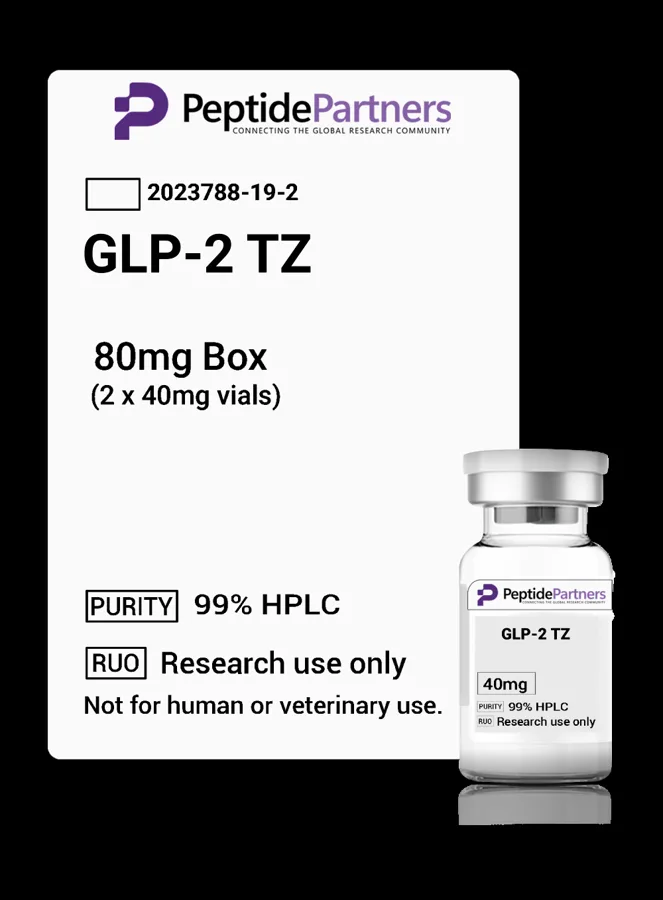
Available packs
GLP-2 Tirzepatide
$208 - $1,800
Buy GLP-2 Tirzepatide (40mg vials) from Peptides Partners
Laboratories and academic institutions seeking high-purity research compounds can buy GLP-2 TZ in high-concentration 40mg formats directly through Peptides Partners. As an established distributor of high-specification research peptides, Peptides Partners supplies reagents formulated exclusively for in vitro experimentation, physiological cell-culture assays, and animal model evaluations. This specialized peptide preparation bridges investigations into multi-receptor metabolic signaling and proglucagon-derived peptide biology, offering scientists a high-yield configuration designed to support robust, high-throughput, and longitudinal experimental designs.
Each 40mg vial provides sufficient mass to prepare stock solutions across a spectrum of working concentrations, reducing batch-to-batch variation across prolonged study phases. At Peptides Partners, our catalog is structured to meet rigorous laboratory standards, ensuring that every research group obtains stable, solid-state lyophilized material capable of consistent reconstitution and clear analytical profiling. Whether your research framework focuses on gastrointestinal peptide receptor cross-reactivity, incretin signaling dynamics, or comparative metabolic assays, our supply infrastructure delivers the scale, packaging integrity, and biochemical stability required for advanced scientific investigation.
Our ordering tiers provide flexible acquisition options ranging from individual two-vial starter packages up to thirty-vial institutional reserves. Because Peptides Partners maintains an uncompromising commitment to laboratory-grade research peptides, all materials are strictly designated for laboratory research use only. They are not intended for human or veterinary use, clinical diagnostics, therapeutic administration, or consumer compounding. Investigators can buy GLP-2 TZ with full confidence in product specification, clear analytical documentation, and dedicated logistical support tailored to the global scientific community.
What is GLP-2 Tirzepatide?
GLP-2 Tirzepatide (CAS: 2023788-19-2) represents a sophisticated synthetic peptide derivative operating within the broader domain of metabolic and incretin mimetic research. Chemically, the core architecture of CAS 2023788-19-2 is derived from a 39-amino-acid synthetic peptide backbone engineered to interact with metabolic peptide receptors. The structural sequence includes non-coded amino acid substitutions, notably alpha-aminoisobutyric acid (Aib) residues at specific positions, which provide structural resistance against degradation by dipeptidyl peptidase-4 (DPP-4). Attached to the peptide backbone via a hydrophilic linker is a C20 fatty diacid moiety that promotes non-covalent binding to albumin, significantly extending its theoretical and biological half-life in comparative animal models.
In academic literature and catalog classifications within the metabolics category, compounds under this designation are investigated for their dual affinity toward the glucose-dependent insulinotropic polypeptide (GIP) receptor and the glucagon-like peptide-1 (GLP-1) receptor, while serving as a comparative structural reference point against glucagon-like peptide-2 (GLP-2) signaling pathways. GLP-1, GLP-2, and glucagon are all naturally derived from the proglucagon precursor molecule, cleavage of which is governed by tissue-specific prohormone convertase enzymes. While GLP-1 and GIP primarily regulate systemic energy homeostasis, insulin secretagogue responses, and central satiety pathways, GLP-2 acts predominantly as an enterotrophic endocrine mediator that modulates intestinal mucosal integrity, crypt cell proliferation, and nutrient absorptive capacity.
The term GLP-2 Tirzepatide is utilized in comparative metabolic research to evaluate how multi-agonist incretin configurations cross-communicate with gut peptide axes, including the enteroendocrine pathways traditionally mediated by GLP-2. With a molecular mass exceeding 4.8 kDa, the compound exhibits distinct secondary conformations, folding into amphipathic alpha-helices upon receptor engagement. The presence of the fatty acid diacid side chain imparts unique biophysical properties, influencing solubility, micelle interaction, and cellular membrane kinetics in bio-membrane research settings.
Research effects studied
Preclinical and cellular investigations evaluating dual incretin agonists and proglucagon-family derivatives encompass several core biochemical domains:
- Dual GIP and GLP-1 Receptor Agonism: Research indicates that compounds sharing the CAS 2023788-19-2 molecular blueprint exhibit balanced, potent agonism at both human and rodent GIP and GLP-1 receptors. In vitro reporter gene assays demonstrate that receptor activation stimulates adenylate cyclase, resulting in intracellular cyclic adenosine monophosphate (cAMP) accumulation and downstream protein kinase A (PKA) signaling cascades.
- Insulinotropic and Glucagonostatic Dynamics: In isolated pancreatic islet cell models and perfused tissue systems, the compound has been studied for its glucose-dependent enhancement of insulin secretion. Concurrently, preclinical data demonstrate suppression of postprandial glucagon release under hyperglycemic conditions, contrasting with preserved glucagon responses during euglycemia or hypoglycemia.
- Intestinal Mucosal and Enteroendocrine Cross-Talk: Given the structural homology across the proglucagon-derived peptide family, researchers investigate the downstream structural adaptations of intestinal tissue. Studies have explored whether extended incretin activation influences intestinal barrier function, tight junction protein expression (such as claudin-1 and occludin), and interactions with endogenous GLP-2-mediated crypt-villus growth mechanisms.
- Metabolic Rate and Adipocyte Energetics: In murine models of diet-induced obesity, researchers have evaluated the impact of dual agonism on white adipose tissue lipolysis, brown adipose tissue thermogenesis, and whole-body oxygen consumption rates. Investigations consistently document reductions in adiposity, shifts in lipid handling profiles, and modulation of systemic insulin sensitivity markers.
- Hypothalamic Satiety Signaling: Preclinical neuroendocrine research indicates that the peptide engages central nervous system pathways regulating caloric intake. Radio-ligand and immunohistochemical studies have tracked its effects on pro-opiomelanocortin (POMC) and cocaine- and amphetamine-regulated transcript (CART) neuronal activation within the arcuate nucleus of the hypothalamus.
How to use in the laboratory
Working with solid-state peptide reagents at a 40mg mass requires methodical preparation and standardized laboratory techniques. Reconstitution should always take place within an environmentally controlled laminar flow hood or biosafety cabinet to prevent biological and chemical contamination. Because 40mg represents a substantial peptide mass per vial, precision in calculating final molar concentrations is critical for reliable data generation.
To reconstitute the peptide, researchers should choose an appropriate analytical solvent tailored to their experimental endpoint. Typical laboratory solvents include bacteriostatic water containing 0.9% benzyl alcohol (for multi-use in vitro experimental series) or sterile, non-pyrogenic deionized water (for single-timepoint or immediate biological assays). When introducing solvent into the vial, the following procedure is recommended:
- Allow the lyophilized vial to equilibrate to ambient room temperature (approximately 20°C to 22°C) for 20 to 30 minutes prior to uncapping, which prevents atmospheric moisture condensation on the cold lyophilized cake.
- Swab the elastomeric stopper with an analytical-grade 70% isopropyl alcohol wipe and allow it to dry completely.
- Introduce the diluent slowly along the inner glass wall of the vial using a low-retention pipette or syringe, avoiding direct forceful jetting onto the lyophilized powder to minimize foaming or denaturation.
- Swirl the vial gently with a slow, circular horizontal motion. Avoid vigorous vortexing, shaking, or rapid inversion, as mechanical agitation can induce shear stress, aggregate formation, and degradation of secondary helical structures.
- Allow the vial to stand undisturbed for 5 to 10 minutes until visual inspection confirms complete dissolution and a crystal-clear, particulate-free solution is achieved.
Accurate laboratory record-keeping requires documentation of the reconstitution date, precise diluent volume, resulting concentration (mg/mL and micromolar equivalents), solvent manufacturer lot number, and technician initials directly on the secondary vial label. For experimental protocols requiring working dilutions, aliquots should be prepared immediately in low-binding microcentrifuge tubes to prevent surface adsorption of peptide molecules.
Pack sizes and price per mg
To accommodate diverse project scales—from exploratory target validation up to extensive multi-cohort animal trials—Peptides Partners offers tiered packaging options for GLP-2 Tirzepatide (40mg vials). Ordering higher vial volumes reduces the unit cost per milligram, enabling laboratories to maximize operational budgets while securing uniform reagent batches.
| Pack Configuration | Total Reagent Mass | Total Price (USD) | Effective Price per mg |
|---|---|---|---|
| 2 vials x 40mg | 80 mg | $208.00 | $2.60 / mg |
| 5 vials x 40mg | 200 mg | $480.00 | $2.40 / mg |
| 10 vials x 40mg | 400 mg | $800.00 | $2.00 / mg |
| 20 vials x 40mg | 800 mg | $1,450.00 | $1.81 / mg |
| 30 vials x 40mg | 1,200 mg | $1,800.00 | $1.50 / mg |
By scaling down to $1.50 per milligram at the 30-vial volume, institutions can standardize multi-month experimental protocols using identical synthesis lots, directly minimizing batch-induced discrepancies in analytical readouts.
Storage and handling
Lyophilized GLP-2 Tirzepatide exhibits optimal long-term structural stability when stored in an ultra-low temperature environment. Upon receipt, intact vials should be placed in a standard laboratory freezer maintained at -20°C for routine storage durations, or at -80°C for multi-year preservation. Vials should be kept in darkness or within light-blocking containment boxes to prevent photo-induced oxidation of susceptible amino acid residues.
Following reconstitution, the peptide’s shelf life decreases as hydrolysis and microbial risks increase. Liquid solutions reconstituted with bacteriostatic solvents should be maintained at 2°C to 8°C and evaluated within 21 to 28 days. If reconstituted in non-bacteriostatic aqueous vehicles, solutions must be utilized immediately or portioned into single-use micro-aliquots and stored at -20°C or -80°C. Repeated freeze-thaw cycles must be strictly avoided, as the repeated formation of ice crystals destabilizes the lipid diacid conjugate and fractures peptide peptide bonds, causing variable degradation that compromises experimental reproducibility.
Quality and documentation
Research reproducibility relies upon stringent chemical verification. Every lot of GLP-2 Tirzepatide supplied by Peptides Partners undergoes rigorous analytical quality control procedures to verify identity, consistency, and structural purity. The analytical verification protocol encompasses two primary evaluation methods:
- High-Performance Liquid Chromatography (HPLC): Reversed-phase HPLC analysis is performed to assess chromatographic purity, confirming the absence of truncated sequences, synthesis deletion fragments, and residual non-peptide contaminants.
- Mass Spectrometry (MS / LC-MS): Electrospray ionization mass spectrometry (ESI-MS) confirms the exact molecular weight and structural fidelity of the conjugated 39-amino-acid peptide chain and its C20 diacid fatty linker against the empirical mass profile of CAS 2023788-19-2.
Lyophilization is carried out under controlled vacuum cycles to achieve a uniform, low-moisture cake that ensures rapid solubility upon reconstitution. Detailed batch documentation, including analytical chromatograms, mass spectral readouts, and gross appearance logs, is systematically maintained for institutional auditing, regulatory cross-referencing, and laboratory record compliance.
Frequently asked questions
What is the scientific distinction of this peptide in laboratory research?
In experimental settings, GLP-2 Tirzepatide (CAS: 2023788-19-2) provides a unique multi-incretin framework. It pairs simultaneous GIP and GLP-1 receptor agonism with structural attributes linked to the broader proglucagon family, which includes GLP-2. This allows researchers to model complex metabolic signaling, glucose homeostasis, and gut endocrine pathway dynamics using a single, engineered molecular agent with an extended half-life profile.
Is this peptide intended for diagnostic or therapeutic applications?
No. GLP-2 Tirzepatide supplied by Peptides Partners is synthesized and sold strictly for laboratory-based research purposes only. It is not licensed, approved, or formulated for clinical use, medical diagnosis, therapeutic treatment, human consumption, or veterinary care. Any handling outside legitimate scientific research environments is strictly prohibited.
What is the recommended liquid diluent for reconstituting 40mg vials?
Reconstitution is typically performed using analytical-grade bacteriostatic water containing 0.9% benzyl alcohol if the solution will be sampled multiple times over a period of up to 4 weeks under refrigeration (2°C to 8°C). For assays sensitive to preservative agents, sterile non-pyrogenic water or buffered laboratory solutions (such as sterile phosphate-buffered saline, pH 7.4) may be utilized, provided solutions are used promptly or aliquoted and stored frozen.
Why is GLP-2 Tirzepatide provided in a 40mg vial format?
The 40mg vial configuration is designed for research laboratories conducting high-volume assays, cell signaling panels, or continuous multi-subject preclinical animal protocols. Providing a higher mass per vial reduces packaging overhead, minimizes pipetting variance across multiple smaller vials, and allows investigators to achieve higher working concentrations without using excessively small diluent volumes.
Related Peptides Partners research peptides
GLP-3 RT (24mg vials); BPC-157 (10mg vials); GLP-1 SM (10mg vials).
GLP-2 Tirzepatide lot documentation
Certificates of analysis are matched to the actual lot supplied with your order. Email sales@peptidespartners.co with the product name and pack size to request the current lot's purity, identity and screening documents before purchase.
Storage
Research peptides are typically supplied lyophilized (freeze-dried), which keeps them stable for shipping and storage. Store unopened vials cool, dry and away from light; for long-term storage, a freezer is generally recommended.
After reconstitution, keep vials refrigerated and use sterile laboratory technique. Follow the handling guidance supplied with your lot documentation.
- Short name
- GLP-2 Tirzepatide (40mg vials)
- Vial strength
- 40mg vials
- Pack sizes
- 80mg pack, 200mg pack, 400mg pack, 800mg pack, 1200mg pack
- Pack count options
- 2, 5, 10, 20, 30 vial packs
- CAS number
- 2023788-19-2
- Category
- Metabolics
- SKU
- PP-876
- Compliance
- Research Use Only. Not for use in diagnostic tests.