
SS-31
10mg per vial
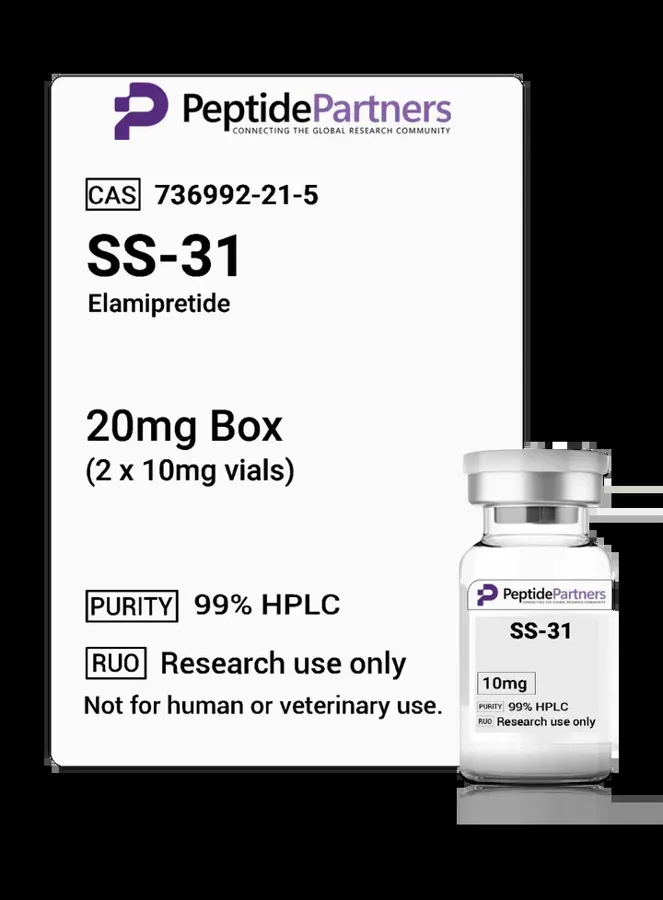
Available packs
SS-31
$110 - $450
Buy SS-31 (10mg vials) from Peptides Partners
Peptides Partners provides premium biochemical compounds engineered for demanding laboratory environments. Qualified investigators seeking to buy SS-31 can access analytical-grade 10mg vials manufactured to ensure reliable structural stability, batch consistency, and solubility. Within our comprehensive catalog of research peptides, each unit undergoes strict synthesis protocols designed to meet the rigorous demands of institutional and academic research programs exploring cellular bioenergetics and mitochondrial physiology.
SS-31 represents one of the most widely evaluated mitochondrial-targeted peptides in contemporary scientific literature. Sourcing this compound through Peptides Partners guarantees that your laboratory receives lyophilized peptide materials prepared under controlled conditions, minimizing atmospheric exposure, moisture degradation, and trace impurities. Whether your investigations center on cell culture models, isolated organelle assays, or complex tissue homogenate studies, our supply infrastructure is tailored to provide verified research materials with consistent availability and transparent documentation.
All compounds supplied by Peptides Partners, including SS-31 10mg vials, are strictly formulated and distributed for in vitro experimentation and non-human laboratory research applications. We maintain rigorous standards across our fulfillment workflow to ensure that scientific researchers acquire compounds that align seamlessly with their investigative methodologies and long-term assay reproducibility.
What is SS-31?
SS-31, also cataloged in preclinical literature under designations such as Elamipretide, Bendavia, and MTP-131, is a synthetic, cell-permeable tetrapeptide with the structural formula D-Arg-Dmt-Lys-Phe-NH2 (where Dmt represents 2′,6′-dimethyltyrosine). It possesses the Chemical Abstracts Service registry number (CAS) 736992-21-5. Unlike many linear peptides that require specialized uptake mechanisms or delivery vectors, SS-31 features an alternating aromatic-cationic structural motif that permits direct translocation across cellular membranes and concentrated accumulation within the inner mitochondrial membrane (IMM).
The molecular mass of the free base is approximately 639.8 g/mol, characterized by an overall net positive charge at physiological pH (+3). This cationic charge, distributed alongside hydrophobic residues, drives the peptide selectively toward the negatively charged environment of energized mitochondria. Once situated at the inner mitochondrial membrane, the unique physical chemistry of SS-31 allows it to interact electrostatically and hydrophobically with cardiolipin, a distinctive tetra-acylated phospholipid found almost exclusively within the mitochondrial inner boundary and cristae membranes.
Cardiolipin serves as a fundamental architectural pillar for mitochondrial integrity, anchoring respiratory chain complexes into organized quaternary structures known as supercomplexes (or respirasomes). Under physiological conditions, cardiolipin promotes efficient electron flux through Complexes I, III, and IV while stabilizing the quaternary assembly of ATP synthase (Complex V). When cardiolipin undergoes structural perturbation, peroxidation, or depletion, electron transfer efficiency drops, leading to reactive oxygen species (ROS) leakage and structural cristae remodeling. SS-31 has emerged as a primary molecular tool for exploring how targeted association with cardiolipin influences organelle microarchitecture, electron transport kinetics, and mitochondrial-mediated apoptotic signaling cascades.
Research effects studied
Across decades of peer-reviewed investigation, SS-31 has been studied in preclinical and clinical research for its multifaceted roles in organelle maintenance, energetic efficiency, and cytoprotection. Investigators utilize this tetrapeptide across diverse experimental models to interrogate mitochondrial dysfunction without directly uncoupling respiration or operating as a non-specific free radical scavenger.
Primary domains of active investigation include:
- Mitochondrial Bioenergetics and ATP Synthesis: Preclinical investigations have observed that the association of SS-31 with cardiolipin optimizes the packing density and cristae curvature of the inner mitochondrial membrane. In isolated mitochondrial assays, researchers have evaluated how SS-31 influences the structural integrity of respiratory supercomplexes, leading to improvements in ADP-stimulated state 3 respiration, enhanced respiratory control ratios (RCR), and sustained ATP production under substrate-limited or stressed conditions.
- Cardiolipin Protection and Cytochrome c Dynamics: During cellular stress, cardiolipin typically detaches from respiratory proteins and complexes with cytochrome c, transforming the hemoprotein into an active peroxidase that catalyzes further membrane lipid peroxidation. SS-31 has been documented in cell-free and cell-based studies to inhibit the cardiolipin-cytochrome c peroxidase complex, thereby mitigating cardiolipin oxidation and preventing the subsequent detachment and release of pro-apoptotic factors into the cytosol.
- Cardiovascular and Ischemia-Reperfusion Models: SS-31 has been extensively investigated in rodent and non-human primate models of myocardial infarction, pressure overload, and heart failure with preserved ejection fraction (HFpEF). Studies focus on its capacity to preserve microvascular flow, limit microvascular no-reflow phenomena, and reduce infarct volume following acute ischemic insults, primarily by stabilizing mitochondrial ultrastructure prior to reperfusion-induced reoxygenation injury.
- Renal Microvascular and Tubular Pathology: In models of acute kidney injury (AKI) and diabetic nephropathy, researchers have utilized SS-31 to evaluate the preservation of tubular brush border membranes, mitochondrial morphology in renal proximal tubules, and glomerular filtration mechanics. Published data demonstrate reductions in oxidative stress biomarkers, suppression of inflammatory cytokine infiltration, and preservation of renal microvascular architecture.
- Neurodegenerative Disease and Synaptic Function: Laboratory models of neurodegenerative conditions, including Parkinson’s disease, Alzheimer’s disease, and amyotrophic lateral sclerosis (ALS), frequently feature bioenergetic decline. SS-31 has been analyzed for its ability to cross the blood-brain barrier in animal models, support axonal transport, protect dopaminergic neurons from neurotoxic insults (such as MPTP), and preserve synaptic density in cortical and hippocampal preparations.
- Skeletal Muscle Senescence and Sarcopenia: Research focusing on age-related muscle deterioration examines how mitochondrial electron leakage contributes to atrophy and reduced specific force. Preclinical studies indicate that sustained application of SS-31 in aged rodent cohorts correlates with restored mitochondrial quality, reduced resting ROS emission, and enhanced maximal exercise capacity without altering baseline mitochondrial biogenesis markers.
How to use in the laboratory
To preserve compound integrity and guarantee assay reproducibility, research personnel must adhere to standardized biochemical handling protocols when working with SS-31. As a research-use-only peptide, all preparation, dilution, and manipulation must occur within an appropriate laboratory containment setting, such as a certified laminar flow hood or biosafety cabinet, utilizing sterile consumables and aseptic technique.
Recommended laboratory reconstitution and handling workflow:
- Equilibration: Prior to reconstitution, remove the lyophilized 10mg vial from cryogenic or sub-zero storage and permit it to reach ambient laboratory temperature (approximately 20°C to 25°C) inside a desiccator. This step prevents ambient moisture from condensing onto the hygroscopic lyophilized cake, which can induce rapid hydrolytic degradation.
- Solvent Selection: SS-31 is highly water-soluble due to its basic residues and overall positive charge. It readily reconstitutes in sterile deionized water, bacteriostatic water for laboratory use, or sterile phosphate-buffered saline (PBS, pH 7.4). For sensitive enzymatic or cell-free assays, high-purity molecular biology grade water is preferred to prevent interference from exogenous ions or buffering agents.
- Reconstitution Technique: Introduce the diluent gently against the inner glass wall of the vial using a calibrated micropipette, avoiding direct, high-pressure injection onto the lyophilized powder. Typical stock concentrations range from 1 mg/mL to 10 mg/mL, depending on experimental design. Gently swirl or invert the vial until the cake is fully dissolved. Avoid vigorous agitation or high-speed vortexing, as mechanical shear stress can promote peptide aggregation or degradation.
- Aliquoting: Once full dissolution is verified visually, aliquot the stock solution into sterile, low-protein-binding microcentrifuge tubes according to the volumetric requirements of planned assays. Aliquoting is critical to prevent repeated freeze-thaw cycles, which compromise peptide conformation and biological activity.
- Record-Keeping: Maintain detailed documentation on every vial, recording the reconstitution date, solvent batch number, final concentration, operator initials, and internal lot number. Log each thaw cycle and verify that analytical controls align with historical lab benchmarks.
Pack sizes and price per mg
Peptides Partners provides flexible acquisition tiers for laboratories conducting pilot evaluations or sustained multi-phase experimental programs. Our SS-31 (10mg vials) are packaged in uniform configurations that allow research facilities to optimize cost efficiency per milligram of active biochemical agent while minimizing waste from opened containers.
Review the standard packaging tiers and volume-based pricing structures outlined below:
| Pack Size | Total Quantity (mg) | Total Price (USD) | Price per mg (USD) |
|---|---|---|---|
| 2 vials x 10mg | 20 mg | $110.00 | $5.50 |
| 5 vials x 10mg | 50 mg | $253.00 | $5.06 |
| 10 vials x 10mg | 100 mg | $450.00 | $4.50 |
By offering tiered pricing structures, Peptides Partners enables academic laboratories, biotechnology institutions, and independent research organizations to effectively plan grant expenditures. Each package tier contains identically manufactured 10mg lyophilized vials, ensuring that scaling up your experimental inventory does not introduce batch-to-batch variation.
Storage and handling
Maintaining appropriate environmental parameters is vital for preventing the degradation of SS-31. In its lyophilized state, the peptide displays optimal stability when stored in dark, desiccated conditions at -20°C. For long-term archiving exceeding six months, storage at -80°C is strongly recommended to preserve structural fidelity and prevent oxidative modification of the 2′,6′-dimethyltyrosine moiety.
Following reconstitution, peptide solutions exhibit reduced stability relative to the dry powder. Aqueous solutions stored at 2°C to 8°C should be utilized within 24 to 48 hours to minimize spontaneous hydrolysis or microbial contamination. For extended experimental timelines, reconstituted stock aliquots must be stored at -20°C or -80°C, under which conditions stability is typically maintained for up to several months. Vials should be shielded from light exposure by utilizing amber containers or opaque storage boxes.
Investigators must take care to avoid plasticware that exhibits high non-specific peptide binding. Utilizing polypropylene or specialized low-retention tubes guarantees accurate final concentrations in micro-molar and nano-molar assay preparations. Any unused solution that has undergone multiple unplanned temperature fluctuations or shows visual precipitation should be discarded according to institutional chemical disposal protocols.
Quality and documentation
The credibility of experimental outcomes rests entirely on the integrity of the input compounds. Peptides Partners subjects every production batch of research peptides to standardized analytical screening methodologies. Analytical parameters confirm sequence fidelity, residual solvent limits, and precise molecular weight confirmation using electrospray ionization mass spectrometry (ESI-MS) alongside purity verification via high-performance liquid chromatography (HPLC).
Detailed batch records verify that our SS-31 lots meet strict chemical identity criteria, preventing the inclusion of truncated peptide sequences, unreacted coupling reagents, or heavy metal contamination. Laboratories sourcing materials through Peptides Partners can reliably integrate our compounds into quantitative assay workflows, knowing that baseline parameters remain consistent across longitudinal studies.
All packaging materials are engineered to maintain a hermetic seal against atmospheric moisture and ambient gases. Every vial features clear labeling indicating compound nomenclature, mass content, net weight, lot identification, and clear research-use-only parameters to ensure compliant chemical management within your research facility.
Frequently asked questions
What is the primary molecular target of SS-31 in research models?
The primary molecular target of SS-31 is cardiolipin, a specialized phospholipid localized predominantly within the inner mitochondrial membrane. The peptide binds selectively to cardiolipin through combined electrostatic interactions between its basic residues and cardiolipin’s phosphate headgroups, alongside hydrophobic interactions involving its aromatic residues and cardiolipin’s acyl chains. This association stabilizes cristae structure, preserves respiratory supercomplexes, and inhibits aberrant cytochrome c peroxidase activity.
How should reconstituted SS-31 be aliquoted for experimental series?
Reconstituted stock solutions should be divided into single-use volumes using sterile, low-protein-binding microcentrifuge tubes immediately following total dissolution. The volume of each aliquot should reflect the exact requirements of a single day’s experimental protocol to prevent repeated freezing and thawing. Aliquots must be clearly labeled with the concentration, solvent system, and date before placement into storage at -20°C or -80°C.
Can SS-31 be utilized for in vivo human or animal therapeutic purposes?
No. SS-31 supplied by Peptides Partners is strictly intended for laboratory research purposes (RUO). It is not approved for human or veterinary use, clinical diagnostics, therapeutics, food additives, cosmetics, or any direct administration to humans or agricultural animals. Purchase and utilization are restricted to qualified academic, scientific, and institutional personnel conducting lawful in vitro or animal model research.
What solvents are typically utilized to reconstitute SS-31 in the laboratory?
SS-31 exhibits high aqueous solubility due to its net positive charge and compact tetrapeptide structure. Standard laboratory solvents include sterile molecular biology grade water, bacteriostatic water, and physiological buffers such as sterile phosphate-buffered saline (PBS, pH 7.4). The choice of solvent depends on downstream assay requirements; organic solvents like DMSO are typically unnecessary and avoided unless specifically dictated by a unique assay matrix.
Related Peptides Partners research peptides
SS-31 (50mg vials); GLP-2 Tirzepatide (40mg vials); CJC-1295 no DAC (10mg vials).
SS-31 lot documentation
Certificates of analysis are matched to the actual lot supplied with your order. Email sales@peptidespartners.co with the product name and pack size to request the current lot's purity, identity and screening documents before purchase.
Storage
Research peptides are typically supplied lyophilized (freeze-dried), which keeps them stable for shipping and storage. Store unopened vials cool, dry and away from light; for long-term storage, a freezer is generally recommended.
After reconstitution, keep vials refrigerated and use sterile laboratory technique. Follow the handling guidance supplied with your lot documentation.
- Short name
- SS-31 (10mg vials)
- Vial strength
- 10mg vials
- Pack sizes
- 20mg pack, 50mg pack, 100mg pack
- Pack count options
- 2, 5, 10 vial packs
- CAS number
- 736992-21-5
- Category
- Mitochondrial
- SKU
- PP-981
- Compliance
- Research Use Only. Not for use in diagnostic tests.