
B1
10mL per vial
Available packs
B1
$165 - $330
Buy B1 (Thiamine HCL) 10mL vials from Peptides Partners
Analytical and biochemical laboratories require verified, highly soluble cofactors to support investigative research into cellular energy pathways, mitochondrial function, and neurochemical regulation. Peptides Partners supplies laboratory-grade B1 (Thiamine Hydrochloride) in sterile 10mL multi-use vials manufactured for strictly non-clinical research settings. Each vial contains verified Thiamine HCL (CAS: 67-03-8), synthesized and packaged to deliver exceptional batch-to-batch consistency for in vitro, cell culture, and enzymatic assays.
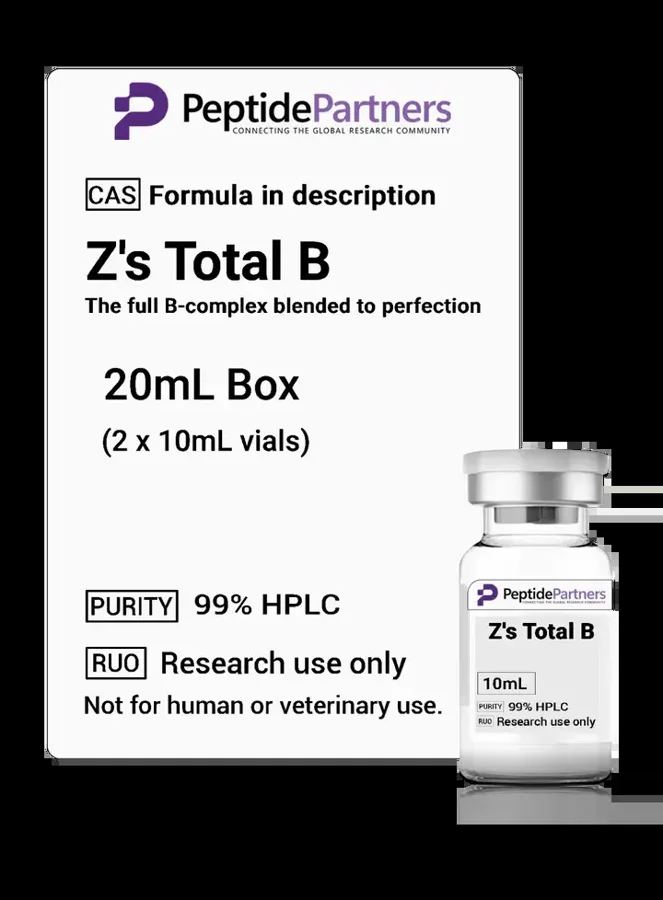
As metabolic and biochemical inquiries expand, researchers often investigate individual water-soluble coenzymes alongside complex formulations. For laboratories seeking comprehensive multi-pathway cofactor suites, investigators frequently buy Z’s Total B Kit alongside standalone vials to establish calibrated control baselines across concurrent experimental arms. In addition to high-grade micronutrient reagents, Peptides Partners maintains an extensive catalog of research peptides, coenzymes, and biochemical reference standards designed to meet the operational standards of university, corporate, and private research institutions.
Every lot of B1 (Thiamine HCL) distributed by Peptides Partners undergoes rigorous quality control verification to confirm identity, concentration, and molecular integrity. Offered in dual-vial and five-vial configurations, these 10mL vials provide scalable utility for long-duration metabolic kinetics, microfluidic cell culture perfusions, and comparative pathway studies.
What is B1?
Vitamin B1, scientifically designated as Thiamine, is an essential water-soluble compound belonging to the B-complex group. In its standard synthesized analytical form, it is prepared as Thiamine Hydrochloride (Thiamine HCL) under the Chemical Abstracts Service registry number 67-03-8. The molecular formula for Thiamine Hydrochloride is C12H17ClN4OS · HCl, with a molecular weight of approximately 337.27 g/mol. Structurally, it consists of an aminopyrimidine ring connected by a methylene bridge to a 4-methyl-5-hydroxyethylthiazole ring, stabilized in salt form by two chloride equivalents.
Thiamine HCL is characterized by its high water solubility and crystalline white or off-white appearance in raw solid state. In aqueous biological and research media, thiamine serves as the indispensable precursor to several phosphorylated esters, the most biochemically active being Thiamine Pyrophosphate (TPP), also referred to as Thiamine Diphosphate (ThDP). TPP functions as a vital non-protein coenzyme in ubiquitous intracellular reactions, particularly those driving the catabolism of carbohydrates and branched-chain amino acids.
Within cellular systems, thiamine pyrophosphokinase catalyzes the conversion of free thiamine into TPP via the transfer of a pyrophosphate group from adenosine triphosphate (ATP). Once synthesized, TPP acts as an electron sink, stabilizing carbanion intermediates during the non-oxidative and oxidative decarboxylation of alpha-keto acids. This molecular capacity places thiamine at the biochemical nexus between glycolysis, the tricarboxylic acid (TCA) cycle, and the pentose phosphate pathway (PPP).
Research effects studied
Thiamine HCL has served as a central molecule of scientific inquiry across several decades of biochemical, cellular, and preclinical exploration. Research models investigate thiamine across diverse physiological and pathophysiological contexts, with particular focus on the following domains:
- Mitochondrial Bioenergetics and Glucose Oxidation: In cellular respiration models, researchers study thiamine’s role as a cofactor for the pyruvate dehydrogenase complex (PDHC) and the alpha-ketoglutarate dehydrogenase complex (alpha-KGDHC). Preclinical models of bioenergetic failure analyze how variations in intracellular thiamine concentration alter the conversion of cytosolic pyruvate into mitochondrial acetyl-CoA, directly influencing downstream ATP yield, substrate-level phosphorylation, and the accumulation of intermediate organic acids like lactate.
- Pentose Phosphate Pathway (PPP) Kinetics: Thiamine is extensively evaluated in enzymology laboratories due to its requirement by transketolase, a rate-limiting enzyme in the non-oxidative branch of the PPP. Investigative studies assess how transketolase activity modulates the generation of ribose-5-phosphate for nucleic acid synthesis, as well as the production of reduced nicotinamide adenine dinucleotide phosphate (NADPH), a critical reducing agent required for intracellular glutathione recycling and lipid synthesis.
- Neuronal and Glial Cell Integrity: Neurobiology research groups utilize thiamine deficiency and repletion models in vitro to study the vulnerability of primary cortical and cerebellar neurons. Published literature investigates the mechanisms by which thiamine depletion promotes focal microglial activation, selective mitochondrial depolarization, altered acetylcholine biosynthesis via choline acetyltransferase, and localized oxidative damage in vulnerable brain regions such as the thalamus and mammillary bodies.
- Oxidative Stress and Reactive Oxygen Species (ROS) Regulation: In cellular oxidative stress assays, scientists study the protective dynamics of thiamine and its derivatives against hydrogen peroxide and lipid peroxidation. Research literature indicates that through its indirect support of NADPH-dependent glutathione reductase, thiamine availability correlates with the maintenance of cellular redox equilibrium and preservation of endothelial cellular monolayers.
- Vascular and Endothelial Cellular Mechanics: Preclinical models investigating high-glucose insults examine the capacity of thiamine and thiamine-derived molecules to attenuate advanced glycation end-product (AGE) formation, protein kinase C (PKC) activation, and hexosamine pathway fluxes in human umbilical vein endothelial cells (HUVECs).
How to use in the laboratory
The handling, dilution, and experimental application of B1 (Thiamine HCL) 10mL vials must be executed exclusively by trained laboratory personnel in accordance with institutional biosafety and standard chemical hygiene plans. This product is prepared for research use only and must never be administered to humans or living clinical subjects.
To ensure consistent analytical results, investigators should observe the following bench protocols:
- Aseptic Preparation: Prior to piercing the septum, wipe the rubber stopper of the 10mL vial with a freshly prepared solution of 70% reagent-grade isopropyl alcohol or ethanol. Allow the surface to dry completely inside a certified laminar flow hood or biological safety cabinet (BSC) to prevent contaminant introduction.
- Analytical Media Incorporation: When preparing defined culture media or enzymatic assay buffers, calculate the required micromolar or millimolar concentration based on the designated batch molarity. Utilize sterile, calibrated micropipettes with hydrophobic barrier tips to draw the liquid aliquot. Introduce the compound into the balanced salt solution, basal media (e.g., DMEM, RPMI 1640), or cell-free enzymatic buffer while gently swirling to ensure uniform distribution.
- Filtration Considerations: If thiamine solutions are combined with non-sterile secondary reagents, the resulting mixture should be clarified using a 0.22-micron polyethersulfone (PES) or polyvinylidene fluoride (PVDF) syringe filter. Avoid the use of aggressive cellulose esters that may non-specifically bind small molecules or cofactors.
- Instrumentation Compatibility: Liquid aliquots can be quantified in spectrophotometric assays by measuring characteristic ultraviolet absorption spectra. Thiamine solutions exhibit specific absorbance maxima dependent on pH; in acidic solutions (pH below 4.0), thiamine HCL displays a prominent absorbance peak near 246 nm.
- Laboratory Record-Keeping: Maintain rigorous documentation within your digital laboratory notebook (ELN) or paper research log. Document the vial lot number, date of initial puncture, calculated working concentration, volume removed, experimental assay identifier, and storage parameters before returning the stock vial to the designated temperature zone.
Pack sizes and price per mg
Peptides Partners provides B1 (Thiamine HCL) 10mL vials in two volume-tiered configurations designed to support both focused pilot projects and high-throughput multi-well plate platforms. Each 10mL vial is filled at an analytical concentration of 100 mg/mL, delivering a total of 1,000 mg (1.0 gram) of pure Thiamine Hydrochloride per individual vial.
The table below provides a detailed economic breakdown of the available package sizes, including the total active compound volume and calculated cost per milligram to support research grant planning and operational budgeting:
| Pack Option | Total Volume (mL) | Total Active Compound (mg) | Pack Price (USD) | Price per mg (USD) |
|---|---|---|---|---|
| 2 vials x 10mL | 20 mL | 2,000 mg | $165.00 | $0.0825 |
| 5 vials x 10mL | 50 mL | 5,000 mg | $330.00 | $0.0660 |
Procuring the 5-vial package option reduces the unit cost of raw thiamine cofactors from approximately 8.25 cents per milligram to 6.60 cents per milligram, representing a 20% cost reduction for high-volume research pipelines. When planning large-scale enzymatic comparative studies alongside research peptides or when scientists buy Z’s Total B Kit for parallel pathway verification, selecting the 5-vial pack provides significant laboratory savings and ensures that identical lot parameters are maintained across prolonged experimental schedules.
Storage and handling
Thiamine HCL exhibits characteristic sensitivities to environmental factors, including temperature, actinic light, and alkaline pH conditions. Adherence to proper storage specifications is critical to maintain coenzyme integrity and prevent chemical hydrolysis into 4-methyl-5-(beta-hydroxyethyl)thiazole and 2-methyl-4-amino-5-hydroxymethylpyrimidine.
Unopened Vials: Store intact, unopened vials at controlled room temperature between 15°C and 25°C, or refrigerated at 2°C to 8°C in a dry environment. Keep vials inside their protective packaging or within an amber storage box to minimize direct exposure to light. When stored under optimal dark, climate-controlled conditions, the compound exhibits stability through the printed expiration or re-test date on the product label.
Opened and Punctured Vials: Once the container closure has been accessed with a sterile needle, store the vial refrigerated at 2°C to 8°C. Do not freeze intact liquid vials, as rapid volumetric expansion of aqueous solution may compromise container closure integrity or lead to microscopic fissure formation in the glass vial walls. For prolonged experimental schedules, working aliquots diluted in pure analytical grade water or compatible buffer may be sub-aliquoted into sterile polypropylene cryovials and stored at -20°C or -80°C to eliminate repeated thermal cycling.
Chemical Stability and Incompatibilities: Thiamine HCL solutions are stable under acidic conditions (pH 2.7 to 3.6), but degrade rapidly when introduced to neutral or alkaline environments (pH above 6.0), where heat or oxidizing agents trigger rapid cleavage of the central methylene bridge. Avoid exposing thiamine reagents to strong oxidizing agents, ferric ions, copper ions, riboflavin, or bisulfites, which catalyze rapid chemical degradation.
Quality and documentation
Peptides Partners is dedicated to supplying standard-grade, chemically verifiable reagents to the scientific and preclinical research communities. We understand that reproducible experimental data hinges entirely on reagent purity, absence of cross-contamination, and strict adherence to molecular specifications.
Every production batch of B1 (Thiamine HCL) 10mL vials is validated through an extensive analytical testing regimen:
- High-Performance Liquid Chromatography (HPLC): Confirms chemical purity and verifies the absence of residual synthetic intermediates, degradation fragments, or unknown chemical peaks.
- Liquid Chromatography-Mass Spectrometry (LC-MS): Validates precise molecular weight and mass ion characteristics matching CAS 67-03-8.
- Sterility and Endotoxin Screening: Evaluates solution clarity, bioburden levels, and endotoxin presence to ensure compatibility with sensitive cell cultures, tissue explants, and cell-free biochemical assays.
- Batch-Specific Certificates of Analysis (CoA): Detailed analytical documentation is compiled for every lot, delineating the physical characteristics, chemical parameters, purity percentages, and manufacturing dates. Institutional researchers can verify documentation prior to integrating products into active project workflows.
Frequently asked questions
What is the CAS registry number and molecular classification of Thiamine HCL?
The CAS registry number for Thiamine Hydrochloride is 67-03-8. It is chemically categorized as a water-soluble aminopyrimidine-thiazole salt belonging to the vitamin B complex family. In scientific nomenclature, it is designated as 3-[(4-amino-2-methylpyrimidin-5-yl)methyl]-5-(2-hydroxyethyl)-4-methylthiazol-3-ium chloride hydrochloride.
Can Thiamine HCL be evaluated in assays alongside research peptides?
Yes. Investigators frequently design multi-faceted cellular assays that study metabolic rate, mitochondrial oxygen consumption (OCR), or cellular signaling by pairing thiamine with diverse research peptides. Because thiamine serves as an essential coenzyme in oxidative phosphorylation and carbohydrate processing, combining it with cell-penetrating peptides, regulatory peptides, or multi-vitamin matrices allows laboratories to measure interactions between metabolic cofactors and peptide-mediated receptor pathways. Many researchers investigating comprehensive mitochondrial cascades buy Z’s Total B Kit in conjunction with isolated thiamine vials to ensure robust experimental controls.
What is the concentration and solvent base of this 10mL formulation?
The B1 (Thiamine HCL) vials provided by Peptides Partners are formulated as a liquid analytical solution containing 100 mg of Thiamine Hydrochloride per milliliter of sterile water for injection, resulting in a total active content of 1,000 mg (1.0 g) per 10mL vial. The aqueous vehicle is buffered and filtered to preserve molecular stability, presenting a clear, colorless to slightly pale-yellow liquid suitable for precise micro-aliquoting into defined laboratory media.
How should researchers handle light sensitivity during benchtop experiments?
Thiamine compounds are sensitive to prolonged exposure to direct ultraviolet and intense fluorescent lighting, which can accelerate photochemical decomposition. During laboratory procedures, it is recommended that technicians work under subdued ambient light, use amber or opaque microcentrifuge tubes for prepared working dilutions, and avoid leaving stock vials exposed on the open benchtop for extended periods. Reagent vessels can also be shielded with laboratory-grade aluminum foil during ongoing kinetic or multi-hour cell incubation assays.
Related Peptides Partners research peptides
GLP-2 Tirzepatide (40mg vials); AOD-9604 (10mg vials); GLOW Blend: BPC-157/TB-500/GHK-Cu (70mg vials).
B1 lot documentation
Certificates of analysis are matched to the actual lot supplied with your order. Email sales@peptidespartners.co with the product name and pack size to request the current lot's purity, identity and screening documents before purchase.
Storage
Research peptides are typically supplied lyophilized (freeze-dried), which keeps them stable for shipping and storage. Store unopened vials cool, dry and away from light; for long-term storage, a freezer is generally recommended.
After reconstitution, keep vials refrigerated and use sterile laboratory technique. Follow the handling guidance supplied with your lot documentation.
- Short name
- B1 (Thiamine HCL) 10mL vials
- Vial strength
- 10mL vials
- Pack sizes
- 20mL pack, 50mL pack
- Pack count options
- 2, 5 vial packs
- CAS number
- 67-03-8
- Category
- All Products
- SKU
- PP-976
- Compliance
- Research Use Only. Not for use in diagnostic tests.