
Thymosin Alpha-1
10mg per vial
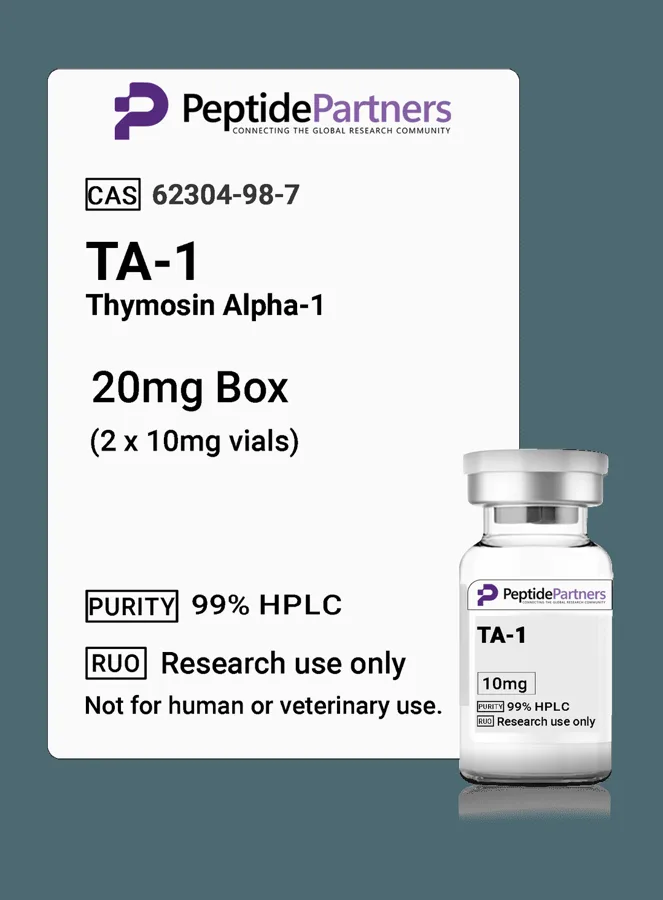
Available packs
Thymosin Alpha-1
$98 - $370
Buy Thymosin Alpha-1 (TA1, 10mg vials) from Peptides Partners
Peptides Partners provides analytical-grade Thymosin Alpha-1 (TA1) supplied in robust 10mg vials, optimized for precision, reproducibility, and stability across a wide variety of in vitro and in vivo scientific protocols. When research teams seek to buy Thymosin Alpha-1 for experimental trials, molecular profiling, or cellular bioassays, obtaining compounds synthesized to strict biochemical specifications is paramount. Peptides Partners distributes high-integrity research peptides designed exclusively for non-human, laboratory-based study, ensuring dependable chemical structure and lot-to-lot consistency.
Thymosin Alpha-1 is categorized among the most widely investigated immunomodulatory peptides in contemporary bioscience. Our 10mg presentation offers an ideal mass format for laboratories requiring exact stock solutions without excessive serial dilution steps or frequent vial reconstitution. Packaged in sealed, borosilicate glass vials under an inert atmosphere, each unit undergoes lyophilization to preserve molecular conformation during transit and ambient handling. Whether conducting academic inquiry into cellular immunology or developing commercial screening assays, researchers rely on Peptides Partners for professional-grade reagent sourcing.
What is Thymosin Alpha-1?
Thymosin Alpha-1 (often abbreviated as TA1) is an endogenous, highly conserved 28-amino-acid peptide that was originally isolated from bovine thymus tissue as part of Thymosin Fraction 5. Scientifically cataloged under Chemical Abstracts Service registry number CAS: 62304-98-7, the peptide has since been synthesized via solid-phase peptide synthesis (SPPS) methods to provide an ultra-pure chemical entity free from native biological contaminants or adventitious cellular factors.
The primary structure of Thymosin Alpha-1 is defined by an N-terminal acetylated serine residue followed by an acid-rich sequence of amino acids: Ac-Ser-Asp-Ala-Ala-Val-Asp-Thr-Ser-Ser-Glu-Ile-Thr-Thr-Lys-Asp-Leu-Lys-Glu-Lys-Lys-Glu-Val-Val-Glu-Glu-Ala-Glu-Asn-OH. This structural configuration yields an empirical chemical formula of C129H215N33O45 and a calculated molecular mass of approximately 3,108.3 Daltons. The abundance of acidic residues, notably glutamic and aspartic acid residues, imparts a net negative charge to the peptide at physiological neutral pH (isoelectric point approximately 4.2), which significantly influences its solubility profile, metal-binding characteristics, and spatial interactions in aqueous experimental solutions.
In standard physiological biochemistry models, Thymosin Alpha-1 is recognized as a cleavage product derived from prothymosin alpha, a ubiquitous nuclear protein involved in cell proliferation and chromatin remodeling. While prothymosin alpha is distributed across numerous somatic tissue types, biological cleavage into the functional 28-amino-acid peptide Thymosin Alpha-1 is predominantly associated with thymic epithelial tissue and specialized secondary lymphoid niches. Within scientific literature, TA1 is primarily investigated for its direct and indirect regulatory actions on mammalian immune pathways, acting as a biological response modifier rather than an inert structural scaffold.
Research effects studied
Over several decades of academic and preclinical investigation, Thymosin Alpha-1 has served as a central subject in cellular immunology, infectious disease modeling, oncology research, and molecular pharmacology. Below are key operational pathways and biological effects documented in peer-reviewed scientific studies:
- T-Lymphocyte Differentiation and Maturation: Preclinical cell culture models have documented that Thymosin Alpha-1 modulates the maturation cascade of primitive thymocytes into fully functional T-lymphocyte subsets. Research has established its capacity to upregulate phenotypic markers on developing T-cells, enhancing the expression of CD3, CD4, and CD8 surface complexes. Studies show an associated enhancement in T-helper (Th1) phenotype differentiation, which correlates with shifted transcription factor profiles like T-bet.
- Cytokine Cascade Modulation: In cellular assays, exposure to TA1 has been shown to induce dose-dependent alterations in cytokine secretion. Investigations demonstrate increased transcription and release of pro-inflammatory and cell-mediated regulatory mediators, including Interleukin-2 (IL-2), Interferon-gamma (IFN-gamma), and Interleukin-12 (IL-12). Conversely, in states of excessive hyper-inflammatory cytokine production, some research models indicate TA1 interacts with suppressive pathways to moderate systemic inflammatory cascades.
- Toll-Like Receptor (TLR) Signaling Pathways: Contemporary research highlights TA1 as an extracellular ligand interacting directly with specific pattern recognition receptors, particularly Toll-like Receptor 2 (TLR2) and Toll-like Receptor 9 (TLR9), on dendritic cells and macrophages. Downstream signal transduction assays reveal activation of myeloid differentiation primary response 88 (MyD88) pathways, resulting in Nuclear Factor kappa-B (NF-kB) translocation and Interferon Regulatory Factor (IRF) activation, thereby linking innate immune surveillance with adaptive cellular responses.
- Major Histocompatibility Complex (MHC) Upregulation: In vitro oncology models have evaluated TA1 for its capacity to augment antigen presentation. Studies indicate that application of the peptide can upregulate Major Histocompatibility Complex Class I (MHC-I) surface expression on transformed or infected cell lines. This increase in target visibility provides an experimental framework for investigating enhanced recognition and lysis by cytotoxic T-lymphocytes (CTLs) and natural killer (NK) cells.
- Modulation of Oxidative Stress and Cellular Apoptosis: Research conducted on isolated tissue models and cellular stress assays suggests Thymosin Alpha-1 plays a regulatory role in maintaining intracellular glutathione (GSH) reserves. By counteracting reactive oxygen species (ROS) accumulation, TA1 has been analyzed for protective actions against toxic insults and induced cellular apoptosis, specifically within liver cell lines and lymphoid compartments.
- Natural Killer (NK) Cell Cytotoxicity: Co-culture experiments demonstrate that incubation with Thymosin Alpha-1 enhances the lytic activity of natural killer cells against target cellular lines. This effect is often studied in tandem with cytokine synergy assays involving low-dose interleukin or interferon co-treatments.
How to use in the laboratory
To ensure validity, reproducibility, and stability throughout scientific experiments, research personnel must adhere to standardized laboratory preparation protocols when working with Thymosin Alpha-1. The compound is supplied as a lyophilized white to off-white cake or powder and must be reconstituted into liquid form prior to introduction into cell cultures, binding assays, or analytical instrumentation. Please note that this product is intended strictly for in vitro and laboratory experimental workflows; it is not suitable for clinical, diagnostic, therapeutic, or in vivo human administration.
The following procedures outline standard laboratory protocol for reconstitution and management:
- Aseptic Benchtop Preparation: Perform all handling within a certified Class II biological safety cabinet or horizontal laminar flow hood to eliminate microbial contamination. Disinfect all external vial surfaces, caps, and pipette shafts with clean 70% isopropanol or ethanol before commencing operations.
- Selection of Reconstitution Vehicle: Bacteriostatic water (containing 0.9% benzyl alcohol) or sterile, endotoxin-free laboratory-grade saline (0.9% NaCl) or water for injection (WFI) is commonly selected for reconstitution depending on assay sensitivity. If cellular viability assays are sensitive to preservatives, sterile deionized water or buffered saline (e.g., PBS, pH 7.2–7.4) without bacteriostatic agents should be used.
- Reconstitution Technique: Allow the sealed glass vial to equilibrate to room temperature (approximately 20°C to 25°C) for 15–20 minutes prior to introducing fluid; this prevents moisture condensation within the lyophilized cake. Using a sterile micro-syringe or precision micropipette with low-binding tips, introduce the diluent slowly down the inside glass wall of the vial. Avoid spraying directly onto the lyophilized cake to minimize peptide shearing.
- Dissolution Dynamics: Gently swirl or invert the vial until the peptide is completely dissolved. Do not agitate vigorously, shake, or vortex, as mechanical shear stress can disrupt peptide tertiary structure and encourage the formation of insoluble micro-aggregates. TA1 generally exhibits rapid dissolution due to its acidic, hydrophilic amino acid sequence.
- Calculation of Stock Concentrations: Reconstituting a 10mg vial with 2.0 mL of solvent yields a stock concentration of 5.0 mg/mL (5000 µg/mL). Reconstituting with 1.0 mL yields a stock concentration of 10.0 mg/mL. Laboratories should verify the desired working concentration against experimental parameters prior to volume addition.
- Aliquotting and Handling Records: Immediately subdivide the reconstituted stock into single-use microcentrifuge tubes constructed from low-retention polypropylene. Document the exact reconstitution date, concentration, solvent type, and designated lot number on the vial label. Maintain a comprehensive laboratory tracking log to monitor freeze-thaw cycles and experimental utilization.
Pack sizes and price per mg
To accommodate diverse project scales ranging from pilot cellular screenings to longitudinal preclinical protocols, Peptides Partners offers Thymosin Alpha-1 (10mg vials) in multiple pack configurations. Volume purchasing provides significant savings per milligram of active peptide, allowing research departments to allocate resources efficiently.
The table below summarizes our current packaging options, pricing tiers, and the effective cost per milligram:
| Pack Configuration | Total Active Content | Price (USD) | Effective Price per mg |
|---|---|---|---|
| 2 vials x 10mg | 20 mg | $98.00 | $4.90 / mg |
| 5 vials x 10mg | 50 mg | $210.00 | $4.20 / mg |
| 10 vials x 10mg | 100 mg | $370.00 | $3.70 / mg |
When you choose to buy Thymosin Alpha-1 from our research peptides catalog, each package is shipped in protective, temperature-monitored materials designed to safeguard product integrity through international or domestic transit corridors.
Storage and handling
Peptide stability is sensitive to ambient thermal fluctuations, atmospheric humidity, and prolonged exposure to ultraviolet (UV) radiation. Observance of strict storage guidelines ensures the retention of peptide potency and prevents hydrolytic or oxidative degradation over time.
- Lyophilized Product Storage: Upon delivery, unopened vials containing lyophilized Thymosin Alpha-1 should be stored at -20°C in a manual-defrost freezer. For long-term archiving exceeding 12 months, storage at -80°C is recommended. Avoid auto-defrost (frost-free) freezers, as their internal heating cycles cause repeated thermal fluctuations that damage lyophilized structures.
- Desiccation Precautions: Ensure that vials are kept in sealed secondary containers containing activated silica desiccant pouches. Moisture ingress is the primary cause of spontaneous peptide hydrolysis and non-enzymatic cleavage of sensitive peptide bonds.
- Post-Reconstitution Storage: Once reconstituted into liquid solution, the peptide must be maintained at 2°C to 8°C for immediate short-term use (ideally within 24 to 72 hours if using preservative-free diluents, or up to 21 days when prepared with bacteriostatic water under sterile conditions).
- Freeze-Thaw Prevention: For extended experimental timelines, frozen aliquots stored at -20°C or -80°C remain stable for several months. However, solutions must never be subjected to repeated freeze-thaw cycles. Each cycle promotes ice crystal formation and local concentration gradients that facilitate peptide aggregation and denaturation. Aliquots thawed once should be utilized in full or discarded according to institutional biosafety guidelines.
- Light Exposure: Store vials in opaque boxes or foil-wrapped containers to avoid photodegradation induced by direct laboratory lighting or solar radiation.
Quality and documentation
Scientific rigor demands that all analytical reagents fulfill defined baseline criteria for identity, purity, and consistency. Peptides Partners distributes research peptides that undergo systematic analytical evaluation prior to release. Every lot of Thymosin Alpha-1 is validated via established physical and chemical characterization methodologies:
- High-Performance Liquid Chromatography (HPLC): Analytical reversed-phase HPLC (RP-HPLC) is utilized to determine chromatographic purity profiles, resolving the main peptide peak from synthesis intermediates, truncated species, and residual deprotection artifacts.
- Mass Spectrometry (MS): Electrospray Ionization Mass Spectrometry (ESI-MS) or Matrix-Assisted Laser Desorption/Ionization Time-of-Flight (MALDI-TOF) mass spectrometry confirms the exact molecular mass of 3,108.3 Da, verifying the accurate assembly of the 28-amino-acid chain and N-terminal acetylation.
- Detailed Batch Records: Every vial is labeled with explicit lot identification numbers, linking the physical reagent directly to factory synthesis logs, gross molecular weight metrics, and synthesis records.
- Contaminant Control: Quality protocols ensure minimal moisture retention, absence of macroscopic particulate matter, and tightly managed acetate counter-ion concentrations, ensuring experimental models are not compromised by uncharacterized chemical interference.
Frequently asked questions
What is the molecular formula and CAS number of Thymosin Alpha-1?
Thymosin Alpha-1 is chemically identified under the Chemical Abstracts Service registry as CAS: 62304-98-7. Its chemical formula is C129H215N33O45, consisting of 28 amino acids with an acetylated N-terminus (Ac-Ser-Asp-Ala-Ala-Val-Asp-Thr-Ser-Ser-Glu-Ile-Thr-Thr-Lys-Asp-Leu-Lys-Glu-Lys-Lys-Glu-Val-Val-Glu-Glu-Ala-Glu-Asn-OH) and a total molecular weight of 3,108.3 g/mol.
What diluent should be used to reconstitute Thymosin Alpha-1 in cell culture research?
For in vitro cell culture assays, researchers typically reconstitute Thymosin Alpha-1 using sterile, endotoxin-free water or sterile phosphate-buffered saline (PBS, pH 7.2–7.4). Bacteriostatic water is generally avoided in direct cell culture applications because the antimicrobial agent (0.9% benzyl alcohol) can exhibit cytotoxic effects on primary cells or established cell lines.
How should reconstituted Thymosin Alpha-1 aliquots be managed to prevent degradation?
To prevent peptide degradation, the primary reconstituted stock should immediately be partitioned into small, single-use aliquots using low-protein-binding polypropylene tubes. These aliquots should be flash-frozen and preserved at -20°C or -80°C. Aliquots must never undergo repeated freeze-thaw cycles, as this induces peptide shear, denaturation, and irreversible aggregation.
Can Thymosin Alpha-1 purchased from Peptides Partners be used in clinical trials or human therapy?
No. Thymosin Alpha-1 supplied by Peptides Partners is synthesized exclusively for research and laboratory purposes. It is strictly not intended for human consumption, clinical diagnosis, veterinary treatment, therapeutic intervention, or household use. Any application of this compound outside of rigorous, contained scientific experimentation is strictly unauthorized.
Related Peptides Partners research peptides
VIP (10mg vials); 5-Amino-1MQ (10mg vials); Epithalon (40mg vials).
Thymosin Alpha-1 lot documentation
Certificates of analysis are matched to the actual lot supplied with your order. Email sales@peptidespartners.co with the product name and pack size to request the current lot's purity, identity and screening documents before purchase.
Storage
Research peptides are typically supplied lyophilized (freeze-dried), which keeps them stable for shipping and storage. Store unopened vials cool, dry and away from light; for long-term storage, a freezer is generally recommended.
After reconstitution, keep vials refrigerated and use sterile laboratory technique. Follow the handling guidance supplied with your lot documentation.
- Short name
- Thymosin Alpha-1 (TA1, 10mg vials)
- Vial strength
- 10mg vials
- Pack sizes
- 20mg pack, 50mg pack, 100mg pack
- Pack count options
- 2, 5, 10 vial packs
- CAS number
- 62304-98-7
- Category
- Immunomodulatory
- SKU
- PP-10686
- Compliance
- Research Use Only. Not for use in diagnostic tests.