
PT-141
10mg per vial
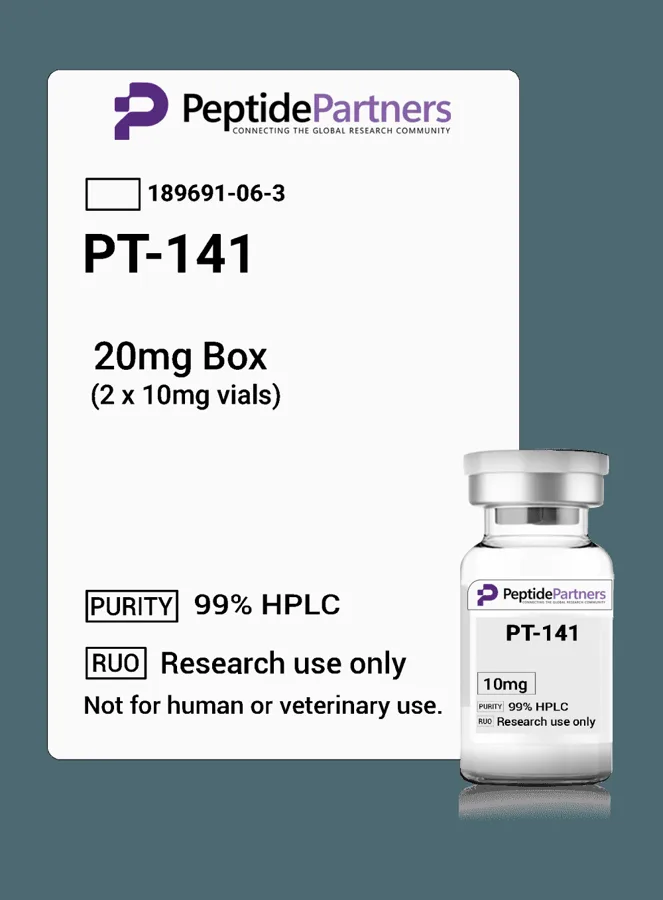
Available packs
PT-141
$84 - $320
Buy PT-141 (10mg vials) from Peptides Partners
Qualified scientific laboratories and academic institutions can buy PT-141 in stable, lyophilized 10mg vials directly from Peptides Partners. Classified within the vasoactive and neuroendocrine research categories, PT-141 (scientifically known as bremelanotide) represents an essential synthetic peptide tool for investigating central melanocortin pathway dynamics, autonomic nervous signaling, and peripheral vascular response mechanisms. When laboratory researchers source research peptides from Peptides Partners, they receive reagents manufactured under stringent quality oversight, ensuring consistent peptide content, structural integrity, and predictable solubility profiles across experimental assays.
Every 10mg vial of PT-141 offered by Peptides Partners is prepared specifically for in vitro experimentation, physiological modeling, and non-clinical preclinical analysis. The compound is supplied as a sterile-filtered, vacuum-sealed lyophilized cake designed to maintain molecular stability throughout international shipping and cold-chain staging. By maintaining meticulous manufacturing standards and transparent inventory workflows, Peptides Partners enables investigators to secure high-integrity biochemical compounds necessary to achieve reproducible findings across complex biological research models.
Investigators seeking to buy PT-141 for their facilities can select from several tiered multi-vial packaging options designed to accommodate varied experimental scales. Whether conducting baseline receptor-binding assays or longitudinal cellular signaling studies, acquiring validated research peptides from Peptides Partners guarantees access to thoroughly documented materials intended exclusively for qualified laboratory research environments.
What is PT-141?
PT-141, cataloged under Chemical Abstracts Service registry number CAS 189691-06-3, is a synthetic cyclic heptapeptide analog of alpha-melanocyte-stimulating hormone (α-MSH). Structurally identified by the chemical formula C50H68N14O10 and a molecular weight of approximately 1025.18 g/mol, the peptide exhibits the primary sequence Ac-Nle-cyclo[Asp-His-D-Phe-Arg-Trp-Lys]-OH. This cyclic conformation is formed via a lactam bridge between the side chains of the aspartic acid and lysine residues, a biochemical configuration that imparts heightened resistance to enzymatic degradation by serum proteases compared to linear endogenous melanocortin peptides.
Originally developed during structure-activity relationship (SAR) investigations into the synthetic peptide Melanotan II, PT-141 was identified as an active metabolite that preserved potent affinity for central melanocortin receptors while exhibiting distinct pharmacodynamic properties. Unlike traditional vasoactive agents that target peripheral vascular smooth muscle directly via nitric oxide pathways or phosphodiesterase enzyme inhibition, PT-141 acts primarily as a central neuromodulator. It binds as a non-selective agonist to several melanocortin receptor (MCR) subtypes, displaying significant binding affinities for the melanocortin-1 (MC1R), melanocortin-3 (MC3R), melanocortin-4 (MC4R), and melanocortin-5 (MC5R) receptors.
Because of its distinct functional architecture, PT-141 is frequently categorized in biochemical catalogs under both neuroendocrine and vasoactive classifications. Its unique mechanism of action enables researchers to study central receptor-mediated control over autonomic outflow, vascular tone modulation, and neurovascular cross-talk without relying exclusively on peripheral intracellular secondary messengers.
Research effects studied
The academic and preclinical literature surrounding PT-141 spans several decades, focusing on neurobiology, endocrinology, cellular signal transduction, and vascular biology. Because PT-141 acts upon centrally localized melanocortin receptors, scientific interest has concentrated on mapping the downstream neurological and physiological cascades initiated by its receptor engagement.
Key areas of published research interest include:
- Melanocortin Receptor Subtype Binding: A substantial volume of in vitro pharmacology research has focused on characterizing the receptor kinetics of PT-141 across human and murine melanocortin receptors. Studies have consistently demonstrated potent agonism at the MC4R and MC3R subtypes, both of which are densely expressed in hypothalamic nuclei, including the paraventricular nucleus (PVN) and the medial preoptic area (MPOA). Receptor activation by PT-141 stimulates adenylate cyclase activity, driving intracellular cyclic adenosine monophosphate (cAMP) accumulation and triggering subsequent downstream protein kinase A (PKA) signaling cascades.
- Central Control of Autonomic and Sexual Responses: Extensive rodent and mammalian model studies have investigated the central mechanisms governing physiological arousal and sexual motivation. Published research indicates that PT-141-mediated activation of central MC4R and MC3R networks stimulates the release of key neurotransmitters, including dopamine, oxytocin, and nitric oxide, within the hypothalamic-limbic circuits. Unlike purely peripheral vasoactive compounds, PT-141 demonstrates an ability to activate central appetitive and consummatory pathways independent of peripheral adrenergic or phosphodiesterase-mediated vasodilation.
- Vasoactive Dynamics and Hemodynamics: PT-141 has been evaluated in various preclinical hemodynamic models to elucidate the relationship between central melanocortin signaling and systemic vascular tone. Research indicates that central melanocortin activation can exert downstream influences on sympathetic nerve activity, transiently altering mean arterial blood pressure and heart rate in experimental subjects. Understanding these neuro-hemodynamic interactions remains a critical focus for cardiovascular researchers studying the central integration of blood flow regulation.
- Energy Homeostasis and Metabolic Pathways: Due to the critical role of hypothalamic MC4R pathways in regulating satiety and basal metabolic rate, researchers have utilized PT-141 to probe the overlap between neuroendocrine arousal and feeding behaviors. Investigations involving rodent models of diet-induced obesity have tracked changes in food intake, oxygen consumption, and lipid mobilization following selective melanocortin receptor activation.
- Inflammatory and Microvascular Research: Although primarily investigated for its central neuroendocrine actions, PT-141 retains moderate affinity for MC1R and MC3R, which are widely expressed on immune cells, endothelial surfaces, and macrophages. Preclinical research has explored the anti-inflammatory and cytoprotective properties of melanocortin agonists in models of ischemia-reperfusion injury, acute systemic inflammation, and microvascular barrier stabilization.
How to use in the laboratory
PT-141 (10mg) is distributed in a sealed, lyophilized format to guarantee chemical stability. To generate reliable, reproducible experimental data, research facilities must adhere strictly to established biochemical reconstitution, liquid handling, and documentation protocols. PT-141 is supplied exclusively for in vitro, ex vivo, and animal laboratory research; it must never be administered to humans or domestic animals.
When preparing PT-141 for laboratory assays, investigators should observe the following standard laboratory procedures:
- Reconstitution Protocol: Reconstitution should be performed within an ISO Class 5 laminar flow hood or a certified biosafety cabinet utilizing aseptic techniques. Laboratory-grade Bacteriostatic Water (0.9% benzyl alcohol preserved) or sterile 0.9% Sodium Chloride (saline) solution for research is introduced into the vial using a sterile single-use laboratory syringe. The reconstituting solvent should be directed down the internal glass wall of the vial rather than sprayed directly onto the lyophilized peptide cake to minimize mechanical foaming and shear-induced degradation.
- Dissolution Technique: Once the diluent is introduced, the vial should be gently rolled between the palms or gently swirled in a circular motion until the cake has fully dissolved into a clear, colorless liquid. The solution must never be vortexed, shaken vigorously, or exposed to excessive mechanical agitation, as physical shear forces can denature cyclic peptide conformations or induce aggregation.
- Stock Concentration Planning: Researchers should calculate reconstitution volumes to produce convenient working stock concentrations (e.g., 1.0 mg/mL, 2.0 mg/mL, or 5.0 mg/mL) that align with the specific sensitivity requirements of downstream microplate assays, binding assays, or cellular exposure models.
- Aliquoting Strategy: To prevent the degradation associated with repeated freeze-thaw cycles, freshly reconstituted PT-141 stock solutions should be subdivided into sterile, low-binding polypropylene microcentrifuge tubes (e.g., 0.5 mL or 1.5 mL volumes) according to planned assay usage volumes before being transferred to sub-zero storage.
- Laboratory Record-Keeping: Each research vial should be logged immediately into the facility’s laboratory information management system (LIMS). Records must include the receipt date, vendor source (Peptides Partners), manufacturer lot number, reconstitution date, diluent type and volume, final concentration, and the initials of the handling technician. Vials and secondary aliquot tubes must be clearly labeled using solvent-resistant laboratory markers or thermal cryo-labels.
Pack sizes and price per mg
To support academic laboratories, biotechnology startups, and independent research institutions operating under varying budgetary requirements, Peptides Partners supplies PT-141 (10mg vials) in multiple pack configurations. Volume purchasing provides significant savings per milligram of active peptide, maximizing the experimental yield for high-throughput screening or extended observational studies.
The table below outlines the current pack options, cumulative peptide quantities, overall package pricing, and the calculated cost per milligram when researchers buy PT-141:
| Pack Size | Total Peptide Content | Total Price (USD) | Price per mg (USD) |
|---|---|---|---|
| 2 vials (10mg each) | 20 mg | $84 | $4.20 / mg |
| 5 vials (10mg each) | 50 mg | $192 | $3.84 / mg |
| 10 vials (10mg each) | 100 mg | $320 | $3.20 / mg |
Procuring research peptides through multi-vial configurations allows facilities to reserve untouched, vacuum-sealed vials at ultra-low temperatures, activating individual 10mg units only as required by experimental timelines. This minimizes the risk of compound degradation over prolonged project schedules.
Storage and handling
Maintaining the structural stability and bioactivity of PT-141 requires strict adherence to temperature-controlled storage and careful environmental handling protocols. Synthetic peptides possessing cyclic structures and specific stereocenters (such as D-Phe at position 4) are susceptible to hydrolysis, oxidation, and photolytic degradation if exposed to adverse conditions.
The following guidelines should be implemented by laboratory personnel:
- Lyophilized Peptide Storage: In its unopened, lyophilized form, PT-141 should be stored in a laboratory freezer maintained at -20°C for standard short-to-medium-term requirements (up to 12 to 24 months). For extended multi-year preservation, storage in an ultra-low temperature freezer at -80°C is recommended. If cold storage is temporarily restricted, the sealed lyophilized cake demonstrates ambient temperature stability for short transit windows (up to 30 days) when shielded from heat and direct sunlight.
- Desiccation and Acclimation: Prior to opening and reconstituting a frozen vial, the vial should be allowed to equilibrate to room temperature inside a desiccator or sealed container for approximately 30 to 45 minutes. This step prevents atmospheric moisture from condensing onto the hygroscopic lyophilized peptide, which can trigger premature hydrolysis.
- Reconstituted Solution Stability: Once dissolved in bacteriostatic water or sterile buffered saline, the working solution must be stored under refrigeration at 2°C to 8°C. Solutions stored at 2°C to 8°C should generally be utilized within 14 to 28 days to prevent gradual potency loss. Reconstituted aliquots frozen at -20°C or -80°C remain viable for up to 3 to 6 months; however, repeated freeze-thaw cycles must be rigorously avoided, as ice crystal formation disrupts secondary and tertiary peptide structures.
- Light and Container Protection: Peptides containing aromatic amino acid residues such as tryptophan (Trp) and phenylalanine (Phe) exhibit sensitivity to photo-oxidation. All PT-141 containers, whether lyophilized or in solution, should be stored in amber vials or kept in light-blocking secondary containers (e.g., light-tight cryo-boxes).
Quality and documentation
At Peptides Partners, product reliability and chemical authenticity form the foundation of our catalog. Academic and institutional investigators requiring research peptides depend on reproducible analytical profiles to eliminate baseline reagent variability from their experimental results. Every production batch of PT-141 undergoes comprehensive verification protocols to ensure that investigators receive reagents that conform strictly to established biochemical benchmarks.
Each production lot of PT-141 (CAS 189691-06-3) is mapped to comprehensive analytical records. Analytical evaluation utilizes High-Performance Liquid Chromatography (HPLC) to verify chromatographic consistency and confirm the absence of truncated peptide fragments or synthesis intermediates. Furthermore, Mass Spectrometry (MS) is utilized to accurately validate the expected molecular mass (1025.18 g/mol) and verify correct peptide composition. Routine lot documentation also accounts for moisture content, residual counter-ions (such as acetate), and solubility assessments.
Peptides Partners maintains transparent batch traceability. Relevant analytical documentation and batch verification data are accessible to research institutions upon request to satisfy internal audit, Institutional Animal Care and Use Committee (IACUC), or institutional review requirements. By maintaining this rigorous focus on chemical verification, Peptides Partners remains a reliable source for laboratories seeking validated chemical reagents for high-precision scientific inquiries.
Frequently asked questions
What is the molecular difference between PT-141 and Melanotan II in research contexts?
Although PT-141 (bremelanotide) is derived from Melanotan II research, the two molecules feature critical structural and functional distinctions. Melanotan II contains an intact terminal amide moiety and functions as a non-selective, potent agonist across MC1R, MC3R, MC4R, and MC5R, historically triggering significant melanogenesis via widespread peripheral MC1R activation. In contrast, PT-141 is a hydroxylated metabolite possessing a C-terminal carboxylate rather than an amide. This structural modification shifts its receptor selectivity profile, producing more pronounced central nervous system and neuroendocrine responses via MC3R and MC4R while demonstrating altered downstream physiological effects compared to its parent peptide.
Which melanocortin receptor subtypes does PT-141 bind to?
In vitro competitive binding and functional assays indicate that PT-141 acts as a non-selective melanocortin receptor agonist with documented affinity for MC1R, MC3R, MC4R, and MC5R. The majority of published pharmacological research focuses on its agonism at the central MC4R and MC3R subtypes located in the hypothalamus and autonomic nuclei. Agonism at MC4R drives cyclic AMP signaling cascades implicated in autonomic arousal, central cardiovascular regulation, and energy homeostasis, while MC1R binding remains primarily associated with peripheral epidermal and microvascular endothelial pathways.
What reconstitution solvents are typically utilized in PT-141 research preparations?
In standard laboratory settings, PT-141 is typically reconstituted using sterile Bacteriostatic Water containing 0.9% benzyl alcohol, which serves to inhibit microbial proliferation when a vial will be accessed multiple times for in vitro assays over a multi-week span. For immediate single-use cellular assays or protocols sensitive to antimicrobial preservatives, sterile 0.9% Sodium Chloride (saline) or sterile non-pyrogenic Water for Injection (WFI) is frequently employed. Buffered solutions such as Phosphate-Buffered Saline (PBS) at physiological pH (7.4) may also be utilized, provided that solubility and osmolarity parameters align with downstream analytical designs.
Is PT-141 supplied by Peptides Partners intended for clinical use in humans or animals?
No. All PT-141 vials supplied by Peptides Partners are formulated and distributed strictly for laboratory research, in vitro experimentation, and preclinical scientific discovery. They are not intended for human consumption, clinical application, diagnostic testing, or veterinary therapeutic use. Handling is restricted to qualified research professionals operating within equipped academic, clinical, or industrial research facilities that adhere to standard biochemical safety protocols.
Related Peptides Partners research peptides
Semax (30mg vials); Thymosin Alpha-1 (TA1, 10mg vials); BPC-157 (10mg vials).
PT-141 lot documentation
Certificates of analysis are matched to the actual lot supplied with your order. Email sales@peptidespartners.co with the product name and pack size to request the current lot's purity, identity and screening documents before purchase.
Storage
Research peptides are typically supplied lyophilized (freeze-dried), which keeps them stable for shipping and storage. Store unopened vials cool, dry and away from light; for long-term storage, a freezer is generally recommended.
After reconstitution, keep vials refrigerated and use sterile laboratory technique. Follow the handling guidance supplied with your lot documentation.
- Short name
- PT-141 (10mg vials)
- Vial strength
- 10mg vials
- Pack sizes
- 20mg pack, 50mg pack, 100mg pack
- Pack count options
- 2, 5, 10 vial packs
- CAS number
- 189691-06-3
- Category
- Vasoactive
- SKU
- PP-7400
- Compliance
- Research Use Only. Not for use in diagnostic tests.