
N-Acetyl Selank Amidate 30mg vials
30mg per vial
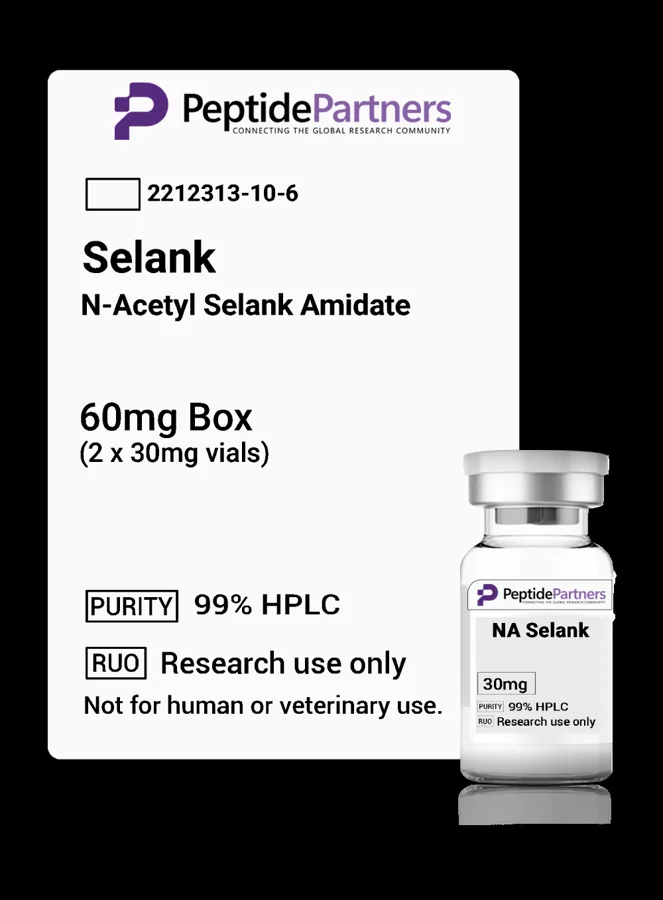
Available packs
N-Acetyl Selank Amidate 30mg vials
$234 - $1,380
Buy N-Acetyl Selank Amidate 30mg vials from Peptides Partners
Peptides Partners provides academic laboratories, clinical research organizations, and biotechnology facilities with qualified research compounds synthesized to strict analytical specifications. When investigators choose to buy NA Selank Amidate 30mg vials from Peptides Partners, they acquire a precision-engineered peptide analogue developed specifically for rigorous experimental environments. N-Acetyl Selank Amidate represents an advanced structural modification of the regulatory heptapeptide Selank, designed to exhibit superior resistance to enzymatic degradation in vitro and in controlled biological model systems.
All research peptides distributed by Peptides Partners are intended strictly for laboratory experimentation, analytical calibration, and in vitro or in vivo animal research by qualified personnel. This product is not intended for diagnostic, therapeutic, clinical, food, cosmetic, or human use under any circumstances. Through stringent batch validation, consistent lyophilization parameters, and dedicated analytical oversight, Peptides Partners ensures that your experimental models receive consistent, highly reproducible material across every project phase.
What is N-Acetyl Selank Amidate 30mg vials?
N-Acetyl Selank Amidate (CAS registry number: 2212313-10-6) is a synthetic derivative of the neuropeptide Selank. The parent sequence of Selank is a synthetic heptapeptide with the primary amino acid sequence Thr-Lys-Pro-Arg-Pro-Gly-Pro. This sequence was originally developed by combining the endogenous tetrapeptide tuftsin (Thr-Lys-Pro-Arg)—a natural immunomodulatory peptide originating from the Fc-fragment of immunoglobulin G—with a C-terminal Pro-Gly-Pro tripeptide fragment designed to enhance structural stability and molecular half-life.
N-Acetyl Selank Amidate carries two distinct chemical modifications relative to the parent heptapeptide:
- N-Terminal Acetylation: The addition of an acetyl functional group ($CH_3CO-$) at the amino terminus ($N$-terminus) of the peptide chain. This modification shields the peptide from degradation by aminopeptidases, which typically cleave terminal amine residues.
- C-Terminal Amidation: The conversion of the terminal carboxyl group ($–COOH$) into a primary amide group ($–CONH_2$) at the carboxy terminus ($C$-terminus). This terminal blockade prevents premature cleavage by carboxypeptidases.
By protecting both endpoints of the peptide backbone, researchers obtain a molecule termed Ac-Thr-Lys-Pro-Arg-Pro-Gly-Pro-$NH_2$. Within the regulatory peptide classification, it is commonly evaluated under the category of neuroactive peptides and experimental nootropics. The dual modification changes the net charge distribution and hydrophobicity profile of the molecule, resulting in altered binding kinetics, shifted pharmacokinetic parameters in tissue assays, and substantially enhanced metabolic half-life compared to unmodified Selank or native tuftsin.
Each 30mg vial supplied by Peptides Partners contains a sterile-filtered, lyophilized white to off-white cake or powder containing the purified peptide salt, formulated for rapid solubility in standard laboratory diluents.
Research effects studied
Scientific literature has documented significant interest in Selank and its modified congeners across neurobiology, psychoneuroimmunology, and behavioral pharmacology. Preclinical and cell-based studies have focused primarily on several key biological mechanisms:
Modulation of GABAergic Neurotransmission
Preclinical investigations indicate that Selank-derived peptides interact with the gamma-aminobutyric acid (GABA) neurotransmitter system. Electrophysiological and ligand-binding assays demonstrate that Selank acts as an allosteric modulator of $GABA_A$ receptors. In rodent neurochemical models, the peptide was observed to alter chloride ion channel conductance and affect the binding affinity of endogenous GABA without displacing classic benzodiazepine site ligands. Researchers explore these mechanisms to understand how the peptide impacts inhibitory signaling in central nervous tissue without inducing the typical myorelaxant, sedative, or habit-forming profiles associated with direct $GABA_A$ receptor agonists.
Neurotrophic Signaling and Gene Expression
In vitro and animal models have been utilized to study the influence of Selank analogues on neurotrophin gene expression. Studies focusing on hippocampal and frontal cortex tissues have reported altered transcriptional activity for Brain-Derived Neurotrophic Factor (BDNF) and its high-affinity receptor, Tropomyosin receptor kinase B (TrkB). Research has shown transient elevations in BDNF mRNA levels following peptide exposure, leading investigators to examine its role in synaptic plasticity, long-term potentiation (LTP), dendritic remodeling, and neuronal resilience under conditions of experimental stress or hypoxia.
Monoaminergic Turnover and Metabolic Profiles
Laboratory assays investigating neurotransmitter dynamics have highlighted the capacity of Selank analogues to modulate monoaminergic pathways. Published research demonstrates regional changes in the synthesis, release, and reuptake metabolism of serotonin (5-HT), dopamine (DA), and norepinephrine (NE) within the prefrontal cortex, striatum, and hippocampus of animal subjects. Specifically, investigators have monitored the concentrations of 5-hydroxyindoleacetic acid (5-HIAA) and homovanillic acid (HVA) to quantify changes in neurotransmitter turnover rates during cognitive and stress-exposure test batteries.
Immunomodulatory and Cytokine Signaling Pathways
Because the core sequence of the molecule is derived from tuftsin, N-Acetyl Selank Amidate retains structural motifs associated with immune regulation. Controlled studies in peripheral blood mononuclear cells (PBMCs) and splenic cultures have evaluated the peptide’s ability to influence the transcription of inflammatory and anti-inflammatory cytokines, including Interleukin-6 (IL-6), Interleukin-10 (IL-10), and Tumor Necrosis Factor-alpha (TNF-$alpha$). Researchers frequently employ the compound in models examining the neuro-immune axis, exploring how central neuropeptides influence peripheral inflammatory responses and microglial activation states.
Comparative Metabolic Stability
A primary focus of studies specifically testing N-Acetyl Selank Amidate, as opposed to native Selank, is comparative degradation kinetics in biological matrices. In vitro incubation studies utilizing serum, plasma, and tissue homogenates demonstrate that the amidated and acetylated termini significantly suppress enzymatic hydrolysis. The resulting extension of physiological and assay stability permits investigators to explore lower effective working concentrations and longer evaluation timepoints in cell culture and tissue preparations.
How to use in the laboratory
N-Acetyl Selank Amidate 30mg vials are distributed as dry lyophilized cakes designed for reconstitution prior to assay design. Appropriate reconstitution, calculation, and documentation procedures must be strictly adhered to within an aseptic laboratory environment.
Reconstitution Protocols
To reconstitute the peptide for experimental procedures:
- Allow the sealed vial to equilibrate to room temperature (typically 20°C to 25°C) for at least 20 to 30 minutes before opening or piercing the septum. This step minimizes condensation formation inside the vial, which can lead to hydrolytic degradation.
- Decontaminate the rubber stopper with a sterile 70% isopropanol wipe inside a certified laminar flow hood or biological safety cabinet.
- Select an appropriate, analytically pure reconstitution medium based on your experimental parameters. Typical diluents include sterile bacteriostatic water (containing 0.9% benzyl alcohol), sterile non-pyrogenic water for injection, or physiological phosphate-buffered saline (PBS, pH 7.4).
- Using a sterile laboratory syringe equipped with a fine-gauge needle, introduce the diluent slowly along the interior glass wall of the vial. Avoid spraying the solvent directly onto the lyophilized powder, as rapid mechanical impact may shear peptide structures.
- Allow the diluent to absorb into the cake passively. Gently swirl the vial in a horizontal circular motion until the peptide is fully dissolved. Do not vortex or violently shake the reconstituted solution, as vigorous agitation can induce peptide aggregation and surface denaturation.
Concentration Calculations
Reconstitution volumes should be predetermined to align with analytical dilution schemes. For example:
- Adding 3.0 mL of solvent to a 30mg vial yields a stock concentration of 10.0 mg/mL (10 $mu$g/$mu$L).
- Adding 6.0 mL of solvent to a 30mg vial yields a stock concentration of 5.0 mg/mL (5 $mu$g/$mu$L).
Laboratory Record-Keeping and Traceability
Accurate experimental records must be maintained whenever working with research peptides. Laboratory notebooks and digital management systems should document:
- Manufacturer batch/lot number and expiration/re-test date.
- Date and time of initial vial reconstitution.
- Identity, volume, and lot number of the reconstitution solvent used.
- Calculated final stock concentration.
- Aliquoting scheme, storage location, and temperature log.
Pack sizes and price per mg
Peptides Partners supplies N-Acetyl Selank Amidate 30mg vials in multiple tiered pack options to support diverse research requirements, from pilot assay validations to expansive multi-arm longitudinal protocols. The table below outlines available package configurations, total delivered active compound, aggregate pricing, and calculated cost per milligram.
| Pack Size | Total Active Peptide (mg) | Total Price (USD) | Calculated Price per mg (USD) |
|---|---|---|---|
| 2 vials x 30mg | 60 mg | $234 | $3.90 / mg |
| 5 vials x 30mg | 150 mg | $495 | $3.30 / mg |
| 10 vials x 30mg | 300 mg | $840 | $2.80 / mg |
| 20 vials x 30mg | 600 mg | $1380 | $2.30 / mg |
When institutions buy NA Selank Amidate in scaled volume packs (such as the 10-vial or 20-vial configurations), the cost per milligram decreases significantly, providing laboratories with an economical path to maintaining consistent reagent batches across ongoing experimental cycles.
Storage and handling
Peptides require careful environmental regulation to preserve their structural fidelity, solubility, and conformational stability over extended periods.
Lyophilized Peptide Storage
- Unopened Vials: Store intact, dry lyophilized vials at -20°C for standard laboratory storage up to 24 months. For long-term archiving exceeding 24 months, storage at -80°C is recommended.
- Desiccation and Light Protection: Store vials in a sealed, dry container containing active desiccant canisters. Protect the compound from direct ultraviolet light, ambient light exposure, and extreme thermal cycling.
Reconstituted Solution Storage
- Short-Term Storage: Once dissolved, aqueous stock solutions intended for immediate use may be stored at 2°C to 8°C for up to 7 to 14 days, depending on solvent sterility and preservative content.
- Long-Term Aliquoting: If the reconstituted peptide must be stored for longer periods, partition the stock solution into sterile, single-use polypropylene microcentrifuge tubes (aliquots) and immediately freeze at -20°C or -80°C.
- Freeze-Thaw Cycles: Strictly avoid repeated freeze-thaw cycles. Each freeze-thaw event accelerates structural fragmentation, deamidation, and irreversible peptide precipitation. Discard aliquots following their initial thaw and experimental usage.
Laboratory Safety and Personal Protection
Personnel handling this substance should follow Standard Operating Procedures (SOPs) for laboratory chemicals:
- Wear proper personal protective equipment (PPE), including laboratory coats, nitrile gloves, and eye protection (safety glasses or face shields).
- Handle dry powder weighing inside an appropriate containment hood to prevent inhalation of aerosolized particulates.
- Dispose of unused materials, contaminated containers, and sharps in accordance with institutional hazardous chemical and bio-waste guidelines.
Quality and documentation
Peptides Partners applies comprehensive analytical screening to validate the identity, consistency, and structural purity of all synthesized lots. Modern peptide synthesis demands precise verification methods to confirm that intended molecular modifications—such as N-terminal acetylation and C-terminal amidation—have proceeded to completion without leaving significant truncated or unblocked side products.
Standard testing methodology applied to our batches includes:
- High-Performance Liquid Chromatography (RP-HPLC): Reverse-Phase HPLC provides high-resolution separation to confirm peptide purity and verify the absence of structural isomers, deletion fragments, or related impurities.
- Mass Spectrometry (MS): Electrospray Ionization Mass Spectrometry (ESI-MS) or Matrix-Assisted Laser Desorption/Ionization (MALDI-TOF) confirms the exact theoretical molecular weight of the acetylated and amidated heptapeptide salt, ensuring correct stoichiometry.
- Residual Solvent and Counter-Ion Analysis: Quantifies manufacturing residues to ensure compatibility with sensitive cellular assays and in vitro enzymatic systems.
A comprehensive Certificate of Analysis (CoA) containing lot-specific analytical data is maintained for each production run. These documents allow research institutions to substantiate reproducibility and maintain compliance with institutional laboratory oversight.
Frequently asked questions
What is the functional difference between N-Acetyl Selank Amidate and standard Selank?
Standard Selank possesses a free amino terminus and a free carboxylic acid terminus ($H-Thr-Lys-Pro-Arg-Pro-Gly-Pro-OH$). N-Acetyl Selank Amidate features an acetylated $N$-terminus and an amidated $C$-terminus ($Ac-Thr-Lys-Pro-Arg-Pro-Gly-Pro-NH_2$). In comparative biochemical assays, these end-cap modifications protect the peptide backbone from common exopeptidases (specifically aminopeptidases and carboxypeptidases), thereby substantially increasing its enzymatic stability and resistance to metabolic degradation in biological test media.
Can this product be used for clinical or therapeutic applications?
No. N-Acetyl Selank Amidate 30mg vials supplied by Peptides Partners are sold exclusively for research-use-only (RUO) laboratory applications. The compound has not been evaluated, cleared, or approved by the United States Food and Drug Administration (FDA) or any international regulatory body for human consumption, clinical diagnosis, therapy, veterinary administration, or cosmetic formulation.
Which diluents are most appropriate for laboratory reconstitution?
The choice of solvent depends on the specific analytical or experimental application. For short-term assays, sterile deionized water (Type I laboratory grade) or phosphate-buffered saline (PBS, pH 7.4) is typically preferred. For protocols requiring multi-day refrigerator storage, sterile bacteriostatic water containing 0.9% benzyl alcohol may be utilized to inhibit microbial growth, provided the preservative does not interfere with assay readouts.
How does the 30mg vial format benefit research workflows?
The 30mg presentation provides an ample quantity of material for high-throughput screening, multi-well microplate assays, or extended animal model studies without requiring constant cross-lot transitions. By securing multiple 30mg vials from a single batch, research teams can maintain experimental consistency across extensive test matrices while reducing setup variability.
Related Peptides Partners research peptides
NAD+ Buffered (900mg vials); SS-31 (10mg vials); KLOW Blend: BPC-157/TB-500/GHK-Cu/KPV (80mg vials).
N-Acetyl Selank Amidate 30mg vials lot documentation
Certificates of analysis are matched to the actual lot supplied with your order. Email sales@peptidespartners.co with the product name and pack size to request the current lot's purity, identity and screening documents before purchase.
Storage
Research peptides are typically supplied lyophilized (freeze-dried), which keeps them stable for shipping and storage. Store unopened vials cool, dry and away from light; for long-term storage, a freezer is generally recommended.
After reconstitution, keep vials refrigerated and use sterile laboratory technique. Follow the handling guidance supplied with your lot documentation.
- Short name
- N-Acetyl Selank Amidate 30mg vials
- Vial strength
- 30mg vials
- Pack sizes
- 60mg pack, 150mg pack, 300mg pack, 600mg pack
- Pack count options
- 2, 5, 10, 20 vial packs
- CAS number
- 2212313-10-6
- Category
- Nootropics
- SKU
- PP-8431
- Compliance
- Research Use Only. Not for use in diagnostic tests.