
Kisspeptin
10mg per vial
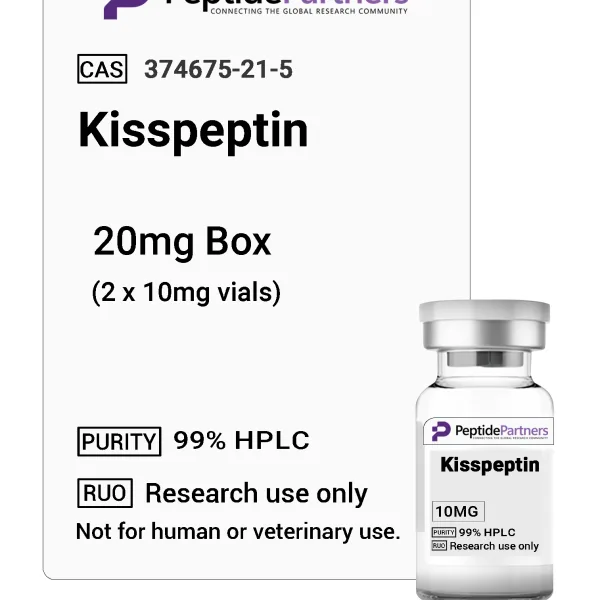
Available packs
Kisspeptin
$120 - $765
Buy Kisspeptin (10mg vials) from Peptides Partners
Investigators seeking reliable, high-integrity compounds for neuroendocrine, cellular, and metabolic signaling studies can buy Kisspeptin in 10mg vials directly from Peptides Partners. Kisspeptin has become an essential tool in contemporary biochemical and endocrinological science, functioning at the nexus of the hypothalamic-pituitary-gonadal (HPG) axis, energy homeostasis, and reproductive neuroendocrinology. As research into metabolic regulation deepens, investigators require consistent, high-grade reagents that yield reproducible experimental data across in vitro assays and animal model frameworks.
Peptides Partners provides research peptides manufactured under strict laboratory standards to ensure sequence fidelity, structural stability, and minimal batch-to-batch variation. Each 10mg vial contains a solid, lyophilized cake designed specifically for laboratory reconstitution and controlled experimental manipulation. Whether your department is conducting receptor binding kinetics, transcriptional profiling, or metabolic cross-talk analyses, our catalog is structured to meet rigorous academic and institutional standards. All products provided by Peptides Partners are intended solely for laboratory experimentation and research use only, and are never intended for human or animal consumption, therapeutic use, or clinical diagnostics.
What is Kisspeptin?
Kisspeptin refers to a family of biologically active peptide fragments encoded by the KISS1 gene, which was originally identified in 1996 as a metastasis suppressor gene in melanoma cell lines and initially designated as metastin. Subsequent discoveries established that the primary translation product is a 145-amino-acid precursor protein. Through targeted intracellular proteolytic processing, this precursor is cleaved into several shorter, biologically active peptides known collectively as kisspeptins. Among these, the most widely studied in scientific literature include Kisspeptin-54, Kisspeptin-14, Kisspeptin-13, and the carboxyl-terminal decapeptide, Kisspeptin-10.
Regardless of their sequence length, all endogenous kisspeptin variants share a conserved amidated carboxyl-terminal decapeptide core (Phe-Leu-Phe-Arg-Pro-Arg-Asn-Arg-Phe-NH2 in mammalian models). This shared sequence motif represents the minimum structural requirement for receptor binding and activation. Kisspeptin functions as the endogenous ligand for the G-protein coupled receptor GPR54, which is officially designated as the KISS1 receptor (KISS1R). The binding of kisspeptin to KISS1R initiates a downstream intracellular cascade via the Gq/11 protein alpha-subunit. This activation stimulates phospholipase C (PLC), which hydrolyzes phosphatidylinositol 4,5-bisphosphate (PIP2) into inositol 1,4,5-trisphosphate (IP3) and diacylglycerol (DAG). IP3 triggers the rapid mobilization of intracellular calcium ions from the endoplasmic reticulum, while DAG activates protein kinase C (PKC). Concurrently, this cascade recruits extracellular signal-regulated kinases (ERK1/2) and p38 mitogen-activated protein kinase (MAPK) pathways, mediating transcription, cell signaling, and secretory events.
Within the classification of metabolics, kisspeptin has garnered intense academic focus due to its role as a master integrator of metabolic status and reproductive viability. In hypothalamic nuclei—specifically the anteroventral periventricular nucleus (AVPV) and the arcuate nucleus (ARC)—kisspeptin-expressing neurons receive direct and indirect inputs regarding systemic energy availability. Circulating metabolic cues such as leptin, insulin, and ghrelin interact with Kiss1 neural networks, positioning kisspeptin as a critical molecular conduit linking nutritional abundance or energetic deficit to downstream neuroendocrine signaling.
Research effects studied
The academic and preclinical exploration of kisspeptin spans multiple disciplines, including cellular biochemistry, endocrinology, oncology, and metabolic research. Investigations utilizing kisspeptin focus predominantly on how targeted receptor activation modulates secondary messenger cascades and tissue-specific processes.
- Hypothalamic-Pituitary-Gonadal (HPG) Axis Activation: In preclinical animal models, kisspeptin has been established as a primary central driver of gonadotropin-releasing hormone (GnRH) secretion. Researchers study kisspeptin-induced stimulation of GnRH neurons to observe the pulsatile release of luteinizing hormone (LH) and follicle-stimulating hormone (FSH) from pituitary gonadotropes. Structural and functional studies frequently examine kisspeptin signaling to map pubertal maturation, reproductive competence, and feedback mechanisms governed by sex steroids.
- Energy Homeostasis and Metabolic Integration: Kisspeptin signaling pathways have been evaluated in the context of energy balance, adiposity, and glucose homeostasis. Studies examine how metabolic states, such as prolonged caloric restriction or diet-induced obesity, alter KISS1 and KISS1R expression within hypothalamic circuits. In vitro models using pancreatic beta-cell lines investigate whether kisspeptin receptor activation exerts regulatory control over glucose-stimulated insulin secretion. Additionally, preclinical research explores kisspeptin’s influence on peripheral metabolic tissues, including brown and white adipose depots and hepatic metabolic enzymes.
- Cellular Migration and Metastasis Suppression: Originating from its historical identity as metastin, kisspeptin continues to be studied in oncology models for its ability to suppress cellular motility and invasion without necessarily inhibiting initial tumor proliferation. Researchers analyze how KISS1R activation modulates cytoskeletal reorganization, focal adhesion kinase (FAK) phosphorylation, and the expression of matrix metalloproteinases (MMPs) in breast, melanoma, and thyroid cancer cell assays.
- Cardiovascular and Vascular Modulation: Preclinical investigations have observed the presence of KISS1R in vascular smooth muscle and cardiac endothelial cells. Research models assess whether kisspeptin exposure leads to localized vasoconstriction or endothelium-dependent vasodilation, providing insight into neuroendocrine vascular tone regulation.
- Circadian and Seasonal Rhythmicity: Photoperiodic animal studies explore kisspeptin neuron density and sensitivity in response to melatonin levels and day-length variations, clarifying how seasonal breeders adapt their metabolic and reproductive cycles to environmental constraints.
How to use in the laboratory
To preserve peptide stability and ensure experimental consistency, laboratory personnel must adhere to standardized preparation and handling techniques when working with Kisspeptin 10mg vials. Reconstitution should only take place within a controlled laboratory environment, such as a biosafety cabinet or clean bench, utilizing aseptic procedures.
Before reconstitution, calculate the target concentration required for your in vitro assays or stock storage. For many laboratory protocols, a stock concentration between 1 mg/mL and 5 mg/mL is standard, though lower or higher concentrations may be required depending on automated dispensing systems or microplate assay limits. Bacteriostatic water (containing 0.9% benzyl alcohol) or sterile water for injection (WFI) is commonly used as a primary reconstituting solvent. When physiological osmolarity or specific pH buffering is required for downstream enzymatic assays, sterile phosphate-buffered saline (PBS) or dilute sterile acetic acid (0.1–1.0%) can be evaluated, taking care that the solvent does not alter peptide solubility or assay compatibility.
To reconstitute, introduce the diluent slowly down the interior wall of the glass vial using a calibrated micropipette to avoid shearing the peptide structure. Do not vortex or violently agitate the solution. Instead, gently swirl or roll the vial between the palms until the lyophilized powder is completely dissolved and the solution is clear and free of particulate matter. Once the stock solution is fully solubilized, immediately aliquot it into sterile, low-protein-binding microcentrifuge tubes according to planned single-experimental volumes. This prevents repeated freeze-thaw cycles, which accelerate hydrolytic cleavage and peptide aggregation.
Strict laboratory record-keeping should accompany every step of preparation. Document the date of reconstitution, the batch or lot number, the specific solvent and lot used, the calculated final concentration, the initials of the preparing researcher, and the designated storage location. Vials and aliquots should be labeled with solvent-resistant markers or cryogenic labels to ensure legibility throughout long-term storage.
Pack sizes and price per mg
Peptides Partners provides tiered volume options to accommodate both single-experiment pilot designs and large-scale, multi-stage research initiatives. Purchasing research peptides in bulk configurations allows laboratories to streamline logistics and significantly reduce costs per milligram while maintaining consistent batch performance.
| Pack Configuration | Total Quantity (mg) | Total Price (USD) | Price per mg (USD) |
|---|---|---|---|
| 2 vials x 10mg | 20 mg | $120.00 | $6.00 |
| 5 vials x 10mg | 50 mg | $279.00 | $5.58 |
| 10 vials x 10mg | 100 mg | $499.00 | $4.99 |
| 20 vials x 10mg | 200 mg | $765.00 | $3.83 |
When selecting a pack option, research facilities benefit from predictable expenditure planning. The entry-level 2-vial package provides 20mg at an accessible price point of $6.00 per milligram, ideal for baseline receptor validation or protocol optimization. For academic labs managing prolonged comparative studies or longitudinal animal cohorts, scaling up to the 10-vial or 20-vial tier reduces unit cost to as low as $3.83 per milligram, ensuring that large-scale experimental designs remain cost-effective without sacrificing reagent uniformity.
Storage and handling
Proper environmental control is critical to extending the shelf life and molecular stability of lyophilized and reconstituted kisspeptin. In its lyophilized state, the peptide is sealed under vacuum or inert gas to protect against atmospheric moisture and oxidative degradation.
- Lyophilized Storage: Store unopened lyophilized vials in a dedicated laboratory freezer maintained at -20°C for standard short-to-medium-term storage (up to 12 months), or at -80°C for extended periods. Keep vials inside a sealed container with a desiccant pack to minimize moisture exposure during storage. Protect the vials from prolonged light exposure by keeping them in opaque storage boxes.
- Acclimation Prior to Opening: Prior to reconstitution, allow the frozen vial to reach room temperature (approximately 20°C to 25°C) inside a desiccated chamber or sealed bag. Opening a cold vial in ambient laboratory air will cause rapid condensation inside the glass, which can introduce moisture and cause premature peptide degradation.
- Reconstituted Solution Storage: Once reconstituted into liquid form, working aliquots should be maintained at 2°C to 8°C if they are to be consumed within 24 to 48 hours. For storage extending beyond 48 hours, store aliquots at -20°C or -80°C. Aliquots stored at -80°C typically remain stable for several months, provided they are not subjected to thermal fluctuations.
- Handling Precautions: Avoid multiple freeze-thaw cycles. Each cycle of freezing and thawing creates ice crystal boundaries that can mechanically cleave peptide backbones and induce protein precipitation. Discard any aliquot that demonstrates cloudiness, discoloration, or persistent precipitation upon thawing.
Quality and documentation
Rigorous chemical analysis and documentation form the foundation of reproducible science. Peptides Partners prioritizes chemical authenticity, synthesis accuracy, and structural integrity across every batch of research peptides cataloged for sale.
Kisspeptin undergoes comprehensive analytical verification using high-performance liquid chromatography (HPLC) and mass spectrometry (MS). HPLC analysis confirms the chromatographic purity of the peptide, confirming that synthesis by-products, truncated sequences, and residual starting materials are removed. Mass spectrometry profiles establish the exact molecular mass of the peptide, verifying sequence accuracy and proper post-translational-like modifications, such as C-terminal amidation, which are essential for receptor affinity.
All batches are assigned unique lot numbers that link the vial directly to its analytical records. Quality documentation detailing molecular weight, chromatographic profiles, and synthesis data is maintained to support institutional compliance, laboratory audit requirements, and publishing standards. Researchers who buy Kisspeptin from Peptides Partners receive compounds managed under strict chain-of-custody protocols designed to support clean, defensible experimental results.
Frequently asked questions
What is the molecular distinction between full-length Kisspeptin and shorter fragments?
The primary translational product of the KISS1 gene is a 145-amino-acid polypeptide that undergoes sequential endogenous enzymatic cleavage. This process yields various lengths, including Kisspeptin-54, Kisspeptin-14, Kisspeptin-13, and Kisspeptin-10. All of these shorter fragments retain the amidated carboxyl-terminal decapeptide sequence, which binds directly to the KISS1R receptor. Shorter synthetic variants, such as Kisspeptin-10, are frequently favored in biochemical assays due to their efficient synthesis, high water solubility, and direct receptor potency, whereas full-length variants (like Kisspeptin-54) are often analyzed in pharmacokinetic and metabolic studies due to differences in endogenous circulating half-life.
What solvents are compatible for reconstituting Kisspeptin in a research setting?
The primary solvent of choice for most laboratory applications is sterile bacteriostatic water (containing 0.9% benzyl alcohol) or sterile water for injection (WFI). If experimental parameters require physiological ionic strength, sterile phosphate-buffered saline (PBS, pH 7.4) may be utilized, provided complete initial dissolution is achieved. In cases where higher concentrations show slight hydrophobicity or slow dissolution, a very dilute sterile organic acid solution (such as 0.1% sterile acetic acid) may be introduced to facilitate rapid solubilization prior to dilution with standard assay buffers. Strong alkaline buffers should be avoided to prevent deamidation of the critical C-terminal residue.
How does Kisspeptin research intersect with metabolic studies?
In metabolic research, kisspeptin serves as an experimental focal point for understanding how the body balances reproductive processes against nutritional status. Kisspeptin neurons express functional receptors for metabolic hormones such as leptin and insulin. Preclinical studies evaluate how energy-deficient states (e.g., fasting, chronic exercise, hypoglycemia) suppress Kiss1 mRNA expression, leading to the down-regulation of the HPG axis. Conversely, researchers utilize kisspeptin to investigate how peripheral receptors in adipose, hepatic, and pancreatic tissues respond to fluctuating metabolic signals, helping map systemic energy expenditure pathways.
Why is freeze-thaw cycling detrimental to Kisspeptin working solutions?
Peptide molecules in aqueous solution are susceptible to mechanical stress, thermal fluctuations, and surface adsorption. When a reconstituted kisspeptin solution undergoes repeated freeze-thaw cycles, the formation of microscopic ice crystals subjects the peptide backbone to shear stresses that can disrupt secondary conformations or cleave peptide bonds. Furthermore, repeated temperature shifts alter the local solute concentration, promoting irreversible aggregation or precipitation out of solution. To prevent loss of active peptide concentration, researchers should always divide stock solutions into single-use micro-aliquots upon initial reconstitution.
Related Peptides Partners research peptides
Kisspeptin lot documentation
Certificates of analysis are matched to the actual lot supplied with your order. Email sales@peptidespartners.co with the product name and pack size to request the current lot's purity, identity and screening documents before purchase.
Storage
Research peptides are typically supplied lyophilized (freeze-dried), which keeps them stable for shipping and storage. Store unopened vials cool, dry and away from light; for long-term storage, a freezer is generally recommended.
After reconstitution, keep vials refrigerated and use sterile laboratory technique. Follow the handling guidance supplied with your lot documentation.
- Short name
- Kisspeptin (10mg vials)
- Vial strength
- 10mg vials
- Pack sizes
- 20mg pack, 50mg pack, 100mg pack, 200mg pack
- Pack count options
- 2, 5, 10, 20 vial packs
- Category
- Metabolics
- SKU
- PP-37822
- Compliance
- Research Use Only. Not for use in diagnostic tests.