
PEPTIDES PARTNERS BLOG · November 11, 2026
The Research Science of SS-31: Mitochondrial Targeting and Cellular Bioenergetics
Introduction to Mitochondria-Targeted Peptides
In cellular biology, mitochondria serve not only as the primary generators of adenosine triphosphate (ATP) via oxidative phosphorylation, but also as central arbiters of cellular stress, calcium homeostasis, and programmed cell death. Dysregulation of mitochondrial bioenergetics is increasingly recognized as a foundational component in systemic aging, ischemia-reperfusion injury, metabolic disorders, and neurodegeneration. Historically, pharmacological modulation of mitochondrial function faced substantial pharmacokinetic hurdles, primarily the challenge of translocating polar molecules across the hydrophobic double-membrane barrier of the organelle.
The discovery of Szeto-Schiller (SS) peptides represented a conceptual breakthrough in targeting mitochondrial architecture. Developed through collaboration between Dr. Hazel Szeto and Dr. Peter Schiller, these synthetic compounds were initially designed as opioid receptor ligands. However, researchers discovered that specific structural motifs within the series displayed an affinity for the inner mitochondrial membrane (IMM) entirely independent of mitochondrial membrane potential. Among these, the synthetic tetrapeptide SS-31 (also documented in literature as elamipretide or Bendavia) has emerged as one of the most comprehensively investigated peptide candidates in bioenergetic and biophysical research.
Molecular Architecture and Binding Mechanisms
SS-31 possesses the primary sequence D-Arg-Dmt-Lys-Phe-NH2, incorporating 2′,6′-dimethyltyrosine (Dmt) alongside standard and D-configured amino acids. This specific configuration yields unique biochemical characteristics that distinguish it from conventional lipophilic cations, such as triphenylphosphonium (TPP), which rely on high negative transmembrane electrical gradients ($DeltaPsi_m$) to accumulate inside mitochondria—a mechanism that can inadvertently dissipate the proton gradient and induce toxicity at higher concentrations.
Instead, SS-31 leverages an alternating aromatic-cationic motif:
- Aromatic-Cationic Alternation: The placement of basic residues (Arginine, Lysine) alternating with aromatic rings (Dmt, Phenylalanine) provides an amphipathic structure that facilitates cellular uptake via passive diffusion without causing membrane lysis or depolarization.
- Cardiolipin Complexation: SS-31 demonstrates targeted affinity for cardiolipin, a tetra-acylated diphosphatidylglycerol lipid localized almost exclusively to the inner mitochondrial membrane. Cardiolipin is critical for stabilizing respiratory chain supercomplexes (respirasomes) and maintaining cristae curvature.
- Cytochrome c Interaction Modulation: Under physiological stress, cardiolipin detaches from respirasomes and forms a complex with cytochrome c, converting the hemoprotein from an electron carrier into a peroxidase that accelerates lipid peroxidation. Preclinical studies indicate that SS-31 binds cardiolipin electrostatically and hydrophobically, preserving physiological cardiolipin-cytochrome c interactions and attenuating aberrant peroxidase activity.
Primary Areas of Preclinical and Translational Investigation
Because the inner mitochondrial membrane is the fundamental site of electron transfer and ATP synthesis, the structural stabilization of cardiolipin by SS-31 has led to its evaluation across a diverse array of disease models.
Ischemia-Reperfusion and Microvascular Injury
Ischemia-reperfusion injury (IRI) in cardiac, renal, and cerebral tissues is characterized by a rapid burst of reactive oxygen species (ROS) upon reoxygenation, opening of the mitochondrial permeability transition pore (mPTP), and subsequent swelling and rupture of organelles. In published animal models of acute myocardial infarction and renal IRI, SS-31 has been studied for its capacity to preserve mitochondrial cristae ultrastructure, prevent swelling, maintain ATP synthesis during reflow, and blunt microvascular no-reflow phenomena.
Neurodegenerative and Neuromuscular Models
Neurons and skeletal muscle fibers depend heavily on mitochondrial density and efficiency. In preclinical models of amyotrophic lateral sclerosis (ALS), Parkinson’s disease, and Alzheimer’s disease, investigators have utilized SS-31 to examine downstream markers of neuroinflammation, axonal transport efficiency, and the reduction of oxidative stress markers in cortical and striatal tissues. Similarly, research in models of sarcopenia explores how stabilizing mitochondrial electron flux may reduce the muscular wasting associated with advanced chronological age.
Metabolic and Fibrotic Pathology
Chronic mitochondrial stress is linked to excessive production of mitochondrial ROS (mtROS), which activates downstream inflammatory cascades, including the NLRP3 inflammasome, and promotes tissue fibrosis. Laboratory studies assessing non-alcoholic steatohepatitis (NASH) and diabetic nephropathy models frequently examine SS-31 to determine whether mitigating electron leak at Complexes I and III can prevent pro-fibrotic signaling in renal tubules and hepatic stellate cells.
Comparing Experimental Formats: Unit Profiles and Packaging
When preparing experimental protocols involving SS-31, research facilities must determine appropriate procurement formats based on assay volume, longitudinal duration, and handling protocols. Lyophilized peptides are susceptible to degradation if subjected to repeated freeze-thaw cycles once reconstituted.
| Configuration | Experimental Utility | Storage Considerations |
|---|---|---|
| Single Vials | Ideal for short-term pilot studies, analytical assay verification, or single-concentration cell culture series. | Minimizes opened product footprint; requires rapid utilization post-reconstitution. |
| Multi-Vial Packs (5–10 units) | Designed for multi-stage animal models, extended dose-response assays, or synchronized in vitro experiments across multiple lab benches. | Allows individual vials to remain lyophilized at -20°C until immediately prior to experimental use, preserving integrity across cohorts. |
Evaluating Documentation and Sourcing at Peptides Partners
SS-31 utilized in laboratory assays must meet rigorous structural and analytical parameters to ensure reproducibility across experimental designs. The catalog at Peptides Partners provides research-grade peptides supported by analytical documentation that laboratories must verify prior to catalog integration:
- High-Performance Liquid Chromatography (HPLC): Research protocols demand verifiable analytical data detailing retention time and chromatographic profile to confirm that the material is free of truncated peptide fragments or synthesis intermediates.
- Mass Spectrometry (MS): Confirms the exact monoisotopic or average molecular weight of the synthetic sequence (theoretical mass of SS-31 is approximately 639.8 Da for the free base, varying according to salt counter-ion formats like acetate or trifluoroacetate).
- Counter-Ion Awareness: Investigators evaluating mitochondrial respiration or cell viability often distinguish between trifluoroacetate (TFA) and acetate salts, as residual counter-ions can influence specific cellular cultures.
Through systematic documentation, reliable multi-vial configurations, and precise analytical controls, Peptides Partners supplies non-clinical academic and industrial laboratories with the essential materials required to investigate the evolving science of mitochondrial bioenergetics and peptide chemistry.
Where to buy SS-31 for research
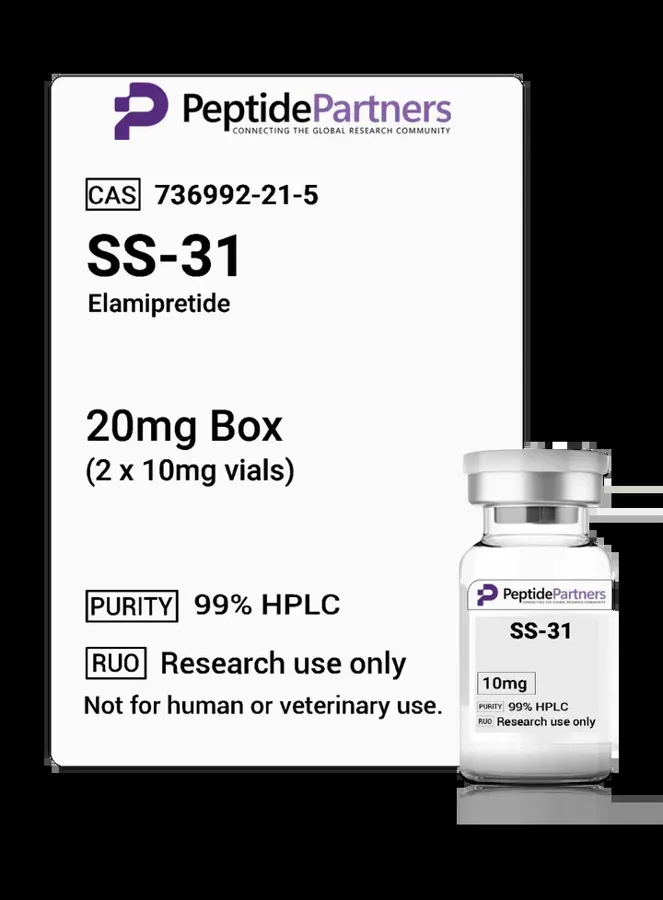
Peptides Partners lists SS-31 (10mg vials) in 3 pack sizes, all in stock, with price per mg shown for each option. Browse more mitochondrial compounds in the Peptides Partners research peptide shop. All products are for laboratory research use only.