
PEPTIDES PARTNERS BLOG · November 11, 2026
The Research Science of Semax: Molecular Origins, Investigated Pathways, and Sourcing Standards
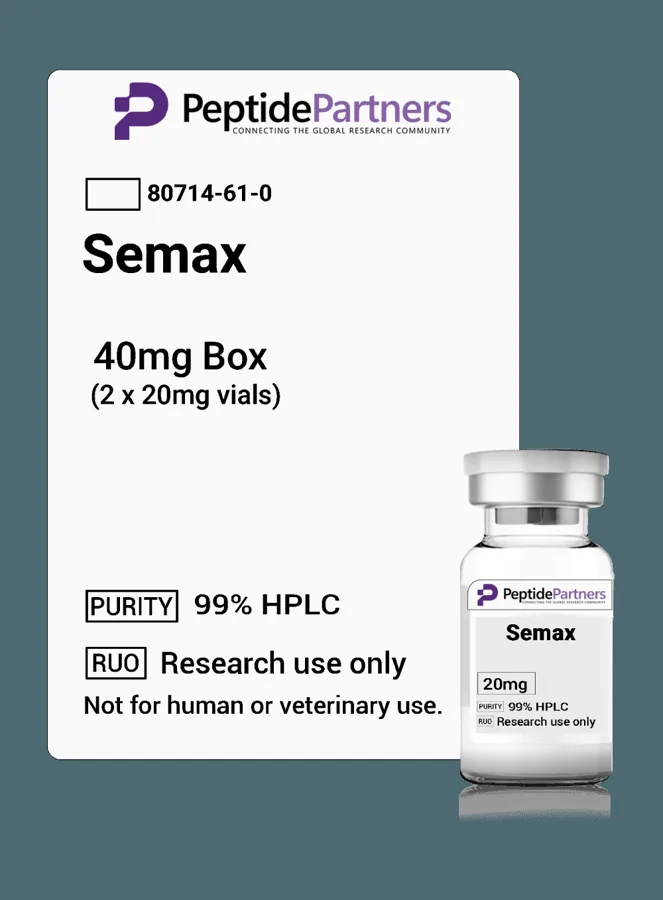
In the landscape of neurochemical investigation, synthetic peptide analogues hold a prominent position for their targeted receptor interactions and distinct pharmacokinetic properties. Among these compounds, Semax has generated extensive academic interest within neurobiology and peptide pharmacology. Classified within research literature as a synthetic heptapeptide derived from adrenocorticotropic hormone (ACTH), Semax was formulated to isolate the neurotropic properties of ACTH fragments while eliminating hormonal, steroidogenic activity. For contemporary laboratories examining cellular protection, neuroplasticity, and neurotransmitter modulation, Semax remains a focal point of ongoing in vitro and in vivo investigation.
Origins and Structural Formulation of Semax
The development of Semax dates back to foundational work conducted in the late 1970s and 1980s by the Institute of Molecular Genetics and the Institute of Experimental Medicine under the Russian Academy of Sciences. Investigators sought to harness the observed central nervous system effects of ACTH fragments—specifically the ACTH(4-10) sequence (Met-Glu-His-Phe)—which had shown promise in preclinical models for behavioral modification and attentional processes. However, native ACTH(4-10) suffered from a rapid rate of enzymatic degradation, resulting in a biological half-life measured in mere minutes.
To overcome this limitation, scientists engineered a modified peptide sequence by appending the tripeptide Pro-Gly-Pro to the C-terminus of ACTH(4-10). The resulting heptapeptide sequence—Met-Glu-His-Phe-Pro-Gly-Pro—demonstrated enhanced stability against endogenous peptidase breakdown. This structural modification yielded a compound that retained the non-hormonal central properties of the parent sequence while offering a significantly prolonged duration of activity in experimental models. Today, this heptapeptide configuration serves as the standard template for analytical evaluations in nootropic and neurobiological research.
Molecular Characteristics of Semax
A clear understanding of the physicochemical properties of Semax is vital for investigators planning bench assays, solubility tests, and stability profiles. The core structural and analytical markers include:
| Property | Analytical Profile |
|---|---|
| Sequence | H-Met-Glu-His-Phe-Pro-Gly-Pro-OH |
| Molecular Formula | C37H51N9O10S |
| Monoisotopic Mass | 813.35 Da |
| Peptide Class | Synthetic ACTH-derived Heptapeptide |
| Common Analytical Methods | RP-HPLC (Purity), ESI-MS / MALDI-TOF (Mass Verification) |
Primary Mechanisms Investigated in Academic Literature
Research into Semax focuses largely on how small synthetic peptides influence complex central nervous processes without activating peripheral endocrine pathways. Several distinct mechanisms have emerged as the primary pathways of study:
1. Expression of Neurotrophic Factors
A primary axis of Semax investigation centers on its interaction with endogenous neurotrophins. In preclinical rodent models, exposure to Semax has been studied for its ability to upregulate the expression of Brain-Derived Neurotrophic Factor (BDNF) and its primary tyrosine kinase receptor, TrkB, particularly in the hippocampus and cerebral cortex. Additionally, researchers have documented shifts in Nerve Growth Factor (NGF) mRNA levels following peptide exposure. By modulating these trophic signals, the peptide serves as a valuable model compound for studying long-term potentiation, synaptic structural remodeling, and cellular survival cascades.
2. Neuromodulation and Monoaminergic Tone
Laboratory models assessing central monoaminergic function have evaluated Semax for its regulatory influence on dopamine and serotonin metabolism. Microdialysis studies in animal models have indicated that administration of the peptide can alter striatal dopamine turnover and modify serotonergic neurotransmission during stress-induced protocols. Researchers study these markers to better understand how peptide signaling interacts with reward, arousal, and cognitive endurance pathways at the molecular level.
3. Cellular Protection and Vascular Responses
In models of cerebral hypoperfusion and focal ischemia, Semax has been studied for its downstream effects on gene expression related to inflammatory cascades and vascular function. Transcriptomic analyses have suggested that the peptide may influence the expression of genes involved in immune signaling, microglial activation, and extracellular matrix integrity. Investigating these gene sets allows scientists to evaluate whether the compound attenuates secondary tissue damage associated with metabolic disruption and reperfusion injury.
Navigating Sourcing, Formats, and Documentation
Reproducibility is the cornerstone of empirical science. When acquiring synthetic peptides for laboratory experimentation, research teams must implement rigorous vetting procedures to ensure that the chemical identity, purity, and physical format align precisely with their experimental protocols. Peptides Partners supplies pure, analytical-grade compounds intended strictly for non-clinical research use.
Evaluating Vial Formats and Packaging Configurations
Semax is typically supplied as a lyophilized (freeze-dried) powder to maintain molecular stability over extended storage periods. When designing an assay schedule, investigators often compare purchasing options:
- Single-Vial Configurations: Best suited for pilot experiments, initial solubility validations, or brief analytical runs where immediate reconstitution and consumption prevent the need for prolonged storage in solution.
- Multi-Vial Packs (5-Pack or 10-Pack Options): Preferred for high-throughput or longitudinally designed studies. Distributing total mass across multiple sealed, inert-gas-purged vials prevents repeated freeze-thaw cycles and mitigates the risk of ambient moisture degradation once a vial is unsealed.
Analyzing Batch Documentation
Authenticity and quality control must be independently confirmed via analytical documentation prior to bench application. Investigators sourcing from Peptides Partners routinely examine specific analytical documentation to verify their compounds:
- High-Performance Liquid Chromatography (HPLC): Reverse-phase HPLC profiles verify the overall purity of the peptide by separating the target heptapeptide from related impurities, truncated fragments, or synthesis byproducts.
- Mass Spectrometry (MS): Electrospray Ionization (ESI) or Matrix-Assisted Laser Desorption/Ionization (MALDI) reports ensure that the detected molecular mass corresponds to the exact theoretical weight of the Met-Glu-His-Phe-Pro-Gly-Pro sequence (813.35 Da).
- Net Peptide Content: Critical for calculating molar concentrations, documentation detailing net peptide versus counter-ion/moisture content ensures standard preparation and reproducible concentration parameters.
Strict Research Framing
Semax remains an active, compelling subject within biochemical, neurological, and physiological science. It is essential to emphasize that all materials, documentation, and structural references regarding Semax provided by Peptides Partners are designated strictly for in vitro, laboratory, and preclinical research applications. These compounds are not approved for human or veterinary use, nor are they intended for therapeutic, diagnostic, or clinical administration. Maintaining strict regulatory compliance and scientific integrity guarantees that investigative data remains credible, robust, and aligned with academic standards.
Where to buy Semax for research
Peptides Partners lists Semax (30mg vials) in 3 pack sizes, all in stock, with price per mg shown for each option. Browse more nootropics compounds in the Peptides Partners research peptide shop. All products are for laboratory research use only.