
PEPTIDES PARTNERS BLOG · November 11, 2026
The Science of Laboratory Reconstitution: Understanding PP Water in Peptide Research
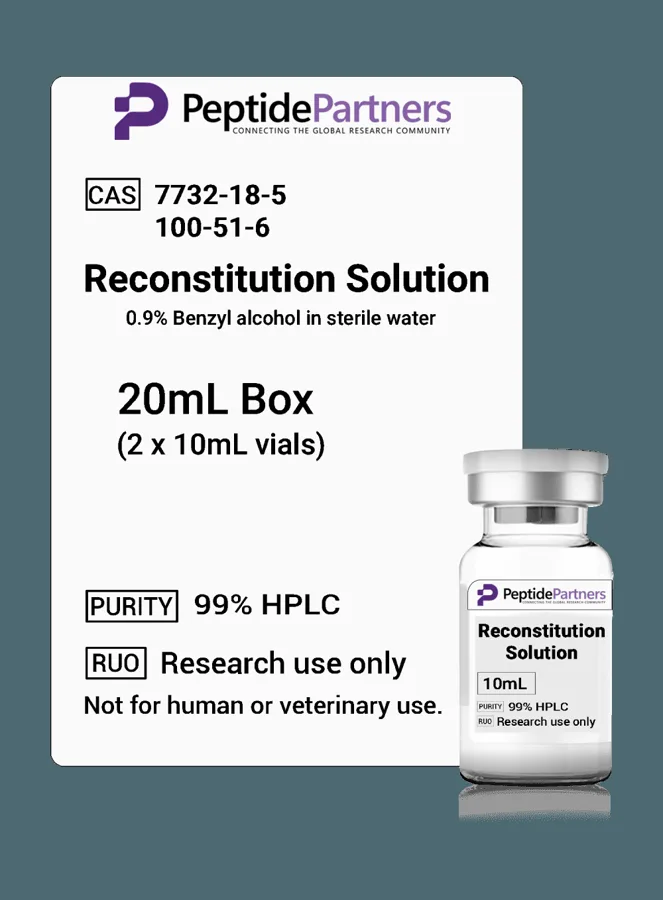
The Role of Reconstitution Media in Peptide Chemistry
Peptide synthesis has advanced rapidly over recent decades, enabling researchers to explore increasingly complex amino acid sequences for cell culture studies, analytical assays, and molecular biology investigations. Most synthetic peptides are isolated following solid-phase peptide synthesis (SPPS) and subsequent purification via high-performance liquid chromatography (HPLC). To preserve their chemical integrity during transport and long-term storage, these molecules are subjected to lyophilization (freeze-drying). Lyophilization removes water content under vacuum, resulting in a stable, dehydrated peptide cake.
However, bringing these compounds back into a liquid state for in vitro testing requires precision. The reconstitution medium is not merely a vehicle; it is an active biochemical environment that directly influences solubility, secondary structure, conformational stability, and reaction kinetics. In laboratory research, specialized reconstitution solutions—such as PP Water from Peptides Partners—serve as standardized solvents designed to maintain structural fidelity, minimize hydrolysis, and provide consistent osmolar and microbial baselines across repeated experimental runs.
Historical Evolution of Reconstitution Solvents
In the early days of synthetic peptide research during the mid-to-late twentieth century, laboratory investigators often prepared in-house distilled or deionized water to resuspend experimental compounds. As analytical methods advanced, researchers realized that standard distilled water introduced critical points of failure. Variations in dissolved atmospheric gases (particularly carbon dioxide, which forms carbonic acid and lowers pH), trace multivalent metal ions, and residual organic matter frequently caused spontaneous degradation, peptide cleavage, or aggregation.
The development of standardized high-purity waters, such as Water for Injection (WFI) standards and bacteriostatic formulations containing antimicrobial preservatives like benzyl alcohol, revolutionized peptide storage stability. Researchers discovered that adding a controlled bacteriostatic agent (typically 0.9% benzyl alcohol) halted microbial proliferation without disrupting the peptide backbone in non-polar or moderately polar sequences. This historical progression shifted peptide solvent preparation from manual, variable benchtop distillation to sealed, certified laboratory-grade reconstitution media.
Physicochemical Mechanisms: Stability, Degradation, and Solvent Dynamics
Understanding how reconstitution water interacts with a lyophilized peptide requires an examination of the degradation pathways common to amino acid chains in solution. When water is reintroduced to a peptide matrix, several distinct chemical pathways are initiated:
- Hydrolysis: The chemical breakdown of peptide bonds by water molecules. This process is highly sensitive to pH shifts and elevated temperatures.
- Deamidation: Commonly observed in sequences containing asparagine (Asn) and glutamine (Gln), where nucleophilic attack forms a cyclic succinimide intermediate, altering charge and molecular mass.
- Oxidation: Methionine (Met) and cysteine (Cys) residues are susceptible to atmospheric oxygen dissolved in water, converting thiol and thioether groups into sulfoxides or disulfides.
- Aggregation: Hydrophobic patches on the peptide may coalesce rather than properly solvate if the dielectric constant, ionic strength, or dissolution technique is sub-optimal, forming insoluble fibrils or precipitates.
PP Water is calibrated to minimize exogenous catalysts of these degradation pathways. By maintaining strict neutrality, low endotoxin thresholds, and zero mineral interference, the solvent allows researchers to study true peptide behavior rather than artifacts caused by solvent contamination.
Comparing Solvents in the Laboratory Setting
Selecting the appropriate reconstitution medium depends heavily on the analytical endpoint, duration of the assay, and sequence characteristics. The table below illustrates the primary differences between common solvent formats utilized in research environments.
| Solvent Type | Composition | Primary Laboratory Application | Microbial Resistance |
|---|---|---|---|
| Sterile Water for Research | 100% Ultra-pure, endotoxin-free water | Immediate in vitro assays, cell culture where preservatives inhibit cell growth | None; single-use protocol required once opened |
| Bacteriostatic Water (PP Water) | Ultra-pure water + 0.9% Benzyl Alcohol | Multi-draw experimental protocols, extended storage of aliquots at 4°C | High; bacteriostatic agent prevents bacterial and fungal replication |
| Phosphate-Buffered Saline (PBS) | Sodium chloride, sodium phosphate, potassium salts | Physiological ionic strength assays, specific antibody-binding experiments | Low; prone to contamination unless kept sterile or preserved |
Laboratory Handling and Reconstitution Protocols
Research protocols dictate precise physical handling to maintain peptide stability during reconstitution. Introducing the solvent directly onto the lyophilized cake under high pressure can cause mechanical shear stress, leading to foaming and structural denaturation, particularly in longer polypeptides or proteins.
Standard experimental procedures involve equilibrating both the lyophilized peptide vial and the reconstitution medium to room temperature prior to use. The fluid is introduced slowly down the interior glass wall of the vial. Rather than aggressive shaking or vortexing, investigators employ gentle swirling or allow the closed vial to stand until dissolution is complete. For peptides known to have low aqueous solubility, preliminary wetting with minute volumes of sterile dilute organic acids (such as 0.1% acetic acid) or bases is sometimes documented before bringing the final volume up with PP Water.
Evaluating Packaging, Formats, and Technical Documentation
When sourcing reconstitution media and associated reagents from catalog providers such as Peptides Partners, research teams must evaluate specific quality control metrics to ensure reproducibility across experimental cohorts. Critical factors include:
- Vial Architecture and Volume: Selecting appropriate volumes (e.g., 10 mL vs. 30 mL) prevents repeated septal punctures beyond validated thresholds. Multi-pack configurations allow laboratories to maintain consistent lots across long-term studies.
- Container Integrity: Borosilicate glass vials or high-grade medical polymer containers prevent leaching of silica or plasticizers into the medium, which could otherwise confound mass spectrometry or spectroscopic readings.
- Certificates of Analysis (COA): Documentation must confirm testing parameters, including pH tolerance (typically within the 4.5–7.0 window depending on formulation), endotoxin levels (measured via Limulus Amebocyte Lysate [LAL] testing), and particulate contamination limits.
- Sterility Assurance: Verification of terminal sterilization or ultrafiltration protocols ensures that the medium will not introduce exogenous bioburden into sensitive analytical workflows.
Conclusion
Precise peptide science relies on controlling every variable within the laboratory system. While significant attention is paid to the synthetic purity of the peptide sequence itself, the aqueous matrix used to bring that sequence into an active liquid phase is equally decisive. By employing dedicated reconstitution solutions like PP Water that meet stringent purity, stability, and documentation standards, researchers can safeguard their assays against degradation, minimize experimental variability, and generate reproducible data in the laboratory.
Where to buy PP Water for research
Peptides Partners lists PP Water (10mL vials) in 3 pack sizes, all in stock, with price per mg shown for each option. Browse more reconstitution compounds in the Peptides Partners research peptide shop. All products are for laboratory research use only.