
PEPTIDES PARTNERS BLOG · November 11, 2026
Exploring the Research Science of Buffered NAD+: Mitochondrial Pathways, Historical Context, and Laboratory Standards
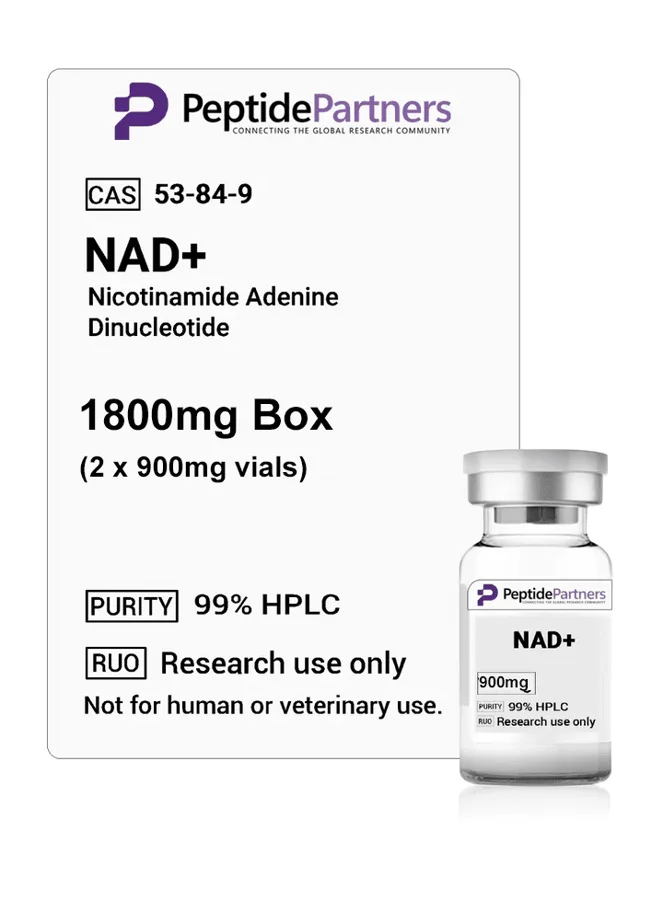
Nicotinamide adenine dinucleotide (NAD+) represents one of the most extensively studied biomolecules in cellular bioenergetics and mitochondrial research. Found in every living cell, this central pyridine nucleotide serves as an indispensable coenzyme for fundamental metabolic transformations and a critical rate-limiting substrate for regulatory enzymes. In experimental literature, researchers frequently explore NAD+ dynamics in relation to mitochondrial efficiency, oxidative stress responses, and age-associated shifts in cellular homeostasis. To overcome common stability limitations inherent to standard lyophilisates, buffered NAD+ formulations have gained significant traction within laboratory research environments. This article provides an educational overview of the scientific history, molecular mechanisms, and analytical sourcing considerations surrounding buffered NAD+ for research applications.
Historical Context and the Discovery of NAD+
The scientific exploration of NAD+ began in the early twentieth century, emerging from investigations into cell-free alcoholic fermentation. In 1906, British biochemists Sir Arthur Harden and William John Young identified a heat-stable, dialyzable factor in boiled yeast juice that accelerated fermentation when added to yeast extracts. Initially termed “cozymase,” this factor represented the first recorded observation of NAD+.
Subsequent decades saw rapid advances in deciphering its chemical identity:
- 1930s: German biochemist Otto Heinrich Warburg established the nucleotide structure of cozymase and demonstrated that it mediates hydrogen transfer in redox reactions through reversible reduction of its nicotinamide ring.
- 1936: Warburg and Christian isolated NADP+ (nicotinamide adenine dinucleotide phosphate), illustrating the broader family of nicotinamide cofactors.
- 1938: Conrad Elvehjem isolated nicotinamide from liver extracts, proving that nicotinic acid (vitamin B3) functions as the dietary precursor required for the endogenous synthesis of NAD+.
- 1950s and 1960s: Arthur Kornberg identified key enzymatic steps in NAD+ biosynthesis, paving the way for modern molecular biology to map both de novo and salvage pathways.
While twentieth-century research viewed NAD+ predominantly as an inert cofactor for metabolic hydride transfer, late-century discoveries revealed that it is actively consumed by signaling enzymes, fundamentally shifting how the scientific community understands its role in cellular biology.
Molecular Mechanisms Investigated in Mitochondrial Science
Within mitochondrial biochemistry, NAD+ operates across two distinct but interconnected biochemical axes: as an electron-carrying cofactor in energy transduction and as a consumed signaling substrate.
1. Redox Homeostasis and the Electron Transport Chain
The primary redox role of the NAD+/NADH couple is to shuttle reducing equivalents derived from catabolic pathways into the oxidative phosphorylation machinery. During glycolysis, the tricarboxylic acid (TCA) cycle, and beta-oxidation, NAD+ accepts electrons to form NADH. This reduced coenzyme then donates high-energy electrons directly to Complex I (NADH:ubiquinone oxidoreductase) of the inner mitochondrial membrane, initiating the proton gradient necessary for ATP generation via ATP synthase. A high cellular NAD+/NADH ratio is essential for maintaining flux through rate-limiting dehydrogenase enzymes in the TCA cycle.
2. Sirtuin Activation (SIRT1-SIRT7)
Sirtuins are a family of evolutionary conserved class III histone deacetylases that strictly depend on NAD+ for their enzymatic activity. Mammalian cells express seven sirtuin isoforms with specific subcellular localization. Researchers heavily investigate mitochondrial sirtuins (SIRT3, SIRT4, and SIRT5) and nuclear sirtuins (such as SIRT1), observing their regulation of:
- Deacetylation of mitochondrial transcription factors, such as PGC-1α, which regulates mitochondrial biogenesis.
- Post-translational modification of metabolic enzymes, including superoxide dismutase (SOD2), involved in mitigating reactive oxygen species (ROS).
- Modulation of lipid metabolism enzymes and amino acid breakdown within the mitochondrial matrix.
3. Poly(ADP-Ribose) Polymerases (PARPs)
PARPs, particularly PARP-1, are abundant nuclear enzymes involved in cellular responses to genomic insults. When DNA single-strand or double-strand breaks occur, PARP enzymes consume significant pools of intracellular NAD+ to synthesize poly(ADP-ribose) chains that recruit repair machinery. In experimental models characterized by excessive oxidative stress, high PARP activation has been observed to deplete intracellular NAD+ pools, subsequently compromising mitochondrial ATP generation.
4. Ectoenzymes and NAD+ Degradation (CD38/CD157)
In preclinical models, researchers investigate CD38, a primary glycohydrolase and ADP-ribosyl cyclase responsible for the baseline degradation of extracellular and intracellular NAD+. Studies often explore the correlation between elevated CD38 expression in aging tissues and the secondary reduction of mitochondrial function.
Preclinical Horizons in NAD+ Research
In vitro and animal models frequently target the modulation of NAD+ availability to understand how cells preserve energetic capacity under metabolic or environmental challenges. Published academic investigations focus on several primary models:
| Research Model | Primary Biological Target | Observed Endpoints in Literature |
|---|---|---|
| Cellular Senescence | SIRT1 / PARP balance | Chromatin stability, expression of senescence-associated secretory phenotypes (SASP). |
| Mitochondrial Dysfunction | Complex I activity, PGC-1α | Oxygen consumption rate (OCR), extracellular acidification rate (ECAR), mitochondrial mass. |
| Metabolic Stress Models | Beta-oxidation enzymes, SIRT3 | Intracellular lipid accumulation, insulin signaling pathways in culture, ROS production. |
| Neuronal Energy Depletion | Axonal integrity, SARM1 | Wallerian degeneration pathways, cellular survival under excitotoxic insult. |
The “Buffered” Formulation: Stability and Laboratory Handling
Unformulated, free-acid NAD+ is notoriously labile in aqueous solution. Native NAD+ possesses an acidic pH when reconstituted, which can accelerate the spontaneous cleavage of the high-energy pyrophosphate linkage or the hydrolytic release of the nicotinamide moiety. Furthermore, significant pH fluctuations can interfere with sensitive in vitro assays, enzyme kinetics studies, and culture viability.
A “buffered” NAD+ research preparation incorporates stabilizing buffer salts (such as sodium carbonate or biological phosphate salts) directly into the lyophilisate. This engineering ensures that upon reconstitution with a laboratory diluent, the resulting solution maintains a physiological or neutral pH range. Key experimental advantages of buffered formulations include:
- Reduced Spontaneous Hydrolysis: Preserves the intact dinucleotide structure over standard analytical preparation windows.
- Assay Neutrality: Minimizes artifacts in enzymatic or cellular assays that are sensitive to acidic pH shifts upon test compound introduction.
- Consistent Solubility: Facilitates rapid, clear dissolution without requiring tedious secondary pH adjustments in the laboratory.
Sourcing and Evaluating NAD+ Buffered for Laboratory Work
When obtaining NAD+ Buffered for research purposes, consistent experimental outcomes depend directly on the structural verification and chemical purity of the compound. Research institutions and laboratories sourcing peptides and small-molecule coenzymes evaluate several quality control benchmarks:
1. Analytical Documentation
Every research batch should be cross-referenced with comprehensive, lot-specific documentation. This includes High-Performance Liquid Chromatography (HPLC) profiles to verify relative purity and confirm the absence of degradation products (such as free nicotinamide or ADP-ribose). Additionally, Liquid Chromatography-Mass Spectrometry (LC-MS) provides molecular weight confirmation to verify the authentic dinucleotide mass.
2. Comparing Vial Configurations
When designing experimental timelines, researchers typically choose between single-vial orders and multi-vial packs (such as 5-vial or 10-vial configurations). Because reconstituted NAD+ must be used promptly or aliquoted and stored at ultra-low temperatures to prevent degradation, utilizing smaller, multi-vial packs allows researchers to reconstitute only the exact quantity needed for a given assay run, preserving the integrity of remaining lyophilized stock.
3. Storage and Reconstitution Protocols
Lyophilized buffered NAD+ should be maintained in desiccated, dark conditions at -20°C for long-term viability. For reconstitution, standard analytical practices require the use of high-grade laboratory solvents such as sterile bacteriostatic water or laboratory-grade deionized water, followed by immediate use or low-temperature aliquot management to avoid repeated freeze-thaw cycles.
Through its specialized research catalog, Peptides Partners supplies non-clinical, analytical-grade compounds and buffered coenzymes accompanied by transparent testing standards, supporting reproducible and rigorous investigations into mitochondrial biology and cellular metabolism.
Where to buy NAD+ Buffered for research
Peptides Partners lists NAD+ Buffered (900mg vials) in 3 pack sizes, all in stock, with price per mg shown for each option. Browse more mitochondrial compounds in the Peptides Partners research peptide shop. All products are for laboratory research use only.