
PEPTIDES PARTNERS BLOG · November 11, 2026
The Science of MOTS-c: Investigating the Mitochondrial-Derived Peptide in Metabolic Research
For decades, cellular biology textbooks characterized mitochondria almost exclusively as the metabolic engines of eukaryotic cells, primarily responsible for generating adenosine triphosphate (ATP) through oxidative phosphorylation. However, modern molecular endocrinology and cellular biology have fundamentally revised this perspective. Mitochondria are now recognized as active signaling hubs that communicate with the nuclear genome to coordinate systemic homeostasis.
Central to this paradigm shift was the discovery of mitochondrial-derived peptides (MDPs)—short bioactive signaling molecules translated from non-canonical small open reading frames (sORFs) within mitochondrial DNA. Among the most widely investigated of these factors is MOTS-c (Mitochondrial Open Reading Frame of the 12S rRNA Type-c). Preclinical researchers routinely investigate MOTS-c to evaluate its regulatory role in cellular energy balance, lipid and glucose metabolism, and stress response pathways.
Discovery and Molecular Classification of MOTS-c
MOTS-c was first identified in 2015 by a research team led by Dr. Pinchas Cohen at the University of Southern California. Utilizing bioinformatic screening tools paired with biochemical verification, researchers uncovered a distinct 16-amino acid peptide encoded within the mitochondrial 12S ribosomal RNA (rRNA) gene. Its discovery challenged classical genetic assumptions that mitochondrial DNA encoded only 13 structural proteins alongside essential transfer and ribosomal RNAs.
Unlike classical hormones synthesized in dedicated endocrine glands, MOTS-c is generated intracellularly and appears to operate both cell-autonomously and as a circulating retrograde signaling factor. Under basal conditions, the peptide primarily resides in the cytoplasm. However, in response to cellular metabolic stress, research has demonstrated that MOTS-c can translocate to the cell nucleus, where it binds chromatin to modulate nuclear gene expression, acting as a direct communicator between the organelle and the nuclear genome.
Mechanisms of Action: AMPK and Cellular Energy Sensing
The primary molecular mechanism investigated in connection with MOTS-c involves the activation of 5′-adenosine monophosphate-activated protein kinase (AMPK), the central cellular sensor of energy status. In vitro investigations indicate that MOTS-c affects the folate-methionine cycle, specifically inhibiting the de novo purine synthesis pathway. This intermediate suppression leads to an accumulation of 5-aminoimidazole-4-carboxamide ribonucleotide (AICAR), a natural agonist of AMPK.
Upon AMPK activation, several downstream signaling cascades are triggered within experimental models:
- Glucose Transporter Expression: Increased translocation of glucose transporter type 4 (GLUT4) in muscle cell models, independent of canonical insulin-receptor signaling pathways.
- Fatty Acid Oxidation: Phosphorylation and inhibition of acetyl-CoA carboxylase (ACC), promoting mitochondrial uptake and oxidation of long-chain fatty acids.
- Mitochondrial Biogenesis: Upregulation of peroxisome proliferator-activated receptor gamma coactivator 1-alpha (PGC-1α), enhancing mitochondrial replication and functional density in treated cell lines.
Core Areas of Preclinical Investigation
Because MOTS-c directly interfaces with fundamental metabolic switches, laboratory scientists study this peptide across several distinct biological contexts:
1. Glucose and Lipid Homeostasis
In animal models of high-fat-diet-induced obesity, MOTS-c has been studied for its capacity to preserve insulin sensitivity and normalize blood glucose levels. Researchers observe that administration in rodent models prevents age-dependent and diet-induced insulin resistance, predominantly by optimizing lipid disposal in skeletal muscle and decreasing hepatic lipid accumulation.
2. Exercise Physiology and Skeletal Muscle
Skeletal muscle is the principal target tissue for MOTS-c. Preclinical trials evaluating exercise capacity in mice have explored whether the peptide acts as an “exercise mimetic.” Studies have documented enhanced treadmill endurance, augmented physical performance, and structural adaptation in myofibers following peptide exposure, attributed largely to enhanced glucose utilization and reduced oxidative damage.
3. Cellular Senescence and Longevity
Endogenous circulating levels of MOTS-c have been observed to decline with advancing age in both animal and human observational cohorts. Consequently, researchers study MOTS-c in models of cellular senescence to determine whether restoring signaling levels mitigates systemic inflammation, preserves physical functional capacity, and attenuates age-associated metabolic decline.
Comparing Vial Packs and Documentation at Peptides Partners
For research institutions, contract research organizations (CROs), and independent investigators, securing reliable, high-grade analytical reagents is paramount for producing reproducible data. When sourcing MOTS-c through Peptides Partners, laboratory managers must evaluate specific structural factors and analytical criteria to align with their experimental design.
| Evaluation Factor | Primary Laboratory Consideration | Impact on Experimental Validity |
|---|---|---|
| Analytical Verification | High-Performance Liquid Chromatography (HPLC) and Mass Spectrometry (LC-MS) data. | Confirms net peptide purity, molecular weight verification, and absence of truncated sequence artifacts. |
| Vial Presentation & Quantity | Single vials versus multi-vial packs (e.g., 5-pack or 10-pack configurations). | Allows experimental cohorts to use identical lot numbers while minimizing repetitive freeze-thaw cycles. |
| Lyophilization Stability | Moisture content reduction through standardized vacuum freeze-drying. | Ensures compound stability during transport and enables prolonged storage at -20°C prior to reconstitution. |
| Batch-Specific Documentation | Detailed Certificates of Analysis (COA) corresponding to exact production batches. | Ensures traceability and provides exact peptide content data needed to prepare accurate molar concentrations. |
Selecting Formats for Experimental Scale
Experimental protocols vary widely between short-duration in vitro cell assays and prolonged longitudinal rodent studies. In smaller in vitro contexts, single-vial allocations may suffice, whereas multi-vial options ensure that long-term in vivo protocols maintain batch uniformity across treatment groups. Minimizing variability in peptide concentration between experimental replicates is fundamental for reliable statistical outcomes.
Conclusion
The discovery of MOTS-c has expanded understanding of the mitochondrial genome from a passive power source to an active metabolic regulator. As research continues to elucidate the complex cross-talk between mitochondrial-derived peptides, the folate cycle, and nuclear transcription, MOTS-c remains an essential compound in the study of metabolic homeostasis, cellular stress, and the biology of aging. Investigators requiring consistent, analytically documented peptides rely on Peptides Partners to support rigor and reproducibility across their scientific pipelines.
Where to buy MOTS-c for research
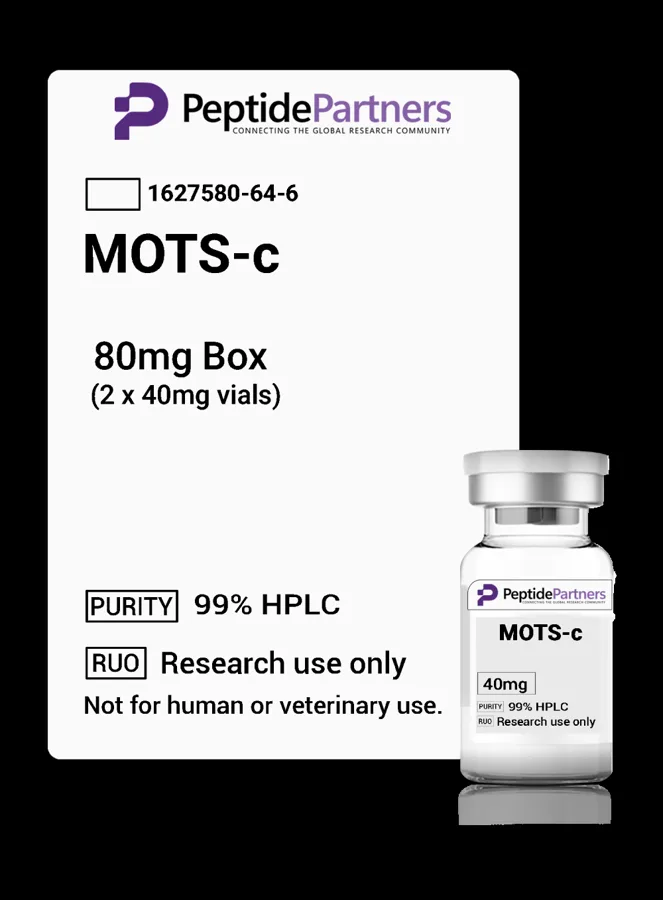
Peptides Partners lists MOTS-c (40mg vials) in 3 pack sizes, all in stock, with price per mg shown for each option. Browse more mitochondrial compounds in the Peptides Partners research peptide shop. All products are for laboratory research use only.