
PEPTIDES PARTNERS BLOG · November 11, 2026
The Research Science of GHK-Cu: Discovery, Cellular Mechanisms, and Laboratory Sourcing
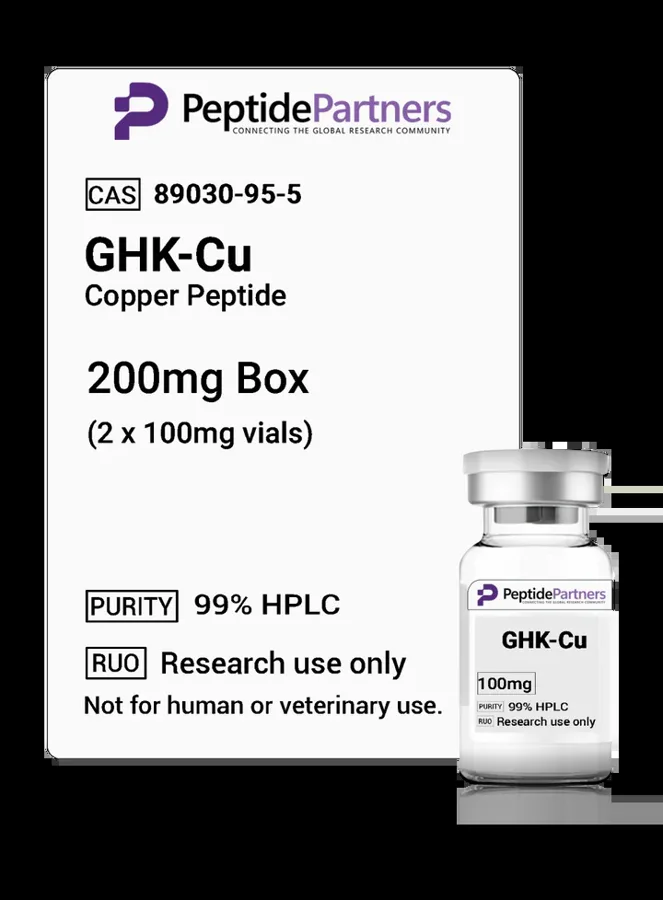
Among endogenous biochemical complexes evaluated in redox biology and peptide chemistry, the copper tripeptide GHK-Cu (glycyl-L-histidyl-L-lysine copper) remains one of the most widely investigated molecular motifs. First characterized in human plasma fractions, this naturally occurring sequence exhibits a high thermodynamic affinity for divalent copper ions. In modern biochemical literature, GHK-Cu is frequently categorized alongside compounds of interest in antioxidant science, extracellular matrix regulation, and genomic modulation. For laboratory investigators, understanding the structural behavior, historical context, and documented pathways of GHK-Cu is essential when designing controlled in vitro or in vivo model protocols.
Discovery and Evolutionary Context of GHK-Cu
The tripeptide glycyl-L-histidyl-L-lysine (GHK) was initially isolated in 1973 by Dr. Loren Pickart during investigations into biological aging and serum-dependent tissue maintenance. Researchers observed that plasma fractions obtained from younger mammalian donors stimulated differentiated function and protein synthesis in aged liver tissue models, whereas plasma from older counterparts failed to elicit the same response. Subsequent fractionation and analytical chromatography isolated GHK as the active endogenous factor responsible for this cellular observation.
Further structural analysis demonstrated that the peptide sequence possessed an extraordinarily high binding affinity for copper(II) ions (Cu2+), forming the complex now designated as GHK-Cu. Evolutionary biologists and biochemists note that the amino acid sequence is conserved across multiple vertebrate species, suggesting an essential biological role in trace mineral transport, tissue repair signaling, and oxidative equilibrium.
Molecular Architecture and Copper Chelation Dynamics
The chemical profile of GHK-Cu is governed by the coordination geometry of the tripeptide with copper. The nitrogen atoms located at the glycine amino terminus, the deprotonated amide of the histidyl residue, and the imidazole ring of histidine cooperate to chelate Cu2+ into a square planar arrangement, with water or oxygen molecules often occupying apical coordination sites.
This chelation mechanism is of profound interest to antioxidant researchers. Free transition metals, particularly iron and copper, are potent catalysts of the Fenton and Haber-Weiss reactions, which generate destructive hydroxyl radicals (•OH) from hydrogen peroxide in biological environments. By sequestering free copper with a high stability constant, GHK-Cu prevents adventitious redox cycling that can damage nearby lipids, proteins, and nucleic acids. Concurrently, the complex can exchange copper ions with physiological carrier proteins such as albumin and ceruloplasmin, serving as an active physiological buffer rather than an inert chelator.
Investigated Antioxidant and Gene Regulatory Pathways
Preclinical studies have explored how GHK-Cu modulates oxidative stress at both the direct molecular level and the transcriptional level. Research groups analyzing gene expression datasets—including profiles from the Broad Institute’s Connectivity Map—have noted that GHK-Cu influences the expression of several thousand human genes, with significant enrichment in pathways associated with antioxidant defense, DNA repair, and inflammatory modulation.
- Superoxide Dismutase Induction: In vitro experiments indicate that exposure to GHK-Cu is associated with increased activity of superoxide dismutase (SOD), a primary enzymatic defense mechanism that dismutates superoxide radicals into molecular oxygen and hydrogen peroxide.
- Suppression of Lipid Peroxidation: Researchers evaluating membrane degradation have observed that the presence of GHK-Cu attenuates iron-catalyzed lipid peroxidation, reducing the accumulation of reactive aldehydes like malondialdehyde (MDA).
- Inhibition of Inflammatory Cytokines: Preclinical models exploring cellular insult report that GHK-Cu administration downregulates mRNA expression of pro-inflammatory mediators, including tumor necrosis factor-alpha (TNF-α) and interleukin-6 (IL-6), which frequently drive downstream oxidative cascades.
- Ferritin and Iron Homeostasis: Emerging literature suggests GHK-Cu may modulate iron storage mechanisms, thereby restricting the pool of unchelated iron available for oxidative cellular damage.
Extracellular Matrix Remodeling in Preclinical Literature
Beyond its classification as an antioxidant regulator, GHK-Cu is heavily featured in extracellular matrix (ECM) research. Studies utilizing cultured dermal fibroblasts, endothelial models, and animal wound matrices demonstrate that the tripeptide complex interacts with pathways governing both the synthesis and breakdown of connective tissue components.
Investigators frequently quantify the expression of collagen types I and III, tropoelastin, and sulfated glycosaminoglycans following GHK-Cu incubation. Importantly, the complex has been shown to modulate matrix metalloproteinases (MMPs) alongside tissue inhibitors of metalloproteinases (TIMPs). Rather than solely promoting uninhibited structural synthesis, GHK-Cu appears to facilitate balanced matrix turnover, making it a prominent reference compound in fibrosis models, vascular remodeling assays, and epithelial repair research.
Laboratory Sourcing: Evaluating Documentation and Formats
When procurement teams and academic laboratories source GHK-Cu for analytical or preclinical experimentation, chemical verification and packaging integrity are paramount. Because research peptides are synthesized via solid-phase peptide synthesis (SPPS), residual reagents, counter-ions, and truncated sequences can compromise experimental reproducibility if quality control is inadequate.
At Peptides Partners, research peptides are cataloged strictly for laboratory and analytical use, requiring rigorous scrutiny of analytical documentation prior to protocol deployment.
| Analytical Parameter | Methodology Used | Significance in Experimental Research |
|---|---|---|
| Chemical Identity | Mass Spectrometry (MS) | Confirms the exact molecular mass of the peptide and validates correct copper coordination. |
| Chromatographic Purity | High-Performance Liquid Chromatography (HPLC) | Ensures absence of sequence deletions, stereoisomers, or synthesis artifacts. |
| Physical State | Lyophilized Powder | Maximizes stability against hydrolytic cleavage during ambient storage and transit. |
Comparing Single Vials vs. Multi-Vial Packs
Investigators must consider their reconstitution schedules when selecting product configurations. Because reconstituted aqueous peptide solutions are susceptible to spontaneous degradation, microbiological growth, and peptide precipitation over prolonged storage, experimental design should guide vial selection.
Procuring multi-vial formats (such as 5-pack or 10-pack options from Peptides Partners) allows research teams to prepare fresh working aliquots for distinct experimental phases. This minimizes the repeated freeze-thaw cycles that can degrade peptide conformation and dissociate the coordinated copper ion. Single vials remain suitable for short-term pilot assays, whereas multi-vial configurations support longitudinal studies, blinded replicate sets, and multi-well plate series requiring identical analytical controls.
Conclusion
GHK-Cu occupies a unique niche at the intersection of bioinorganic chemistry, redox regulation, and genomic research. From its discovery as an endogenous serum regulator to contemporary investigations into cellular defense mechanisms, it continues to serve as an indispensable tool for understanding trace metal kinetics and oxidative balance. Research groups studying this complex must maintain rigorous laboratory protocols, relying on validated analytical documentation and stable lyophilized preparations to ensure experimental validity.
Where to buy GHK-Cu for research
Peptides Partners lists GHK-Cu (100mg vials) in 4 pack sizes, all in stock, with price per mg shown for each option. Browse more anti-oxidant compounds in the Peptides Partners research peptide shop. All products are for laboratory research use only.