
PEPTIDES PARTNERS BLOG · November 11, 2026
The Science of Retatrutide: Investigating Triple-Agonist Metabolic Research Peptides
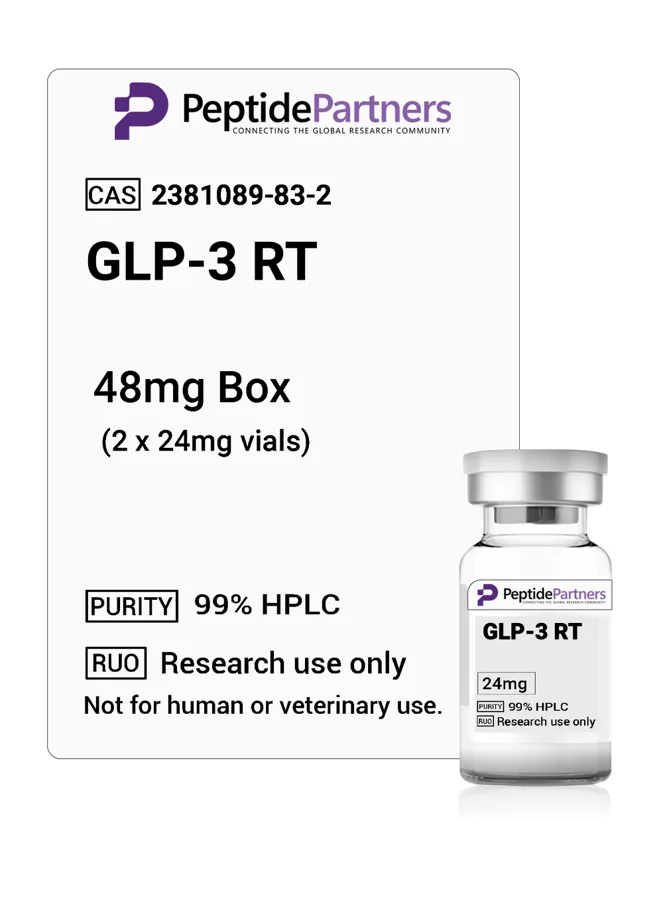
Within the rapidly evolving landscape of metabolic biochemistry, single-receptor agonists are increasingly giving way to multi-pathway targeting molecules. Retatrutide, frequently referenced in laboratory contexts and informal search nomenclature as a “GLP-3” or triple agonist, represents one of the most sophisticated synthetic peptides currently evaluated in metabolic science. Designed to interact simultaneously with three distinct cellular targets—the glucagon-like peptide-1 (GLP-1) receptor, the glucose-dependent insulinotropic polypeptide (GIP) receptor, and the glucagon receptor (GCGR)—this compound has stimulated extensive inquiry across academic and pre-clinical research environments.
The Evolution of Incretin Mimetics to Triple Agonism
To understand the biochemical significance of retatrutide, researchers trace the progression of incretin mimetics over the past two decades. Early metabolic investigations focused primarily on isolated GLP-1 receptor activation, which demonstrated reproducible influence on insulin secretion, gastric emptying rates, and central appetite pathways in various research models. Later, dual-agonist compounds bridged the gap between GLP-1 and GIP receptors, revealing that co-activation could produce additive effects on cellular energy dynamics.
Retatrutide emerged from rational drug design programs intended to expand this paradigm by incorporating glucagon receptor agonism. While glucagon historically carried the reputation of merely acting as a counter-regulatory hormone to insulin, modern biochemical assays have demonstrated its direct involvement in energy expenditure, thermogenesis, and hepatic lipid turnover. By integrating affinity for all three receptors into a single, cohesive peptide sequence, researchers sought to determine whether coordinated tripartite signaling could achieve metabolic modulation beyond the scope of mono- or dual-agonist peptides.
Molecular Architecture and Receptor Pharmacology
Retatrutide is a synthetic peptide engineered with structural modifications that prolong its enzymatic stability while maintaining balanced potency across its target receptors. Its backbone features a modified amino acid sequence paired with a fatty diacid side-chain moiety, facilitating non-covalent binding to albumin and extending its operational half-life in laboratory trial systems.
| Receptor Target | Primary Endogenous Ligand | Investigative Cellular Endpoints in Research |
|---|---|---|
| GLP-1 Receptor (GLP-1R) | Glucagon-Like Peptide-1 | Glucose-dependent insulin secretion, satiety signaling cascades, beta-cell functional preservation. |
| GIP Receptor (GIPR) | Glucose-Dependent Insulinotropic Polypeptide | Adipocyte lipid buffering, systemic insulin sensitizing pathways, attenuation of gastrointestinal reactivity. |
| Glucagon Receptor (GCGR) | Glucagon | Hepatic beta-oxidation, stimulation of energy expenditure, modulation of resting metabolic rates. |
In vitro binding assays indicate that retatrutide displays tailored potency ratios rather than equal affinity across all three sites. It functions as a potent agonist at the GIP receptor, while exerting calibrated partial-to-full agonism at the GLP-1 and glucagon receptors. This deliberate calibration allows metabolic investigators to observe the thermogenic and lipolytic contributions of glucagon receptor activation while offsetting potential hyperglycemic signaling through simultaneous incretin pathway engagement.
Primary Areas of Metabolic Investigation
Current peer-reviewed scientific literature highlights several focused domains where retatrutide serves as an analytical probe for studying mammalian energy balance and substrate handling:
Hepatic Lipid Dynamics and Steatosis Models
Because glucagon receptors are densely concentrated in hepatic tissue, researchers utilize retatrutide to monitor changes in liver fat content and intrahepatic metabolic pathways. Preclinical models of non-alcoholic fatty liver disease (NAFLD) and metabolic-associated steatohepatitis (MASH) evaluate the peptide’s capacity to induce fatty acid oxidation and suppress de novo lipogenesis.
Energy Expenditure and Basal Metabolic Rate
Single and dual incretin mimetics typically influence metabolic models predominantly through hypophagic (intake-reducing) mechanisms. With retatrutide, investigators study the extent to which concurrent glucagon activation elevates oxygen consumption and energy expenditure independently of caloric intake variations.
Glycemic Regulation and Beta-Cell Modulation
In diabetic and insulin-resistant animal models, scientists assess how the complementary activities of GLP-1R and GIPR counterbalance the hepatic glucose output mediated by GCGR signaling, charting the net equilibrium of plasma glucose dynamics during controlled glucose tolerance tests.
Evaluating Documentation and Sourcing Standards for Research
For research facilities and analytical laboratories exploring retatrutide, analytical integrity and structural fidelity are critical prerequisites for experimental reproducibility. Because peptides synthesized through solid-phase peptide synthesis (SPPS) can generate truncation sequences or aggregation states, thorough validation must accompany any research reagent.
When reviewing peptide sourcing catalogs such as Peptides Partners, principal investigators evaluate several foundational technical benchmarks:
- High-Performance Liquid Chromatography (HPLC): Confirms chemical purity by detailing retention profiles and ensuring the absence of uncoupled precursors or degradation products.
- Mass Spectrometry (MS): Confirms exact molecular weight and sequence identity, proving that the synthesized polypeptide strictly matches the theoretical mass of retatrutide.
- Counter-Ion Analysis and Moisture Content: Lyophilized preparations require low residual moisture to guarantee stability during storage at sub-zero temperatures.
- Batch Consistency Across Formats: Laboratories frequently examine multi-vial configurations (such as standard multi-pack sets) to verify that intra-batch and inter-batch variances remain within tightly defined analytical limits.
Handling and Reconstitution Considerations in Laboratory Systems
Retatrutide is manufactured as a sterile-filtered, lyophilized cake to prevent spontaneous hydrolytic or thermal degradation. Within controlled laboratory workflows, investigators emphasize controlled reconstitution methodologies to avoid mechanical shear stress. Gentle introduction of bacteriostatic water or laboratory-grade sterile diluents against the inner vial wall, followed by slow circular rotation rather than vigorous agitation, preserves the secondary folding architecture of the peptide chain. Unused aliquots are systematically logged, maintained under refrigeration or deep freeze, and shielded from direct light exposure to maintain assay integrity.
Conclusion
Retatrutide occupies a prominent position in contemporary metabolic research, acting as an essential tool for evaluating how synchronized multi-receptor agonism alters metabolic homeostasis. By simultaneously probing GLP-1, GIP, and glucagon signaling cascades, laboratory investigators continue to deepen scientific knowledge surrounding fuel utilization, lipid metabolism, and biological energy balance. Sourcing fully documented, highly verified lyophilized materials from dedicated research platforms like Peptides Partners ensures that ongoing experimental work rests on a foundation of verifiable chemical accuracy.
Where to buy GLP-3 Retatrutide for research
Peptides Partners lists GLP-3 Retatrutide (24mg vials) in 4 pack sizes, all in stock, with price per mg shown for each option. Browse more metabolics compounds in the Peptides Partners research peptide shop. All products are for laboratory research use only.