
VIP
10mg per vial
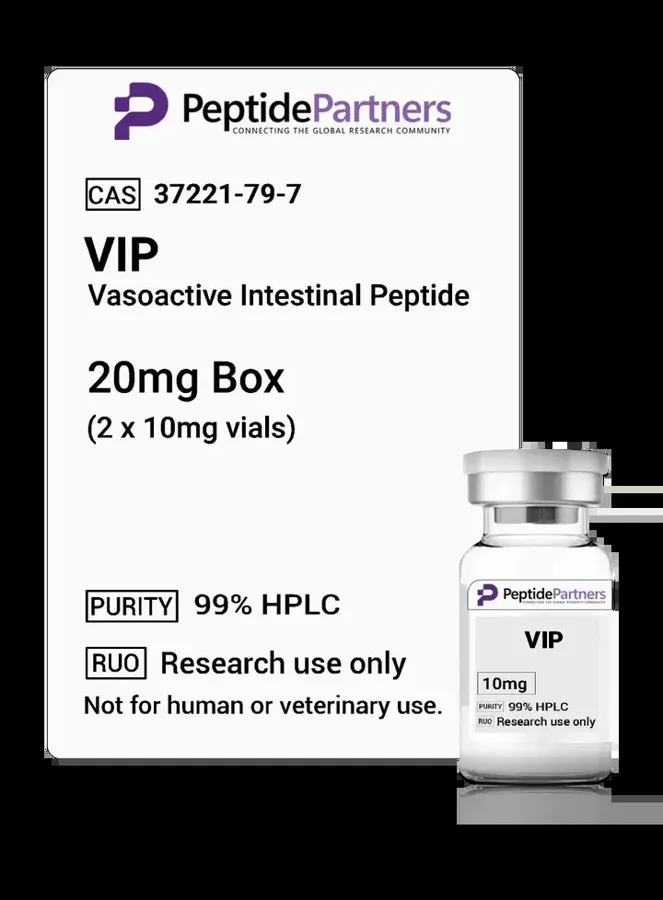
Available packs
VIP
$150 - $990
Buy VIP (10mg vials) from Peptides Partners
Vasoactive Intestinal Peptide (VIP) is an essential 28-amino-acid regulatory neuropeptide widely investigated across molecular biology, neurobiology, and cardiovascular physiology. For investigators seeking consistent, high-grade reagents to maintain assay reproducibility, Peptides Partners supplies solid-phase synthesized VIP packaged in robust 10mg lyophilized vials. When you buy VIP for your laboratory, having access to precisely measured, standardized aliquots is critical to maintaining uniform concentrations across multi-well plates, tissue bath apparatuses, and receptor binding assays.
At Peptides Partners, our catalog is curated exclusively for academic institutions, contract research organizations (CROs), and biotechnology laboratories requiring dependable research peptides. The 10mg vial format of VIP provides an optimal mass balance for modern laboratory operations, offering enough material to prepare concentrated stock solutions while minimizing the degradation risks associated with repeated container access. Whether your team is investigating VIP receptor pharmacology, microvascular tone, or downstream cyclic adenosine monophosphate (cAMP) secondary messenger signaling, our platform delivers the reliability required for peer-reviewed scientific discovery.
Securing research peptides from a specialized vendor ensures that your experimental workflows benefit from predictable physical properties, controlled synthesis profiles, and minimal lot-to-lot variance. Investigators can buy VIP through our streamlined catalog with volume options suited for both exploratory pilot projects and large-scale, automated screening protocols.
What is VIP?
Vasoactive Intestinal Peptide (VIP), registered under Chemical Abstracts Service (CAS) registry number 37221-79-7, is a naturally occurring basic peptide consisting of 28 amino acid residues with a amidated C-terminus. The exact canonical sequence of VIP is H-His-Ser-Asp-Ala-Val-Phe-Thr-Asp-Asn-Tyr-Thr-Arg-Leu-Arg-Lys-Gln-Met-Ala-Val-Lys-Lys-Tyr-Leu-Asn-Ser-Ile-Leu-Asn-NH2, corresponding to an approximate empirical molecular formula of C147H238N44O42S and a theoretical monoisotopic molecular weight of approximately 3325.8 Da.
Originally isolated in 1970 from porcine intestinal tissue by Sami Said and Viktor Mutt, VIP belongs to the secretin-glucagon superfamily of peptide hormones. This structural family also includes pituitary adenylate cyclase-activating polypeptide (PACAP), secretin, growth hormone-releasing hormone (GHRH), and glucagon. Within biological systems, VIP is synthesized as part of a larger 170-amino acid prepro-VIP precursor molecule, which undergoes sequential post-translational enzymatic cleavage and alpha-amidation to yield the fully functional 28-residue peptide along with peptide histidine isoleucine (PHI) or peptide histidine methionine (PHM).
In pharmacological and physiological research, VIP is recognized as a non-adrenergic, non-cholinergic (NANC) neurotransmitter and neuroendocrine mediator. Its biological actions are mediated through high-affinity interactions with two primary class B secretin-like G-protein coupled receptors (GPCRs): VPAC1 and VPAC2. Furthermore, VIP exhibits low-affinity cross-reactivity with the PAC1 receptor, which preferentially binds PACAP. Binding of VIP to VPAC1 or VPAC2 predominantly activates the stimulatory G-protein subunit (Gs), triggering adenylate cyclase activation and a subsequent intracellular surge of cyclic AMP (cAMP), which subsequently phosphorylates protein kinase A (PKA) and down-stream transcriptional factors such as CREB.
Research effects studied
Because of its widespread expression throughout the central nervous system, enteric nervous system, and immune system, VIP has been studied in preclinical research across multiple specialized domains:
- Vascular Tone and Hemodynamic Regulation: In vascular research models, VIP has been studied extensively for its role as a potent vasodilator. Preclinical tissue bath preparations and perfused organ systems demonstrate that VIP induces vascular smooth muscle relaxation through both endothelium-dependent pathways (mediated by nitric oxide release) and direct cAMP-mediated smooth muscle cell hyperpolarization. Research has focused on mapping its activity across peripheral, mesenteric, coronary, and pulmonary arterial beds.
- Pulmonary and Respiratory Research: Investigations using isolated tracheal and bronchial rings have explored VIP as an endogenous smooth muscle relaxant. VIP has been studied in preclinical models of pulmonary arterial hypertension (PAH) and inflammatory airway responsiveness, where scientists investigate its capacity to counterbalance vasoconstrictive and bronchoconstrictive stimuli such as endothelin-1 and leukotrienes.
- Enteric Physiology and Mucosal Secretion: Within gastrointestinal research, VIP serves as a classical model peptide for understanding non-adrenergic, non-cholinergic relaxation of the lower esophageal, pyloric, and internal anal sphincters. Preclinical cell culture models utilizing intestinal epithelial monolayers (such as T84 or Caco-2) frequently use VIP to study the activation of the cystic fibrosis transmembrane conductance regulator (CFTR) and active chloride/water secretion.
- Immunomodulation and Cytokine Networks: In immunological investigations, VIP has been evaluated for its interactions with T-lymphocytes, dendritic cells, and macrophages, which naturally express both VPAC1 and VPAC2 receptors. Published literature indicates that VIP has been studied in vitro for its ability to shift macrophage phenotypes from pro-inflammatory (M1) toward regulatory or anti-inflammatory (M2) profiles, typically measured via the suppression of tumor necrosis factor-alpha (TNF-alpha), interleukin-6 (IL-6), and interleukin-12, alongside the upregulation of interleukin-10.
- Neuroprotection and Circadian Biology: In neurobiological models, VIP expression within the suprachiasmatic nucleus (SCN) of the hypothalamus has made it a principal target for circadian rhythm entrainment research. Scientists study VIP’s capacity to synchronize individual neuronal pacemakers across the SCN network. Additionally, in primary neuronal and microglial co-cultures, VIP has been evaluated for neuroprotective properties against microglial activation, oxidative stressors, and excitotoxic insults.
How to use in the laboratory
The handling of VIP (10mg vials) requires standard chemical biology protocols to ensure integrity, solubility, and quantitative accuracy across analytical assays. This material is sold exclusively for in vitro and laboratory research applications; it is strictly not for human or animal consumption, diagnostic use, or clinical treatment.
When preparing VIP for laboratory experiments, follow these validated handling principles:
- Aseptic Reconstitution Technique: Before removing the crimped aluminum seal and elastomer stopper, allow the lyophilized vial to equilibrate to room temperature (20°C to 25°C) within a desiccator for approximately 20 to 30 minutes. This prevents ambient moisture from condensing onto the hygroscopic peptide cake. Reconstitute using an appropriate, sterile laboratory solvent such as sterile deionized water, bacteriostatic water, or sterile phosphate-buffered saline (PBS, pH 7.2–7.4). For basic peptides like VIP, neutral aqueous solutions are generally sufficient for rapid solubilization at concentrations between 1.0 mg/mL and 10.0 mg/mL.
- Minimizing Surface Adsorption: Peptides of this molecular weight and amphipathic structure exhibit a recognized tendency to non-specifically adsorb onto conventional glass and hydrophobic polypropylene surfaces. To ensure accurate working concentrations, investigators often utilize low-binding polypropylene microcentrifuge tubes and pipette tips. In binding or cell-based assays, research protocols frequently incorporate non-reactive carrier proteins, such as 0.1% Bovine Serum Albumin (BSA), into the working dilution buffer to prevent peptide loss.
- Aliquot Strategy: Reconstituted stock solutions should be immediately partitioned into single-use volumetric aliquots based on daily or weekly assay requirements. Avoid subjecting reconstituted peptide solutions to repetitive freeze-thaw cycles, which introduce shear stress, denature tertiary confirmations, and accelerate peptide cleavage.
- Laboratory Record-Keeping: Record the date of reconstitution, solvent lot, final nominal concentration, and assigned internal lot number directly on both the storage container and the institutional electronic laboratory notebook (ELN). Spectrophotometric quantification at 280 nm (leveraging the absorbance of Tyrosine residues at positions 10 and 22) or standard bicinchoninic acid (BCA) protein assays may be employed to empirically confirm solution concentrations prior to critical assay runs.
Pack sizes and price per mg
Peptides Partners provides tiered volume purchasing options for VIP (10mg vials), allowing laboratories to scale their inventory economically based on the duration and scope of their research programs. Purchasing multi-vial packs significantly reduces the effective cost per milligram while providing independent, sealed units that protect the bulk inventory from repeated atmospheric exposure.
| Pack Option | Total Quantity (mg) | Total Price (USD) | Effective Price per mg (USD) |
|---|---|---|---|
| 2 vials x 10mg | 20 mg | $150 | $7.50 / mg |
| 5 vials x 10mg | 50 mg | $330 | $6.60 / mg |
| 10 vials x 10mg | 100 mg | $560 | $5.60 / mg |
| 20 vials x 10mg | 200 mg | $990 | $4.95 / mg |
As demonstrated in the table, laboratories scaling from an entry-level evaluation pack (2 vials) to an institutional screening quantity (20 vials) realize substantial savings per milligram, ensuring cost efficiency for recurring receptor-ligand binding kinetics, organ bath pharmacological assays, and high-throughput cell culture models.
Storage and handling
To preserve the structural integrity and biological potency of VIP, rigorous environmental controls must be maintained during storage:
- Lyophilized Peptide Storage: The lyophilized powder is stable at room temperature for brief periods during transit, but should be placed into long-term storage immediately upon arrival. For optimal stability, store sealed vials at -20°C. For extended storage exceeding six months, storage at -80°C in a manual defrost (non-frost-free) freezer is recommended to prevent temperature fluctuations. Keep the vials protected from direct light exposure and store alongside desiccant packets to prevent hydrolytic degradation.
- Reconstituted Solution Storage: Once dissolved, aqueous solutions of VIP should be maintained at 2°C to 8°C for no longer than 24 to 48 hours for immediate use. For longer retention, aliquoted solutions must be stored at -20°C or -80°C. Under these conditions, aliquots generally remain stable for up to several months.
- Oxidation Precautions: VIP contains a methionine residue at position 17 (Met17), which is susceptible to chemical oxidation into methionine sulfoxide under exposure to atmospheric oxygen or transition metal catalysts. In sensitive binding or structural experiments, investigators may consider purging dilution buffers with an inert gas (such as nitrogen or argon) or incorporating trace antioxidants if permitted by the specific assay design.
Quality and documentation
Research reproducibility depends heavily on the chemical definition of the peptides utilized in experimental systems. Vasoactive Intestinal Peptide sourced from Peptides Partners is synthesized via automated solid-phase peptide synthesis (SPPS), followed by preparative reverse-phase high-performance liquid chromatography (RP-HPLC) purification to isolate the target sequence from incomplete deletion sequences.
Each production lot is subjected to rigorous analytical verification, including analytical RP-HPLC to confirm chromatographic profile and purity, alongside electrospray ionization mass spectrometry (ESI-MS) or matrix-assisted laser desorption/ionization time-of-flight (MALDI-TOF) mass spectrometry to confirm exact molecular weight against theoretical calculations. Standard safety documentation, including a Safety Data Sheet (SDS) and lot-specific Certificate of Analysis (CoA), is available to support institutional biosafety, compliance, and auditing protocols.
Frequently asked questions
What is the molecular weight and CAS number of VIP?
Vasoactive Intestinal Peptide (VIP) possesses a theoretical molecular mass of approximately 3325.8 Da and is officially cataloged under CAS registry number 37221-79-7. Its chemical formulation comprises a continuous 28-amino-acid chain ending with an amidated C-terminus, which is required for full biological affinity at the VPAC receptor family.
What receptor pathways are typically investigated using VIP in vitro?
In vitro and cell culture studies primarily utilize VIP to investigate class B GPCR activation, specifically via the VPAC1 and VPAC2 receptor subtypes. Researchers assess downstream intracellular signaling mechanisms, including adenylate cyclase induction, cyclic AMP (cAMP) accumulation, protein kinase A (PKA) activation, and subsequent transcriptional modulation. VIP is also studied for its low-affinity cross-talk with the PACAP-selective PAC1 receptor.
What reconstitution solvents are recommended for laboratory research with VIP?
VIP is readily soluble in sterile deionized water, bacteriostatic water, and neutral physiological buffers such as phosphate-buffered saline (PBS, pH 7.2–7.4). Because peptides can adhere non-specifically to untreated container walls, preparing stock solutions in low-retention tubes or adding a compatible carrier protein like 0.1% BSA is commonly adopted in research protocols.
Is VIP provided by Peptides Partners intended for clinical or diagnostic use?
No. VIP supplied by Peptides Partners is strictly sold as a research-use-only (RUO) biochemical for in vitro laboratory investigations, pharmacological modeling, and preclinical experiments. It is not approved, licensed, or formulated for human or veterinary administration, medical treatment, therapeutic intervention, or clinical diagnostics.
Related Peptides Partners research peptides
Z's Total B Kit (10mL vials); 5-Amino-1MQ (50mg vials); GHK-Cu (100mg vials).
VIP lot documentation
Certificates of analysis are matched to the actual lot supplied with your order. Email sales@peptidespartners.co with the product name and pack size to request the current lot's purity, identity and screening documents before purchase.
Storage
Research peptides are typically supplied lyophilized (freeze-dried), which keeps them stable for shipping and storage. Store unopened vials cool, dry and away from light; for long-term storage, a freezer is generally recommended.
After reconstitution, keep vials refrigerated and use sterile laboratory technique. Follow the handling guidance supplied with your lot documentation.
- Short name
- VIP (10mg vials)
- Vial strength
- 10mg vials
- Pack sizes
- 20mg pack, 50mg pack, 100mg pack, 200mg pack
- Pack count options
- 2, 5, 10, 20 vial packs
- CAS number
- 37221-79-7
- Category
- Vasoactive
- SKU
- PP-924
- Compliance
- Research Use Only. Not for use in diagnostic tests.