
Sermorelin
10mg per vial
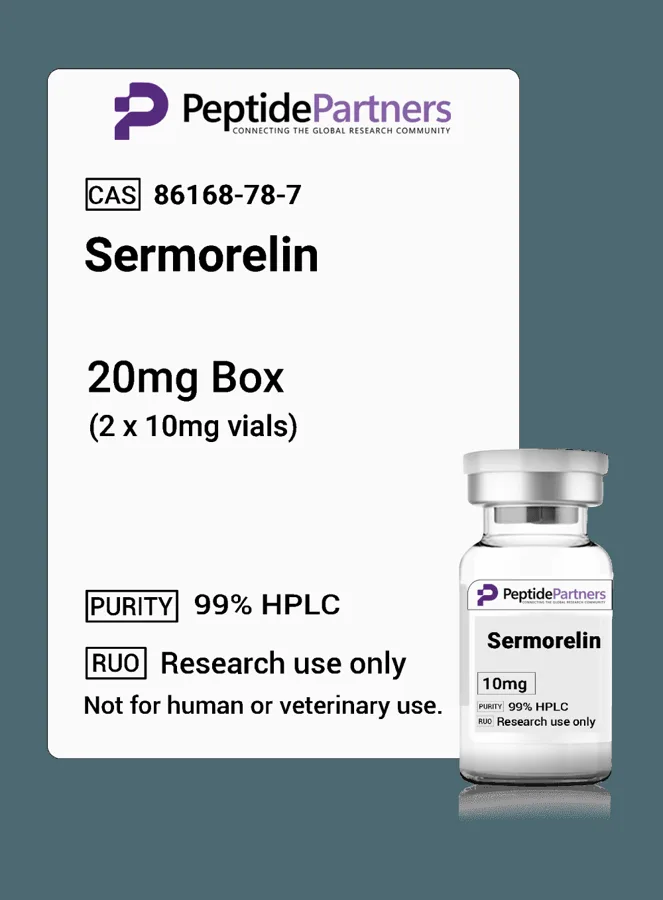
Available packs
Sermorelin
$98 - $797
Buy Sermorelin (10mg vials) from Peptides Partners
Sermorelin acetate (CAS: 86168-78-7) represents one of the most comprehensively evaluated growth hormone-releasing factor analogues within modern neuroendocrine and metabolic research. Formulated as a high-integrity, lyophilized powder in individual 10mg vials, this peptide provides investigators with an essential reagent for probing the somatotropic axis, receptor kinetics, and downstream cellular signaling. When scientific institutions, universities, and independent laboratories seek to buy Sermorelin for in vitro, ex vivo, or animal model studies, Peptides Partners delivers an uncompromising standard of chemical stability, verifiable analytical consistency, and streamlined logistical support.
As the metabolic category within peptide science continues to expand, maintaining experimental reproducibility requires reagents that conform strictly to analytical expectations. Variations in synthesis, residual counterions, or improper handling can introduce confounding variables into sensitive assays. At Peptides Partners, our catalog of research peptides is curated specifically to meet the rigorous demands of contemporary biochemical investigations. By sourcing Sermorelin 10mg vials through Peptides Partners, research teams secure a biologically intact analogue designed solely for controlled scientific investigation, ensuring that baseline measurements and stimulated responses reflect true physiological and cellular phenomena rather than reagent degradation.
What is Sermorelin?
Sermorelin, chemically designated as GRF (1-29) amide or GHRH (1-29), is a synthetic truncated peptide derived from native human Growth Hormone-Releasing Hormone (GHRH). Whereas endogenous GHRH exists predominantly as a 44-amino acid peptide chain, structural and functional mapping studies demonstrated that the bioactivity of the full-length hormone is fully retained within its first 29 N-terminal amino acids. Sermorelin corresponds exactly to this sequence:
Tyr-Ala-Asp-Ala-Ile-Phe-Thr-Asn-Ser-Tyr-Arg-Lys-Val-Leu-Gly-Gln-Leu-Ser-Ala-Arg-Lys-Leu-Leu-Gln-Asp-Ile-Met-Ser-Arg-NH2
With an empirical molecular formula of C149H246N44O42S and a molecular weight of approximately 3357.9 g/mol, the peptide features an amidated C-terminus, which protects it against rapid carboxypeptidase-mediated degradation in experimental media. Sermorelin operates as a selective and potent agonist at the GHRH receptor (GHRHR), a class B G-protein-coupled receptor located primarily on the cell surfaces of anterior pituitary somatotrophs.
Upon ligand-receptor binding, Sermorelin activates the adenylate cyclase pathway through the stimulatory G-protein (Gs) alpha subunit. This cascade catalyzes the conversion of adenosine triphosphate (ATP) to cyclic adenosine monophosphate (cAMP). Elevated intracellular cAMP subsequently engages protein kinase A (PKA), which phosphorylates specific transcription factors, such as the cAMP response element-binding protein (CREB). This signaling pathway stimulates both the transcription of the growth hormone gene and the influx of extracellular calcium via voltage-dependent L-type calcium channels, triggering the exocytosis of pre-stored secretory granules containing growth hormone (GH).
A critical characteristic of Sermorelin in research models is its preservation of physiological negative feedback mechanisms. Unlike direct secretagogues, somatotroph responsiveness to Sermorelin remains subject to attenuation by somatostatin (growth hormone-inhibiting hormone) and elevated circulating levels of insulin-like growth factor 1 (IGF-1), making it a valuable target for exploring autonomous versus regulated endocrine feedback loops.
Research effects studied
Sermorelin has been the subject of extensive peer-reviewed literature across clinical endocrinology, gerontology, cellular biochemistry, and functional physiology. Because it preserves normal regulatory loops, researchers frequently deploy it to elucidate mechanisms that govern endocrine maintenance, metabolic balance, and cellular longevity.
- Somatotroph Function and Secretory Dynamics: A primary area of preclinical and clinical research involves utilizing Sermorelin to measure pituitary reserve capacity. Because it directly challenges the GHRH receptor, researchers can delineate whether deficiencies in downstream hormonal pathways stem from hypothalamic dysfunction (insufficient endogenous GHRH release) or primary pituitary insensitivity. Its transient, pulsatile stimulation pattern enables investigators to model physiological secretory rhythms without overwhelming the receptor apparatus or inducing rapid receptor desensitization.
- Metabolic Pathway Regulation and Adiposity: In metabolic investigations, Sermorelin has been studied for its influence on carbohydrate and lipid metabolism. Downstream elevations in growth hormone activity initiate lipolysis in adipose tissue by upregulating hormone-sensitive lipase while simultaneously attenuating lipid accumulation via lipoprotein lipase inhibition. Animal models evaluated with Sermorelin have displayed shifts in body composition, characterized by enhanced lean tissue accretion, accelerated lipid substrate oxidation, and alterations in hepatic glucose output.
- Cellular Proliferation and Tissue Remodeling: Beyond pure endocrine dynamics, the GHRH-GHRHR axis has garnered significant interest in the context of wound repair and myocardial tissue remodeling. Preclinical studies examining ischemic cardiac models have explored whether GHRH agonists like Sermorelin possess cardioprotective properties. Findings indicate that receptor activation on non-pituitary cells can attenuate post-infarct remodeling, reduce pathological fibrosis, and support cell survival through anti-apoptotic signaling cascades independent of systemic GH release.
- Neuroendocrine Aging and Senescence: The natural decline of the somatotropic axis—often referred to in the literature as the somatopause—is characterized by progressive reductions in GH and IGF-1 secretion, accompanied by sleep fragmentation, bone mineral loss, and decreased protein synthesis. Research models have utilized Sermorelin to examine whether targeted hypothalamic-pituitary stimulation can safely restore youthful endocrine profiles without provoking the adverse cellular changes often linked to chronic, supraphysiological levels of synthetic growth hormone.
- Sleep Architecture and Central Nervous System Interactions: In neurobiological research, GHRH and its functional analogues have been investigated for their reciprocal interactions with sleep-wake cycles, specifically the induction and maintenance of slow-wave (delta) sleep. Administration of GHRH analogues in controlled laboratory environments has shown correlations with enhanced non-rapid eye movement (NREM) sleep stages, illustrating a bidirectional communication channel between hypothalamic sleep centers and the endocrine system.
How to use in the laboratory
Appropriate handling of Sermorelin 10mg requires meticulous attention to peptide chemistry principles. Lyophilized peptides are susceptible to chemical and physical degradation when exposed to improper solvents, erratic temperature changes, or mechanical agitation. The following protocols are designed strictly for laboratory preparation, reconstitution, and analytical record-keeping.
Prior to reconstituting the 10mg vial, allow the container to equilibrate to ambient room temperature (approximately 20°C to 25°C) inside a laminar flow cabinet or clean laboratory bench. Opening a cold vial exposes the lyophilized cake to atmospheric condensation, which can introduce moisture and initiate spontaneous hydrolysis.
- Solvent Selection: Reconstitution should be performed using an appropriate laboratory diluent, such as sterile Bacteriostatic Water (containing 0.9% benzyl alcohol) for multi-use analytical workflows, or sterile 0.9% Sodium Chloride injection grade solution. The choice of solvent must align with the analytical assay or culture system being employed.
- Reconstitution Mechanics: Using a sterile laboratory syringe, slowly introduce the diluent along the inner glass wall of the vial. Avoid spraying the liquid directly onto the lyophilized powder cake, as violent hydration can disrupt peptide tertiary characteristics.
- Dissolution: Gently swirl the vial with a circular motion until the cake dissolves completely into a clear, colorless solution. Do not shake or vortex vigorously; mechanical shear stress can promote peptide aggregation, unfolding, or precipitation.
- Aliquoting: If the reconstituted peptide will not be consumed within a single experimental protocol, divide the solution into single-use, low-binding microcentrifuge tubes to prevent repeated freeze-thaw cycles.
- Record-Keeping: Maintain an exhaustive log containing the vial lot number, reconstitution date, precise volume and type of solvent added, resulting concentration (e.g., mg/mL), and technician initials. Affix clear labeling indicating “For Research Use Only” and clearly display the calculated expiration window based on storage conditions.
Pack sizes and price per mg
To support a wide spectrum of research budgets and experimental timelines—ranging from brief pilot assays to longitudinal animal studies—Peptides Partners offers Sermorelin 10mg vials across four scaled pack sizes. Bulk configurations reduce procurement friction while yielding significant cost savings per unit of active compound.
| Pack Size | Total Content | Price (USD) | Price per Milligram |
|---|---|---|---|
| 2 vials x 10mg | 20 mg | $98.00 | $4.90 / mg |
| 5 vials x 10mg | 50 mg | $212.00 | $4.24 / mg |
| 10 vials x 10mg | 100 mg | $411.00 | $4.11 / mg |
| 20 vials x 10mg | 200 mg | $797.00 | $3.99 / mg |
When selecting the appropriate quantity to buy Sermorelin, investigators should balance their anticipated monthly solvent reconstitution rate against the total mass required to execute standardized research protocols without mid-study batch discrepancies.
Storage and handling
Maintaining the structural stability of Sermorelin is critical for preserving target receptor binding affinities and reproducible bioactivity. The peptide should be stored in environments that strictly limit exposure to heat, light, and ambient moisture.
- Lyophilized State: Upon delivery, intact vials of lyophilized Sermorelin should be stored at -20°C for long-term stability (up to 24 months). If sub-zero freezers are temporarily unavailable, the lyophilized material remains stable at standard refrigerated temperatures (2°C to 8°C) for several weeks, provided the container seal is intact and kept out of direct sunlight. Desiccant packs are recommended inside primary storage enclosures.
- Reconstituted Solution: Once dissolved, Sermorelin becomes significantly more vulnerable to thermal degradation, deamidation of asparagine/glutamine residues, and oxidation of the methionine residue at position 27. Store the reconstituted liquid strictly between 2°C and 8°C. For bacteriostatic solutions, experimental utility is generally maintained for up to 21 to 28 days under strict refrigeration. Solutions prepared without preservatives must be consumed immediately or aliquoted and frozen.
- Freeze-Thaw Prevention: Aliquots frozen at -20°C or -80°C should only be thawed once. Multiple freeze-thaw cycles cause repeated ice crystal formation that shears peptide chains, resulting in irreversible conformational denaturation and reduced assay potency.
Quality and documentation
Peptides Partners treats chemical transparency and rigorous quality verification as primary pillars of modern scientific supply. Every synthesis of Sermorelin undergoes standard analytical verification protocols to confirm sequence integrity, chemical purity, and net peptide content.
Quality parameters are systematically assessed via High-Performance Liquid Chromatography (HPLC) and Mass Spectrometry (MS). Reversed-phase HPLC traces confirm chromatographic homogeneity, ensuring the absence of truncated deletion sequences, persistent protecting groups, or synthetic byproducts. Electrospray Ionization Mass Spectrometry (ESI-MS) or Matrix-Assisted Laser Desorption/Ionization (MALDI-TOF) confirms that the observed molecular weight corresponds exactly with the theoretical molecular mass of 3357.9 g/mol.
Detailed Certificates of Analysis (COA) accompany every production lot, supplying laboratory directors with the precise data needed for institutional review compliance, internal record-keeping, and audit readiness. Sourcing research peptides through Peptides Partners ensures that your laboratory operates with fully characterized, verified reagents designed to sustain the highest standards of scientific reproducibility.
Frequently asked questions
What is the structural difference between Sermorelin and native GHRH?
Native human GHRH is a 44-amino acid polypeptide secreted by the arcuate and ventromedial nuclei of the hypothalamus. Sermorelin represents the truncated 1-29 sequence of this endogenous hormone, with an amidated C-terminus. Research has proven that the biological activity, receptor affinity, and signal transduction capabilities of full-length GHRH reside fully within these first 29 residues. The deletion of residues 30 through 44 does not compromise bioactivity, but it does yield a shorter peptide that is more chemically stable and cost-effective to synthesize via solid-phase peptide synthesis (SPPS).
What diluents are suitable for reconstituting Sermorelin in vitro?
The standard diluents for reconstituting Sermorelin are sterile Bacteriostatic Water (containing 0.9% benzyl alcohol) and sterile 0.9% Sodium Chloride (saline) solution. If the peptide is intended for sensitive cellular culture systems where antimicrobial preservatives may cause cytotoxicity, sterile Water for Injection (WFI) or physiological buffers such as Phosphate-Buffered Saline (PBS) can be used. However, preservative-free solutions should be used immediately or frozen in single-use aliquots to avoid microbial proliferation.
How does Sermorelin interact with the GHRH receptor signaling cascade?
Sermorelin acts as a selective agonist at the G-protein coupled GHRH receptor located on pituitary somatotrophs. Ligand binding activates the Gs alpha subunit, stimulating adenylate cyclase to convert ATP to cAMP. This rise in secondary messenger cAMP activates protein kinase A (PKA), which triggers phosphorylation events—such as CREB activation—that stimulate growth hormone gene transcription. Simultaneously, the pathway induces the opening of voltage-sensitive calcium channels, allowing an influx of extracellular calcium that facilitates the fusion and exocytosis of growth hormone storage granules.
Why is Sermorelin supplied in a lyophilized format?
Peptides in aqueous solution are constantly exposed to hydrolytic degradation pathways, including deamidation, oxidation, and cleavage of sensitive peptide bonds. Lyophilization (freeze-drying) removes virtually all water from the compound while it is frozen under a high vacuum, locking the peptide into a stable, solid matrix. This dry cake prevents degradation and bacterial growth, allowing the compound to be safely stored and shipped at room temperature for brief periods without losing chemical potency.
Related Peptides Partners research peptides
SS-31 (10mg vials); Z's Total B Kit (10mL vials); Cagrilintide (10mg vials).
Sermorelin lot documentation
Certificates of analysis are matched to the actual lot supplied with your order. Email sales@peptidespartners.co with the product name and pack size to request the current lot's purity, identity and screening documents before purchase.
Storage
Research peptides are typically supplied lyophilized (freeze-dried), which keeps them stable for shipping and storage. Store unopened vials cool, dry and away from light; for long-term storage, a freezer is generally recommended.
After reconstitution, keep vials refrigerated and use sterile laboratory technique. Follow the handling guidance supplied with your lot documentation.
- Short name
- Sermorelin (10mg vials)
- Vial strength
- 10mg vials
- Pack sizes
- 20mg pack, 50mg pack, 100mg pack, 200mg pack
- Pack count options
- 2, 5, 10, 20 vial packs
- CAS number
- 86168-78-7
- Category
- Metabolics
- SKU
- PP-3151
- Compliance
- Research Use Only. Not for use in diagnostic tests.