
PEPTIDES PARTNERS BLOG · November 11, 2026
The Research Science of TB-500: Exploring Actin Regulation and Cellular Repair Pathways
In the field of regenerative biochemistry, research into cellular motility and matrix restoration has increasingly focused on endogenous peptide fragments. Among these, TB-500 has garnered significant interest within preclinical literature. Chemically related to the naturally occurring peptide Thymosin Beta-4 (Tβ4), TB-500 represents an abbreviated, synthetic derivative designed to encapsulate the primary functional domain of its parent molecule. Investigated predominantly in cell cultures and animal models, this compound serves as a foundational tool for laboratories exploring tissue remodeling, cytoskeletal reorganization, and angiogenic signaling.
This overview outlines the historical identification of Thymosin Beta-4, the molecular pathways targeted by TB-500, its primary investigative applications, and standard analytical considerations researchers must observe when sourcing research-grade materials from Peptides Partners.
History of Discovery: From Thymic Extracts to Sequence Mapping
The lineage of TB-500 traces back to the mid-1960s during investigations into thymic endocrinology. Researchers Dr. Allan L. Goldstein and Dr. Abraham White isolated crude bovine thymic extracts (initially termed Thymosin Fraction 5) to determine whether the thymus gland functioned as an endocrine organ capable of controlling immune responsiveness. Subsequent fractionation in the late 1970s and early 1980s revealed distinct polypeptide families, categorized by their isoelectric points into alpha, beta, and gamma thymosins.
Thymosin Beta-4 emerged as the most abundant member of the beta-thymosin family, comprising 43 amino acids. While initially studied for its immunomodulatory properties, subsequent studies demonstrated that Tβ4 was ubiquitous in mammalian tissue, exhibiting exceptionally high concentrations in blood platelets, wound fluid, and circulating leukocytes. Through structural mapping, investigators isolated the central bio-active region—specifically the amino acid sequence spanning residues 17 to 23 (often identified as the LKKTET motif). This sequence was identified as the critical site responsible for actin-binding activity. TB-500 was developed as a synthetic analog centering on this functional sequence, offering a targeted molecular structure for in vitro and animal models investigating cellular locomotion and tissue repair dynamics.
Molecular Mechanisms Investigated in Preclinical Studies
The cellular functions attributed to TB-500 revolve around its modulation of the cytoskeleton and its interaction with extracellular signaling cascades. Rather than acting as a structural extracellular matrix protein, TB-500 operates intracellularly and paracrinely through several distinct mechanisms:
1. Actin Sequestration and Cytoskeletal Dynamics
The primary established mechanism of the Tβ4 active domain is its role as an actin-monomer-sequestering protein. In eukaryotic cells, the dynamic equilibrium between monomeric globular actin (G-actin) and polymeric filamentous actin (F-actin) dictates cell shape, division, and movement. TB-500 binds G-actin in a 1:1 stoichiometry. By maintaining a soluble pool of unpolymerized G-actin, it allows rapid filament assembly at the leading edge of migrating cells in response to chemotactic stimuli, accelerating the motility of essential repair cells including fibroblasts, endothelial cells, and keratinocytes.
2. Upregulation of Angiogenic Factors
Preclinical models examining vascular biology have noted that the functional domain of Tβ4 stimulates endothelial cell migration and promotes the formation of capillary-like structures. In vitro assays demonstrate that exposure to these peptide sequences can modulate vascular endothelial growth factor (VEGF) expression and matrix metalloproteinases (MMPs), facilitating the enzymatic degradation of basement membranes required for new vascular sprouting.
3. Modulation of Inflammatory Cytokines
Investigations into cellular stress responses have analyzed the peptide’s capacity to downregulate specific pro-inflammatory cascades. Research models have demonstrated that exposure to Tβ4 derivatives can inhibit the nuclear translocation of nuclear factor-kappa B (NF-κB), a primary transcription factor governing the expression of tumor necrosis factor-alpha (TNF-α), interleukin-1 beta (IL-1β), and interleukin-6 (IL-6).
Primary Areas of Laboratory Investigation
Preclinical researchers utilize TB-500 across a spectrum of physiological and pathological models, focusing on how cellular repair pathways operate under induced conditions:
- Dermal and Epithelial Wound Healing: In vitro scratch assays and rodent punch-biopsy studies analyze the rate of re-epithelialization, collagen deposition, and wound contraction when treated with actin-sequestering fragments.
- Musculoskeletal and Tendon Biology: Researchers examine collagen synthesis (specifically the ratio of Type I to Type III collagen), tenocyte proliferation, and tensile strength recovery in experimental models of tendon and ligament disruption.
- Myocardial Ischemia Models: Laboratory investigations study whether localized administration following hypoxia preserves cardiomyocyte viability, limits fibrotic scar thickness, and mobilizes cardiac progenitor cells.
- Ocular Surface Integrity: Murine corneal chemical burn and desiccation models are used to evaluate how TB-500 supports corneal re-epithelialization and suppresses damaging localized inflammation.
Comparative Summary: Investigational Domains
| Research Category | Target Mechanisms | Key Model Systems |
|---|---|---|
| Cytoskeletal Motility | G-actin sequestration, lamellipodia formation | Fibroblast and keratinocyte migration assays |
| Angiogenesis | Endothelial proliferation, MMP/VEGF activation | HUVEC tube formation, rodent vascular models |
| Tissue Fibrosis | Modulation of TGF-β, myofibroblast differentiation | Cardiovascular, renal, and dermal injury models |
| Inflammatory Signaling | Suppression of NF-κB nuclear translocation | Macrophage and leukocyte activation assays |
Laboratory Handling, Reconstitution, and Storage
TB-500 is supplied as a lyophilized (freeze-dried) powder to maintain molecular integrity during transport. Lyophilized peptides generally demonstrate thermal stability at ambient room temperatures for transient periods, but long-term laboratory preservation requires storage at -20°C or lower in a desiccation chamber to prevent moisture-induced degradation.
For experimental application, reconstitution is typically performed using sterile, non-pyrogenic laboratory solvents, such as Bacteriostatic Water or physiological saline solution, depending on the requirements of the specific experimental assay. Due to the delicate nature of peptide bonds, reconstitution protocols emphasize gentle swirling rather than aggressive mechanical agitation to prevent denaturation. Following reconstitution, peptide solutions are maintained at 2°C to 8°C for immediate experimental use or aliquoted and stored at -80°C to avoid repeated freeze-thaw cycles, which degrade the peptide chain.
Sourcing Research Peptides: Documentation and Pack Configurations
When procuring TB-500 from the Peptides Partners catalog, laboratories must evaluate physical configurations and analytical documentation to ensure reproducible experimental data:
Assessing Analytical Documentation
Scientific rigor requires verified purity and sequence identity. Researchers should verify that analytical documentation accompanying the peptide includes:
- High-Performance Liquid Chromatography (HPLC): Confirms chemical purity by identifying and quantifying any residual truncated sequences or chemical impurities.
- Mass Spectrometry (MS / LC-MS): Confirms the exact molecular weight of the peptide, verifying that the synthesized chain precisely matches the theoretical mass of the intended sequence.
Evaluating Vial Configurations
Study design dictates the most appropriate packaging format. Peptides Partners provides various vial capacities and multi-vial packs to align with laboratory workflows:
- Single-Vial Configurations: Best suited for pilot projects, solubility confirmation, or initial cell-viability titrations where minimal material is consumed.
- Multi-Vial Packs (5-Pack or 10-Pack): Essential for longitudinal in vivo studies or high-throughput screening. Multi-vial sets ensure that researchers can draw from a single, uniform production lot, minimizing inter-assay variability across experimental cohorts while allowing individual vials to remain sealed until needed.
Regulatory Status and Intended Use
TB-500 is synthesized strictly for in vitro laboratory experimentation, scientific research, and academic inquiry. It has not been approved by the United States Food and Drug Administration (FDA) or other international health authorities for human consumption, clinical application, or therapeutic use. The compound must not be introduced into humans or animals outside of approved institutional protocols, and it is distributed exclusively to qualified researchers and institutional laboratories.
Where to buy TB-500 for research
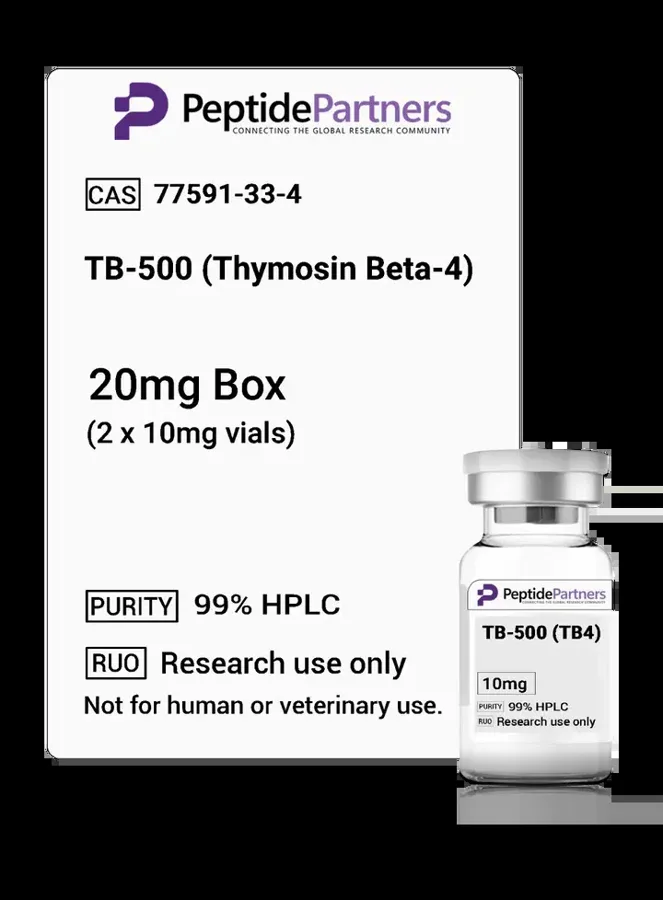
Peptides Partners lists TB-500 (Thymosin Beta-4) TB4, 10mg vials in 3 pack sizes, all in stock, with price per mg shown for each option. Browse more cellular repair compounds in the Peptides Partners research peptide shop. All products are for laboratory research use only.