
PEPTIDES PARTNERS BLOG · November 11, 2026
The Research Science of Retatrutide: Understanding Triple Agonism in Metabolic Research
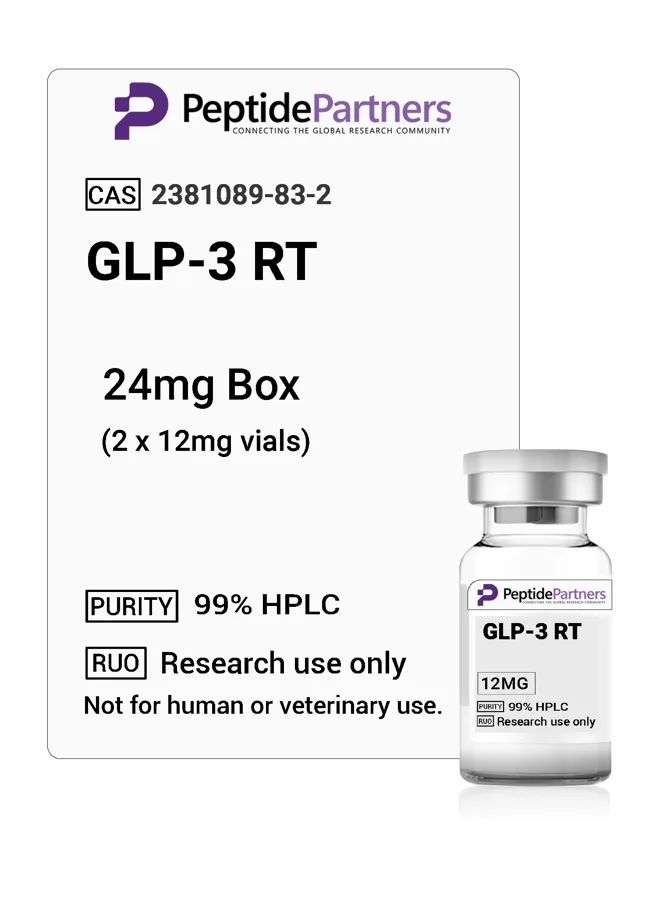
The study of metabolic regulation has advanced rapidly over the past two decades, transitioning from traditional mono-target interventions to multi-receptor peptide complexes. Central to this scientific evolution is the emergence of triple-agonist peptides, frequently referred to in exploratory literature under designations such as triple incretin mimetics or “GLP-3” agonists. Among these compounds, retatrutide (development code LY3437943) has emerged as a significant focus for researchers exploring physiological pathways governing glucose balance, substrate utilization, and energy expenditure.
The Scientific Evolution: From Single to Triple Agonism
To contextualize the scientific interest in retatrutide, researchers examine the historical lineage of peptide therapeutics targeting metabolic systems:
- Mono-Agonists (GLP-1): Early structural biology focused exclusively on native glucagon-like peptide-1 (GLP-1) analogs, evaluating how receptor binding influenced postprandial insulin release and central satiety signaling.
- Dual Agonists (GLP-1 / GIP): Subsequent exploration demonstrated that co-activating the glucose-dependent insulinotropic polypeptide (GIP) receptor alongside GLP-1 elicited additive or synergistic responses in metabolic models, expanding the research paradigm.
- Triple Agonists (GLP-1 / GIP / GCGR): Retatrutide represents the next phase of this continuum. Synthesized as a single peptide backbone, it contains specific residue modifications engineered to bind and activate three distinct G-protein coupled receptors (GPCRs): the GLP-1 receptor, the GIP receptor, and the glucagon receptor (GCGR).
In research environments, this tri-agonist model allows investigators to isolate how balanced engagement across three divergent metabolic cascades modulates physiological set points more comprehensively than single-pathway activation.
Mechanisms Investigated in Metabolic Preclinical Models
Retatrutide is designed to interact with its target receptors with tailored affinities. Laboratory investigations primarily focus on the distinct intracellular signaling downstream of each receptor complex:
1. Glucose-Dependent Insulinotropic Polypeptide (GIP) Receptor Pathway
Preclinical data show robust activation of the GIP receptor by retatrutide. In vitro models suggest that GIP pathway activity contributes to enhanced insulinotropic signaling under hyperglycemic conditions while participating in adipose tissue lipid turnover and buffering capacity. Researchers study GIP signaling to understand how lipid storage dynamics adapt under sustained metabolic flux.
2. Glucagon-Like Peptide-1 (GLP-1) Receptor Pathway
GLP-1 receptor binding leads to adenylate cyclase activation and subsequent increases in intracellular cyclic adenosine monophosphate (cAMP). In rodent and non-human primate research protocols, this mechanism is observed for its effects on delaying gastric clearance markers, moderating central nutrient intake signaling, and supporting beta-cell functional preservation.
3. Glucagon Receptor (GCGR) Pathway
The recruitment of the glucagon receptor differentiates retatrutide from dual agonists. Traditionally viewed purely as a counter-regulatory hormone to insulin, glucagon is now studied extensively for its role in metabolic rate elevation and hepatic lipid clearance. Researchers monitor how GCGR stimulation promotes mitochondrial energy uncoupling, stimulates hepatic lipid oxidation, and increases baseline energy expenditure, offering a biochemical counterweight to sustained caloric exposure in animal cohorts.
Key Research Endpoints in Published Literature
Across cellular assays, animal models, and clinical phase evaluations, academic teams investigate retatrutide across several specific metabolic parameters:
- Adiposity and Body Composition Dynamics: Studies assess shifts in whole-body lean-to-fat ratios, examining whether GCGR-mediated thermogenesis preserves structural tissue while accelerating lipid pool depletion.
- Hepatic Steatosis Models: Research models evaluating non-alcoholic fatty liver disease (NAFLD) and metabolic dysfunction-associated steatohepatitis (MASH) monitor changes in intrahepatic triglyceride levels and inflammatory biomarker transcription.
- Insulin Sensitivity Markers: Researchers analyze hyperinsulinemic-euglycemic clamp data in animal groups to map whole-body and hepatic insulin sensitivity profiles under steady-state peptide exposure.
- Cardiovascular and Biomarker Correlates: Laboratory panels frequently track circulating lipid profiles, blood pressure metrics in telemetry-monitored subjects, and markers of endothelial function.
Analytical Standards for Peptide Research Sourcing
Conducting reliable research requires compounds that match exact molecular weights and conformational integrity. Variations in peptide synthesis, sequence truncations, or improper counter-ion content can introduce experimental variability in receptor-binding assays.
When reviewing technical documentation for retatrutide and other catalog compounds at Peptides Partners, research facilities prioritize standard analytical benchmarks:
- High-Performance Liquid Chromatography (HPLC): Confirms peptide purity by separating target sequences from synthesis byproducts, ensuring research-grade baseline parameters.
- Mass Spectrometry (MS): Confirms exact molecular mass, confirming that the synthesized peptide corresponds precisely with the calculated mass for retatrutide’s unique primary structure.
- Lyophilization Integrity: Proper vacuum-sealed cake formation preserves peptide stability during transit, preventing degradation before reconstitution in laboratory buffers.
Comparing Research Formats and Packaging Protocols
Laboratory workflows vary widely depending on study design, cohort size, and measurement intervals. Sourcing requires alignment between vial allocations and experimental timelines to minimize repeated freeze-thaw cycles that can degrade secondary peptide structure.
| Research Format | Study Applicability | Workflow Consideration |
|---|---|---|
| Single Vials | Preliminary assay calibration, pilot receptor-binding checks | Minimizes material storage footprint for short-run exploratory tests. |
| Multi-Vial Packs (5–10 Vials) | Longitudinal rodent studies, multi-point time-course experiments | Allows parallel cohort dosing from a standardized batch, reducing inter-run variance. |
| Bulk Research Reserves | High-throughput screening, multi-institutional research projects | Ensures consistent peptide sequence metrics across extensive analytical protocols. |
Peptides Partners provides clearly labeled, research-grade retatrutide intended exclusively for in vitro, ex vivo, and non-human animal research settings. Vials should be stored in controlled low-temperature environments (-20°C or lower) upon receipt, and reconstituted using standardized laboratory diluents, such as sterile bacteriostatic water or buffered saline, based on experimental protocol demands.
Conclusion
The exploration of GLP-1, GIP, and glucagon receptor triple agonism through compounds like retatrutide has transformed our theoretical understanding of systemic metabolism. By orchestrating distinct physiological signals simultaneously, retatrutide provides laboratory investigators with a powerful tool to study the complex interplay between energy balance, hepatic lipid metabolism, and glucose regulation. As preclinical and clinical data continue to emerge, strict adherence to analytical quality control and rigorous research protocols remains fundamental to advancing the field of metabolic science.
Where to buy GLP-3 Retatrutide for research
Peptides Partners lists GLP-3 Retatrutide (12mg vials) in 4 pack sizes, all in stock, with price per mg shown for each option. Browse more metabolics compounds in the Peptides Partners research peptide shop. All products are for laboratory research use only.