
PEPTIDES PARTNERS BLOG · November 11, 2026
The Research Science of Pinealon: Mechanisms, Discovery, and Mitochondrial Investigation
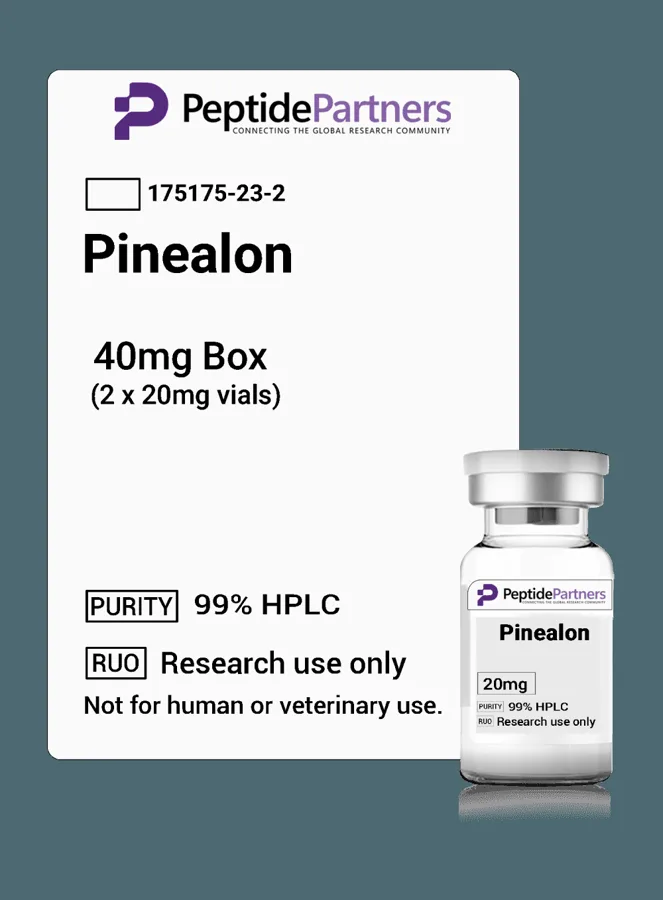
Among the catalog of synthetic short-chain peptides studied in modern molecular biology, Pinealon occupies a distinctive position. Composed of just three amino acids—glutamic acid, aspartic acid, and arginine (Glu-Asp-Arg, or EDR)—this synthetic tripeptide has generated significant scientific interest, particularly in preclinical models assessing mitochondrial dynamics, neuroprotection, and cellular aging. Investigated as a candidate bioregulatory peptide, Pinealon is frequently evaluated in cell cultures and animal models to observe how ultrashort peptide sequences interact with chromatin, influence gene expression, and modulate cellular responses to metabolic and oxidative stress.
Origins: The Discovery of Short Peptide Bioregulators
The history of Pinealon is rooted in the bioregulatory peptide research pioneered during the late 20th century, predominantly at the Saint Petersburg Institute of Bioregulation and Gerontology. Researchers investigating the biological activity of crude organ and tissue extracts noticed that specific fractions maintained organ-specific functional integrity in experimental models. Over decades of refinement, investigators isolated and identified the active minimalist motifs responsible for these effects.
While early research focused on complex extracts from pineal, cortex, and hypothalamic tissues, synthesis technologies eventually allowed researchers to construct specific, well-defined oligopeptides. Pinealon was synthesized as an analog designed to mimic the active peptide fragments observed in neuroendocrine and pineal tissues. Because of its defined chemical structure as a tripeptide, it provided research teams with a pure, reproducible molecule capable of being studied without the biological variability inherent to crude biological extracts.
Molecular Structure and Epigenetic Mechanisms
The molecular profile of Pinealon is straightforward: L-glutamic acid, L-aspartic acid, and L-arginine assembled via standard peptide bonds. Despite its low molecular weight, the compound exhibits complex interactions within the cell nucleus and cytoplasm. Researchers have focused extensively on the physical and chemical capacity of short peptides to enter cells without requiring dedicated receptor-mediated transport.
Published laboratory evaluations propose several distinct mechanisms of action:
- Direct Chromatin Interaction: Structural modeling and biophysical assays have demonstrated that short hydrophilic peptides like EDR are capable of penetrating nuclear membranes and binding to specific motifs within the major and minor grooves of double-stranded DNA. This interaction is hypothesized to alter histone acetylation and DNA methylation profiles, facilitating the transcription of targeted protective genes.
- Gene Expression Modulation: In preclinical neurodegenerative and senescence assays, Pinealon has been documented to influence the transcription of genes regulating cell survival, such as the down-regulation of pro-apoptotic markers (e.g., Caspase-3, Bax) and the up-regulation of anti-apoptotic signals like Bcl-2.
- Antioxidant Enzyme Regulation: Exposure to Pinealon in oxidative stress models has been observed to correlate with increased endogenous expression of enzymatic antioxidants, notably superoxide dismutase (SOD) and glutathione peroxidase (GPx).
Pinealon in Mitochondrial and Metabolic Research
Although initially classified as a neuroprotective peptide, Pinealon is increasingly examined through the lens of mitochondrial bioenergetics. Mitochondria are both the primary source of cellular adenosine triphosphate (ATP) and the main endogenous generator of reactive oxygen species (ROS). During metabolic insult, hypoxia, or excessive oxidative load, mitochondrial membrane permeabilization often triggers apoptotic cascades.
In laboratory studies of mitochondrial resilience, Pinealon has been studied for its ability to preserve the mitochondrial membrane potential (ΔΨm). When exposed to hypoxia or chemical uncouplers, untreated cellular lines typically undergo rapid depolarization, uncoupling of the electron transport chain, and release of cytochrome c into the cytosol. Cell models pre-incubated with the EDR tripeptide have demonstrated reduced swelling of the mitochondrial matrix and attenuated rates of ROS accumulation.
Furthermore, researchers explore how Pinealon impacts cellular energy metabolism under ischemic conditions. In vitro protocols have indicated that the presence of the peptide may aid in sustaining basal respiration rates and preserving intracellular ATP concentrations, suggesting an indirect stabilization of mitochondrial enzyme complexes.
Preclinical Research Directions and In Vitro Models
Scientific literature surrounding Pinealon spans multiple experimental frameworks, highlighting its utility across several discrete fields of study:
- Cerebral Ischemia and Hypoxia Models: Rodent models of focal cerebral ischemia have utilized Pinealon to monitor infarct volume, blood-brain barrier permeability, and post-ischemic neurological outcomes in controlled laboratory environments.
- Neuronal Senescence: Long-term primary cortical and hippocampal neuronal cultures are used to study how Pinealon exposure affects dendritic spine density, synaptic plasticity, and markers of age-associated functional decline.
- Circadian and Pineal Function: Given its conceptual derivation from pineal research, Pinealon has been studied in animal models exhibiting light-induced or age-related disruption of melatonin synthesis and neuroendocrine rhythmicity.
Sourcing Pinealon for Laboratory Research: Comparing Packs and Documentation
When procuring Pinealon for academic or industrial research via specialized chemical catalogs such as Peptides Partners, research teams must align product specifications with their experimental design. Ensuring strict batch-to-batch consistency and high chemical integrity is essential to generating reproducible data.
| Format Configuration | Primary Research Application | Operational Advantage |
|---|---|---|
| Single-Vial Units | Preliminary assay validation, pilot studies, binding affinity checks | Low-volume testing with minimal waste of reconstituted material |
| Multi-Vial Packs (5–10 Vials) | Dose-response curves, time-course experiments, multi-cohort animal models | Ensures identical synthesis lot across replicates, minimizing batch bias |
| Bulk / Custom Lots | High-throughput screening, long-term cellular senescence programs | Standardized concentration baseline for extensive longitudinal series |
Investigators evaluating supplier documentation should scrutinize analytical verification reports. Every catalog item designated for laboratory research should be accompanied by clear analytical data, including:
- High-Performance Liquid Chromatography (HPLC): To confirm chemical purity and quantify the absence of truncated synthesis byproducts or residual protecting groups.
- Mass Spectrometry (MS): To verify the precise molecular weight of the Glu-Asp-Arg structure, ensuring identity confirmation prior to assay introduction.
- Handling and Storage Guidance: Because lyophilized tripeptides are hygroscopic, analytical documentation should outline proper reconstitution parameters using sterile, bacteriostatic, or molecular biology-grade water, alongside recommended storage at -20°C to prevent peptide bond degradation via non-enzymatic hydrolysis.
As researchers continue to unpack the cellular pathways governed by short bioregulatory sequences, Pinealon remains a fundamental reference compound in mitochondrial stability, epigenetic modulation, and cytoprotective research.
Where to buy Pinealon for research
Peptides Partners lists Pinealon (20mg vials) in 3 pack sizes, all in stock, with price per mg shown for each option. Browse more mitochondrial compounds in the Peptides Partners research peptide shop. All products are for laboratory research use only.