
PEPTIDES PARTNERS BLOG · November 11, 2026
The Research Science of MOTS-c: Mechanisms, Discovery, and Laboratory Sourcing
The Emerging Paradigm of Mitochondrial-Derived Peptides
For decades, standard biological dogma treated the mitochondrial genome as a highly specialized, closed system. Containing just 37 genes, the human mitochondrial DNA (mtDNA) was historically understood to encode only 13 core subunits of the electron transport chain, alongside 22 transfer RNAs (tRNAs) and two ribosomal RNAs (rRNAs). However, advances in high-throughput transcriptomics and ribosome profiling have challenged this classical model, uncovering biologically active, functional peptides hidden within previously overlooked short open reading frames (sORFs).
Among the most widely investigated of these mitochondrial-derived peptides (MDPs) is MOTS-c (Mitochondrial Open Reading Frame of the 12S rRNA Type-c). Unlike traditional mitochondrial proteins that remain confined to local bioenergetic machinery within the organelle, MOTS-c represents a class of signaling molecules capable of retrograde and systemic signaling. In academic and preclinical research, investigators evaluate MOTS-c to understand how mitochondria communicate directly with the nuclear genome and peripheral tissues to influence metabolic homeostasis, cellular resilience, and biological aging.
Discovery and Structural Identity of MOTS-c
MOTS-c was identified in 2015 by a research team led by Dr. Pinchas Cohen at the University of Southern California. By examining sORFs embedded within the 12S rRNA gene of the mitochondrial genome, researchers identified an evolutionarily conserved 16-amino acid sequence. The primary structure of MOTS-c is represented by the sequence:
Met-Arg-Trp-Gln-Glu-Met-Gly-Tyr-Ile-Phe-Tyr-Pro-Arg-Lys-Leu-Arg
Despite its origins inside the mitochondrion, subsequent assays revealed that MOTS-c is capable of exporting out of the organelle and entering the systemic circulation. In preclinical rodent models and cell culture assays, endogenous levels of the peptide have been detected in plasma, skeletal muscle, and circulating white blood cells. This discovery confirmed that mitochondria do not function merely as isolated cellular powerhouses; they act as active endocrine-like signaling centers capable of producing hormone-like regulators of whole-body physiology.
Investigated Biological Mechanisms: From Organelle to Nucleus
Preclinical studies have explored several distinct molecular pathways through which MOTS-c alters cellular function, primarily centering on metabolic regulation, cellular stress responses, and epigenetic adaptation.
1. Modulation of the Folate-Methionine Cycle
One of the earliest mechanisms elucidated in laboratory models showed that MOTS-c targets the folate-methionine metabolic cycle. In cellular assays, exposure to MOTS-c has been observed to inhibit 5-methyltetrahydrofolate production, causing a temporary reduction in de novo purine biosynthesis. This selective inhibition leads to an accumulation of 5-aminoimidazole-4-carboxamide ribonucleotide (AICAR), an endogenous intermediate metabolite known to activate cellular energy sensors.
2. AMPK Activation and Glucose Disposal Pathways
Through the elevation of intracellular AICAR concentrations, MOTS-c has been demonstrated in preclinical literature to stimulate the phosphorylation of AMP-activated protein kinase (AMPK). In cell cultures and murine models of metabolic syndrome, research has focused on downstream outcomes of this activation, including:
- Enhanced glucose uptake via translocation of glucose transporter 4 (GLUT4) in skeletal muscle independent of canonical insulin cascades.
- Increased mitochondrial biogenesis and fatty acid oxidation.
- Downregulation of pathways responsible for ectopic lipid deposition and lipid accumulation in hepatic tissues.
3. Nuclear Translocation and Epigenetic Remodeling
Beyond cytoplasmic signaling, research has demonstrated that MOTS-c can translocate to the cell nucleus under conditions of cellular stress, such as metabolic deprivation or oxidative challenge. Within the nucleus, MOTS-c has been studied for its interactions with transcription factor networks, including the antioxidant response element (ARE) pathways regulated by Nrf2. These observations suggest that MOTS-c acts as an epigenetic coordinator, linking mitochondrial metabolic status to nuclear gene transcription during stress adaptation.
Key Preclinical Research Focus Areas
Laboratory investigation into MOTS-c spans several complementary biomedical domains:
- Metabolic Physiology: Preclinical models frequently employ MOTS-c to study dietary-induced insulin resistance, metabolic inflexibility, and adipose tissue remodeling.
- Exercise Biology: Because MOTS-c targets skeletal muscle pathways similar to those engaged during physical exertion, investigators have examined its role as an exercise-induced factor that modulates physical performance capacity in aged animal models.
- Cellular Senescence and Longevity: Research teams analyze how declining endogenous MOTS-c levels correlate with aging, testing hypotheses regarding whether restoring MDP levels affects cellular proteostasis, systemic inflammation, and functional longevity.
Sourcing MOTS-c: Evaluating Vials, Formats, and Documentation
When obtaining synthesized peptides like MOTS-c for academic, industrial, or institutional assays, experimental integrity depends strictly on reagent quality, batch consistency, and analytical documentation. Research peptide catalogs like Peptides Partners provide reference materials strictly designed for in vitro testing and laboratory animal research.
Comparative Analysis of Laboratory Sourcing Options
| Research Parameter | Standard Vial Formats | Multi-Pack Configurations | Analytical Documentation Requirements |
|---|---|---|---|
| Experimental Scope | Pilot studies, initial assay calibration, solubility trials | Longitudinal cohort studies, high-throughput in vitro screens | All research phases |
| Degradation Risk | Lowest per experiment; limits freeze-thaw cycles | Requires synchronized reconstitution schedules | N/A |
| Core Analytical Data | High-Performance Liquid Chromatography (HPLC) | Mass Spectrometry (MS) batch verification | Certificate of Analysis (CoA) matching vial lot |
| Storage Conditions | -20°C to -80°C (lyophilized solid) | -20°C to -80°C (lyophilized solid) | Temperature stability validation data |
Evaluating Technical Documentation
To ensure high reproducibility across laboratory cohorts, researchers sourcing MOTS-c from Peptides Partners must review lot-specific Certificates of Analysis. Key analytical metrics include:
- Chromatographic Purity (HPLC): Confirms the absence of truncated peptide sequences, oxidation products, or incomplete synthesis intermediates.
- Identity Confirmation (Mass Spectrometry): Verifies that the observed molecular weight accurately matches the theoretical theoretical monoisotopic mass of MOTS-c (approximately 2174.6 Da).
- Lyophilization Integrity: Ensures uniform, moisture-free cakes suitable for precise reconstitution in sterile, research-grade diluents such as bacteriostatic water or laboratory buffers without peptide clumping or denaturation.
Conclusion
MOTS-c continues to occupy a prominent position in mitochondrial biology research. As an active communicator between the mitochondrial and nuclear genomes, its investigated mechanisms—including AMPK stimulation, folate cycle regulation, and stress-induced nuclear translocation—offer substantial insight into basic metabolic and bioenergetic pathways. Sourcing verified, analytically documented reagents through specialized research catalogs such as Peptides Partners ensures that laboratory teams can evaluate these fundamental biological questions with rigorous scientific control and reproducibility.
Where to buy MOTS-c for research
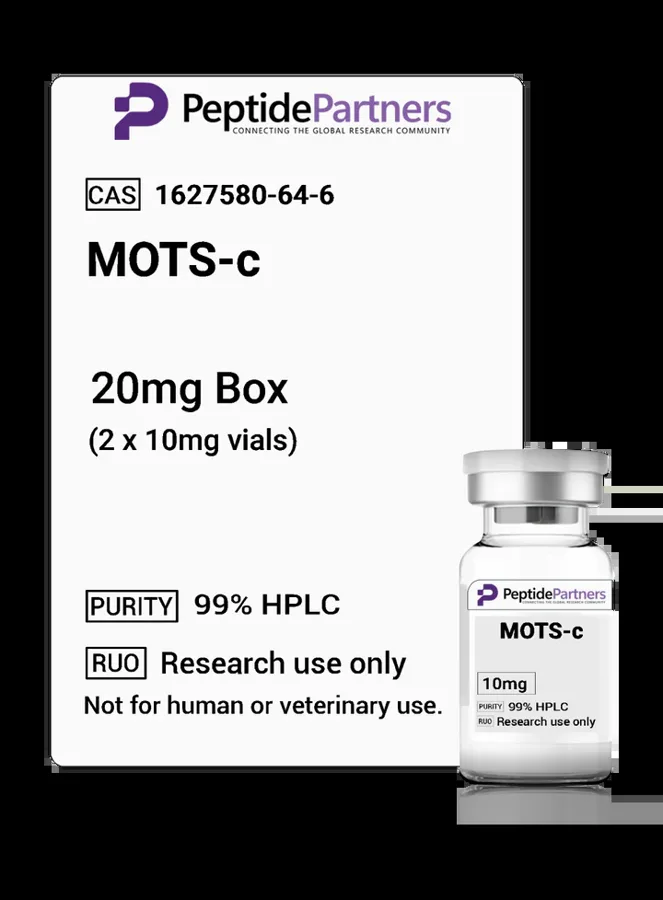
Peptides Partners lists MOTS-c (10mg vials) in 3 pack sizes, all in stock, with price per mg shown for each option. Browse more mitochondrial compounds in the Peptides Partners research peptide shop. All products are for laboratory research use only.