
PEPTIDES PARTNERS BLOG · November 11, 2026
The Research Science of Ipamorelin: Discovery, Mechanism, and Experimental Sourcing
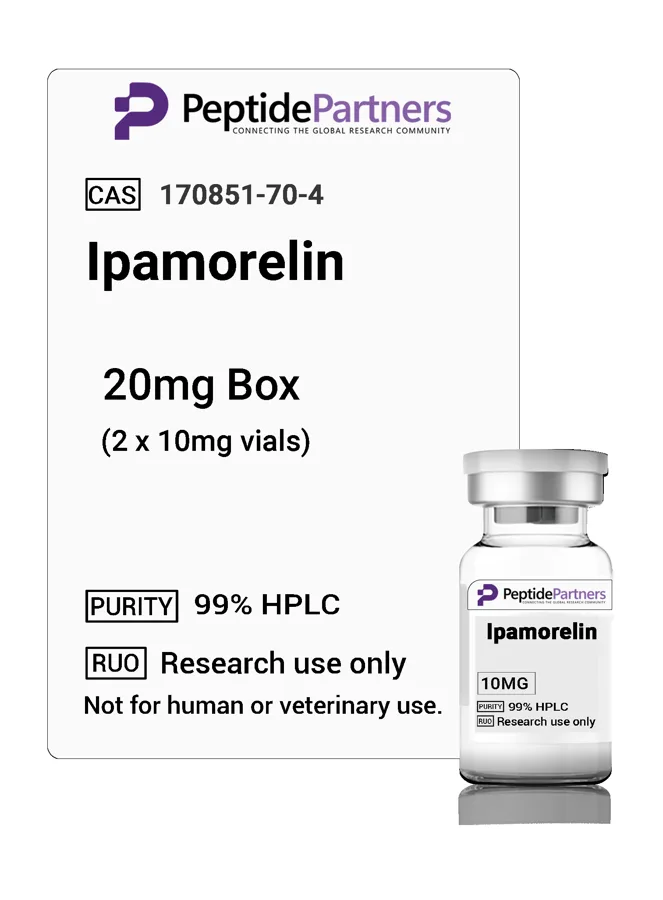
In the field of metabolic peptide science, growth hormone secretagogues (GHS) have provided critical insights into neuroendocrine regulation, cellular repair, and metabolic homeostasis. Among the various synthetic molecules synthesized to investigate the growth hormone (GH) axis, Ipamorelin occupies a unique position. Recognized as a highly selective pentapeptide, Ipamorelin is extensively evaluated in preclinical models to explore somatotrophic signaling pathways without the broad-spectrum endocrine cross-reactivity observed with earlier generations of secretagogues.
For scientific investigators evaluating peptides within the metabolics category, understanding the mechanistic profile of Ipamorelin, its historical discovery, and the parameters required for authentic laboratory sourcing is essential. This article provides an educational overview of published research concerning Ipamorelin, the biological mechanisms evaluated in peer-reviewed literature, and critical criteria for evaluating laboratory-grade documentation through providers such as Peptides Partners.
History and Development of the Pentapeptide
The pursuit of synthetic compounds capable of eliciting endogenous growth hormone secretion accelerated in the late 20th century. Early peptide secretagogues, such as GHRP-6 (Growth Hormone Releasing Peptide-6) and GHRP-2, demonstrated pronounced efficacy in elevating circulating growth hormone levels in laboratory models. However, these first- and second-generation compounds frequently triggered off-target neuroendocrine responses, notably activating the hypothalamic-pituitary-adrenal (HPA) axis and stimulating the release of adrenocorticotropic hormone (ACTH), cortisol, and prolactin.
In the late 1990s, researchers at Novo Nordisk engineered a series of modified peptide analogues designed to isolate the somatotrophic response. Published by Raun et al. in 1998, Ipamorelin (chemical designation Aib-His-D-2-Nal-D-Phe-Lys-NH2) was identified as a pentapeptide exhibiting a remarkably refined pharmacological footprint. By substituting specific non-natural amino acids within the sequence, researchers successfully created a compound that retained high binding affinity for the growth hormone secretagogue receptor while demonstrating negligible interaction with receptors responsible for stress-hormone cascades.
Mechanisms Investigated in Laboratory Models
Ipamorelin is classified pharmacologically as a selective agonist of the growth hormone secretagogue receptor 1a (GHS-R1a), which is the functional endogenous receptor for the metabolic peptide hormone ghrelin. Located predominantly in the anterior pituitary gland and hypothalamic nuclei, GHS-R1a activation triggers a distinct intracellular signaling pathway:
- G-Protein Coupled Receptor Cascade: Upon binding GHS-R1a, Ipamorelin activates the G-alpha-q/11 protein subunit.
- Phospholipase C (PLC) Pathway: Receptor engagement stimulates PLC, which hydrolyzes phosphatidylinositol 4,5-bisphosphate (PIP2) into inositol 1,4,5-trisphosphate (IP3) and diacylglycerol (DAG).
- Intracellular Calcium Release: IP3 binds to receptors on the endoplasmic reticulum, initiating an efflux of calcium ions (Ca2+) into the cytoplasm.
- Exocytosis of Somatotrophic Granules: The localized surge in calcium promotes protein kinase C (PKC) activation and the subsequent exocytosis of pre-stored growth hormone secretory vesicles into the intercellular space.
What differentiates Ipamorelin in comparative endocrinology is its lack of intrinsic stimulation toward other pituitary hormones. Preclinical assays have repeatedly demonstrated that even at supra-physiological concentrations in vitro, Ipamorelin does not induce significant elevations of ACTH, luteinizing hormone (LH), follicle-stimulating hormone (FSH), thyroid-stimulating hormone (TSH), or prolactin.
Primary Research Domains in Metabolic Science
Because of its targeted receptor affinity, Ipamorelin has served as an essential molecular probe across various metabolic and physiological research models.
Body Composition and Nitrogen Balance
Preclinical studies involving rodent models have evaluated Ipamorelin’s influence on longitudinal body weight, adiposity, and nitrogen retention. In research analyzing catabolic states, administration of selective secretagogues has been studied to assess whether localized growth hormone elevation promotes cellular protein synthesis while mitigating muscle degradation markers. Researchers examine downstream biomarkers such as insulin-like growth factor 1 (IGF-1) expression to evaluate metabolic turnover.
Bone Mineral Density and Osteogenesis
Growth hormone and systemic IGF-1 are established regulators of bone turnover and osteoblast proliferation. In preclinical osteopenia models, researchers have investigated Ipamorelin to quantify changes in bone mineral density, cortical thickness, and bone formation rates. Because aging models often exhibit reduced endogenous GH pulsation, evaluating selective secretagogues helps clarify how targeted signaling affects skeletal architecture over designated experimental periods.
Gastrointestinal Motility Investigations
Because the GHS-R1a receptor is expressed in the enteric nervous system and throughout gastrointestinal smooth muscle, ghrelin receptor agonists have garnered interest in gastrointestinal motility research. Ipamorelin has been explored in animal models of postoperative ileus to determine if selective receptor activation accelerates gastric emptying and restores coordinated bowel contractions following surgical interventions.
Comparative Profile: Ipamorelin and Historical Secretagogues
To contextualize its role in laboratory studies, researchers frequently reference structural and functional differences between major growth hormone secretagogues:
| Compound | Peptide Length | Primary Molecular Target | Observed Hormonal Specificity |
|---|---|---|---|
| GHRP-6 | Hexapeptide | GHS-R1a | Moderate; stimulates GH alongside minor elevations in cortisol and prolactin; influences appetite pathways. |
| GHRP-2 | Hexapeptide | GHS-R1a | Lower selectivity; strong GH output with measurable concurrent increases in ACTH, cortisol, and prolactin. |
| Ipamorelin | Pentapeptide | GHS-R1a | High selectivity; stimulates somatotroph GH release without significant alteration of ACTH, cortisol, or prolactin baselines. |
Evaluating Specifications and Sourcing from Peptides Partners
When procuring Ipamorelin for in vitro or in vivo animal research, reproducibility depends heavily on the chemical integrity and verification of the research peptide. Peptides Partners supplies research-grade Ipamorelin intended strictly for laboratory exploration and preclinical evaluation.
Investigators sourcing peptides within the metabolics category must carefully review technical documentation to protect experimental validity:
- Analytical Verification: Research compounds must be verified via High-Performance Liquid Chromatography (HPLC) to confirm peptide purity and assess chromatographic peak uniformity.
- Mass Identification: Mass Spectrometry (MS) analysis should accompany experimental materials to confirm the exact molecular weight (approximately 711.86 g/mol) and verify sequence fidelity against standard chemical libraries.
- Vial Pack Configuration: Laboratories should evaluate study timelines and sample sizes when selecting vial packs. Sourcing appropriate quantities per vial (e.g., single-study vs. multi-vial configurations) prevents redundant freeze-thaw cycles that can disrupt the tertiary structure and peptide stability once reconstituted in sterile bacteriostatic or deionized solvents.
- Lyophilization Quality: High-grade vacuum lyophilization ensures minimal residual moisture content, enhancing the shelf life and stability of the dry peptide cake during baseline cold storage.
Conclusion
Ipamorelin remains one of the most widely evaluated tools for delineating the specific actions of GHS-R1a activation. Its unique lack of cross-reactivity with the adrenocortical axis allows laboratory investigators to study somatotroph-specific pathways, cellular growth parameters, and gastrointestinal motility with high experimental control. By leveraging verifiable documentation, rigorous analytical assays, and standardized laboratory handling from specialized research catalogs such as Peptides Partners, academic and independent researchers can ensure precision, continuity, and reliability across their metabolic research initiatives.
Where to buy Ipamorelin for research
Peptides Partners lists Ipamorelin (10mg vials) in 4 pack sizes, all in stock, with price per mg shown for each option. Browse more metabolics compounds in the Peptides Partners research peptide shop. All products are for laboratory research use only.