
PEPTIDES PARTNERS BLOG · November 11, 2026
The Research Science of Glutathione: Mechanisms, Discovery, and Laboratory Sourcing
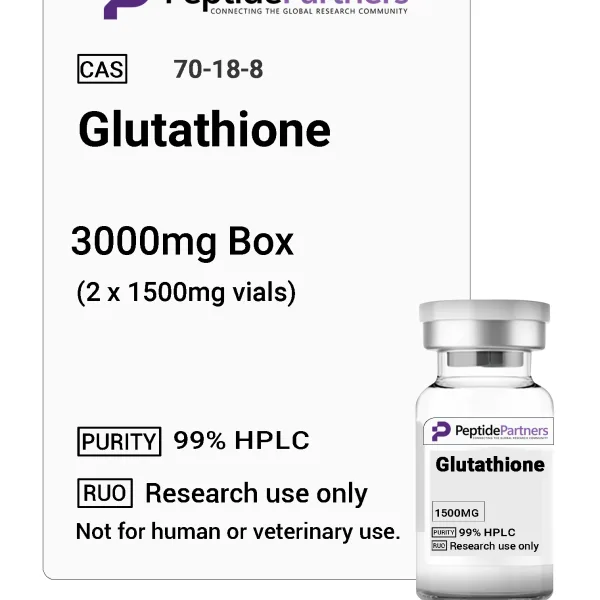
Glutathione occupies a distinct position in cellular biochemistry. Frequently described in biological literature as a primary endogenous antioxidant, this low-molecular-weight tripeptide plays an essential role in maintaining intracellular reduction-oxidation (redox) balance, detoxifying xenobiotic agents, and modulating cellular signaling pathways. In scientific laboratories, glutathione serves as a critical reference compound and experimental reagent across studies in molecular biology, toxicology, cellular senescence, and metabolic biochemistry.
This overview examines the discovery of glutathione, the primary biochemical mechanisms investigated in preclinical models, emerging areas of laboratory inquiry, and standard protocols for evaluating analytical documentation and vial configurations when sourcing reference materials from Peptides Partners.
Historical Context and Discovery of the Tripeptide
The scientific study of glutathione began in the late nineteenth century. In 1888, French pharmacologist J. de Rey-Pailhade identified an organic sulfur-containing substance in yeast and various animal tissues capable of reducing elemental sulfur to hydrogen sulfide, which he termed “philothion.” Decades later, in 1921, English biochemist Sir Frederick Gowland Hopkins isolated the compound and renamed it “glutathione,” initially proposing it was a dipeptide composed of glutamate and cysteine.
By the late 1920s and early 1930s, Hopkins, alongside researchers such as George Hunter and Edward Eagles, clarified that the molecule is a tripeptide consisting of three amino acids: L-glutamate, L-cysteine, and glycine. Structural studies revealed an uncommon gamma-peptide linkage between the amine group of cysteine and the carboxyl group of the glutamate side chain (γ-L-glutamyl-L-cysteinylglycine). This specific bond protects the peptide against degradation by common intracellular peptidases, allowing it to function as a stable intracellular buffer against oxidative challenges.
Core Biochemical Mechanisms Investigated in Preclinical Models
Glutathione exists predominantly in two states: reduced glutathione (GSH) and oxidized glutathione disulfide (GSSG). The ratio of GSH to GSSG is widely used by researchers as an indicator of cellular oxidative stress and health. Under baseline physiological conditions in vitro, the reduced form vastly exceeds the disulfide form, often maintaining ratios greater than 100:1.
Investigators focus heavily on several key mechanisms involving glutathione:
- Direct and Enzymatic Free Radical Scavenging: The active component of the molecule is the sulfhydryl (thiol) group on the cysteinyl residue. This moiety acts as a single-electron donor, neutralizing reactive oxygen and nitrogen species (ROS and RNS) such as hydrogen peroxide, lipid hydroperoxides, and hydroxyl radicals. This process is frequently mediated by the glutathione peroxidase (GPx) family of enzymes, converting GSH to GSSG.
- Phase II Conjugation Pathways: In toxicological research, glutathione is studied for its role in xenobiotic metabolism. Enzymes known as Glutathione S-Transferases (GSTs) catalyze the conjugation of GSH with diverse electrophilic substrates. This modification neutralizes reactive intermediates and enhances their water solubility, facilitating cellular transport and excretion models.
- S-Glutathionylation: Preclinical studies examine protein S-glutathionylation, a post-translational modification wherein a glutathione molecule forms a mixed disulfide with reactive cysteine residues on target proteins. This mechanism acts as both a reversible shield against irreversible oxidation and a switch modulating enzymatic activity, transcription factor binding, and apoptosis.
- Enzymatic Regeneration via Glutathione Reductase: The enzyme glutathione reductase (GR) restores GSSG back to its monomeric GSH state using NADPH as an electron donor. Researchers often monitor this cycle to assess cellular metabolic reserve, particularly the activity of the pentose phosphate pathway that supplies NADPH.
Overview of Investigational Applications
Contemporary preclinical studies employ glutathione to interrogate diverse cellular processes. The table below highlights key experimental contexts in which the tripeptide is commonly studied.
| Research Area | Experimental Target | Primary Laboratory Readouts |
|---|---|---|
| Cellular Senescence | Telomere erosion and mitochondrial decline | GSH/GSSG ratio, mitochondrial membrane potential |
| Neurobiology | Dopaminergic and cortical neuron viability | Lipid peroxidation markers (MDA), caspase-3 activity |
| Hepatology & Toxicology | Chemical-induced hepatic injury models | GST activity, transaminase release, bile acid transport |
| Immunology | T-cell and macrophage polarization | Cytokine profiles, NF-κB activation dynamics |
Comparative Analysis of Research Formulations and Packaging
For reproducible experimental outcomes, investigators must evaluate the physical properties and documentation of research peptides. Because the thiol group of glutathione is susceptible to auto-oxidation in liquid environments, laboratory parameters require close control.
Lyophilized Cake vs. Reconstituted Solution Stability
In analytical supply chains, glutathione is typically prepared via lyophilization (freeze-drying) under an inert atmosphere. Lyophilized powder exhibits superior shelf-life stability compared to aqueous solutions, provided it is stored desiccated at controlled temperatures. Once reconstituted in sterile water or buffered solutions, spontaneous oxidation into GSSG can occur, especially in the presence of trace transition metals or elevated pH levels. Research protocols typically account for this by preparing solutions immediately prior to assay execution or storing aliquots at sub-zero temperatures.
Documentation and Quality Verification
When selecting research materials from catalog providers like Peptides Partners, verifying analytical documentation is standard protocol. Key quality control assets include:
- High-Performance Liquid Chromatography (HPLC): Confirms chemical purity by identifying the retention profile of the primary tripeptide relative to potential degradation products or synthesis impurities.
- Mass Spectrometry (MS): Confirms molecular identity by validating the theoretical molecular weight of the compound (approximately 307.32 g/mol for the monomeric GSH form).
- Batch Traceability: Ensures that distinct lots maintain uniform chemical characteristics, preventing confounding variables across longitudinal studies.
Selecting Vial Packs for Laboratory Use
Peptides Partners provides glutathione strictly for in vitro, preclinical, and laboratory-based analytical applications. Research institutions typically select among individual vials or multi-pack configurations based on protocol design. Multi-vial sets reduce freeze-thaw cycles by allowing investigators to reconstitute only the quantity needed for immediate experimental runs, thereby preserving the integrity of remaining dry reserves.
By understanding the precise biochemical mechanics, degradation liabilities, and analytical metrics of glutathione, laboratories can design robust experimental frameworks that yield reliable data across toxicology, redox signaling, and cellular pathology investigations.
Where to buy Glutathione for research
Peptides Partners lists Glutathione (1500mg vials) in 3 pack sizes, all in stock, with price per mg shown for each option. Browse more anti-oxidant compounds in the Peptides Partners research peptide shop. All products are for laboratory research use only.