
PEPTIDES PARTNERS BLOG · November 11, 2026
The Research Science of CJC-1295 No DAC and Ipamorelin: Cellular Repair Mechanisms and Sourcing Considerations
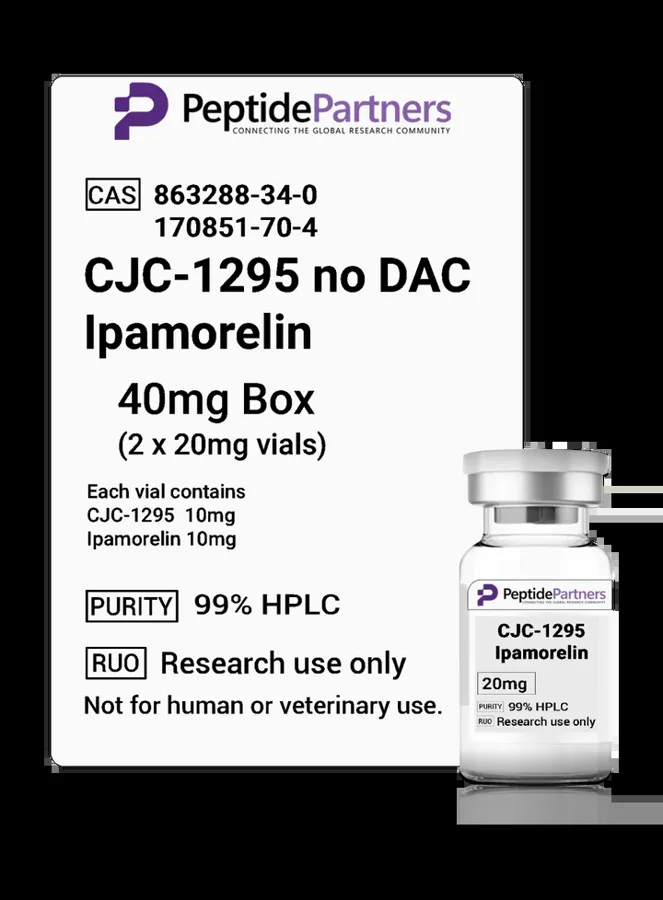
In the domain of peptide science, the study of secretagogues—molecules that trigger the endogenous release of native endocrine signals—occupies a central role in modern cellular biology. Among the combinations most frequently cited in preclinical literature is the dual-compound model pairing CJC-1295 without Drug Affinity Complex (frequently documented as Modified GRF 1-29) and Ipamorelin. Investigated within various cellular repair and physiological preservation paradigms, this blend models how distinct receptor cascades can be coordinated simultaneously to examine tissue remodeling, metabolic regulation, and cellular turnover.
For laboratory professionals and academic investigators acquiring compounds from Peptides Partners, understanding the pharmacology, historical emergence, and analytical criteria associated with these peptides is vital for experimental consistency and reproducibility.
Historical Context and Structural Discovery
The development of secretagogue research evolved out of a desire to understand native biological feedback loops rather than introducing exogenous downstream hormones. Growth Hormone-Releasing Hormone (GHRH) was originally characterized in the 1980s, revealing that the first 29 amino acids of the peptide sequence retained full biological activity. This truncated fragment was termed sermorelin (GRF 1-29). However, wild-type GRF 1-29 displayed a very short half-life in physiological conditions, prone to rapid cleavage by the dipeptidyl peptidase-4 (DPP-4) enzyme.
To address this enzymatic vulnerability, medicinal chemists modified four specific positions within the peptide sequence (positions 2, 8, 15, and 27), producing Modified GRF 1-29, widely referred to in research circles as CJC-1295 without DAC. Crucially, the absence of the Drug Affinity Complex prevents covalent bonding to circulating albumin, thereby maintaining a physiological, transient pharmacokinetic profile rather than an artificial, continuous release.
In parallel, the discovery of the growth hormone secretagogue receptor (GHS-R1a) prompted investigations into non-GHRH signaling mechanisms. In the late 1990s, research teams identified Ipamorelin, a synthetic pentapeptide (Aib-His-D-2-Nal-D-Phe-Lys-NH2). Distinct from earlier synthetic secretagogues like GHRP-6 or GHRP-2, Ipamorelin was synthesized to provide selective interaction with GHS-R1a without triggering secondary releases of adrenocorticotropic hormone (ACTH), cortisol, or prolactin in comparative animal models.
Investigated Cellular Mechanisms: Synergistic Receptor Signaling
The scientific rationale for combining CJC-1295 No DAC with Ipamorelin in laboratory settings centers on complementary signaling axes within pituitary and peripheral tissues. By acting on two distinct receptor families, these compounds allow researchers to study amplified intracellular communication without disrupting native inhibitory feedback mechanisms, such as somatostatin signaling.
GHRH Receptor Activation (CJC-1295 No DAC)
CJC-1295 No DAC binds directly to the pituitary GHRH receptor, a classical G-protein-coupled receptor (GPCR) associated with the Gs-alpha subunit. Upon binding, adenylyl cyclase is stimulated, driving an intracellular rise in cyclic adenosine monophosphate (cAMP). This activates protein kinase A (PKA), which phosphorylates specific transcription factors and promotes gene expression linked to hormone synthesis and pulsatile release dynamics.
GHS-R1a Stimulation (Ipamorelin)
Ipamorelin functions as a selective ghrelin receptor agonist targeting GHS-R1a, which pairs with the Gq-protein pathway. Activation of this pathway stimulates phospholipase C (PLC), producing inositol trisphosphate (IP3) and diacylglycerol (DAG). IP3 triggers the mobilization of calcium ions from intracellular stores within the endoplasmic reticulum, while DAG activates protein kinase C (PKC). This transient elevation of intracellular calcium acts as a mechanical trigger for exocytosis, coordinating with the PKA cascade activated by CJC-1295.
Cellular Repair Horizons in Preclinical Research
The coordinated biochemical pathways studied via the combo vial format have made this peptide pairing a focal point in literature surrounding cellular longevity, structural tissue repair, and metabolic preservation.
- Fibroblast Proliferation and Extracellular Matrix (ECM) Synthesis: Preclinical models studying soft tissue and tendon repair frequently evaluate downstream signaling cascades related to insulin-like growth factor 1 (IGF-1). Researchers investigate how localized increases in secretagogue signaling influence collagen deposition, tenocyte proliferation, and structural remodeling following microtrauma.
- Myocyte Turnover and Protein Accretion: In cellular models of muscle atrophy, researchers examine how coordinated secretagogue cascades affect mRNA expression of key markers involved in protein synthesis (such as mTOR) and muscle preservation.
- Bone Density and Mineralization Markers: Osteoblast and osteoclast activity have been assessed in animal models to determine the degree to which pulsatile growth axis stimulation supports periosteal bone formation and mineral density over time.
- Cellular Senescence and Mitochondrial Function: Emerging in vitro research explores the role of endogenous regulatory cascades on mitochondrial efficiency, oxidative stress management, and the maintenance of stem cell niches in aging tissues.
Overview of Research Characteristics
The individual and combined profiles of these compounds in published research demonstrate distinct pharmacodynamic attributes:
| Compound | Primary Receptor Target | Intracellular Pathway | Key Research Focus |
|---|---|---|---|
| CJC-1295 (No DAC) | GHRH Receptor | cAMP / Protein Kinase A (PKA) | Signal amplitude, enzymatic stability, baseline transcription |
| Ipamorelin | GHS-R1a (Ghrelin Receptor) | PLC / IP3 / Intracellular Calcium | Selectivity, exocytic triggering, minimal ACTH interaction |
| Combined Formulation | Dual Receptor Signaling | Co-activation of PKA and Calcium Flux | Synergistic cellular repair, tissue remodeling models |
Sourcing Research Peptides: Evaluating Formats and Documentation
Procuring dual-peptide combinations for laboratory use requires strict attention to chemical stability, compound stoichiometry, and analytical verification. Because lyophilizing two distinct peptide chains within a single matrix introduces formulation complexities, investigators must evaluate several technical criteria when ordering from Peptides Partners.
Lyophilization and Molar Proportions
In a blended vial format, achieving homogenous co-lyophilization without promoting aggregation or peptide-peptide interaction is critical. Laboratories must verify that both peptides retain their native secondary structure upon solvent introduction. Research teams must also calculate whether the specified milligram ratios between the GHRH analogue and the GHRP analogue suit their specific cellular or animal experimental design.
Analytical Documentation Verification
Reliable research depends directly on the integrity of the compounds under investigation. When sourcing materials, investigators should verify documentation for:
- High-Performance Liquid Chromatography (HPLC): Confirms that both peptide constituents resolve cleanly into distinct chromatographic peaks with minimal related substances, oxidation products, or incomplete synthesis sequences.
- Mass Spectrometry (MS): Confirms molecular weight verification for both the 29-amino acid sequence of CJC-1295 No DAC and the pentapeptide structure of Ipamorelin, ensuring absence of truncations or counter-ion anomalies.
Comparing Single versus Multi-Vial Configurations
Peptides Partners provides diverse pack formats designed around laboratory volume needs. Single-vial configurations are standard for initial titration models and exploratory in vitro assays where short-term stability testing is primary. Multi-vial packs are selected for longitudinal experimental protocols requiring identical production lots, preventing batch-to-batch variability across multi-week data collection periods.
Conclusion: Maintaining Experimental Integrity
The study of CJC-1295 No DAC and Ipamorelin represents an established framework for investigating coordinated neuroendocrine signaling and downstream cellular repair models. By focusing on biochemical pathways, strict receptor selectivity, and robust analytical standards, researchers can effectively observe how secretagogue pathways influence tissue biology without circumventing native physiological regulation.
Where to buy Combo Vial: CJC-1295 no DAC/Ipamorelin for research
Peptides Partners lists Combo Vial: CJC-1295 no DAC/Ipamorelin (20mg vials) in 3 pack sizes, all in stock, with price per mg shown for each option. Browse more cellular repair compounds in the Peptides Partners research peptide shop. All products are for laboratory research use only.