
PEPTIDES PARTNERS BLOG · November 11, 2026
Tesamorelin in Metabolic Research: Scientific Discovery, Mechanisms, and Sourcing Considerations
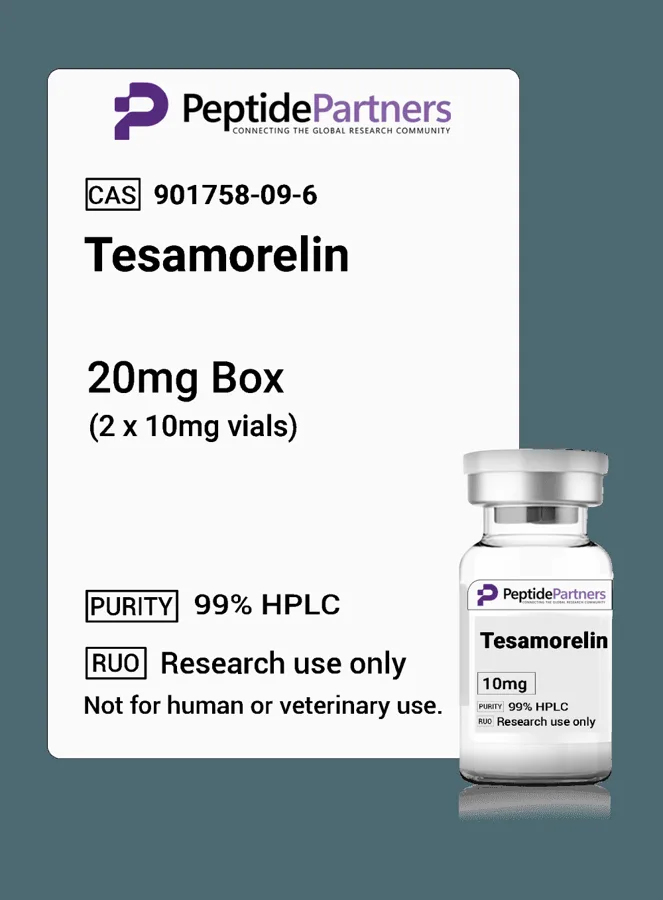
In the field of metabolic research, synthetic secretagogues and hormone-releasing factor analogs have emerged as critical tools for investigating endocrine pathways. Among these, Tesamorelin represents a significant advancement in the molecular engineering of growth hormone-releasing hormone (GHRH) derivatives. Identified structurally as an analog of human GHRH, Tesamorelin has garnered sustained interest across preclinical laboratories investigating cellular metabolism, visceral adiposity markers, lipid homeostasis, and neurobiological signaling. For investigators sourcing compounds for laboratory assays, understanding the biological architecture, research history, and analytical benchmarks associated with Tesamorelin is essential to designing rigorous and reproducible research protocols.
Historical Discovery and Molecular Development
Tesamorelin was developed as part of targeted efforts to overcome the pharmacokinetic limitations inherent to native human GHRH. Endogenous GHRH is a 44-amino acid hypothalamic peptide that stimulates the synthesis and pulsatile secretion of growth hormone (GH) from anterior pituitary somatotrophs. However, in laboratory settings, native GHRH exhibits a very short biological half-life, predominantly due to rapid enzymatic degradation by dipeptidyl peptidase-4 (DPP-4) at its N-terminus.
To address this enzymatic vulnerability, molecular researchers modified the native GHRH sequence. Tesamorelin retains the complete 44-amino acid structure of human GHRH but incorporates a trans-3-hexenoic acid moiety attached to the tyrosine residue at position 1. This structural alteration significantly enhances structural stability against enzymatic cleavage by DPP-4 without disrupting the peptide’s binding affinity for the growth hormone-releasing hormone receptor (GHRH-R). The development of this stabilized derivative provided researchers with a more durable molecular instrument for exploring downstream metabolic cascades in experimental models.
Mechanisms Investigated in Metabolic Science
At the cellular level, Tesamorelin functions as an agonist of the pituitary GHRH-R, which belongs to the secretin-like class B G-protein-coupled receptor (GPCR) family. Preclinical studies illustrate that receptor engagement triggers a classic intracellular cascade:
- Adenylate Cyclase Activation: Binding stimulates G-protein coupling (specifically Gs), which activates adenylate cyclase and increases intracellular cyclic adenosine monophosphate (cAMP) levels.
- Pulsatile Secretion: The elevation in cAMP, alongside protein kinase A (PKA) signaling, mediates calcium influx, facilitating the transcription and exocytosis of growth hormone. Unlike direct administration of exogenous recombinant growth hormone, which bypasses regulatory feedback loops, GHRH analogs preserve the physiologic, pulsatile nature of endogenous release modulated by somatostatin.
- Hepatic IGF-1 Induction: Circulating growth hormone stimulated by the analog engages growth hormone receptors on hepatocytes, inducing the synthesis and release of insulin-like growth factor 1 (IGF-1), a primary mediator of anabolic and metabolic effects.
Because Tesamorelin maintains physiological feedback mechanisms, laboratory models evaluating its mechanisms typically exhibit proportional shifts in circulating IGF-1 rather than the sustained, non-pulsatile spikes associated with exogenous hormone administration.
Key Areas of Scientific Investigation
In metabolic research frameworks, Tesamorelin is frequently employed to study the downstream cellular outcomes of somatotroph axis stimulation. The literature reflects several concentrated domains of inquiry:
Adipocyte Biology and Lipid Mobilization
Preclinical and translational models have explored the peptide’s effects on lipid metabolism, specifically focusing on lipolysis in deep-tissue adipocytes. Research has examined how localized activation of hormone-sensitive lipase (HSL) and down-regulation of lipid-storing enzymes may influence visceral adipose tissue (VAT) depots compared to subcutaneous fat. Researchers frequently utilize the peptide to study the transcriptional profiles of genes governing fatty acid oxidation and adipokine secretion.
Hepatic Steatosis and Triglyceride Accumulation
Because visceral adiposity is intricately tied to hepatic lipid content, cellular and animal models have evaluated GHRH analog pathways in the context of non-alcoholic fatty liver conditions. Investigators analyze markers of hepatic de novo lipogenesis, mitochondrial beta-oxidation rates, and systemic inflammatory mediators to understand how somatotrophic modulation influences intrahepatic lipid accumulation.
Neurocognitive and Vascular Signaling
Beyond peripheral metabolic systems, GHRH receptors are present in distinct regions of the central nervous system, including the hippocampus. Published preclinical studies have investigated whether Tesamorelin and related analogs modulate neurogenesis, synaptic plasticity, or microvascular endothelial function, providing a foundation for ongoing exploration into the neuro-metabolic axis.
Laboratory Sourcing: Evaluating Documentation and Quality Controls
When procuring Tesamorelin for laboratory research, consistency, analytical verification, and appropriate presentation are vital parameters. Peptides Partners (peptidespartners.co) supplies research-grade compounds intended strictly for in vitro, ex vivo, or non-clinical in vivo laboratory experimentation. To maintain scientific integrity across repeated experimental runs, research teams must evaluate specific quality criteria before selecting peptide inventory.
| Analytical Standard | Methodology | Scientific Relevance |
|---|---|---|
| Chemical Purity | High-Performance Liquid Chromatography (HPLC) | Confirms the absence of truncated sequences, deletion peptides, or residual synthesis reagents. |
| Molecular Identification | Mass Spectrometry (MS / ESI-MS) | Verifies precise molecular weight against the theoretical mass of the hexenoyl-derivatized sequence. |
| Lyophilization Integrity | Controlled Freeze-Drying | Ensures cake stability, low residual moisture, and optimal solubility during protocol reconstitution. |
Comparing Vial Configurations for Research Protocols
When selecting Tesamorelin from a research catalog, scientific teams must align the vial format with their experimental throughput:
- Single-Vial Units: Suitable for exploratory assays, initial solubility testing, or short-term baseline verifications where reconstituted material can be used within a limited laboratory window.
- Multi-Vial Research Packs: Recommended for extended, longitudinal studies or multi-sample assay panels. Utilizing standardized batch packs allows researchers to minimize inter-experimental variability by ensuring that all assay replicates draw from the exact same synthesis lot.
Before initiating research protocols, investigators should review the accompanying Certificate of Analysis (COA) for lot-specific confirmation of identity and purity. Lyophilized peptides must be stored in accordance with laboratory cold-chain standards, typically at sub-zero temperatures (-20°C or lower), protected from light and moisture to prevent premature degradation.
Summary of Future Research Directions
Tesamorelin remains a focal compound in the biochemical study of growth hormone dynamics, adiposity regulation, and systemic lipid metabolism. Its unique chemical architecture provides a stable framework for isolating the biological activities of the GHRH axis in controlled experimental environments. As metabolic research continues to unravel the complex intersections between endocrine signaling, organ fat distribution, and cellular senescence, meticulously characterized research peptides from dependable suppliers like Peptides Partners provide the foundation for reproducible and rigorous scientific inquiry.
Where to buy Tesamorelin for research
Peptides Partners lists Tesamorelin (10mg vials) in 4 pack sizes, all in stock, with price per mg shown for each option. Browse more metabolics compounds in the Peptides Partners research peptide shop. All products are for laboratory research use only.