
PEPTIDES PARTNERS BLOG · November 11, 2026
SS-31 in Mitochondrial Research: Mechanisms, Discovery, and Laboratory Sourcing
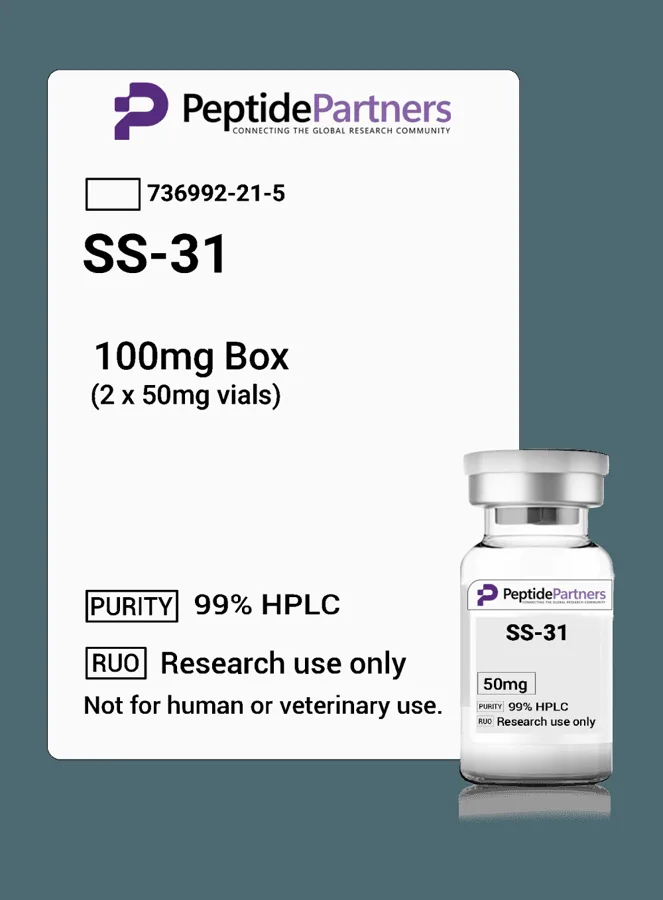
Mitochondrial integrity is central to cellular bioenergetics, metabolic signaling, and cell survival. Over the past two decades, peptide chemistry has unlocked targeted approaches to investigate mitochondrial dynamics directly at the inner membrane level. Among these compounds, the tetrapeptide SS-31—also identified in scientific literature as elamipretide or Bendavia—has emerged as one of the most widely evaluated tool compounds for studying mitochondrial microenvironments and electron transport chain efficiency.
This educational guide examines the structural origins of SS-31, the biochemical pathways observed in preclinical models, and standard evaluation protocols for laboratories sourcing this peptide from Peptides Partners for in vitro and ex vivo experimentation.
Discovery and History of the Szeto-Schiller Peptides
SS-31 belongs to the Szeto-Schiller (SS) peptide family, originally synthesized through a collaborative effort led by Dr. Hazel Szeto and Dr. Peter Schiller. The initial research program focused on engineering synthetic opioid peptide analogues containing alternating aromatic and basic amino acid residues. During structure-activity relationship assays, researchers made a serendipitous observation: certain tetrapeptides displayed a natural propensity to cross biological membranes independently of receptor-mediated uptake mechanisms.
Subsequent investigation revealed that these small molecules preferentially partitioned into the inner mitochondrial membrane (IMM). Unlike traditional lipophilic cations, such as triphenylphosphonium (TPP), which rely entirely on high mitochondrial membrane potential (ΔΨm) for uptake and can trigger membrane depolarization at elevated concentrations, SS-31 localized to the IMM without disrupting the mitochondrial transmembrane gradient. This structural advantage opened new avenues for investigators exploring mitochondrial bioenergetics under pathological states where membrane potential is already compromised.
Biochemical Structure and Mechanisms Investigated
SS-31 possesses the primary sequence D-Arg-Dmt-Lys-Phe-NH2, where Dmt represents 2′,6′-dimethyltyrosine. The sequence features alternating aromatic residues and positive charges, providing amphipathic characteristics that facilitate membrane diffusion and targeted lipid binding.
Interaction with Cardiolipin
Preclinical studies have consistently shown that SS-31 interacts selectively with cardiolipin, a unique tetra-acylated phospholipid concentrated almost exclusively in the IMM. Cardiolipin plays a structural role in maintaining mitochondrial cristae architecture and organizing the individual enzyme complexes of the electron transport chain (ETC) into quaternary assemblies known as supercomplexes or respirasomes.
Under conditions of oxidative stress, cardiolipin undergoes peroxidation, destabilizing supercomplex formation and causing electron leakage. Biophysical and structural studies indicate that SS-31 associates with cardiolipin via electrostatic and hydrophobic interactions. This association has been studied in research settings for its capacity to:
- Stabilize membrane curvature and preserve cristae structure under metabolic stress.
- Prevent the detachment of cytochrome c from cardiolipin, thereby mitigating the initiation of apoptotic cascades.
- Enhance the structural cohesion of Complexes I, III, and IV, facilitating efficient electron transfer and supporting ATP synthesis rates.
- Attenuate excessive reactive oxygen species (ROS) production without acting as a general stoichiometric scavenger.
Areas of Preclinical Investigation
Because mitochondrial breakdown is common across diverse biological models, SS-31 has been applied across various experimental paradigms in basic science literature:
- Ischemia-Reperfusion Models: Evaluated in cellular and rodent tissue models to measure mitochondrial structural preservation following transient hypoxia and reoxygenation.
- Skeletal and Cardiac Muscle Aging: Investigated in senescent animal models to measure maximum mitochondrial ATP generation capacity and exercise tolerance metrics.
- Neurodegenerative Pathways: Studied in vitro to evaluate neuronal survival, axonal transport integrity, and microglial activation in models of neuroinflammation.
- Renal Microvascular Research: Explored in rodent tubular cells to assess preservation of brush-border membranes and endothelial function under ischemic challenge.
Methodological Considerations in Laboratory Research
When working with SS-31 in laboratory environments, experimental design requires careful control over peptide handling, reconstitution, and analytical endpoints.
Lyophilized SS-31 is typically reconstituted using sterile laboratory-grade water or buffered solutions, such as phosphate-buffered saline (PBS), depending on the assay protocol. Because peptide concentration can influence membrane interaction kinetics, investigators commonly utilize analytical methods such as Seahorse extracellular flux analysis, Clark-type oxygen electrodes, and fluorescence microscopy with cardiolipin-specific probes (like Nonyl Acridine Orange) to monitor mitochondrial respiratory control ratios (RCR) and membrane dynamics in real time.
Sourcing SS-31: Comparing Vial Formats and Documentation
Selecting consistent peptide reagents is essential to reproducing published findings across preclinical trials. Laboratories sourcing SS-31 from specialized research catalogs like Peptides Partners must evaluate several chemical and packaging factors before designing multi-phase protocols.
Analytical Documentation
Research peptides must be verified using modern analytical chemistry methods. Sourcing protocols should prioritize vendors that provide comprehensive analytical documentation for every manufacturing lot, including:
- High-Performance Liquid Chromatography (HPLC): Confirms peptide purity profiles and the absence of truncated synthesis byproducts.
- Mass Spectrometry (MS / LC-MS): Verifies the exact molecular weight of the SS-31 tetrapeptide, confirming chemical identity and sequence fidelity.
- Lyophilization Integrity: Proper lyophilization ensures low residual moisture, reducing the risk of spontaneous hydrolysis during storage at −20°C.
Selecting Vial Configurations
Experimental scale dictates whether a project requires individual unit vials or bundled multi-vial packs. The table below outlines standard laboratory selection criteria when sourcing SS-31:
| Format | Experimental Suitability | Operational Advantage |
|---|---|---|
| Single Vials | Preliminary assay calibration; dose-response optimization; pilot in vitro screens. | Minimizes material waste while establishing baseline assay protocols and vehicle controls. |
| 5-Vial Packs | Medium-scale cell culture series; comparative temporal studies; replicate Western blots. | Reduces batch-to-batch variation across related experimental sets conducted over several weeks. |
| 10-Vial Packs | Extended animal tissue studies; chronic exposure protocols; longitudinal mitochondrial flux series. | Secures uniform lot numbers across an entire study cohort, eliminating batch divergence. |
Research Use and Regulatory Scope
SS-31 supplied by Peptides Partners is strictly designated for laboratory research, in vitro studies, and preclinical testing in academic or industrial settings. It is not approved for human or veterinary use, and it must not be utilized as a drug, food additive, cosmetic, or clinical therapeutic. Adherence to institutional biosafety guidelines, proper personal protective equipment (PPE), and controlled chemical disposal practices are mandatory when handling synthesized research peptides.
Where to buy SS-31 for research
Peptides Partners lists SS-31 (50mg vials) in 3 pack sizes, all in stock, with price per mg shown for each option. Browse more mitochondrial compounds in the Peptides Partners research peptide shop. All products are for laboratory research use only.