
PEPTIDES PARTNERS BLOG · November 11, 2026
Investigating the Science Behind the GLOW Blend: Research Mechanisms of BPC-157, TB-500, and GHK-Cu
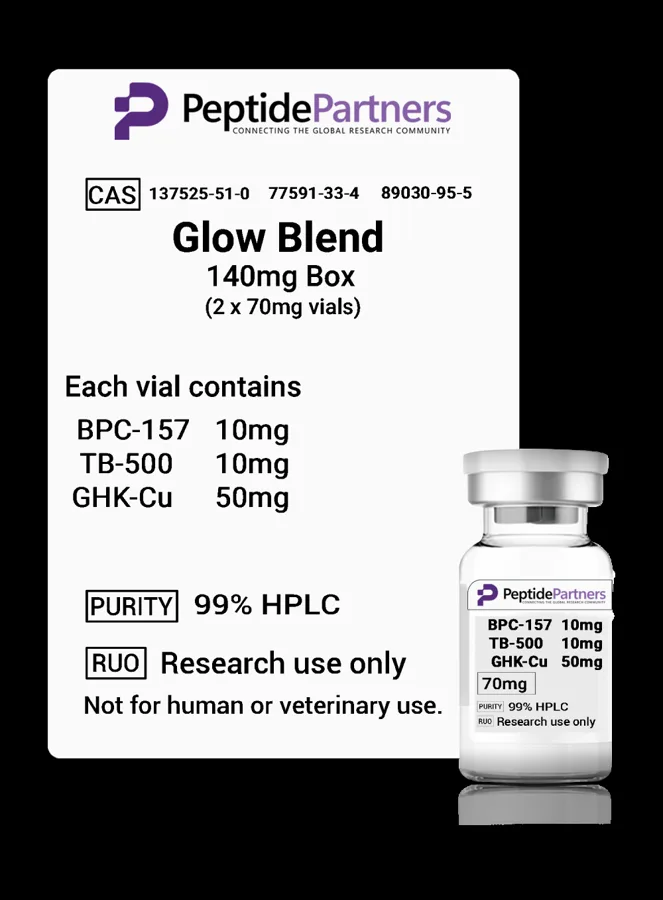
In contemporary molecular biology and tissue regeneration research, multi-peptide formulations have garnered substantial academic interest. Among these, the combination informally termed the GLOW blend—comprising BPC-157, TB-500 (a synthetic fragment of Thymosin Beta-4), and the copper-binding tripeptide GHK-Cu—is frequently examined in laboratory models focusing on cellular recovery, extracellular matrix remodeling, and oxidative stress modulation. While each peptide possesses distinct structural characteristics and signaling pathways, their concurrent use in experimental protocols allows investigators to examine multi-target cellular responses to microenvironmental stress.
Historical Discovery and Molecular Origins
The three constituent peptides in this blend emerged from entirely distinct areas of biochemical inquiry over several decades, each tracing back to endogenous biological systems.
GHK-Cu (glycyl-L-histidyl-L-lysine copper(II)) was discovered in 1973 by Dr. Loren Pickart during studies evaluating the differences between young and aged human plasma. Pickart observed that fractions containing this small tripeptide possessed a high affinity for copper ions (Cu2+) and demonstrated the ability to influence protein synthesis and cellular survival markers in cultured hepatocytes.
TB-500 represents an active synthetic sequence derived from Thymosin Beta-4 (Tβ4), a 43-amino acid peptide originally isolated from bovine thymus tissue in the late 1960s and early 1970s. Biochemical characterization later identified Tβ4 as the primary actin-sequestering molecule in mammalian cells, with subsequent research focusing on specific functional domains (notably amino acids 17–23) capable of promoting cellular migration and cytoskeletal organization.
BPC-157 (Body Protection Compound-157) is a synthetic 15-amino acid pentadecapeptide derived from a naturally occurring protective peptide isolated from human gastric juice. Pioneered predominantly in the early 1990s by researchers investigating mucosal integrity, BPC-157 was observed to remain remarkably stable in gastric secretions where standard proteins undergo rapid enzymatic degradation.
Investigated Molecular Mechanisms
Researchers study these three molecules collectively to observe their complementary and non-overlapping mechanisms of action, particularly within the category of antioxidant biology, cell motility, and vascular signaling.
Antioxidant Regulation and Redox Homeostasis via GHK-Cu
GHK-Cu has been evaluated extensively for its capacity to regulate oxidative damage in cellular assays. Its primary biological mechanism centers on its role as a physiological copper carrier. Copper is an essential cofactor for superoxide dismutase (SOD1), an enzyme integral to clearing reactive oxygen species (ROS). Research suggests that GHK-Cu helps regulate copper availability without causing the Fenton reactions associated with free ionic copper. Furthermore, genomic profiling assays have demonstrated that GHK-Cu modulates the expression of genes involved in DNA repair and the suppression of inflammatory cytokines such as TNF-alpha and IL-6.
Cytoskeletal Remodeling and Actin Dynamics via TB-500
TB-500 functions in experimental models through its interaction with globular actin (G-actin). By sequestering G-actin monomers, the peptide prevents premature polymerization into filamentous actin (F-actin), maintaining a ready pool of structural components. This dynamic is critical during cellular migration assays, where dynamic restructuring of the cytoskeleton enables keratinocytes, fibroblasts, and endothelial cells to polarize and migrate toward areas of experimental mechanical injury.
Vascular Signaling and Angiogenic Pathways via BPC-157
BPC-157 is primarily studied for its role in vascular signaling pathways, particularly through the upregulation of vascular endothelial growth factor receptor 2 (VEGFR2) and the early growth response 1 (Egr-1) transcription factor. In vitro and animal models suggest that BPC-157 modulates the nitric oxide (NO) pathway, promoting balanced endothelial nitric oxide synthase (eNOS) activation. This activity supports research models assessing endothelial cell survival, microvascular stability, and the mitigation of oxidative degradation in vascular tissues.
Comparative Profile of Components
The following table outlines the structural and functional distinctions between each component in the blend:
| Component | Peptide Classification | Primary Structural Target | Key Investigated Laboratory Pathways |
|---|---|---|---|
| GHK-Cu | Tripeptide-copper complex | Cu2+ ion transport; gene expression | Superoxide dismutase induction, ROS scavenging, collagen synthesis |
| TB-500 | Thymosin Beta-4 fragment | G-actin binding site | Actin sequestration, cell motility, lamellipodia formation |
| BPC-157 | Stable pentadecapeptide | VEGFR2; eNOS; FAK-paxillin axis | Angiogenic signaling, cell adhesion, mucosal cytoprotection |
Why Multi-Target Blends Interest Researchers
In classical experimental protocols, biological processes such as extracellular matrix deposition and redox equilibrium are often evaluated in isolation. However, in physiological systems, these events occur concurrently. An oxidative microenvironment can inhibit cell migration and impair capillary tube formation. By studying GHK-Cu, TB-500, and BPC-157 simultaneously, researchers can measure whether the reduction of oxidative stress by copper transport enhances the actin-dependent migratory response observed with TB-500, or whether BPC-157’s modulation of vascular markers functions more efficiently in an environment stabilized by antioxidant cascades.
Evaluating Documentation and Sourcing at Peptides Partners
When selecting research-grade peptide blends, consistency and analytical transparency are essential for data reproducibility. Because multi-peptide formulations introduce multiple molecular weights into a single matrix, laboratory verification requires stringent quality control methods.
At Peptides Partners, research materials are provided strictly for in vitro and laboratory experimental use. Investigators evaluating peptide blends should assess the following technical parameters prior to procurement:
- High-Performance Liquid Chromatography (HPLC): Analytical HPLC traces confirm the resolution of each distinct peptide peak within the blend, ensuring absence of truncated sequences or synthesis-related impurities.
- Mass Spectrometry (MS): Liquid chromatography–mass spectrometry (LC-MS) validates the molecular weights of all three entities (e.g., verifying the distinct masses of the BPC-157 sequence, the TB-500 fragment, and the GHK-Cu complex with its associated copper adduct).
- Lyophilization Integrity: Proper freeze-drying protocols ensure low residual moisture, preventing spontaneous hydrolysis during storage at standard laboratory temperatures (-20°C).
- Vial Packaging and Sizing: Evaluating vial packaging configurations allows research teams to match aliquot sizes with their specific experimental timelines, preventing unnecessary freeze-thaw cycles that can degrade fragile peptide bonds.
By reviewing analytical documentation and sourcing standardized compounds from specialized catalogs like Peptides Partners, academic and industrial laboratories maintain the control parameters necessary to produce reliable, peer-verifiable data in peptide science.
Where to buy GLOW Blend: BPC-157/TB-500/GHK-Cu for research
Peptides Partners lists GLOW Blend: BPC-157/TB-500/GHK-Cu (70mg vials) in 3 pack sizes, all in stock, with price per mg shown for each option. Browse more anti-oxidant compounds in the Peptides Partners research peptide shop. All products are for laboratory research use only.